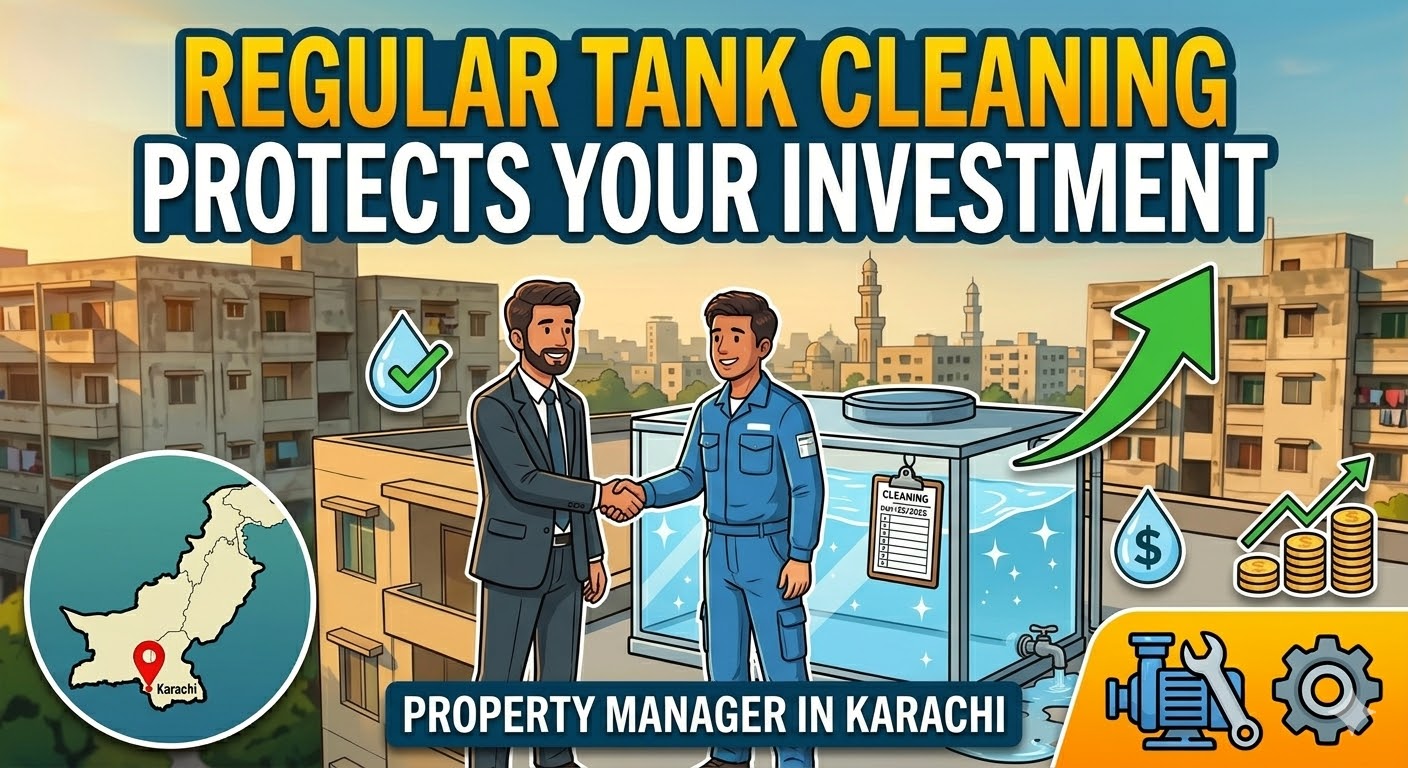
For landlords and property managers across Karachi, a real estate investment is only as valuable as the building behind it. Here’s why the water tank is one of the most financially critical — and most neglected — assets on any property.
The Maintenance Item Every Karachi Landlord Overlooks
If you own or manage a residential building, an apartment complex, a commercial property, or even a single rental unit in Karachi, you’re probably careful about the visible things: painting before a new tenant moves in, fixing a broken geyser fast, replacing a faulty pump. These problems demand attention because you can see them.
But there’s one maintenance item almost every property manager in Karachi overlooks — not out of negligence, but because it’s genuinely invisible. The water storage tank sits on the rooftop or underground, out of sight and out of mind. It doesn’t break down, doesn’t make noise, and rarely causes an obvious problem.
Until it does.
By the time a neglected tank causes a visible problem — sick tenants, a corrosion-related structural failure, a contamination complaint, or a legal dispute — the damage to your investment is already done. This article makes the financial, legal, and reputational case for treating water tank cleaning as a non-negotiable part of property management in Karachi.
Why Karachi’s Water Supply Makes This Worse
Intermittent Supply, Prolonged Storage
Unlike cities with 24-hour pressurised municipal supply, Karachi depends on scheduled water delivery from the Karachi Water and Sewerage Board (KWSB), with most neighbourhoods receiving supply every 3 to 7 days. That forces building owners to store large volumes of water in overhead tanks and underground sumps for extended periods.
Water sitting stagnant for days in an enclosed, warm tank — especially during Karachi’s summer, when rooftop temperatures can exceed 50°C — breeds bacteria fast. Sediment from KWSB pipelines settles at the bottom. Algae grows on the walls. Biofilm, a thin but dangerous layer of microbial colonies, coats interior surfaces. Without regular cleaning, every fresh batch of delivered water is contaminated the moment it touches that buildup.
The Tanker Problem
In many parts of Karachi — including Orangi Town, Baldia, Lyari, Surjani Town, and even established neighbourhoods during supply disruptions — buildings rely on private water tankers. That water is almost entirely unregulated; it may come from a bore well, a canal, or a recycled source. Pour it into an already-dirty tank, and the contamination compounds.
For a property manager, this is a liability waiting to happen. If a tenant falls ill and traces it back to contaminated water in your building, you’re exposed to complaints, disputes, and potentially legal action.
Coastal and Environmental Factors
Properties in Karachi’s coastal and southern zones — DHA, Clifton, Bath Island, Baloch Colony, Keamari — face an added challenge: salt air. The corrosive marine atmosphere speeds up degradation of tank materials, particularly mild steel and older GRP (Glass Reinforced Plastic) tanks. Corrosion byproducts leach into stored water, adding rust and metallic contamination on top of the biological risk. Regular professional inspection catches these structural issues early, before a tank wall fails and turns into a far more expensive emergency.
The Financial Case: How a Dirty Tank Costs You Money
Tenant Complaints and Turnover
Tenant retention is the foundation of profitable property management. In Karachi’s competitive rental market — DHA, Clifton, Gulshan-e-Iqbal, Gulistan-e-Johar — tenants have options. If water quality in your building is consistently poor, they eventually leave, and replacing a good tenant costs money: lost rent during vacancy, agent commissions, repainting, and the time spent finding someone new.
The irony is that professional tank cleaning typically costs a few thousand rupees per visit — a fraction of even one month’s lost rent. Most landlords never make that connection until a tenant hands in notice citing water quality as the reason.
Structural Damage from Neglected Tanks
A concrete tank that develops cracks from biological activity and chemical corrosion will eventually leak. A leaking rooftop tank damages the building below — ceilings, walls, electrical wiring, load-bearing structures. Repairing water-damaged construction in Karachi can run into hundreds of thousands of rupees, far more than years of professional cleaning would have cost.
For underground sumps — common in larger buildings across PECHS, North Nazimabad, and Federal B Area — the risk extends to groundwater contamination and undermined foundations, an even more serious and expensive problem.
Legal Exposure
Pakistan’s tenancy and consumer protection laws are evolving, and while enforcement has historically been inconsistent, the trend is toward stronger tenant rights in urban centres. A well-documented complaint about unhygienic water — especially one backed by medical evidence — creates real legal exposure. Keeping a cleaning schedule with a professional company, and keeping records of every clean, is the simplest and cheapest protection against that risk.
Khan Tank Cleaning: Your Property Management Partner Across Karachi
Khan Tank Cleaning works with individual landlords, property management companies, housing societies, and corporate building managers across Karachi. We understand that for you, this isn’t just about hygiene — it’s about protecting an asset and your reputation with tenants.
We run two dedicated service branches for faster, local response across the city:
DHA, Clifton, Korangi, Malir, Landhi, and the southern/coastal belt: our dedicated team for DHA and Clifton properties offers priority scheduling for residential buildings, apartment complexes, and commercial premises. We know the tank types and building structures here — from bungalow tanks to the large-capacity systems in Khayaban-e-Ittehad’s mid-rises and Clifton’s seafront towers.
Gulshan-e-Iqbal, Gulistan-e-Johar, North Nazimabad, PECHS, Federal B Area, Liaquatabad, and Nazimabad: our Gulshan and Jauhar team handles everything from single-unit residential tanks to the large underground sumps in multi-storey buildings — including some of Karachi’s densest rental markets, like Blocks 13, 14, and 17 of Gulshan-e-Iqbal and the residential towers of Gulistan-e-Johar, where water complaints are common.
Both branches offer one-time cleans, scheduled maintenance contracts, and institutional packages, and we serve all areas of Karachi with local teams prioritised for faster response in their zones.
What Professional Cleaning Involves — and Why DIY Falls Short
Many property managers ask a chowkidar or maintenance worker to “clean” the tank. With respect to those workers, that’s rinsing, not cleaning. A bucket, a brush, and some water won’t remove:
- Biofilm, which clings to tank walls and needs high-pressure washing plus chemical treatment to eliminate
- Sludge and sediment, which settles at the bottom and has to be vacuumed out with industrial equipment
- Algae colonies, which grow in the upper portions exposed to indirect light and need specific fungicidal treatment
- Bacterial contamination — E. coli, Legionella, Salmonella — which requires food-safe disinfection at the right concentration and dwell time
A professional clean follows a strict protocol: complete draining, high-pressure jet washing of every interior surface, industrial vacuuming of loosened waste, food-safe disinfectant application, and a final visual inspection before the tank is certified ready for refilling. That process can’t be replicated with a bucket and a broom — and for the standard Karachi setup of a rooftop tank plus an underground sump, both need treating thoroughly and at the same time.
How Often Should a Rental Property’s Tank Be Cleaned?
Frequency depends on property type and usage. Here’s a practical baseline for Karachi’s conditions:
- Single-family homes and small rental units: every 6 months, ideally before summer (March/April) and again before winter (October/November)
- Multi-unit buildings (up to 10 floors): every 4 months, given higher combined usage and larger stored volumes
- Large residential towers and commercial buildings: every 3 months, plus additional cleans after any extended supply disruption or tanker delivery
- Coastal properties (DHA, Clifton, Keamari): every 3 to 4 months, due to faster corrosion and higher contamination risk
- Areas with poor KWSB supply (Orangi, Baldia, Surjani, parts of Lyari): every 3 months, since heavier tanker reliance raises contamination risk
Keeping a simple log of cleaning dates — digital or a physical building register — takes minutes and becomes valuable documentation if a tenant dispute or regulatory inspection ever comes up.
What to Include in Your Tenant Agreement
Forward-thinking landlords in Karachi are starting to add water tank maintenance clauses to rental agreements. It protects both sides: the tenant gets a guaranteed cleaning schedule, and the landlord gets documented proof of due diligence. A simple clause might read:
“The landlord undertakes to arrange professional water tank cleaning for the property at intervals of no less than [X] months. The tenant agrees to report any concerns about water quality to the landlord or property manager in writing within [X] days of first noticing the issue.”
This kind of proactive documentation matters more every year, as tenants in Karachi’s growing rental market — particularly in premium areas — become more aware of their rights and more willing to assert them.
The Reputational Dividend: Clean Water Builds a Better Property Brand
In Karachi’s rental market, word of mouth still moves the needle. Tenants talk to neighbours, colleagues, and online communities. A landlord known for running a clean, well-maintained building attracts better tenants, commands higher rents, and sees lower vacancy.
It sounds abstract until you picture it in practice: in a 20-flat building in Gulshan-e-Iqbal, a simple WhatsApp message every 4 months — “The water tank was professionally cleaned today; all units will have fresh, disinfected water from this evening” — does real work for tenant confidence. It costs almost nothing to communicate maintenance you’re already doing, but the reputational payoff is real and lasting.
Property managers in DHA, Clifton, and southern Karachi can build that trust with our DHA and Clifton tank cleaning service. Those in Gulshan, Jauhar, and central Karachi can do the same through our Gulshan and Jauhar service — a simple, professional step that becomes a real competitive advantage across your rental portfolio.
Protect Your Investment. Retain Your Tenants. Book Khan Tank Cleaning Today.
Every month you delay is another month of bacterial growth, sediment buildup, and avoidable risk to your property and your tenants.
Khan Tank Cleaning is Karachi’s specialist water tank cleaning company. We don’t do plumbing, painting, or pest control on the side — we clean water tanks, and we do it thoroughly. Our teams use industrial-grade pressure washers, vacuum equipment, and food-safe disinfectants to deliver a genuinely clean tank, not just a rinsed one.
We offer single cleans, scheduled maintenance contracts, and packages for property portfolios and housing societies, with competitive pricing, a thorough process, and a certificate of cleaning for your property records.
Managing properties in DHA, Clifton, or southern Karachi? Schedule your cleaning through our DHA and Clifton water tank cleaning service.
Managing properties in Gulshan-e-Iqbal, Gulistan-e-Johar, North Nazimabad, PECHS, or central Karachi? Book through our Gulshan and Jauhar water tank cleaning team.
Call us now: 0340-2717530 | 0333-0293174 — available 24 hours a day, 7 days a week. We serve all areas of Karachi with fast turnaround and professional results.
Your tenants deserve clean water. Your investment deserves professional maintenance. Khan Tank Cleaning delivers both.
Khan Tank Cleaning | Suite-203, Mumtaz Manzil, Block-16, Gulshan-e-Iqbal, Karachi | khantankcleaning.com

Mateen Khan is the Founder & Owner of Khan Tank Cleaning, Karachi’s first dedicated professional water tank cleaning company (est. 2005). With 20+ years of industry experience, he leads an ISO 9001 & ISO 45001 certified team that follows a strict 8-step process using industrial equipment and food-grade disinfectants. Mateen is committed to making clean, safe water accessible to every household and business in Karachi.
Leave a Reply