
Our Gulshan-e-Iqbal branch
Water tank cleaning in Gulshan & Jauhar
Most buildings here share one tank between dozens of flats. We quote the whole building once, invoice the society, and give the committee a report they can put on the noticeboard.
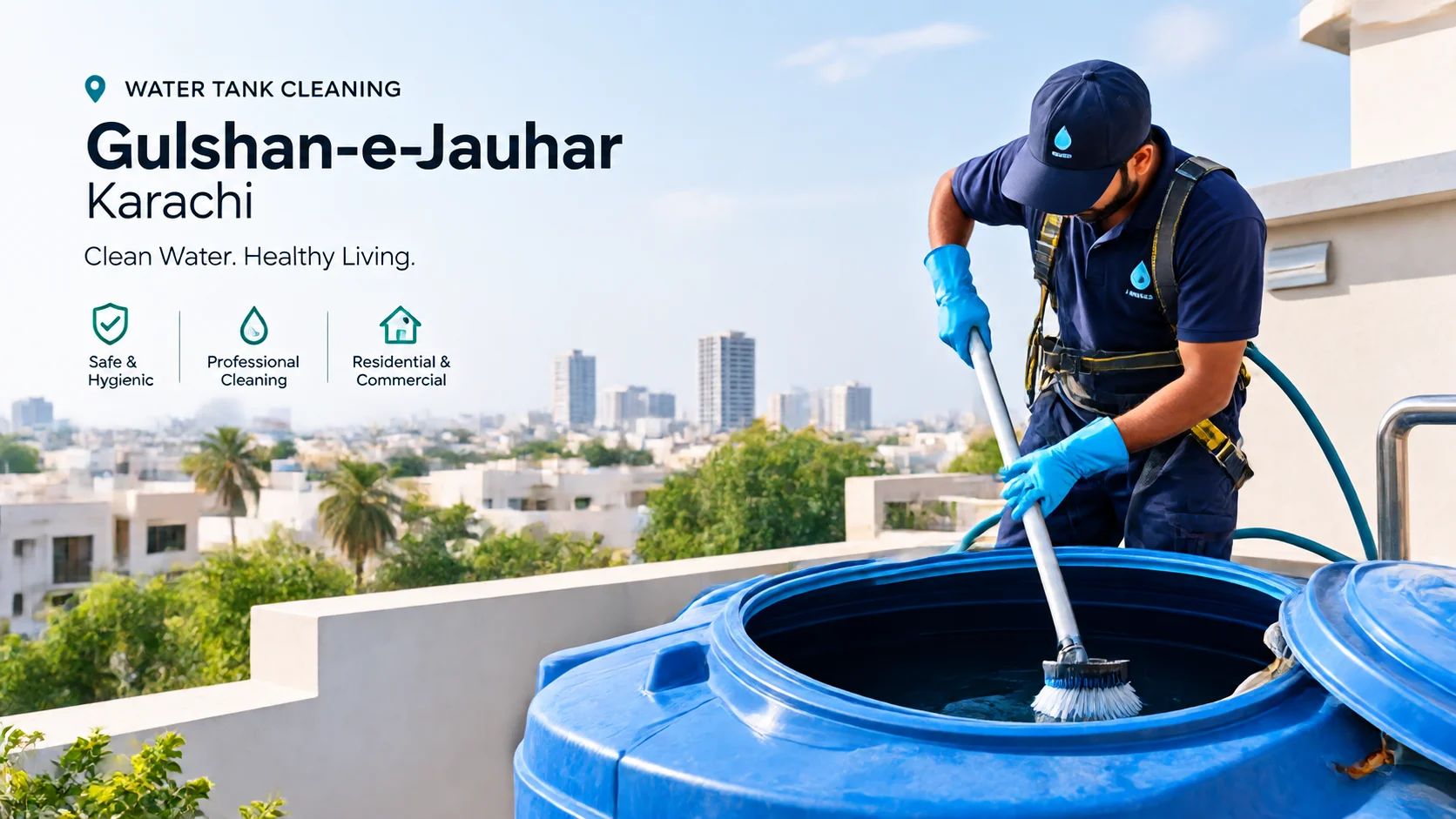
Why shared tanks are the harder problem
Gulshan and Jauhar are apartment territory, and a shared tank behaves nothing like a household one. A single underground tank feeding forty flats is drawn down and refilled several times a day. That constant movement keeps sediment in suspension instead of letting it settle harmlessly at the bottom, and it means any contamination reaches every flat in the building at the same moment. Shared tanks need cleaning more often than single-family ones, not less.
The obstacle is almost never money. Split across the flats, a building clean is small money per household — usually far less than residents assume before anyone checks. The real obstacle is that no single resident has the authority to book it. Everyone can see the problem, nobody owns it, and it sits in the building WhatsApp group for another year.
If you are on the committee, the thing that actually moves it is a written quote addressed to the society with a date on it. That turns a group conversation into a decision somebody can approve or decline. We will give you that in writing, with the per-flat figure worked out, so you are not the one doing the arithmetic in a meeting.
One practical thing specific to this area: roof access and hatch sizes vary enormously between blocks. Some older buildings in Gulshan and Nazimabad have overhead tank openings too narrow for standard equipment. We check that on the survey rather than discovering it on the day with the building's water already drained — which is exactly how a job stalls halfway and residents end up with no supply for an evening.
Apartment blocks and societies
Shared underground and overhead tanks on a six-monthly cycle. One quote for the building, one invoice to the society, and a dated report the committee can circulate as proof the work was done.
Nazimabad and Federal B Area houses
Older properties where the underground tank is often original to the building and has frequently never been fully emptied. These take longer than a routine clean, and we quote them honestly rather than discovering it halfway.
SITE and Landhi industrial units
Factory and warehouse storage, scheduled around your shutdown rather than ours. Documented procedure and a compliance report for your audit file.
Pricing
Find out what your tank costs before you call
You should not have to phone a company to learn a price. Ours is on the site.
Price your tank in about thirty seconds
Choose property type, tank location and size — in gallons or square yards — and the calculator gives you the figure straight away. For a building, get the total and divide by the number of flats; that per-flat number is usually what settles the decision.
- Houses, portions and flats priced instantly
- Shared underground tanks quoted for the whole building
- Societies invoiced once, not flat by flat
- The quote is the final price — nothing added on the day
- SRB and FBR tax invoice with every job
Registrations
What you can ask us to produce
If you are approving this on behalf of a society, these are the documents to ask any contractor for. We would rather you did.
Quality management. Every job follows the same documented procedure and is signed off at handover.
Occupational health and safety — the standard that covers our crews entering a sealed underground tank.
Sindh Revenue Board. Service tax charged and deposited properly, so the society or company can claim input tax.
Federal Board of Revenue. A numbered invoice that survives an audit.
How the job runs
The short version
Survey and written quote. Controlled drainage, with nothing pushed back into your supply line. Forced ventilation and a gas test before anyone enters a sealed tank. Jet washing at 3,000+ PSI to break the biofilm, at reduced pressure on fiber surfaces. All sludge vacuumed out and removed from the property. Silver-stabilised hydrogen peroxide at full contact time. Rinse until clear. Then a dated report with the photographs, and a numbered SRB/FBR invoice made out to the society or the owner, whichever you need.
Coverage
Areas this branch reaches first
Either branch can take any job in Karachi. This one is nearest to the areas below, so it gets to you fastest.
Gulshan & Jauhar
- Gulshan-e-Iqbal, all blocks
- Gulistan-e-Johar, all sectors
- Gulshan-e-Maymar
- Gulzar-e-Hijri / Scheme 33
North & Central
- Nazimabad
- North Nazimabad
- Liaquatabad
- New Karachi
- North Karachi Township
- Federal B Area
- Buffer Zone
Industrial
- SITE
- Korangi Industrial Area
- Landhi
- Surjani Town
Also covered
- PECHS
- Shahrah-e-Faisal
- Bahria Town Karachi
- Jamshed Quarters
- Garden East & West
Questions
Before you book
Who is responsible for cleaning the tank in an apartment building?
How much does it cost per flat?
Our building has one underground tank for forty flats. Is that different?
The hatch on our overhead tank is very narrow. Can you still do it?
How quickly can you reach Gulshan, Jauhar or Nazimabad?
Do you clean underground RCC tanks, and is it safe?
Will residents lose their water supply, and for how long?
Can you invoice the society rather than individual residents?
Closer to DHA & Clifton? Our DHA Phase 2 branch covers South Karachi and will reach you sooner.
See the DHA Phase 2 branchBook a clean in Gulshan or Jauhar
Price it online in thirty seconds, or call the branch and speak to someone now. If you need a quote addressed to the society, say so and we will send it in writing with the per-flat figure worked out.