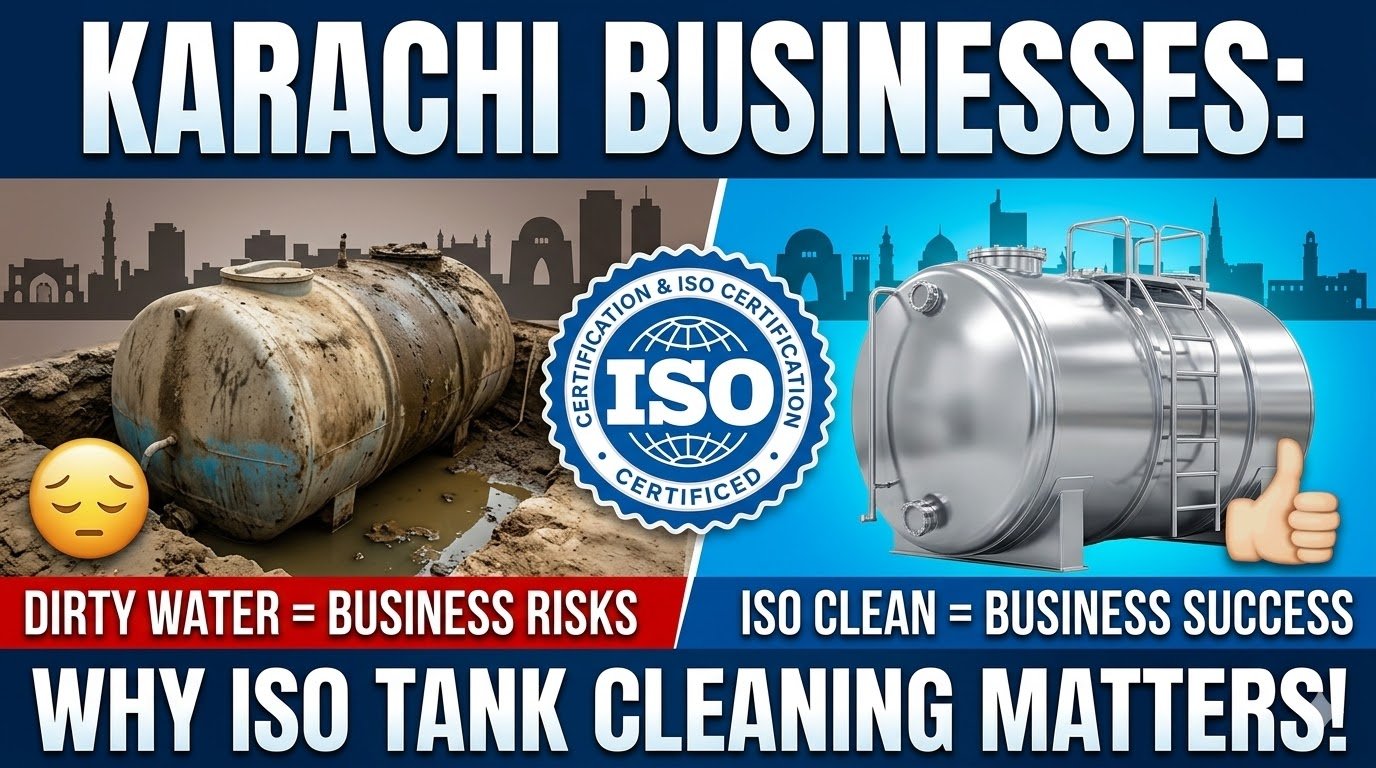
A certificate on an office wall does not clean a tank. What it should do is change how the job is carried out: the same steps in the same order, safety precautions that are not optional, and a record at the end. This article looks at ISO-certified tank cleaning in Karachi from the customer’s side: what is different on the day, why businesses ask for it, what a homeowner gains, and what it cannot promise.
For an explanation of the two standards themselves, see ISO 9001 and ISO 45001 explained.
In brief
- A company is certified to a named standard: ISO 9001 for quality, ISO 45001 for health and safety.
- On the day, certification should mean a written price, safe entry, proper equipment, measured disinfection and a report.
- Businesses ask for it because auditors, regulators and their own systems require controlled suppliers.
- Homeowners gain safety on their property, consistency and proof.
- It does not guarantee sterile water, and the certificate itself should be checked.
What “ISO-certified” should mean
Strictly, a company is certified to a named standard. For tank cleaning the relevant ones are ISO 9001, for quality management, and ISO 45001, for occupational health and safety. Certification means an independent certification body has audited the company’s management system against the standard and continues to audit it every year. It is voluntary. There is no licensing regime for tank cleaners in Karachi, which is exactly why some customers ask for it.
What is different on the day
| Stage | Uncertified, informal cleaning | Cleaning under a certified system |
|---|---|---|
| Before work | Verbal price, often revised | Written quote that is the final price |
| Entering an underground tank | Straight in, usually alone | Ventilation, gas check, harness, attendant at the hatch |
| Removing sludge | Stirred and bailed | Vacuum extraction off the property |
| Cleaning surfaces | Brush within arm’s reach | Jet washing of walls, floor and ceiling at 3,000+ PSI |
| Disinfection | Bleach or acid by eye, or nothing | Named product, dose matched to tank volume, contact time, rinse |
| Finishing | Refill and leave | Inspection of walls, joints and lids; defects photographed |
| Paperwork | None | Dated report, photographs, next-service date, tax invoice |
The right-hand column is our eight-step procedure. The certificate is the assurance that it is followed on every job and not only when the owner is watching. A step-by-step account is in what happens during a professional tank cleaning.
Why Karachi raises the stakes
- Poor incoming water. When the Pakistan Council of Research in Water Resources tested Karachi’s water for a Supreme Court commission, 107 of 118 samples were unsafe. Tanks start each fill with contamination already in them.
- Long storage. Supply comes in turns, so water sits for days.
- Heat. Stored water is warm most of the year, which favours bacterial growth. See heat and bacteria in water tanks.
- Shared tanks. One tank often serves a whole building or workforce.
- Dangerous tanks. Underground tanks have killed workers and householders in the city, including five people in one incident in 2025.
In those conditions the gap between a rinse and a proper cleaning is wide, and so is the gap between safe and unsafe entry.
Why businesses ask for certified contractors
For an organisation, the tank cleaning contractor is a supplier like any other, and suppliers have to be justified to someone.
- Supplier approval. Companies that run their own ISO, food safety or pharmaceutical quality systems are expected to control their service providers. A contractor with a certified system and proper records is far easier to approve.
- Audit evidence. An auditor or inspector wants a dated record of each cleaning from an identifiable contractor. The service report and tax invoice provide it.
- Legal duties. Factories must provide wholesome drinking water under section 22 of the Sindh Factories Act, 2015, and the same Act restricts entry into tanks where dangerous fumes are likely (section 48). A contractor working inside your premises under a safety management system helps you meet both.
- Regulators. Food businesses are inspected by the Sindh Food Authority, which reported 47,875 inspections and improvement notices, and 370 outlets sealed, across the province between July 2025 and January 2026. Healthcare establishments answer to the Sindh Healthcare Commission.
- Liability. If someone is hurt in your tank, you will be asked who you hired and what precautions they took.
- Tax. Payments to unregistered providers cause problems in the accounts, as explained in why SRB and FBR registration matters.
We have written sector guides for factories and warehouses, hospitals, hotels and restaurants and schools and universities.
What homeowners gain
A household has no auditor to satisfy, so is certification relevant? We think so, for three practical reasons.
- Safety on your property. You do not want an accident in your underground tank. A company certified for occupational health and safety has a system for entering it.
- Consistency. The crew that arrives follows the same procedure as the one your neighbour had, whoever is on shift.
- Proof. You receive photographs of the inside of your tank before and after, and a date to plan the next cleaning from.
It is not the only way to get a good job, and it costs more than a man with a bucket. The comparison is set out in tank wallah versus professional cleaning.
How often, by type of property
| Property | Recommended interval | Note |
|---|---|---|
| House | Every 4 to 6 months | Every 3 months if tanker-fed or with an infant at home |
| Apartment building or housing society | Every 3 months | Shared tanks; keep the report with the union’s records |
| Restaurant, cafe, caterer, food factory | Every 3 months | Have the report ready for inspections |
| School, college, university | Every 3 months | Before each term is a practical rhythm |
| Hotel or serviced apartments | Every 3 months | Low-occupancy periods mean stagnant water; clean before reopening wings |
| Hospital or clinic | At least every 3 months, or as your infection control plan requires | Vulnerable patients; follow your own committee’s schedule if stricter |
| Factory or warehouse | Every 3 to 6 months for drinking water tanks; process tanks per audit schedule | Document every cleaning |
The reasoning behind these intervals is in how often to clean a water tank in Karachi. The official minimum for any tank, from the Sindh health department, is once a year before summer.
What certification cannot promise
- Sterile water. No certificate covers what the supply delivers after the cleaning.
- A permanent result. The tank will need cleaning again on schedule.
- That a certificate is genuine. You have to check. Certificates expire and forged ones exist.
- That a certified company is right for your job. Ask about your tank type and access all the same.
How to check a contractor’s claim
- Ask which standards they are certified to. “ISO certified” without a number is not an answer.
- Ask for a copy of the current certificate and read the name, scope and expiry date.
- Look up the certificate or the certification body. The IAF CertSearch database covers accredited certification worldwide.
- Ask to see the written procedure and a sample report.
- Ask how they enter an underground tank. The answer should come without hesitation.
The full list of questions is in what to ask before hiring a tank cleaning company.
ISO-certified tank cleaning in Karachi from our two branches
Khan Tank Cleaning is certified to ISO 9001 and ISO 45001, registered with the SRB and FBR, and has cleaned tanks in Karachi since 2005, a history told in our story. Ask either branch to show you the current certificates. Organisations we work for are listed on our clients page.
For the south of the city, contact the DHA and Clifton branch; for the east, centre and north, the Gulshan and Jauhar branch. Homes can get a fixed price online, and commercial and industrial sites are surveyed free of charge.
Frequently asked questions
Is ISO-certified tank cleaning more expensive?
Usually more than informal cleaning, because of equipment, trained staff and safety measures. The price is fixed in writing before the work.
Do I need a certified company for a small rooftop tank?
A small plastic tank can be cleaned safely from outside by a careful person. Certification matters most for underground tanks, shared tanks and any premises that are inspected or audited.
Will a certified company give me a certificate for my tank?
You receive a dated service report with photographs and an invoice. That is a record of the work done. It is not a laboratory certificate of water quality.
Our auditor wants evidence of tank cleaning. What should we keep?
The service report, the photographs, the tax invoice and a copy of the contractor’s current certificates, filed by date for each tank.
Does every tank cleaning company in Karachi hold these certificates?
No. Certification is voluntary and most operators do not have it. Always ask to see the document.
Does the new ISO 9001:2026 edition change anything for customers?
Not immediately. Certified companies have about three years from September 2026 to move to the new edition, and certificates to the 2015 edition remain valid in the meantime.
Is ISO 22000 or HACCP relevant to tank cleaning?
Those are food safety standards held by food businesses, not by cleaning contractors. They are the reason food businesses need documented tank cleaning from a controlled supplier.
Sources
Figures in this article were checked in October 2026 against the following:
- Dialogue Earth, 28 July 2017: 91% of Karachi’s water unfit to drink (PCRWR results)
- Dawn, 11 June 2025: Five dead after inhaling toxic gases in water tank in Karachi
- The Sindh Factories Act, 2015
- APP, 23 February 2026: Sindh Food Authority board meeting and inspection figures
- IAF CertSearch: global database of accredited certifications
- Geo News, 13 September 2025: Naegleria claims another life in Karachi, toll hits five in Sindh
About Khan Tank Cleaning
Khan Tank Cleaning is a Karachi company that does one thing: clean and disinfect water storage tanks. It was started in 2005 by Mateen Khan and now runs branches in DHA Phase 2 and Gulshan-e-Iqbal. Read our background or reach the nearest branch on 0333 0293174 (DHA) or 0340 2717530 (Gulshan), day or night.

Mateen Khan is the Founder & Owner of Khan Tank Cleaning, Karachi’s first dedicated professional water tank cleaning company (est. 2005). With 20+ years of industry experience, he leads an ISO 9001 & ISO 45001 certified team that follows a strict 8-step process using industrial equipment and food-grade disinfectants. Mateen is committed to making clean, safe water accessible to every household and business in Karachi.