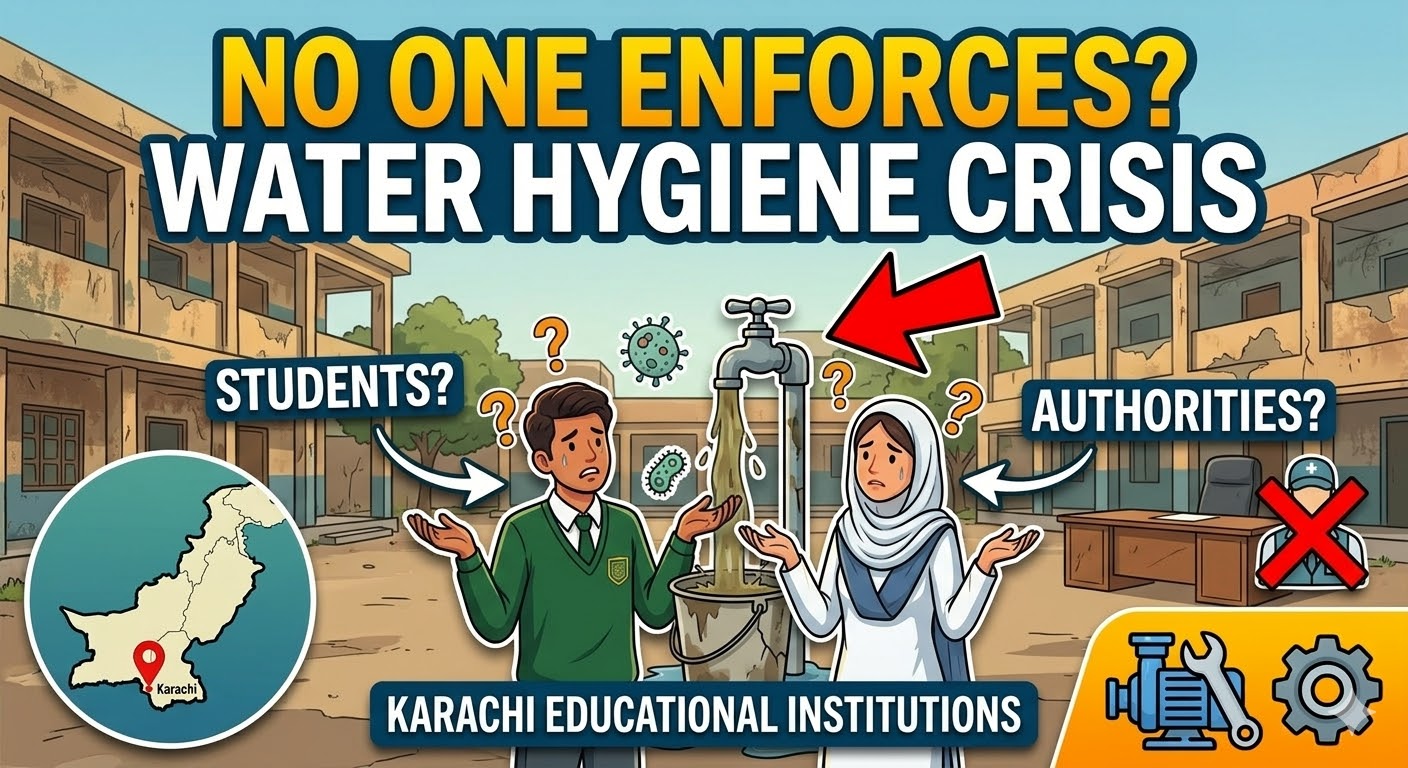
Thousands of students drink from tanks that have never been professionally cleaned. Here is what parents, school administrators, and property owners need to know — and do — right now.
A Problem Hidden in Plain Sight
Every morning, millions of children and young adults across Karachi walk into schools, colleges, and universities. They drink from water coolers, wash their hands at taps, and consume food prepared in canteen kitchens. Most parents give very little thought to where that water comes from — or what it has passed through before it reaches their child’s glass.
That water almost certainly passed through a storage tank. And in the vast majority of educational institutions across Karachi, that tank has not been professionally cleaned in months — or years. Some have never been cleaned at all.
This is not an exaggeration. It is one of the most overlooked public health issues in a city that already struggles with waterborne disease. And unlike contaminated street food or an obviously murky tap, a dirty water tank leaves no visible clues. The water looks clean. It tastes normal. And all the while, harmful bacteria are breeding quietly inside the tank walls, the sludge at the bottom, and the biofilm coating the interior surfaces.
Why Karachi’s Educational Institutions Are Particularly Vulnerable
Irregular Water Supply Means Stagnant Storage
Karachi’s municipal water supply from the Karachi Water and Sewerage Board (KWSB) is notoriously unreliable. Many areas of the city — from North Nazimabad and Gulshan-e-Iqbal to Landhi and Orangi Town — receive water just once every few days. Educational institutions compensate by storing large volumes of water in overhead tanks and underground sumps, sometimes for 5 to 7 days at a stretch.
Stagnant water in a warm, enclosed tank is the perfect breeding environment for bacteria such as E. coli, Legionella, and Pseudomonas. In Karachi’s extreme summer heat — when temperatures regularly exceed 40°C — this bacterial growth accelerates dramatically. The longer the water sits, the greater the risk.
Ageing Infrastructure in Older Schools
Many of Karachi’s oldest and most established schools — including institutions in Saddar, Lyari, Garden, and the inner city — operate in buildings that are decades old. Their water tanks are often made of concrete, which cracks over time, harbouring contamination in pores and crevices that cannot be cleaned by rinsing alone. Old galvanised pipework adds rust and heavy metal contamination to the equation.
Even in newer schools, if tank maintenance is not built into the annual budget or assigned to a specific responsible party, it simply does not happen.
High Volume, High Turnover, High Risk
A school with 1,000 students consumes a large volume of water daily. Unlike a household where one family’s consistent health provides indirect feedback on water quality, an institution with hundreds of students, teachers, and support staff creates a situation where cause and effect are hard to connect. When 30 children go home with stomach pain in the same week, it may be attributed to exam stress, canteen food, or ‘something going around’ — when the common denominator was the water tank.
What the Law Says — and Why It Rarely Matters in Practice
Pakistan’s Pure Food Laws, Karachi Metropolitan Corporation (KMC) health regulations, and the Pakistan Environmental Protection Act all include provisions for potable water quality in public and semi-public premises. Schools and universities are legally required to provide safe drinking water to students and staff.
In practice, however, enforcement is almost nonexistent. Health inspectors rarely visit educational institutions for routine water safety checks. When they do, their focus tends to be on canteen food hygiene and waste disposal — not on water storage infrastructure. There is no standard requirement for institutions to document tank cleaning records or submit water quality reports.
This regulatory gap means that the burden of responsibility falls entirely on school management, university administration, and — ultimately — on parents who care enough to ask the right questions.
If you are a parent in Karachi, the single most powerful question you can ask your child’s school is: “When was your water tank last professionally cleaned?” You may be surprised by the response.
The Health Consequences: What Dirty Tank Water Does to Children
Children are more vulnerable to waterborne illnesses than adults. Their immune systems are still developing, and their smaller body weight means that a lower dose of a pathogen can cause a more severe reaction. The diseases most commonly associated with contaminated water storage in urban Pakistan include:
- Typhoid fever — a serious bacterial infection that remains alarmingly common in Karachi, with thousands of cases reported annually, including extensively drug-resistant (XDR) typhoid strains that are extremely difficult to treat.
- Gastroenteritis — causing vomiting, diarrhoea, and dehydration, leading to missed school days and, in severe cases, hospitalisation.
- Hepatitis A — a viral liver infection spread through contaminated water and food, with outbreaks documented across Karachi’s low and middle-income areas.
- Cholera — though less common in institutional settings, still a real risk during supply disruptions when water quality drops further.
- Skin and eye infections — often linked to contaminated water in bathrooms and washrooms, causing rashes, conjunctivitis, and fungal conditions.
In a city where antibiotic resistance is rising and healthcare costs are a burden on middle-income families, preventing these illnesses through basic water hygiene is far more sensible than treating them after the fact.
Khan Tank Cleaning: Serving Schools and Homes Across Karachi
Whether you are a school administrator looking to bring your institution up to a proper hygiene standard, or a parent who wants to ensure the home your child returns to is equally safe, Khan Tank Cleaning provides professional, certified water tank cleaning services throughout Karachi.
We operate two dedicated service branches to ensure fast turnaround and local expertise across the entire city:
For institutions and homes in DHA, Clifton, Korangi, Malir, and surrounding areas: Our professional tank cleaning service covering DHA and Clifton is your nearest and fastest point of contact. Defence Housing Authority schools, the private institutions of Clifton, and the residential societies of Phase 1 through 8 are all within our primary service zone. We understand the premium hygiene standards expected in this part of the city — and we deliver them consistently.
For schools, universities, and households in Gulshan-e-Iqbal, Gulistan-e-Johar, Federal B Area, North Nazimabad, PECHS, Liaquatabad, and central Karachi: Our water tank cleaning specialists serving Gulshan and Jauhar are equipped to handle everything from small domestic tanks to the large-capacity sumps found in multi-storey school buildings. These densely populated neighbourhoods have some of the city’s most stretched water supply infrastructure — making professional tank maintenance not a luxury, but a necessity.
Both branches serve all areas of Karachi for larger institutional contracts, with a simple booking process and competitive rates for educational institutions, housing societies, and commercial premises.
What Parents Can Do Right Now
You do not have to wait for your child’s school to act. Here is a practical checklist for concerned parents in Karachi:
1. Ask the School Administration Directly
Write a formal letter or email to the school principal or facilities manager asking for documentation of the last water tank cleaning, the method used, and the schedule going forward. A school that takes hygiene seriously will have this information readily available.
2. Raise It at the Parent-Teacher Association (PTA)
If your school has a PTA, water tank hygiene is a legitimate agenda item. Collective parent pressure is far more effective than individual requests. Frame it as a student health and safety matter — which it is.
3. Ensure Your Own Home Tank Is Clean
Your child spends roughly 6 to 8 hours at school. They spend the rest of the day at home. If your household water tank has not been professionally cleaned in the last 6 months, the risk does not disappear when the school bell rings — it continues at home.
Homeowners in DHA, Clifton, and southern Karachi can book a home water tank cleaning service in DHA and Clifton quickly and affordably. Families in Gulshan, Jauhar, North Nazimabad, and central Karachi can schedule their residential tank cleaning in Gulshan and Jauhar with the same professional team that serves institutional clients.
4. Do Not Rely on Visual Inspection Alone
If the water looks clear, that does not mean it is clean. Bacterial contamination, heavy metals, and dissolved chemical residues are invisible to the naked eye. Professional cleaning and, where necessary, water testing are the only reliable methods.
A Note for School and University Administrators
If you manage a school, college, madrassa, tuition centre, or university campus in Karachi, the case for regular professional tank cleaning is both ethical and practical.
Ethically, you are in a position of trust. Parents send their children to your institution in the belief that you are looking after their wellbeing. Water safety is a fundamental part of that responsibility — and it is one that costs far less to maintain than it does to remedy after an outbreak.
Practically, a single waterborne illness incident linked to your institution can trigger health department visits, parental uproar, and lasting reputational damage. In the age of WhatsApp parent groups and Google reviews, word travels fast. The cost of professional tank cleaning — done twice or three times per year — is negligible compared to the cost of managing a public health incident.
Khan Tank Cleaning offers institutional service packages with flexible scheduling, certificate of cleaning for your records, and the option for follow-up water quality guidance. Our technicians are trained, our equipment is industrial-grade, and our process follows a strict multi-step protocol including complete draining, high-pressure jet washing, vacuuming of all sludge and debris, and food-safe chemical disinfection.
How Often Should an Educational Institution Clean Its Tanks?
- Primary and secondary schools: Every 4 months minimum — more frequently if water supply is irregular or if the tank is underground.
- Colleges and universities with canteens or hostels: Every 3 months, given the high volume of daily water usage.
- Tuition centres and smaller institutions: Every 6 months at minimum, aligning with the residential standard.
- Any institution after a water supply disruption or tanker delivery: Immediate inspection and cleaning recommended, as tanker water quality in Karachi is frequently unverified.
Book Khan Tank Cleaning Today — Protect Your Family and Your Community
Clean water is not a privilege. It is a right — and it starts with a clean tank.
Khan Tank Cleaning is Karachi’s only company dedicated exclusively to professional water tank cleaning. We do not treat this as a side service — it is everything we do, and we do it better than anyone else in the city. Our teams are trained, our process is thorough, and our results are guaranteed.
Whether you are a parent who wants peace of mind about the water your family drinks at home, a school administrator who needs to bring your institution up to a proper hygiene standard, or a landlord responsible for a residential building, we are ready to help.
Located in DHA, Clifton, Defence, Korangi, or Malir? Book your cleaning today with our DHA and Clifton professional water tank cleaning team.
Based in Gulshan-e-Iqbal, Gulistan-e-Johar, North Nazimabad, PECHS, Federal B Area, or anywhere in central Karachi? Reach out to our Gulshan and Jauhar water tank cleaning specialists and get your tank cleaned by professionals who know your neighbourhood.
Call us now: 0340-2717530 | 0333-0293174 — available 24 hours a day, 7 days a week.
Don’t wait for an illness to motivate action. The water your child drinks today — at home and at school — deserves to be safe. Book Khan Tank Cleaning and make sure it is.
Khan Tank Cleaning | Suite-203, Mumtaz Manzil, Block-16, Gulshan-e-Iqbal, Karachi | khantankcleaning.com

Mateen Khan is the Founder & Owner of Khan Tank Cleaning, Karachi’s first dedicated professional water tank cleaning company (est. 2005). With 20+ years of industry experience, he leads an ISO 9001 & ISO 45001 certified team that follows a strict 8-step process using industrial equipment and food-grade disinfectants. Mateen is committed to making clean, safe water accessible to every household and business in Karachi.
Leave a Reply