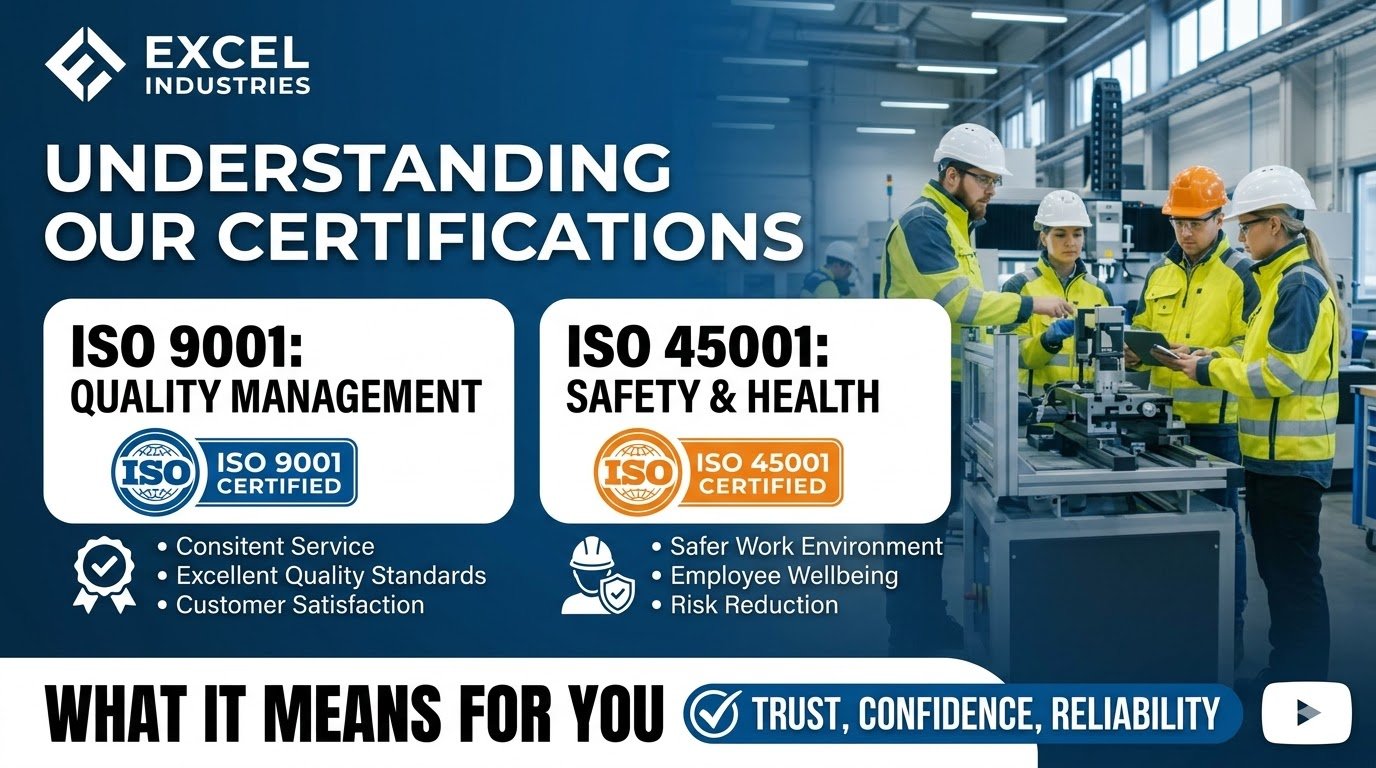
There is no licence for cleaning water tanks in Karachi. Anyone can offer the service. In a trade with no regulator, management system certificates are one of the few outside checks a customer can rely on, provided the certificates are genuine and the customer knows what they do and do not cover.
Khan Tank Cleaning is certified to ISO 9001 and ISO 45001. This article explains ISO 9001 and ISO 45001 in tank cleaning terms: what each standard asks of a company, how a certificate is earned and kept, what changed with the 2026 revision of ISO 9001, and how to check any certificate you are shown, ours included.
First, three things people get wrong
- ISO does not certify anyone. The International Organization for Standardization writes the standards. It does not issue certificates. Certification is carried out by independent certification bodies.
- There is no such thing as plain “ISO certified”. A company is certified to a specific standard, such as ISO 9001. The standard should always be named.
- These standards certify a management system, not a service. They show that the company runs its work through a documented, audited system. They are not a product approval and they do not guarantee that every job is perfect.
ISO 9001 and ISO 45001 at a glance
| ISO 9001 | ISO 45001 | |
|---|---|---|
| Subject | Quality management | Occupational health and safety |
| Question it answers | Is the work done the same, correct way every time? | Are the people doing the work protected from harm? |
| Current edition | ISO 9001:2026, published 16 September 2026; certificates to the 2015 edition remain valid during the transition | ISO 45001:2018 |
| Core requirements | Documented processes, trained staff, records, customer feedback, internal audits, corrective action | Hazard identification, risk controls, safe procedures, emergency planning, incident investigation |
| In tank cleaning | One procedure, followed on every job, with a report as evidence | Confined-space entry, chemical handling, equipment inspection |
| Who benefits | The customer | The crew, and the customer on whose property they work |
ISO 9001: quality management
ISO 9001 is the most widely used management standard in the world. ISO’s own description is that it helps organisations of any size consistently provide products and services that meet customer and regulatory requirements. In practice it comes down to a loop: say what you do, do what you say, record it, check it, and fix what went wrong.
What that means on a tank cleaning job
- A written procedure. Ours has eight steps, and they are published on our cleaning procedure page. A customer in Clifton and a customer in Gulistan-e-Johar should get the same sequence.
- Defined inputs. Which disinfectant is used, at what strength, for which kind of contamination. No improvising with whatever is on the van.
- Records. A dated service report with photographs for each job. Without records there is nothing for an auditor to audit.
- Training. People are shown the procedure and assessed on it before they work unsupervised.
- Handling complaints. Customer feedback is recorded and followed up, and repeated problems lead to a change in the procedure.
- Internal audits and management review. The company checks itself between external audits.
The 2026 revision
A new edition, ISO 9001:2026, was published on 16 September 2026. Organisations certified to the 2015 edition have a transition period of about three years to move across. So for the next few years you will see valid certificates quoting either edition. What matters is that the certificate is current and issued by an accredited body.
ISO 45001: occupational health and safety
ISO 45001:2018 sets requirements for a management system that prevents work-related injury and ill health. For most service trades that means ladders and electrics. For tank cleaning it means something more serious.
Confined spaces
An underground tank is a confined space. Gas can collect in it and oxygen can run low. In June 2025, five men died in a household water tank in Ibrahim Hyderi, three of them trying to rescue the first two. In 2022, four workers died in a factory tank in Landhi in the same way.
A safety management system exists to make sure that cannot happen through habit or haste. On our jobs it translates into forced ventilation and a gas check before entry, a harness and tripod, an attendant at the hatch, and a rule that the step is never skipped. Sindh law takes the same view for factories: section 48 of the Sindh Factories Act, 2015 bars entry into a confined space where dangerous fumes are likely unless it has been made safe or the person has breathing apparatus and a rope held from outside.
Chemicals
Disinfectant concentrates are hazardous before dilution. The standard requires the company to assess that risk, train staff, provide gloves and eye protection, and keep safety data for each product. For the customer, the visible result is that the crew can tell you what they are using. Ours is described in silver hydrogen peroxide for tank disinfection.
Equipment
A hose that bursts at 3,000 PSI can injure someone. Pressure washers, vacuums, electrical leads, harnesses and gas detectors all need inspection on a schedule, with records.
How a company gets certified, and stays certified
- Build the system. Procedures, responsibilities, forms and records are written and put into use.
- Run it. The system has to operate for some months so there is evidence to examine.
- Internal audit and management review.
- External audit in two stages by a certification body: first the documents, then the work itself.
- Certificate issued, normally valid for three years.
- Surveillance audits each year in between.
- Recertification at the end of the three years.
The certification body should itself be accredited by a national accreditation body. In Pakistan that is the Pakistan National Accreditation Council (PNAC). Accreditation bodies around the world recognise one another through the International Accreditation Forum (IAF).
How to verify a certificate
Fake and lapsed certificates are common enough that checking is worth five minutes.
- Ask for a copy of the certificate itself, not a logo.
- Read it. It should show the company’s legal name and address, the standard and edition, the scope of certification, a certificate number, issue and expiry dates, the certification body and an accreditation mark.
- Check the scope. It should cover the service you are buying, not something unrelated.
- Check the dates. An expired certificate means nothing.
- Look it up. The IAF CertSearch database lists certificates issued under accredited certification. ISO explains the process in how to verify an accredited certification.
- Contact the certification body named on the certificate if you are still unsure.
We encourage customers to do this with ours. Ask either branch to show you the current certificates.
A short glossary
| Term | Meaning |
|---|---|
| Standard | A published document setting out requirements, such as ISO 9001 |
| Management system | The policies, procedures and records a company uses to run an aspect of its work |
| Certification | Written assurance from an independent body that the system meets the standard |
| Certification body | The organisation that audits and issues the certificate |
| Accreditation | Formal recognition that a certification body is competent, given by a national accreditation body such as PNAC |
| Scope | The activities and locations the certificate covers |
| Surveillance audit | The yearly check between full recertifications |
| Nonconformity | A failure to meet a requirement, which must be corrected |
What the certificates do not tell you
- They do not test your water. No ISO management standard certifies that a tank is free of bacteria.
- They do not replace the report. The evidence for your job is the dated report and photographs, not the certificate on the wall.
- They do not cover tax status. That is a separate check, explained in why SRB and FBR registration matters.
- They do not make a company the cheapest. Running an audited system costs money.
Why this matters in Karachi
Three features of the city raise the stakes. The trade is unregulated, so there is no minimum standard. Buildings are dense, so one shared tank serves dozens of families or hundreds of staff. And the supply water is poor, so a badly cleaned tank becomes a health problem quickly. The background is in our guide to KWSB water supply. Factories have legal duties of their own, set out in our industrial water compliance guide. How certification plays out for different kinds of customer, with a cleaning schedule by property type, is covered in why ISO-certified tank cleaning matters.
Certificates are only one of the things worth checking. A fuller list of questions is in what to ask before hiring a tank cleaning company, and the company’s own background is in our story.
Booking a certified service
Our branches cover DHA, Clifton and South Karachi and Gulshan, Jauhar and East Karachi. Standard homes can get a fixed price online; commercial and industrial sites are surveyed free of charge.
Frequently asked questions
Is ISO certification required by law for tank cleaning in Pakistan?
No. It is voluntary. Some corporate and industrial clients require it of their contractors as part of supplier approval.
What is the difference between ISO 9001 and ISO 45001?
ISO 9001 is about the quality and consistency of the service. ISO 45001 is about the health and safety of the people doing the work.
Does ISO 9001:2026 make older certificates invalid?
No. Certificates to ISO 9001:2015 remain valid during the transition period of about three years from September 2026, as long as they have not expired.
How can I tell if an ISO certificate is fake?
Check that it names a real certification body with an accreditation mark, that the scope and dates make sense, and that it can be found through IAF CertSearch or confirmed by the certification body.
Do ISO 9001 and ISO 45001 in tank cleaning mean my water will be safe?
They mean the company follows an audited system for doing the work and protecting its workers. The safety of your water also depends on the supply, the condition of your tank and lids, and how you treat drinking water.
How long does an ISO certificate last?
Normally three years, with a surveillance audit each year. After three years the company is audited again in full.
Can a company lose its certificate?
Yes. A certification body can suspend or withdraw a certificate if serious problems found at audit are not corrected, or if the audits are not kept up.
Sources
Figures in this article were checked in October 2026 against the following:
- ISO: Certification and conformity (ISO does not itself certify organisations)
- ISO: ISO 9001 Quality management systems
- ISO: ISO 45001:2018 Occupational health and safety management systems
- NSF: ISO 9001:2026 published on 16 September 2026
- ISO: How to verify an accredited certification
- IAF CertSearch: global database of accredited certifications
- Dawn, 11 June 2025: Five dead after inhaling toxic gases in water tank in Karachi
- Dawn, 4 January 2022: Four workers die after inhaling toxic fumes in factory’s water tank
- The Sindh Factories Act, 2015
About Khan Tank Cleaning
Written by the team at Khan Tank Cleaning, which has worked on Karachi’s water tanks since 2005 under founder Mateen Khan. Some of the organisations we clean for are listed on our clients page. To talk to a branch, use the contact page or call 0333 0293174 (DHA Phase 2) or 0340 2717530 (Gulshan-e-Iqbal).

Mateen Khan is the Founder & Owner of Khan Tank Cleaning, Karachi’s first dedicated professional water tank cleaning company (est. 2005). With 20+ years of industry experience, he leads an ISO 9001 & ISO 45001 certified team that follows a strict 8-step process using industrial equipment and food-grade disinfectants. Mateen is committed to making clean, safe water accessible to every household and business in Karachi.