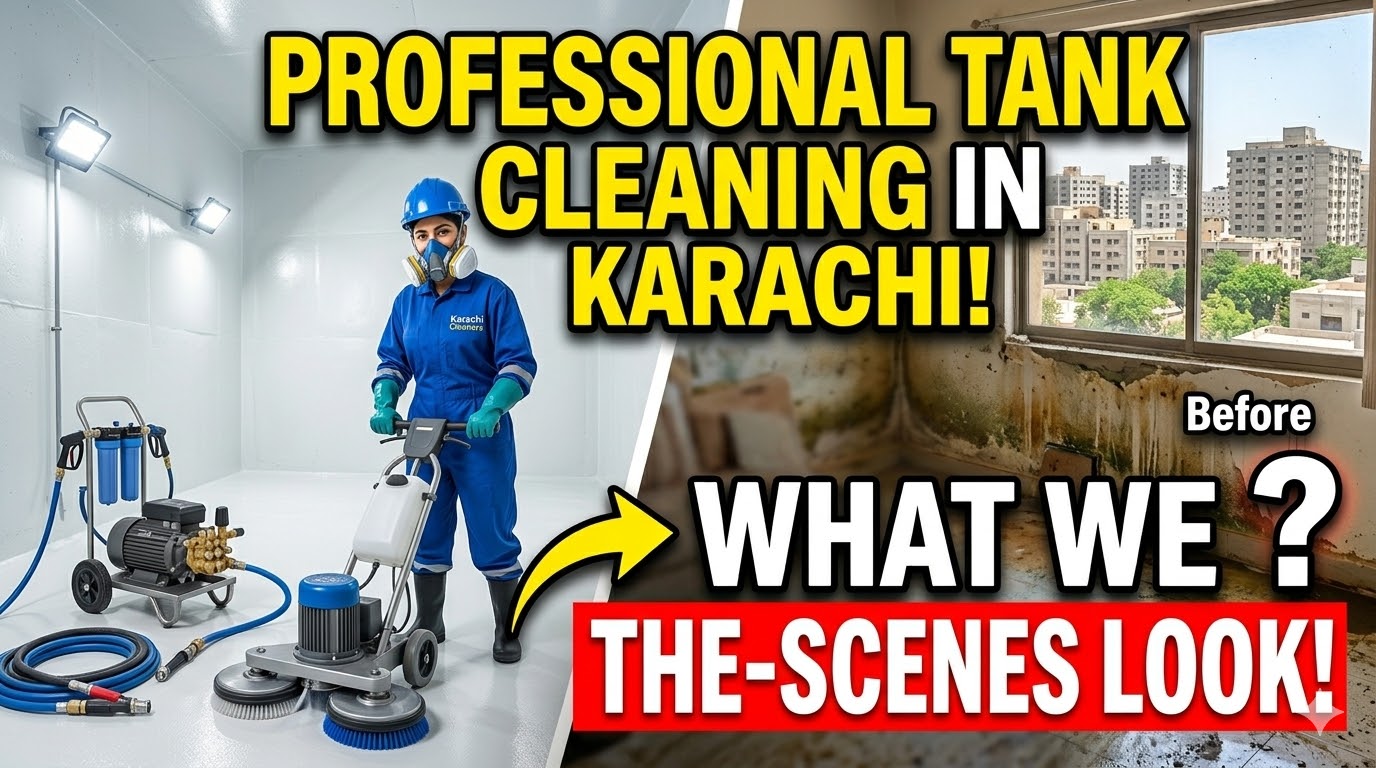
If you live in Karachi, you already know how precious water is. Whether it arrives once or twice a week via the KWSB tanker, or flows through municipal lines, virtually every drop that enters your home passes through a storage tank first — either an overhead rooftop tank or an underground sump. Most Karachi homeowners never think twice about what’s sitting inside that tank. The reality, however, might surprise you.
Sludge, algae, bacterial biofilm, rust particles, and even insect matter can accumulate inside an uncleaned water tank within as little as a few months. The city’s intermittent water supply and hot climate accelerate this process considerably. The water you use to cook, bathe, brush your teeth, and give your children is filtered through that tank — and no filter in the world can fully compensate for a contaminated storage source.
So what actually happens when a professional team shows up at your door? What do they do, what equipment do they use, and why does it matter so much for your family’s health? In this article, we take you through the entire process — step by step, behind the scenes — so you know exactly what you’re paying for and why it’s worth every rupee.
Why Karachi’s Water Tanks Get Dirty Faster Than You Think
Before we dive into the cleaning process, it’s important to understand why Karachi homes face a higher-than-average risk of water tank contamination. Several local factors combine to create a perfect breeding ground for bacteria and sludge:
- Irregular supply: When water arrives in bursts, it stirs up sediment that has settled at the bottom of the tank, spreading it throughout the stored water.
- Hard water: Karachi’s water supply is notoriously high in minerals, leading to rapid scale and sediment buildup on tank walls and floors.
- Extreme heat: Temperatures regularly exceeding 40°C in summer create ideal conditions for algae growth and bacterial multiplication.
- Dust and pollution: Tank lids that are not fully sealed — common in older buildings across Gulshan-e-Iqbal, Orangi Town, and Lyari — allow dust, insects, and environmental pollutants to enter.
- Ageing infrastructure: Many residential buildings in older parts of the city have underground concrete tanks that are decades old and prone to seepage and biofilm buildup in porous walls.
Given these conditions, experts recommend cleaning your water tank at least every six months in Karachi — and more frequently for families with children, elderly members, or anyone with a compromised immune system.
Step 1: Pre-Cleaning Inspection — The Foundation of a Good Job
The first thing a properly trained professional team does is not start spraying water around. They begin with a thorough inspection.
Our teams at Khan Tank Cleaning arrive with the equipment and training to assess your tank before a single drop is drained. This includes checking the tank type (overhead plastic, underground concrete, fiber, or stainless steel), evaluating the inlet and outlet valves, looking for cracks or leaks, and assessing the level and nature of contamination inside. This step determines the cleaning approach, the chemicals required, and the safety precautions necessary — particularly for underground tanks, which are classified as confined spaces.
For homeowners in areas like Gulshan-e-Iqbal, Gulistan-e-Johar, and FB Area, the majority of residential setups involve a combination of an underground sump (where the main supply is stored) and an overhead plastic tank. Both require different techniques and both are covered in a single visit when you book our dedicated water tank cleaning service in Gulshan and Jauhar Karachi.
Step 2: Draining — Getting Rid of Contaminated Water Properly
Once the inspection is complete, the next step is fully draining the tank. This sounds simple, but it’s a critical stage where amateur services often cut corners.
The contaminated water at the bottom of your tank — laden with sludge, sediment, bacteria, and debris — must be completely removed. Our teams use high-powered submersible pumps to drain the tank entirely, including the sludge layer that settles at the floor. This thick layer is where the highest concentration of harmful microorganisms lives. Leaving even a thin film of it behind before re-filling is one of the most common mistakes made by untrained workers.
For underground tanks in Karachi — which can hold anywhere from 1,000 to over 10,000 litres — this process requires the right equipment and, critically, the right safety protocols. Underground confined spaces can develop dangerous oxygen-deficient atmospheres or accumulate toxic gases. Our teams working in areas such as DHA, Clifton, PECHS, and Zamzama are equipped with oxygen safety systems and forced ventilation to ensure worker safety. If you live in those areas, our professional tank cleaning services in DHA and Clifton Karachi are specifically designed to handle the mix of large residential bungalows, apartments, and commercial buildings common to those localities.
Step 3: Industrial Vacuuming — Removing What Draining Cannot
After draining, a residue of sludge, sand, algae, and sediment remains stuck to the walls, corners, and floor of the tank. This is where professional services diverge sharply from what a local handyman or maid might attempt with a bucket and mop.
Khan Tank Cleaning uses industrial-grade vacuum systems specifically designed for water tank interiors. These machines suck out every trace of residual sludge and particulate matter from corners, floor seams, and wall surfaces. Manual scrubbing alone simply cannot access all areas and inevitably leaves behind contaminated residue — which then begins re-contaminating your fresh water from day one.
This step is one of the most visually striking for homeowners who choose to observe the process. The amount of black or brown sludge extracted from a tank that appears ‘fairly clean’ from the outside is often shocking — and an immediate reminder of what has been passing through household taps.
Step 4: High-Pressure Jet Washing — Deep-Cleaning the Tank Interior
With the bulk of sludge vacuumed out, our teams move to high-pressure jet washing — arguably the most important mechanical cleaning stage. Industrial-grade pressure washers blast water at high velocity across all interior surfaces: walls, floor, ceiling (for overhead tanks), and any structural features like columns or reinforcement bars in concrete underground tanks.
The high-pressure jet physically dislodges biofilm, algae colonies, mineral scale, and embedded contaminants that no amount of manual scrubbing could reach. This is especially important for:
- Older underground concrete tanks found in properties in North Nazimabad, Nazimabad, Liaquatabad, and similar established neighbourhoods, where porous concrete walls harbour deep-rooted bacterial communities.
- Plastic overhead tanks (such as Bestank, Aqua Plus, and similar brands) common in apartment buildings across Gulistan-e-Johar, Block 14, and Scheme 33, where algae tends to develop in the roof-heat-exposed walls.
- Fiber and fibreglass tanks used in newer constructions across DHA Phases and Clifton, which require careful non-abrasive jet washing to avoid surface damage.
Many small operators in Karachi skip this step entirely or use domestic garden hoses that lack the pressure to actually clean. This is one of the key differences in the service quality that separates a genuinely professional company from a side-hustle operation.
Step 5: Disinfection — The Stage That Protects Your Family’s Health
This is the most technically important step in the entire process — and the one that most directly affects your family’s health outcomes.
After the tank has been physically cleaned, it still contains microorganisms that cannot be removed by vacuuming or jet washing alone. Bacterial biofilm, in particular, forms a protective matrix on surfaces that survives physical cleaning unless specifically targeted with the right chemical agents.
At Khan Tank Cleaning, our primary disinfectant is Silver Hydrogen Peroxide — a professional-grade, potable-water-safe disinfectant that is highly effective against bacteria, viruses, and biofilm while being completely safe for human consumption. Unlike harsh industrial acids or chlorine bleach used by some operators in Karachi, Silver Hydrogen Peroxide does not damage your tank’s structure, does not leave harmful residues, and does not affect the taste of your water.
The disinfectant is applied to all internal surfaces and left to act for a specific dwell time — then the tank is rinsed thoroughly before being closed and prepared for refilling. For cases requiring stronger sanitization (such as tanks where waterborne illness has already occurred in the household), a secondary disinfection protocol is also available.
Whether you are booking our tank cleaning service in the Gulshan and Jauhar belt or our specialist cleaning for homes and businesses in DHA and Clifton, the same rigorous disinfection protocol applies — no shortcuts, no compromises.
Step 6: Post-Cleaning Inspection and Water-Safety Confirmation
A professional job does not end when the disinfectant is applied. Before the tank is sealed and refilling begins, our technicians carry out a final inspection of the interior to confirm:
- All sludge and sediment has been fully removed
- No visible biofilm, algae, or scale remains on walls and floor
- The disinfectant has been properly applied and rinsed
- Inlet and outlet valves are functioning correctly
- Tank lid/cover is properly sealed to prevent re-contamination
This final check is something the homeowner is always welcome to observe — and we encourage it. Transparency is part of what makes a professional service genuinely professional.
What Types of Tanks Does Khan Tank Cleaning Service?
Karachi’s housing stock is remarkably diverse, and so are its water storage systems. Khan Tank Cleaning’s teams are trained and equipped to handle all major types:
- Underground concrete tanks — Common in older homes, bungalows, and large apartment buildings in areas like PECHS, Saddar, North Nazimabad, and Lyari. Require confined-space safety systems.
- Overhead plastic tanks (Bestank, Aqua Plus, Master, etc.) — Widely used across mid-rise apartments and houses throughout Gulshan-e-Iqbal, Gulistan-e-Johar, Malir, and Shah Faisal Town.
- Fiber/fibreglass tanks — Increasingly popular in newer constructions in DHA phases and Bahria Town Karachi. Require non-abrasive cleaning techniques.
- Stainless steel tanks — Found in commercial properties, high-end residential buildings, and hospitals across Clifton and Zamzama. Require specialised non-abrasive cleaning.
- Boring/borehole water tanks — Common where families supplement KWSB supply with underground bore water. These tanks often have higher sediment loads and require more intensive cleaning cycles.
How Often Should You Schedule a Professional Tank Clean in Karachi?
The general international recommendation is every six months. For Karachi specifically, given the water quality challenges outlined above, we recommend:
- Every 3 months for households with infants, young children, elderly members, or anyone with weakened immunity
- Every 4–6 months for the average urban Karachi household
- Every 6 months minimum for commercial properties, offices, and small businesses
- Immediately if household members have experienced unexplained gastrointestinal illness, if you notice discoloration or odour in tap water, or if your tank has not been cleaned in over a year
If your tank has not been professionally cleaned in the last twelve months, it is almost certainly overdue — regardless of how the water looks or smells. Many of the most dangerous waterborne pathogens are colourless and odourless.
Karachi’s Water Reality: Numbers That Should Concern Every Homeowner
The urgency is not theoretical. Waterborne diseases — including typhoid, cholera, hepatitis A, and gastroenteritis — remain among the leading causes of hospitalisation in Karachi. The city’s water distribution infrastructure, while gradually improving, still delivers water that carries bacteria and contamination risk. The storage tank in your home is both the last line of defense and, if poorly maintained, the source of illness itself.
A clean tank does not just protect against disease. It also:
- Extends the lifespan of your water filters, purifiers, and household appliances by reducing sediment load
- Reduces bad taste and odour that Karachi homeowners often attribute to the supply rather than the storage
- Lowers the bacterial load on your water purifier, making it more effective at the point of use
- Protects structural integrity of older underground tanks where biofilm accelerates concrete corrosion
Why Choose Khan Tank Cleaning? What Sets Us Apart
Not all tank cleaning services in Karachi are equal. Many operate as side businesses, sending general workers without specialized training or proper equipment. Here is what differentiates Khan Tank Cleaning:
- Dedicated, specialized company: We are focused exclusively on water tank cleaning — it is not a side offering. This specialization means our teams have years of hands-on experience that general cleaning or fumigation companies cannot match.
- Industrial equipment: High-pressure jet washers, industrial vacuum systems, oxygen safety equipment for confined spaces, and full PPE for our workers.
- Safe, certified disinfectants: Silver Hydrogen Peroxide as the primary disinfectant — potable-water-safe, effective, and non-corrosive. We do not use harsh industrial acids that damage tanks.
- 24/7 availability: Available for both scheduled and emergency bookings, seven days a week.
- Two dedicated service branches: Serving all of Karachi with priority response in their respective zones — so you get faster service from a team that knows your neighbourhood.
Our Gulshan-Jauhar branch prioritizes rapid response for residents and businesses across Gulshan-e-Iqbal, Gulistan-e-Johar, FB Area, North Nazimabad, Scheme 33, and surrounding areas. Our DHA-Clifton branch provides specialized services for the diverse residential and commercial tank types found across DHA Phases 1–8, Clifton, PECHS, Saddar, Zamzama, Bahadurabad, and neighbouring localities.
Book Your Professional Tank Clean Today — Your Family’s Health Depends on It
When did you last have your water tank professionally cleaned? If you’re not sure — or if the answer is ‘more than six months ago’ — then the answer is: it’s overdue.
Every day your tank goes uncleaned is another day of potential contamination flowing through your taps. In a city with Karachi’s water challenges, that is a risk no family should take. The good news is that a professional clean takes just a few hours, causes minimal disruption to your daily routine, and delivers results that last months.
Khan Tank Cleaning is available 24 hours a day, 7 days a week. Our teams are ready to visit your home or business, assess your tank, and deliver a complete clean using industrial equipment and certified disinfectants.
📍 Live in Gulshan, Jauhar, FB Area, or surrounding areas? Book with our dedicated Gulshan-Jauhar water tank cleaning team for priority service near you.
📍 Based in DHA, Clifton, PECHS, Saddar, or nearby? Our DHA and Clifton professional tank cleaning specialists are equipped for every tank type in your area.
📞 Call Us Now: 0340-2717 530 | 03330293174
Available 24/7 · Serving All Areas of Karachi · Residential & Commercial
Clean water starts with a clean tank. Don’t wait for a health crisis to remind you — take action today.
— Khan Tank Cleaning | Karachi’s Dedicated Water Tank Cleaning Specialists

Mateen Khan is the Founder & Owner of Khan Tank Cleaning, Karachi’s first dedicated professional water tank cleaning company (est. 2005). With 20+ years of industry experience, he leads an ISO 9001 & ISO 45001 certified team that follows a strict 8-step process using industrial equipment and food-grade disinfectants. Mateen is committed to making clean, safe water accessible to every household and business in Karachi.
Leave a Reply