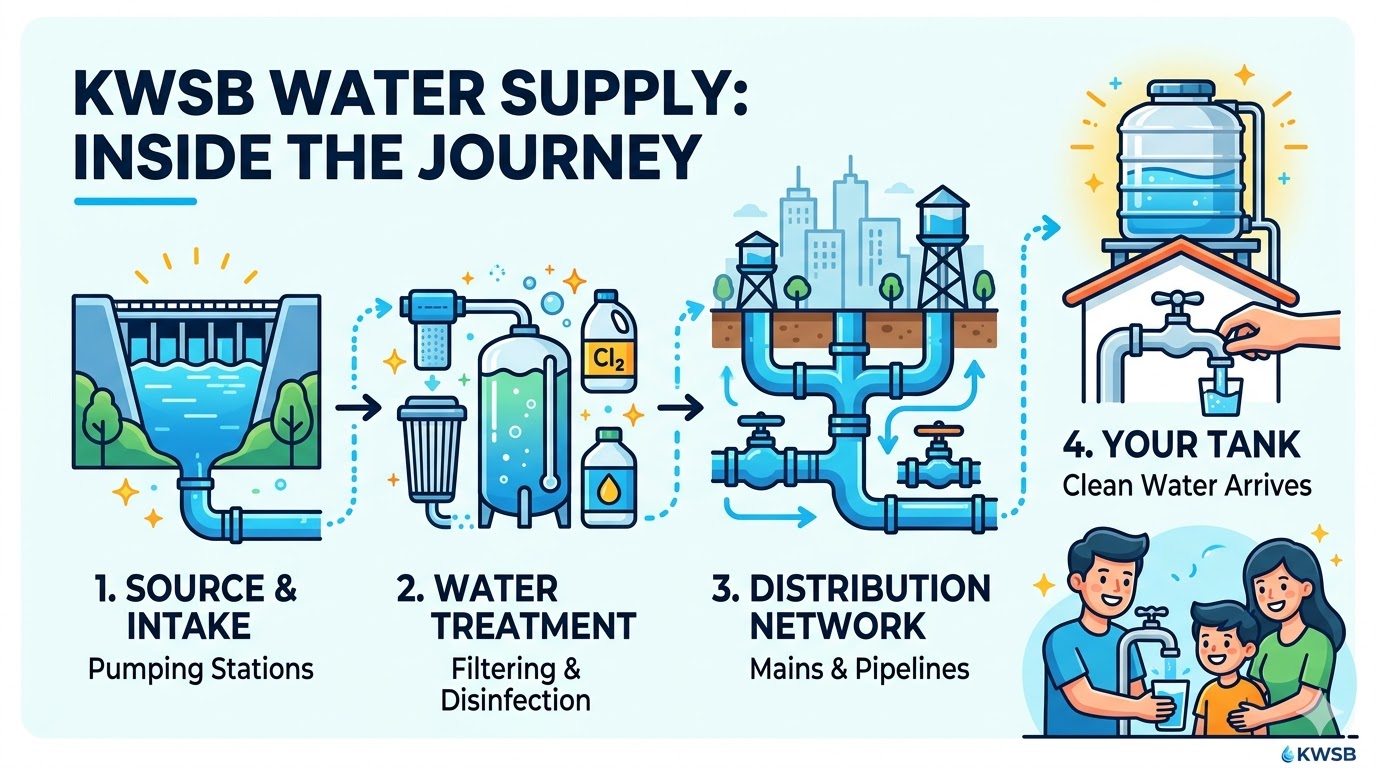
Turn on your tap and water flows. It is easy to take that moment for granted. What very few Karachi homeowners realise is that the water filling your glass has survived one of the longest, most demanding, and most risk-laden journeys of any public utility service in Pakistan — and that the final, most critical leg of that journey ends not in some treatment plant run by professionals, but in your own storage tank, which may not have been cleaned in years.
This article traces exactly what happens to Karachi’s water — from its source over 120 kilometres away, through canals, pumping stations, filtration plants, miles of aging pipes, and a gauntlet of leakages, illegal connections, and pressure failures — before it finally lands in your tank. Understanding this journey will change the way you think about your water, your tank, and your family’s health.
1. Where Does Karachi’s Water Actually Come From?
Most Karachi residents know, vaguely, that water comes from somewhere far away. The reality is more specific — and more sobering — than most people appreciate.
Primary Source: Keenjhar Lake and the Indus River
Keenjhar Lake, also known as Kalri Lake, sits approximately 122 kilometres from Karachi in District Thatta. It is a man-made reservoir created by earthen embankments in the 1950s, fed by the Indus River via the Kalri-Baghar Feeder canal that runs from the Kotri Barrage. According to the Sindh Irrigation Department, Keenjhar serves as Karachi’s primary water source, accounting for roughly 80% of the city’s total requirement.
Here is a figure that immediately puts the system’s fragility into perspective: the first drop of water that enters Keenjhar Lake from the Indus River takes 17 days to reach Karachi. That single fact — cited by KWSB’s own Deputy Managing Director — tells you everything about the complexity and vulnerability of this supply chain.
Secondary Source: Hub Dam
Hub Dam, located on the Hub River to the northwest of Karachi, contributes approximately 70–100 million gallons per day (MGD) when it holds water. The critical qualifier is when it holds water. The Hub Dam has gone dry in multiple recent years due to insufficient rainfall, leaving Hub District West — and many homes in Orangi Town, SITE, and Baldia — entirely dependent on the Keenjhar supply. When Hub Dam is dry, that 70–100 MGD shortfall is simply not replaced.
The Supply Gap No One Talks About
Karachi’s total daily water demand from a population now exceeding 20 million is estimated at 1,080–1,200 MGD. Total supply from all sources — Keenjhar, Hub Dam, and minor contributions from Haleji Lake and Dumlottee wells — amounts to approximately 650 MGD. That means Karachi receives, at best, roughly 55% of its daily water requirement. Many areas receive nothing for days or weeks at a stretch.
| The Scale in Numbers: Keenjhar Lake delivers 450 MGD. Hub Dam adds up to 100 MGD when full. Total supply: ~650 MGD. Total demand: 1,100–1,200 MGD. The gap — nearly 550 MGD — is filled by expensive water tankers, illegal hydrants, and, in many areas, simply going without. |
2. Stage One: The Canal Journey From Keenjhar to Dhabeji
Water leaves Keenjhar Lake through the Keenjhar-Gujjo (KG) Canal and travels via the Roller Compacted Concrete (RCC) Canal and the K-II/K-III Canal system to the Dhabeji Pumping Station — the heart of Karachi’s water supply. The total conveyance capacity between Gujjo and Dhabeji is currently rated at 515 MGD.
This canal journey is the first point of contamination risk. Open canals are exposed to:
- Agricultural runoff containing fertilisers, pesticides, and animal waste from farmland along the canal banks
- Industrial discharge where canal routes pass near manufacturing areas
- Direct human dumping — waste, plastics, and debris entering open water channels
- Wildlife and bird contamination in unenclosed stretches of the canal
- Sedimentation — silt and particulate matter that the canal carries from its source
By the time raw water reaches Dhabeji, it is already carrying turbidity, organic matter, bacteria, and chemical residues that require treatment before it is safe for human consumption. The canal journey, in other words, is not neutral — it actively adds contamination to water that started out considerably cleaner at its source.
3. Stage Two: Dhabeji Pumping Station — The City’s Water Heart
The Dhabeji Pumping Station, located roughly 50 kilometres from central Karachi, is the single most critical piece of infrastructure in the city’s water supply. It is the main intake point where canal water is received, and from where it is pumped onward to filtration plants across the city. According to KWSC, the station serves over 15 million residents.
From Dhabeji, water is gravity-fed and pumped to several key destinations:
- Pipri Filter Farm — one of the city’s main treatment facilities
- NEK (North East Karachi) Filter Plant — serving northern and eastern Karachi including Surjani, North Nazimabad, North Karachi, and surrounding areas
- COD Filter Plant — serving central districts
- Old NEK Filter Plant — an aging facility still in active use
Dhabeji itself has faced repeated crises in recent years. A January 2025 explosion at the station disrupted water supply to vast sections of the city. In December 2024, the 84-inch pipeline along University Road suffered three consecutive leakages during BRT Red Line construction, cutting supply to areas including Gulshan Town, Liaquatabad, Chanesar Town, Keamari, Clifton, and Saddar for an extended period. These are not rare events — they are recurring features of a system under extreme stress.
| Infrastructure Alert: In December 2024 alone, three consecutive leaks in the University Road main pipeline reportedly caused a loss of 2.5 billion gallons of water and cut supply to dozens of Karachi neighbourhoods. Repair work required shutting down 12 pumps at Dhabeji. This is the infrastructure your family’s water depends on. |
4. Stage Three: Filtration — What It Does and What It Cannot Do
Water arriving at Karachi’s filtration plants undergoes several treatment steps before entering the distribution network. A standard treatment process includes coagulation (adding chemicals to bind fine particles), sedimentation (letting those clumps settle), filtration through sand and gravel beds, and chlorination to kill pathogens.
When the system works as designed, this process produces water that meets basic safety standards. But there are several important limitations that Karachi homeowners must understand:
- Karachi’s filtration plants are operating well below their combined potential capacity due to aging equipment, power failures, and maintenance backlogs. KWSC has been working to rehabilitate filter plants at Gharo, Pipri, COD, and NEK, and new filtration facilities are under construction — but the gap between what is needed and what currently functions is significant.
- Filtration treats what enters the plant. It cannot compensate for water that was contaminated in the canals, nor for contamination that occurs after the water leaves the plant and enters the distribution network.
- Chlorine dosing — the primary bactericidal treatment — is effective at the point of application but dissipates over time and distance. By the time water travels from the filtration plant to a neighbourhood in Gulshan, Jauhar, DHA, or North Karachi, the chlorine residual may have dropped significantly below effective levels.
A 2020 study that tested 118 water samples across Karachi found that a staggering 90.7% of samples were unsafe for drinking. Of these, 88.1% showed coliform bacteria beyond WHO limits, and 33.4% had faecal contamination (E. coli). These figures were from treated and distributed water — not raw canal water. The distribution system was recontaminating water that had already been treated.
5. Stage Four: The Distribution Network — 10,000 Kilometres of Risk
From the filtration plants, treated water enters Karachi’s distribution network — a system of approximately 10,000 kilometres of pipes that snake beneath the city’s streets, many of which are 30, 40, or even 50 years old. This is the most dangerous leg of the journey, and the one most directly responsible for the condition of the water that eventually reaches your tank.
5.1 Leakages and Non-Revenue Water Loss
According to KWSB data, an estimated 42% of water — approximately 235 MGD — is either lost through leakages in the distribution network or stolen before it reaches consumers. Some estimates place leakage losses alone at 35% of total supply, compared to Tokyo’s benchmark loss rate of under 5%. This means that for every litre of water that leaves the Dhabeji filtration system, almost half never reaches a household tap.
Every leakage point is a two-way vulnerability: water leaks out, but when pressure drops, soil and groundwater can enter the pipe through the same breach. This is the mechanism through which agricultural chemicals, industrial pollutants, and in densely built areas, sewage contaminants enter Karachi’s treated water supply.
5.2 Illegal Connections and Water Theft
Illegal connections — pipes tapped directly into the main distribution lines without authorisation — are widespread across all areas of Karachi. As KWSB’s own senior officials have acknowledged, detecting these underground punctures is far more difficult than identifying illegal electricity connections. Each illegal connection further reduces system pressure, multiplies contamination entry points, and degrades water quality for everyone else on the same line.
5.3 Intermittent Supply and Biofilm
Because Karachi’s water is not supplied continuously — many areas receive water once a week, some less frequently — the pipes between supply cycles are not filled with flowing water. They are empty. Or worse, they hold stagnant puddles of residual water in their lower sections. Research cited in environmental reporting on Karachi’s water crisis shows that a single E. coli bacterium entering a dry pipeline can multiply into trillions within a week if conditions are favourable. Inside aging iron pipes, biofilm — a structured colony of bacteria embedded in a protective film on pipe walls — provides an ideal breeding environment that survives normal chlorination.
| The Pipeline Reality: Karachi has 10,000 kilometres of pipeline. Many are old iron pipes. The water in them is intermittent, meaning they spend much of the week empty or stagnant. Biofilm grows on their walls. Pressure fluctuations cause soil and sewage to enter through cracks. This is the pipe that delivers water to your building’s storage tank. |
6. Stage Five: The Final Destination — Your Storage Tank
After this entire journey — 122 kilometres of canals exposed to agriculture and industrial runoff, pumping stations under constant stress, filtration plants working below capacity, and 10,000 kilometres of aging distribution pipes plagued by leakages and illegal connections — the water finally reaches your building. And it enters your storage tank.
If you live in a house in Gulshan-e-Iqbal, Gulistan-e-Johar, Federal B Area, or North Nazimabad, that tank is almost certainly an overhead tank. If you are in DHA, Clifton, or Defence, you likely have both an underground tank and a rooftop tank. In housing societies, you share a central tank with dozens or hundreds of other families.
Whatever the configuration, the tank is where the journey ends — and where your responsibility begins. Everything the water has accumulated during its journey — sediment, bacterial contamination, reduced chlorine residual, traces of agricultural and industrial chemicals — is now sitting in your tank. And if that tank has not been professionally cleaned recently, it is also accumulating:
- A layer of sludge at the base — sediment, rust particles, and organic matter that settles with every cycle of water supply
- Biofilm on the interior walls — invisible colonies of bacteria that adhere to tank surfaces and are impossible to remove with manual scrubbing
- Algae growth — particularly in tanks that are not fully sealed, which describes the majority of tanks in Karachi
- Scale and mineral deposits — calcium and magnesium buildups from Karachi’s hard water supply that degrade water taste and provide surfaces for bacterial adhesion
7. Why Your Neighbourhood Matters: Area-by-Area Risk Factors
The journey described above affects every part of Karachi — but not equally. Infrastructure age, distance from filtration plants, supply frequency, and local density all affect how much contamination accumulates by the time water reaches your tank.
Gulshan-e-Iqbal, Gulistan-e-Johar, Federal B Area, North Nazimabad
These densely populated central-eastern areas are served by the NEK and COD filter plants. Many supply lines here are older, running beneath high-traffic roads where construction and road work frequently damage and create pressure fluctuations in pipelines. The 84-inch University Road pipeline — which runs directly through this corridor — has suffered repeated critical failures in recent years. Apartment complexes with shared overhead tanks in these areas carry compounded risk: one contamination event can affect every family in the building simultaneously.
Khan Tank Cleaning’s water tank cleaning service in Gulshan and Jauhar Karachi is the dedicated branch for this zone, with teams that understand the specific water supply challenges of this part of the city.
DHA, Clifton, Bath Island, Defence
While these areas generally receive more consistent supply, they present different challenges. Large underground tanks common in DHA and Clifton hold substantial volumes of water for extended periods, creating ideal conditions for bacterial growth and sedimentation. The longer the water sits in a large tank between cleaning cycles, the more pronounced the biofilm and sludge accumulation. Elevated rooftop tanks in Clifton’s older buildings are particularly prone to algae growth due to sun exposure and inadequate sealing.
Khan Tank Cleaning’s professional water tank cleaning service in DHA and Clifton Karachi is specifically equipped for the larger-capacity underground and elevated tanks common in this corridor, with the industrial-grade equipment needed to clean tanks of all sizes effectively.
Korangi, Landhi, Malir, Shah Faisal Town
These areas are among the most infrastructure-stressed in the city. Supply is irregular, pipelines are older, and the proximity of water and sewage infrastructure creates heightened back-siphonage risk during pressure fluctuations. Residents here may go days or weeks without supply, and when water does arrive, its quality has often degraded significantly during transmission.
Orangi Town, Baldia, SITE, Liaquatabad
Areas previously supplied by Hub Dam — now often dry — are particularly vulnerable to supply shortfalls and the quality degradation that comes with irregular, low-pressure delivery through aging pipes. These areas also have higher rates of illegal connections to the main supply lines, which increases contamination risk for all households in the zone.
8. The Health Consequences of a Contaminated Tank
A KWSB official speaking about Karachi’s water infrastructure noted that the city’s water supply challenge is not just quantity — it is fundamentally a quality problem at every stage of the supply chain. The health consequences for families consuming tank water that has accumulated contamination across this entire journey are well-documented:
- Typhoid fever — Salmonella typhi, one of the most common water-borne illnesses in Karachi, transmitted through faecally contaminated water
- Hepatitis A and E — viral infections causing liver inflammation, both spread through contaminated drinking water
- Cholera — bacterial infection associated with contaminated water sources; health risks linked to contaminated tanker water are connected to approximately 30% of hospital admissions for cholera in parts of Karachi
- Gastroenteritis — severe vomiting and diarrhea, most dangerous for children and the elderly
- Chronic digestive conditions — long-term low-level consumption of bacterially contaminated water
- Skin conditions and eye infections — from bathing and washing in contaminated water
9. What a Professional Tank Cleaning Actually Resolves
You cannot change Karachi’s canal infrastructure or fix the distribution network’s aging pipes. But you can completely control what happens at the end of the journey — in your own tank. Professional cleaning addresses every layer of contamination that has accumulated:
- High-pressure jet washing removes biofilm from all interior surfaces — corners, seams, and walls that manual scrubbing cannot reach
- Industrial vacuum extraction removes all sludge and sediment from the tank base without dispersing it back into the water
- Silver Hydrogen Peroxide disinfection — a hospital-grade treatment — kills residual bacteria and viruses and prevents rapid recontamination
- Full inspection of tank integrity, seals, and covers to prevent external contamination entry
For households and businesses across Gulshan, Jauhar, Federal B Area, North Nazimabad, Gulshan-e-Maymar, and surrounding areas, the Gulshan and Jauhar branch of Khan Tank Cleaning provides rapid-response professional service with full familiarity of local water supply conditions.
For properties in DHA, Clifton, Zamzama, Bath Island, Defence, and adjacent areas, the DHA and Clifton branch of Khan Tank Cleaning brings specialised equipment sized for the large-volume tanks typical of that zone.
10. How Often Should You Clean? A Karachi-Specific Guide
Given the contamination accumulating at every stage of Karachi’s supply chain, standard cleaning intervals are not sufficient. The recommended schedule for Karachi conditions:
- Every 3 months: Households in areas with very irregular supply, older infrastructure, or shared building tanks (apartments, housing societies)
- Every 4–6 months: Standard residential properties in areas with moderate supply consistency
- Immediately: After any period of discoloured or unusual-smelling water, after any major pipeline failure in your area, after monsoon season, or after extended supply disruption
It is also worth noting that if you cannot recall when your tank was last professionally cleaned, it is overdue. In our experience serving Karachi homeowners, the majority of households requesting their first professional cleaning have tanks with years of accumulated contamination — sludge layers, mature biofilm colonies, and scale deposits that have been building silently since the tank was installed.
Your Tank Is the Last Line of Defence.
Make Sure It Is Doing Its Job.
| Karachi’s water has already survived a 122-kilometre journey through open canals, under-capacity filtration plants, and 10,000 kilometres of aging leaking pipes before it reaches your neighbourhood. By the time it enters your storage tank, it is carrying everything it has picked up along the way. You cannot fix the canals. You cannot repair the city’s pipes. But you can ensure that your family’s water tank is clean, disinfected, and safe — and that everything your water has collected during its long journey is removed before it reaches your family’s taps. Khan Tank Cleaning is Karachi’s dedicated professional water tank cleaning company. Water tank cleaning is all we do. We use industrial high-pressure jet washing, professional vacuum extraction, and Silver Hydrogen Peroxide disinfection to clean tanks that bucket-and-brush methods simply cannot. Our trained technicians serve all areas of Karachi from two dedicated branches: |
📍 Gulshan | Jauhar | Federal B Area | North Nazimabad | Gulshan-e-Maymar & surrounding areas:
Book Your Professional Tank Cleaning — Gulshan & Jauhar Branch
📍 DHA | Clifton | Defence | Zamzama | Bath Island | Korangi & surrounding areas:
Book Your Professional Tank Cleaning — DHA & Clifton Branch
| 📞 Call / WhatsApp: 0340-2717530 | 03330293174 Available 24/7 for residential, commercial, and industrial clients across all of Karachi. |
Your water’s journey was 122 kilometres. Your tank cleaning call takes 30 seconds.
Khan Tank Cleaning | khantankcleaning.com | Professional Water Tank Cleaning — Serving All Karachi

Mateen Khan is the Founder & Owner of Khan Tank Cleaning, Karachi’s first dedicated professional water tank cleaning company (est. 2005). With 20+ years of industry experience, he leads an ISO 9001 & ISO 45001 certified team that follows a strict 8-step process using industrial equipment and food-grade disinfectants. Mateen is committed to making clean, safe water accessible to every household and business in Karachi.
Leave a Reply