Category: Karachi Water Problems

Water issues are a common challenge for residents across Karachi. In this section, we cover the most frequent water-related problems faced by households and businesses, including contaminated tank water, poor water quality, storage issues, and the health risks associated with unsafe water. These articles help readers understand the causes of Karachi’s water problems and provide practical insights on how proper tank maintenance, cleaning, and hygiene practices can help ensure safer water for everyday use.

  • Water Tanks in Gulshan-e-Iqbal and Gulistan-e-Johar: The Problem Nobody Talks About

    Water Tanks in Gulshan-e-Iqbal and Gulistan-e-Johar: The Problem Nobody Talks About

    Gulshan-e-Iqbal and Gulistan-e-Johar are among the most densely built parts of Karachi: block after block of apartment buildings, each with an underground tank, a motor and a tank on the roof, shared by everyone inside. When the water is bad here, it is bad for a whole building at once.

    This article looks at the state of the average water tank in Gulshan, Karachi and in neighbouring Johar: how the area is supplied, what has gone wrong recently, why shared tanks are a particular problem, and what residents and unions can do.

    In brief

    • Most residents here share an underground tank and rooftop tanks with the whole building.
    • The 84-inch University Road main failed in late 2024, and the dirty first flow afterwards settled in tanks across the area.
    • Suction pumps, borehole water and inactive unions make the problem worse.
    • Shared tanks should be cleaned every three months, and the union is normally responsible.
    • A written proposal with a date and a quote gets a tank cleaned faster than a complaint does.

    How the area gets its water

    Piped water comes from the Karachi Water and Sewerage Corporation (KWSC) through large mains that run along University Road and into the blocks. Like the rest of the city, the area receives water in turns, not continuously. Karachi as a whole gets about 650 million gallons a day against a need of more than 1,200, a gap explained in our guide to KWSB water supply. Residents fill the gaps with tankers and with borehole water, which in much of the area is hard and salty.

    The University Road failure of 2024

    On 29 November 2024 the 84-inch main on University Road burst during construction of the BRT Red Line. Three consecutive leakages followed, and Geo News reported a shortage of 150 million gallons a day before the line was fully repaired about three weeks later. Gulistan-e-Jauhar, Mosamiyat, Safoora and several blocks of Gulshan-e-Iqbal were among the areas left dry, along with Bahadurabad, Tariq Road, Garden, Lyari and Saddar.

    Two things happened to tanks during those weeks. First, households and buildings bought tanker water from wherever they could get it. Second, when the main was recharged, the first water through carried rust, silt and whatever had entered the empty line. All of that settled in underground tanks across the area, and unless a tank has been properly cleaned since, it is still there.

    Every later repair or diversion of a main produces a smaller version of the same event.

    Why Gulshan and Johar tanks are especially exposed

    • Shared tanks. One underground tank and one or two rooftop tanks serve 20, 40 or more flats. A single contaminated fill reaches every family.
    • High turnover. Large buildings pump several times a day, so sludge is constantly stirred.
    • Suction pumps. Where pressure is weak, buildings pull water from the main with powerful motors. That lowers pressure in the street and draws contamination in through leaks.
    • Old lines under busy roads. Traffic and repeated excavation damage pipes, and water and sewer lines run close together.
    • Borehole water. Mixed into the same tanks, it leaves heavy scale.
    • Nobody in charge. In many buildings the union is informal or disputed, and tank cleaning is the first thing to slip.

    What builds up in a shared water tank in Gulshan, Karachi

    DepositWhere it comes fromWhat residents notice
    Sludge on the floorSilt and rust from the mains, sand from tankersBrown water when the tank runs low; grit in buckets
    Biofilm on wallsBacteria attaching to any wet surfaceSlippery tank walls; musty smell
    AlgaeLight entering through broken or missing coversGreen tint; earthy taste
    Mineral scaleBorehole waterWhite crust on taps and geysers; blocked float valves
    Insects and debrisOpen hatches on roofs used for drying clothes and storageLarvae and floating matter

    These match what our crews find across the city, described in what we find in Karachi’s water tanks.

    Houses, flats and Scheme 33

    The area is not all apartment blocks, and the right approach differs with the property.

    • Older blocks of Gulshan-e-Iqbal: a mix of bungalows and low-rise flats. Many bungalows have been divided into portions that share the original tanks, so three households depend on a system built for one.
    • Gulistan-e-Johar: mostly multi-storey apartment projects with large shared tanks, pumped several times a day.
    • Scheme 33 and Gulzar-e-Hijri: newer societies with heavier reliance on tankers and boreholes, so more sand and scale.
    • Commercial strips along the main roads: restaurants, clinics and schools in converted buildings, which should be on a three-month cycle whatever the residents upstairs decide.

    Symptoms residents tend to ignore

    • Stomach upsets that go round the building
    • Water that is brown for the first minute after the motor runs
    • A musty or earthy smell in the bathroom
    • Filters that clog within weeks
    • Skin or eye irritation after bathing

    None of these proves the tank is at fault, but several together in one building is a strong hint. The full list is in ten signs your water may be making you sick, and the infections involved are covered in waterborne disease in Karachi. Families with young children should also read our guide for parents.

    Who is responsible in an apartment building?

    The tanks are common property, so the duty sits with whoever manages the common areas: the residents’ union or association, the builder if the project has not been handed over, or the landlord in a building under single ownership. Individual flat owners cannot clean a shared tank on their own, but they can and should ask for it.

    We set out the roles, and how to raise the issue, in who is responsible for an apartment building’s water tank. Managers of several buildings will find a planning approach in our guide for property managers.

    What flat residents can do this week

    1. Ask the union for the date of the last cleaning and whether there is a report with photographs.
    2. Look at the roof. Are the tank covers in place and intact? Is the area around them clean?
    3. Raise it in writing in the building’s group, with a proposed date and a quote, so it becomes a decision and not a complaint.
    4. Share the cost. Split across the flats, a proper cleaning every three months is a small monthly amount per household.
    5. Boil or filter drinking water regardless. A filter does not replace a clean tank, as we explain in water filter versus tank cleaning.
    6. If your flat has its own small tank or drum, clean and cover that too.

    How often should tanks here be cleaned?

    PropertyRecommended interval
    Apartment building, shared tanksEvery 3 months
    Independent house, mostly piped supplyEvery 4 to 6 months
    House or building using borehole or tanker waterEvery 3 months
    Shops, clinics, schools and restaurantsEvery 3 months
    After a main line failure, flooding or sewage leakStraight away

    The reasoning is in how often to clean a water tank in Karachi. The Sindh health department’s minimum for every tank is once a year before summer.

    Cleaning a shared tank without leaving the building dry

    Unions often put the job off because they fear a day without water. It can be planned around that. We survey the building first, free of charge, agree a day just before the supply turn when the underground tank is low, and where there are two rooftop tanks they can be cleaned one at a time so the building always has one in service. Residents are asked to store a few buckets for the hours the underground tank is out of use, typically four to eight.

    The method is our standard eight-step procedure: drainage, ventilation and a gas check before anyone enters, jet washing at 3,000+ PSI, vacuum extraction of the sludge, disinfection, rinse and inspection. The union receives a dated report with photographs and a numbered SRB/FBR tax invoice for its accounts.

    Our Gulshan-e-Iqbal branch

    Our branch at Suite-203, Mumtaz Manzil, Block 16, Gulshan-e-Iqbal handles water tank cleaning across Gulshan-e-Iqbal, Gulistan-e-Johar and East Karachi, including Scheme 33, Federal B Area, Nazimabad, North Nazimabad and PECHS. The number is 0340 2717530, answered 24 hours. Houses can get a fixed price online; buildings are quoted after the survey. The south of the city is served by our DHA and Clifton branch.

    Frequently asked questions

    How often should an apartment building’s tank be cleaned?

    Every three months for shared tanks, and immediately after a main line failure or any sign of sewage contamination.

    Can I get the building’s tank cleaned if the union will not act?

    Not on your own, because it is common property. Put the request in writing with a quote attached, gather support from other residents, and offer to coordinate the day.

    Why is our water brown after the motor runs?

    The pump is stirring sludge on the tank floor, or the level has dropped close to it. It is one of the clearest signs that cleaning is overdue.

    Is borehole water safe to store in the same tank?

    It is usually hard and salty and can carry contamination in dense areas. It also leaves heavy scale. If you rely on it, clean the tank every three months and treat drinking water.

    How long will the building be without water?

    With planning, a few hours for each tank. Rooftop tanks take two to four hours and underground RCC tanks four to eight.

    Do you clean tanks in Scheme 33 and Gulshan-e-Maymar?

    Yes. Both are covered from the Gulshan-e-Iqbal branch.

    Our building uses a suction pump on the line. Should we stop?

    Where the line pressure is enough to fill the underground tank unaided, yes. Suction lowers pressure in the street main and can draw contaminated groundwater in through leaks. Where there is no alternative, clean the tank more often.

    Sources

    Figures in this article were checked in October 2026 against the following:

    About Khan Tank Cleaning

    Khan Tank Cleaning is a Karachi company that does one thing: clean and disinfect water storage tanks. It was started in 2005 by Mateen Khan and now runs branches in DHA Phase 2 and Gulshan-e-Iqbal. Read our background or reach the nearest branch on 0333 0293174 (DHA) or 0340 2717530 (Gulshan), day or night.

  • DHA Karachi Water Quality: What Residents Are Really Drinking

    DHA Karachi Water Quality: What Residents Are Really Drinking

    DHA is one of Karachi’s most expensive addresses and one of its worst supplied with piped water. Residents pay for tankers, sink boreholes and build large underground tanks to cope. Each of those workarounds affects water quality in DHA Karachi in ways that are easy to overlook when the water looks clear.

    This guide explains where DHA’s water comes from, what the recent supply record looks like, what each source puts into your tank, and how to manage storage in a DHA or Clifton home.

    In brief

    • DHA receives its piped water from KWSC through the Cantonment Board Clifton, and receives very little: 4 to 5 MGD according to Dawn in 2025.
    • Most homes top up with tankers and boreholes, each of which brings its own contaminants.
    • There is no public evidence that DHA’s water is cleaner than the rest of Karachi’s.
    • Large underground cisterns, old concrete in the early phases and sea air are the local risk factors.
    • A 10 MGD line from Dumlottee was agreed in September 2026, with a 12-month construction period.

    How water reaches DHA

    DHA and Clifton do not have their own source. Bulk water comes from the Karachi Water and Sewerage Corporation (KWSC), which hands it to the Cantonment Board Clifton (CBC), and CBC distributes it within the cantonment area. The quantity is small. When the Sindh cabinet approved funding for a dedicated pipeline in July 2025, Dawn reported that DHA residents were receiving only 4 to 5 million gallons per day (MGD) and that the shortage had persisted for years.

    The whole city is short. Supply is about 650 MGD against demand of more than 1,200 MGD, so there is little spare water to send anywhere. The route is described in our guide to KWSB water supply.

    The recent record

    DateEventEffect on DHA and Clifton
    July 2025Sindh cabinet approves a 36 km, 24-inch line from Dumlottee designed to carry 10 MGDFirst dedicated supply line for the area, on paper
    Late April to May 2026Line No. 5 near Dhabeji taken offline for replacement; power breakdown bursts three 72-inch linesKWSC names DHA and Clifton among the worst-hit areas; crisis runs into a second week
    13 September 2026KWSC and the Frontier Works Organisation sign the agreement for the Dumlottee lineAn additional 10 MGD promised within 12 months

    If the Dumlottee line is completed on schedule it will roughly triple the piped water reaching the area. Until then, and for the gaps afterwards, most households will keep buying water.

    Where DHA’s water really comes from

    SourceWhat it bringsWhat it does to your tank
    CBC piped supplyTreated water that has travelled the length of the network; arrives intermittently at low pressureFine silt and rust in every fill, more after outages and repairs
    Tanker waterDepends entirely on where the tanker filled. Some loads are from official hydrants, others are notSand and silt, sometimes salt, sometimes microbial contamination; quality changes load to load
    Borehole (boring) waterGroundwater close to the sea is commonly brackish and hardHeavy mineral scale on walls and fittings; salty taste; corroded metal parts
    Bottled water for drinkingSolves the glass, not the houseNo effect on tank water used for bathing, cooking and washing

    Most DHA homes use a mix of the first three over a year, which is why the same tank can hold soft piped water one week and hard, salty water the next. Mixed sources make scale and sediment build up faster than any single source would.

    Is water quality in DHA Karachi better than in the rest of the city?

    There is no public evidence that it is. The piped water comes from the same bulk system that has repeatedly failed testing. In the 2017 sampling carried out for a Supreme Court commission, 107 of 118 Karachi samples were unsafe to drink, and later monitoring by the same agency put the unsafe share at 93 percent. Tanker and borehole water are not tested by anyone unless you pay for it yourself.

    What DHA does have is better buildings: newer plumbing in the later phases, bigger tanks and more households with filters. Those help at the tap. They do not change what goes into the tank.

    DHA-specific risk factors

    • Large underground cisterns. RCC cisterns are standard in DHA and Clifton houses. Big tanks mean water sits longer, and a large floor area collects a lot of sludge before anyone notices.
    • Old concrete in the early phases. Houses in Phases 1 to 4 are decades old. Their tanks develop cracks and rough surfaces that hold biofilm and can let groundwater seep in.
    • Sea air. Salt-laden air corrodes tank lids, hinges and inspection covers faster in Clifton, Gizri and Seaview. A rusted lid is an open tank.
    • Surges on supply day. When water does arrive it comes in a rush that stirs up settled sediment.
    • Multiple tanks. A bungalow may have an underground cistern, a main rooftop tank and a separate one for servants’ quarters or the garden. One of them is usually forgotten.
    • Apartment towers. In the newer phases and in Clifton, shared tanks serve dozens of flats. See who is responsible for an apartment building’s water tank.
    • Heat. Rooftop tanks sit in the growth range for bacteria for most of the year, as explained in heat and bacteria in water tanks.

    What builds up in a DHA tank

    • Sand and silt from tanker loads and from first flow after outages
    • Mineral scale from borehole water, as a hard white or brown crust
    • Biofilm on the walls, thickest near the waterline
    • Algae in rooftop tanks where light gets in
    • Rust from corroded lids and fittings

    Our crews’ usual findings across the city are described in what we find in Karachi’s water tanks.

    Managing tanker water

    1. Ask where the tanker filled. A reputable operator will tell you. Official KWSC hydrants are preferable to unknown boreholes.
    2. Look at the first few litres. If it is visibly dirty or smells, refuse the load.
    3. Check the hose. A delivery hose that has been dragged along the road should not go into your tank without a rinse.
    4. Let it settle. Avoid pumping to the roof for an hour or two after delivery so sand sinks in the underground tank.
    5. Clean more often. Tanker-fed tanks need cleaning about every three months.
    6. Treat what you drink. Boil it, or use RO with UV. A filter and a clean tank do different jobs; see water filter versus tank cleaning.

    How often should DHA residents clean their tanks?

    SituationRecommended interval
    House on mostly piped supply, tanks in good repairEvery 4 to 6 months
    House using tankers regularlyEvery 3 months
    House on borehole waterEvery 3 to 4 months, with descaling as needed
    Old RCC underground tank (early phases)Every 4 months, with a structural check each time
    Apartment building or commercial premisesEvery 3 months
    After a supply crisis, flooding or a change in smell or colourStraight away

    This follows the citywide schedule in how often to clean a water tank in Karachi. The official minimum, from the Sindh health department, is once a year before summer.

    A DHA homeowner’s checklist

    • List every tank on the property, including the ones nobody uses much
    • Replace corroded lids with covers that seal; consider non-metal covers near the sea
    • Raise the underground hatch above floor level before the monsoon
    • Fit mesh to vents and overflows
    • Keep each service report and note the next date
    • Tell domestic staff not to enter the underground tank for any reason

    The last point matters. Closed tanks can hold gas, and people have died entering them. The safety steps a crew should take are described in what happens during a professional tank cleaning, and the wider picture for this part of the city, including commercial premises, is in water safety in Clifton, PECHS and Defence.

    Tank cleaning in DHA and Clifton

    Our DHA Phase 2 branch covers Phases 1 to 8, Clifton, Gizri, Seaview, Zamzama and the surrounding areas, and is the nearest team for water tank cleaning in DHA and Clifton. The work follows our eight-step cleaning procedure: drainage, ventilation and gas check before anyone enters a cistern, jet washing at 3,000+ PSI, vacuum extraction, disinfection, rinse and a dated report with photographs. An underground RCC tank takes four to eight hours and a rooftop tank two to four.

    For a standard house you can get a fixed price online. The branch number is 0333 0293174, answered 24 hours. Customers in the east of the city are served from Gulshan-e-Iqbal by our Gulshan and Jauhar branch.

    Frequently asked questions

    Is tap water in DHA Karachi safe to drink?

    Do not assume so. The piped supply comes from the same system as the rest of the city, and tanker and borehole water are untested. Boil or properly filter drinking water.

    Why is my water salty?

    Usually because of borehole water, or a tanker that filled from a borehole. Groundwater near the coast is brackish. RO treatment removes the salt for drinking; the tank will still collect scale.

    When will DHA get more piped water?

    The agreement for the 10 MGD Dumlottee line was signed in September 2026 with a 12-month construction period. Earlier targets for this project were missed, so treat the date as a target.

    We only drink bottled water. Does the tank still matter?

    Yes. Tank water is used for bathing, brushing teeth, washing food and dishes, and wudu, none of which bottled water covers.

    How long does it take to clean a large underground tank?

    Typically four to eight hours for an underground RCC tank, depending on size and how much sludge it holds.

    How many tanks does a typical DHA house have?

    Usually an underground cistern and at least one rooftop tank, and often a separate tank for staff quarters or the garden. All of them should be on the same cleaning schedule.

    Does borehole water damage the tank?

    It leaves hard scale on walls and fittings and speeds up corrosion of metal parts. Scale also gives bacteria a rough surface to cling to, so tanks on borehole water need cleaning more often.

    Sources

    Figures in this article were checked in October 2026 against the following:

    About Khan Tank Cleaning

    Khan Tank Cleaning has cleaned residential, commercial and industrial water tanks in Karachi since 2005. The company was founded by Mateen Khan, who still oversees quality control at both branches. More about us, or get in touch: 0333 0293174 for DHA and South Karachi, 0340 2717530 for Gulshan and East Karachi, both answered 24 hours.

  • KWSB Water Supply in Karachi: What Happens Before It Reaches Your Tank

    KWSB Water Supply in Karachi: What Happens Before It Reaches Your Tank

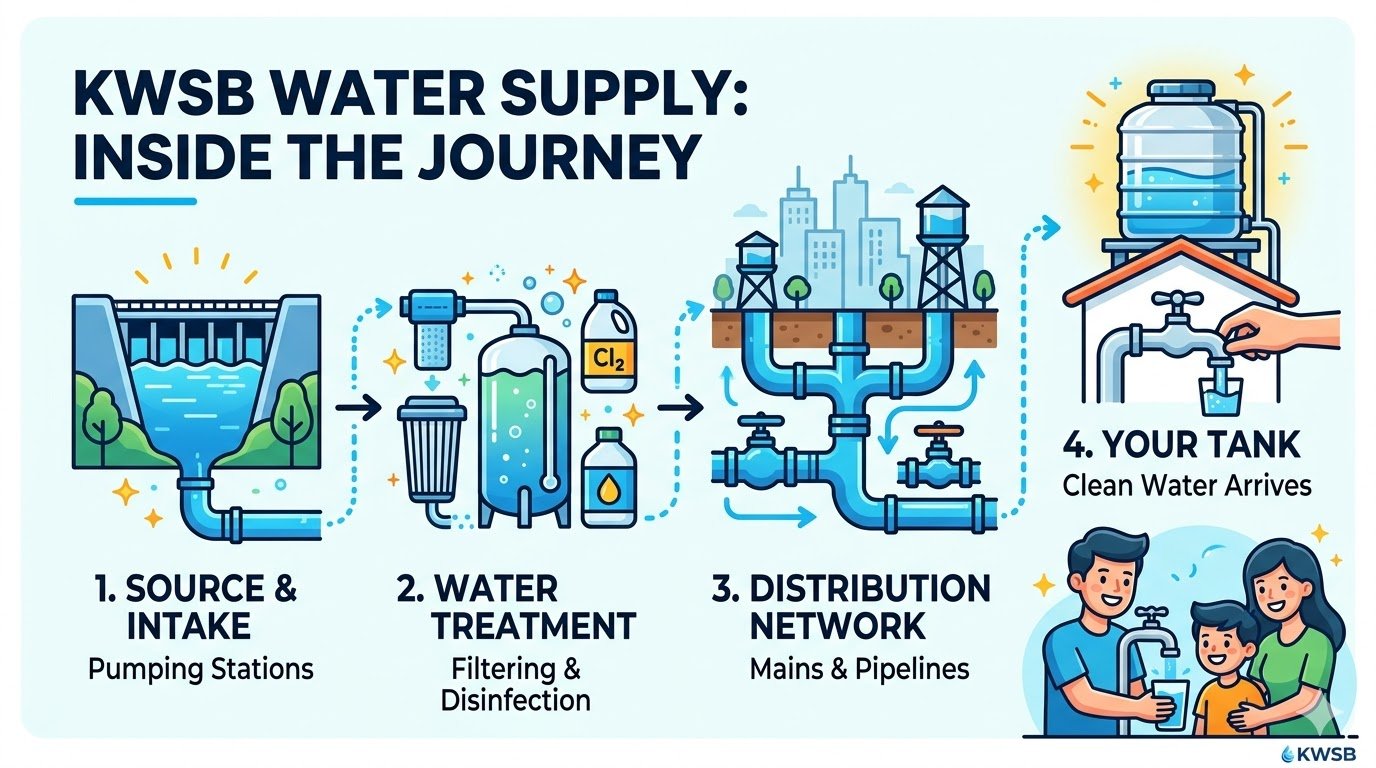
    Most of Karachi still calls it the KWSB water supply, although the utility has been the Karachi Water and Sewerage Corporation (KWSC) since the Karachi Water and Sewerage Corporation Act, 2023. Whatever name is on the bill, the water follows the same route: roughly 120 kilometres from the Indus at Keenjhar Lake, through canals, the Dhabeji pumping station, filter plants and thousands of kilometres of city pipes, and finally into a storage tank that belongs to you, not to the utility.

    This guide follows that route stage by stage, using KWSC’s own published figures and dated reporting, shows where water quality is lost along the way, and is honest about which part of the journey a household can actually control. We have cleaned water tanks across Karachi since 2005, so the last stage is the one we know first-hand.

    KWSB water supply at a glance

    • Supply: about 650 million gallons per day (MGD), according to KWSC.
    • Demand: 1,080 MGD on KWSC’s own page; more than 1,200 MGD in 2025 and 2026 press reporting.
    • Sources: the Indus via Keenjhar Lake (about 580 MGD) and Hub Dam (about 70 MGD).
    • Filtration: KWSC states that about 440 MGD of the roughly 640 MGD it supplies is filtered.
    • Delivery: intermittent. A 2019 World Bank project document describes supply ranging from two hours every two days to four hours a day, at very low pressure.
    • Last stop: your underground or overhead tank, where the water can sit for days before anyone drinks it.

    KWSB or KWSC: who supplies Karachi’s water now?

    The Karachi Water and Sewerage Board (KWSB) was reconstituted as the Karachi Water and Sewerage Corporation under the 2023 Act, with the Mayor of Karachi as chairman. The pipes, pumping stations, filter plants and staff are the same ones the Board operated. People still search for “KWSB water supply”, complaint slips and older bills still carry the old name, and both names refer to the same supply. In this guide we use KWSC for anything current and KWSB where an older source used it.

    Where does Karachi’s water come from?

    Karachi has no large freshwater source of its own. Almost everything is imported from two places, and KWSC puts the present combined supply at approximately 650 MGD.

    SourceHow it reaches KarachiSupply (KWSC figure)
    Indus River via Keenjhar (Kalri) Lake, Thatta districtCanals and conduits from Keenjhar to Gujjo and on to the Dhabeji pumping station, then pumped towards the cityAbout 580 MGD
    Hub Dam, north-west of the cityA 22.4 km canal from the dam, treated at the Hub filter plantAbout 70 MGD, dependent on rainfall in the catchment
    Haleji Lake and the Dumlottee wellsKarachi’s original schemes: the wells date from 1881, Haleji from 1943 and 1953Historic. Around 20 MGD and 8 MGD when built

    Keenjhar Lake and the Indus

    Keenjhar is the main reservoir. Water released from the Indus at Kotri Barrage reaches the lake by feeder canal, and from there it is carried towards Dhabeji. A senior KWSB official told Dialogue Earth in 2017 that the first drop reaching Keenjhar from the Indus takes 17 days to travel to Karachi. The exact figure matters less than what it implies: a long chain with many places for something to go wrong, and no quick way to make up a shortfall.

    Hub Dam

    Hub Dam fills from rain, so its contribution rises and falls with the monsoon. In good years the dam fills; in dry years the western districts that depend on it are the first to run short. A new Hub Canal with a stated capacity of 100 MGD was inaugurated on 13 August 2025 to serve the Central, Keamari and West districts.

    Karachi water demand vs supply: the numbers

    You will see different figures quoted for Karachi’s water gap. They differ mainly because demand estimates have grown with the population while bulk supply has barely moved.

    Source and yearDemandSupplyShortfall
    KWSB official quoted by Dialogue Earth, 2017Up to 1,100 MGD450 to 480 MGDMore than 600 MGD
    KWSC website (figure as published)1,080 MGDAbout 650 MGD430 MGD
    The Express Tribune, December 20251,200 MGD650 MGD550 MGD
    Dawn, 1 May 2026More than 1,200 MGD650 MGDAbout 550 MGD

    On the most recent figures the city receives a little over half of what it needs. The difference is covered by tankers, boreholes, hydrants and rationing, which is why most neighbourhoods receive water on a schedule rather than around the clock.

    Will K-IV close the gap?

    K-IV is the project meant to bring an additional 260 MGD from Keenjhar in its first stage. The original 2025 deadline was missed. In May 2026 the federal minister for water resources told the National Assembly that about 67.9 percent of the work was complete, with completion targeted for December 2026. Bulk water arriving at the edge of the city is only half the job: separate augmentation works inside Karachi are needed to carry it to neighbourhoods, and those are still under construction. Even on schedule, K-IV narrows the gap rather than closing it.

    Stage 1: The canal journey from Keenjhar to Dhabeji

    From Keenjhar the raw water travels through canals and conduits to Gujjo and then to Dhabeji. KWSC rates the total conveyance capacity between Gujjo and Dhabeji at 515 MGD.

    At this point it is raw surface water. An open channel collects silt, organic matter and whatever drains into it from the land alongside, which is the reason the water has to be treated before it is fit for supply. Nothing a household does can change this stage, but it explains why the water that eventually reaches a tank always carries some fine sediment, even on a good day.

    Stage 2: Dhabeji pumping station

    Dhabeji is where the Indus water is lifted and sent on to the city. It is also the system’s most obvious single point of failure: the pumps depend on uninterrupted power, and the large-diameter lines leaving the station carry a major share of Karachi’s daily supply.

    The most recent example came in late April 2026. KWSC shut a key conduit to connect a newly laid 72-inch pipeline replacing the deteriorated Line No. 5 near Dhabeji, which Dawn reported as an initial shortfall of 250 MGD, roughly 40 percent of daily supply. A power breakdown then burst three 72-inch lines, adding a further 140 MGD shortfall. Korangi, Malir, Jinnah Town, Saddar, DHA and Clifton were named by KWSC as the worst-hit areas, and the crisis ran into a second week.

    For a homeowner the outage itself is only part of the problem. When pumping stops, lines lose pressure, and when it restarts the first water through carries whatever was disturbed inside them. We cover that mechanism in detail in our guide to how power cuts and pressure loss contaminate stored water.

    Stage 3: Filter plants, and what filtration cannot do

    From the bulk system, water goes to KWSC’s treatment plants. Conventional treatment means coagulation, settling, sand filtration and then chlorination. These are the plants KWSC lists:

    Filter plantCapacityCommissioned
    Gharo I and II20 MGD1944, 1953
    COD Hill (two plants)115 MGD1962, 1971
    Pipri I, II and III98 MGD1971, 1978, 2005
    North East Karachi (NEK) Old25 MGD1978
    North East Karachi (NEK) K-II100 MGD1998
    Hub80 MGD2005
    Total rated capacity438 MGD

    Two things follow from that table. First, rated treatment capacity is well below the roughly 650 MGD entering the system, and KWSC itself puts filtered water at about 440 MGD. Second, most of that capacity was commissioned before 2000, and the oldest plant dates from 1944.

    The larger limitation is that treatment only protects water up to the plant gate. Chlorine added there is used up as the water travels and waits. The WHO Guidelines for Drinking-water Quality recommend a free chlorine residual of at least 0.2 mg/L at the point of delivery for exactly this reason. Water that sits in pipes between supply turns, and then in a tank for several days, has usually lost that protection by the time it reaches a tap.

    Stage 4: The distribution network

    After treatment the water enters a city network that KWSB described in 2017 as about 10,000 kilometres of pipeline, a mix of old iron mains and newer high-density polyethylene lines. This is the stage where treated water is most often spoiled.

    Leaks and losses

    A 2019 World Bank project document for the Karachi Water and Sewerage Services Improvement Project gives a conservative estimate of non-revenue water, meaning physical leaks plus commercial losses and theft, of around 55 to 60 percent. A leak is a two-way opening. While the line is pressurised, water escapes. When the pressure drops, whatever surrounds the pipe can be drawn in.

    Intermittent supply and low pressure

    The same document describes availability ranging from two hours every two days to four hours per day at very low pressure. Pipes that are empty or barely pressurised for most of the week sit in ground that, in much of the city, also carries sewer lines. Many households then fit a suction motor directly on the supply line to pull more water during their turn, which lowers pressure in the street main further and increases the chance of drawing in contaminated groundwater through nearby leaks.

    Main line failures

    On 29 November 2024 the 84-inch main on University Road burst during BRT Red Line construction. Three consecutive leakages followed, and Geo News reported a shortage of 150 MGD before the line was fully repaired about three weeks later. Gulistan-e-Jauhar, several blocks of Gulshan-e-Iqbal, Bahadurabad, Tariq Road, Garden, Lyari, Saddar and Lines Area were among the affected areas. Every repair of this kind involves cutting into a main in an open excavation, and the first supply afterwards is rarely clean.

    What testing has found

    The most widely cited citywide test was carried out in 2017 by the Pakistan Council of Research in Water Resources (PCRWR) for a Supreme Court judicial commission. Of 118 samples collected in Karachi, 107 (90.7 percent) were unsafe for drinking, 104 (88.1 percent) contained coliform bacteria, and 40 showed faecal contamination with E. coli. The samples came mostly from surface water sources, with some groundwater and reverse osmosis plants. The WHO standard is that E. coli must not be detectable in any 100 ml sample of drinking water.

    That study is now several years old, and a single round of sampling cannot describe every street. It is consistent, though, with the World Bank document, which sets a baseline of only 20 percent of water samples complying with quality standards.

    Stage 5: Your storage tank

    Because supply is intermittent, almost every Karachi property stores water. The usual arrangement is an underground tank that fills during the supply turn, a motor, and an overhead tank that feeds the taps. KWSC’s responsibility ends at your connection. Everything after it, including both tanks, belongs to the owner, or in a block of flats to the union or builder, a question we deal with in who is responsible for an apartment building’s water tank.

    The tank is also where everything the water picked up on the way finally settles. This is what we find when we open tanks that have not been cleaned for a long time:

    • Sludge on the floor: silt, rust flakes and organic matter that settle a little more with every fill.
    • Biofilm on the walls: a thin, slippery bacterial layer that survives rinsing and ordinary scrubbing.
    • Algae: wherever light gets in through a cracked lid, a missing cover or a translucent plastic tank.
    • Scale: mineral deposits from hard water and borehole water, which give bacteria a rough surface to hold on to.
    • Things that fell in: insects, lizards, birds and debris, almost always through a lid that does not seal.

    Heat makes all of this worse. Stored water in a rooftop tank warms quickly in a Karachi summer, and our article on how heat speeds up bacterial growth inside a tank explains why the same tank is a bigger risk in June than in January. The weeks during and after the rains are the other high-risk period, covered in our monsoon water risk guide.

    Why supply risk differs by area

    The whole city draws from the same bulk system, but each area’s exposure depends on which main it sits on, how often its turn comes, and how its buildings store water.

    Gulshan-e-Iqbal, Gulistan-e-Jauhar and the University Road corridor

    These areas were directly affected by the 2024 University Road failure, and they have a high share of apartment blocks where one shared tank serves dozens of families. Local conditions are covered in our piece on water tank problems in Gulshan-e-Iqbal and Gulistan-e-Jauhar, and our Gulshan-e-Iqbal branch handles tank cleaning in Gulshan, Jauhar and East Karachi.

    DHA, Clifton and Saddar

    These areas were among the worst hit when Line No. 5 was offline in 2026, and many homes here rely on tankers between supply turns. Houses tend to have large underground tanks that hold water for long periods. See what DHA residents are really drinking for the local picture. Our DHA Phase 2 branch covers water tank cleaning in DHA and Clifton.

    Korangi, Malir, Landhi and Shah Faisal Colony

    KWSC named these districts among the areas that suffered most in the 2026 outage. Long gaps between turns mean longer storage and more dependence on tanker water of unknown origin.

    Central, Keamari and West districts

    The western side of the city depends heavily on Hub Dam, which is why its supply swings with the rains and why the new Hub Canal was built for these districts.

    What contaminated water does to health

    According to the World Health Organization, microbiologically contaminated drinking water can transmit diarrhoea, cholera, dysentery, typhoid and polio. Karachi has direct experience of this. In the extensively drug-resistant (XDR) typhoid outbreak that began in Sindh in November 2016, WHO recorded 5,274 XDR cases out of 8,188 typhoid cases by December 2018, and 69 percent of them were in Karachi. Safe water and sanitation were at the top of WHO’s recommendations.

    Young children and older people are affected first and worst. We go through the illnesses and their link to stored water in typhoid, E. coli and stomach infections in Karachi, and the early warning signs in signs your drinking water is making you sick.

    What you can control: a tank checklist

    You cannot repair the canal, the pumps or the street main. You can make sure your own storage does not add to the problem.

    1. Seal the lid. A tight, intact cover on both tanks keeps out light, insects and animals. Replace cracked or warped lids rather than weighting them down with a brick.
    2. Screen the vent and overflow. Fit fine mesh so air can pass and mosquitoes cannot.
    3. Check the underground tank’s surroundings. The hatch should sit above ground level so wash water and rain cannot run in, and no sewer line or gutter should run beside the tank wall.
    4. Let the first water go after an outage. When supply returns after a long gap or a line repair, run the first few minutes to waste or to the garden if you can, rather than straight into the tank.
    5. Clean on a schedule. For most Karachi homes we recommend every four to six months, and every three months for shared building tanks and areas with very irregular supply. Our guide to how often to clean a water tank in Karachi explains how to choose.
    6. Clean after an event. Book a clean after a main line failure in your area, after the monsoon, or whenever the water turns cloudy, coloured or foul-smelling.
    7. Still treat what you drink. A clean tank removes one source of contamination. It does not make incoming supply water safe to drink, so keep boiling or filtering drinking water. The two do different jobs, as we explain in why a water filter alone is not enough.

    How we clean the last stage

    Khan Tank Cleaning has cleaned water tanks in Karachi since 2005. Our eight-step cleaning procedure is the same on every job: survey and written quote, controlled drainage, ventilation and a gas check before anyone enters an underground tank, jet washing at 3,000+ PSI to cut biofilm off the walls, vacuum extraction of the sludge, disinfection, a clear-water rinse, and a dated service report with photographs taken inside the tank.

    For disinfection we use silver-stabilised hydrogen peroxide, which breaks down into water and oxygen and leaves no taste, with food-grade chlorine at a controlled concentration reserved for heavily contaminated tanks. Our article on silver hydrogen peroxide tank disinfection explains how it works, and what happens during a professional tank cleaning walks through a visit from start to finish. A rooftop tank usually takes two to four hours and an underground RCC tank four to eight.

    If you want a price before you call, the instant price calculator gives one for standard homes, and the quote is the final price.

    Frequently asked questions

    Is KWSB the same as KWSC?

    Yes. The Karachi Water and Sewerage Board became the Karachi Water and Sewerage Corporation under the 2023 Act. It is the same utility with the same network.

    Where does KWSB water come from?

    From two sources: the Indus River via Keenjhar Lake in Thatta district, which KWSC says provides about 580 MGD, and Hub Dam, which provides about 70 MGD when it holds enough water.

    How much water does Karachi need, and how much does it get?

    Recent reporting puts demand at more than 1,200 MGD against a supply of about 650 MGD, a shortfall of roughly 550 MGD. KWSC’s own website gives demand as 1,080 MGD.

    Is KWSB tap water safe to drink?

    Do not assume so. The 2017 PCRWR testing found 107 of 118 Karachi samples unsafe, and intermittent supply through leaking pipes gives treated water many chances to be recontaminated. Boil or properly filter the water you drink, and keep the tank it is stored in clean.

    Why is the water dirty when supply comes back after a break?

    When a line is shut or loses pressure, sediment and biofilm inside it are disturbed and dirty water can enter through leaks. The first flow after restoration carries that into your tank, where it settles on the floor.

    When will the K-IV project be completed?

    The current official target is December 2026 for the first 260 MGD stage, with work reported at about 67.9 percent complete in May 2026. Distribution works inside the city will take longer.

    How often should a water tank be cleaned in Karachi?

    Every four to six months for a typical house, every three months for shared apartment tanks or areas with very irregular supply, and straight away after discoloured water, a major line failure or the monsoon.

    Sources

    Figures in this article were checked in October 2026 against the following:

    About Khan Tank Cleaning

    This guide is published by Khan Tank Cleaning, a Karachi water tank cleaning company founded in 2005 by Mateen Khan. We work from two branches, DHA Phase 2 and Gulshan-e-Iqbal, and you can read more about the company or contact either branch at any hour. Call or WhatsApp 0333 0293174 (DHA) or 0340 2717530 (Gulshan).

  • How Load Shedding Affects Your Water Quality in Karachi

    How Load Shedding Affects Your Water Quality in Karachi

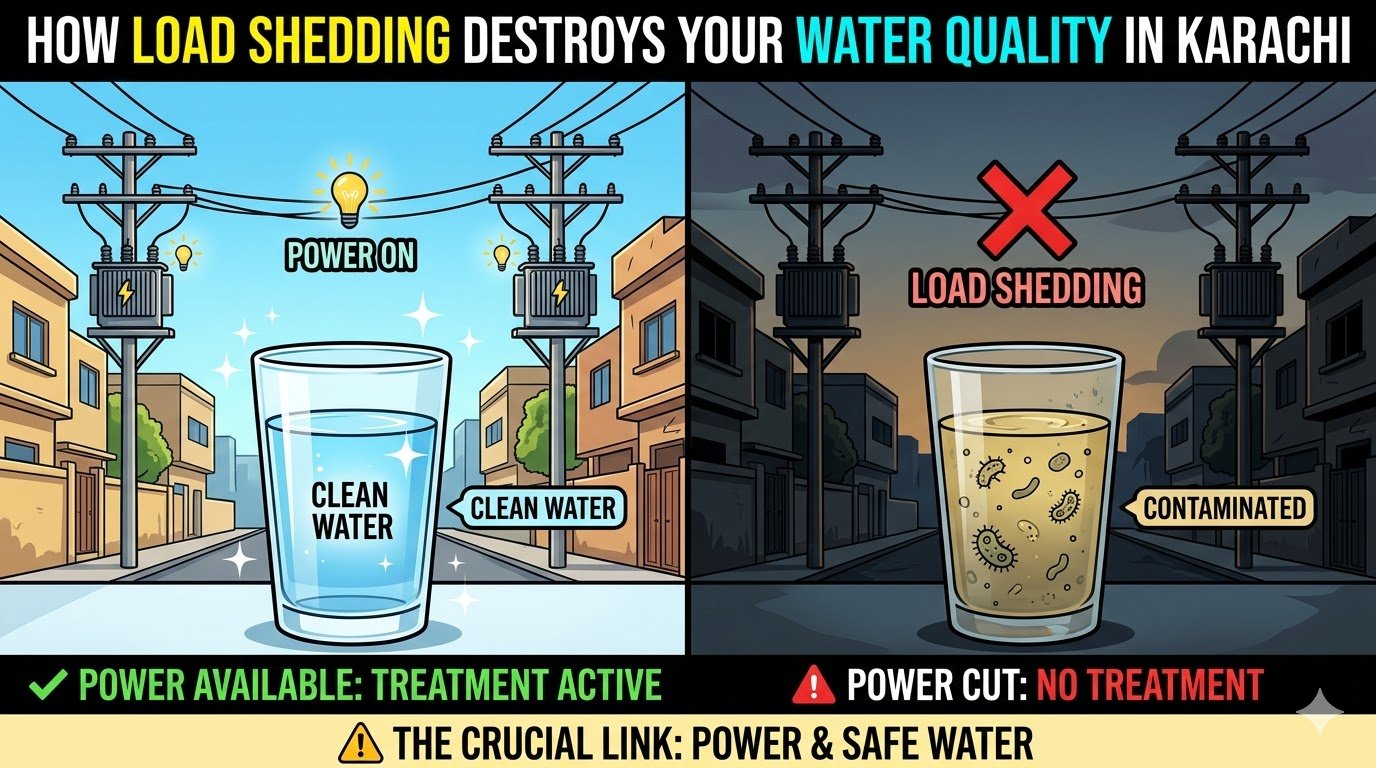
    In Karachi, electricity and water fail together. The city’s supply depends on pumps at every stage, from the bulk stations outside the city to the motor in your own house. When the power goes, the water stops moving, and the way it stops and restarts is what damages its quality.

    This guide explains the link between load shedding and water contamination in Karachi at both ends of the system, using incidents from 2026, and sets out what you can do at home.

    In brief

    • Power failures at Dhabeji and Pipri depressurise the mains. Leaking pipes then draw in dirty groundwater.
    • The first water after supply returns is the dirtiest, and it goes straight into your underground tank.
    • Power cuts at home cause stagnation and stir up sludge when the motor restarts.
    • Backup power helps with your own pump. It does nothing about the mains.
    • Waste the first flow where you can, avoid suction pumps, and keep to a cleaning schedule.

    Two kinds of power cut, two kinds of problem

    Where the power failsWhat happens to the waterWhat you see at home
    Bulk pumping stations such as Dhabeji and PipriPumps trip, pressure collapses across large parts of the network, big lines can burst from the surgeNo supply for hours or days, then dirty first flow
    Your own buildingThe motor cannot lift water to the roof; the underground tank overfills or the roof tank runs dryStagnant water below, empty tank above, sediment stirred when the motor restarts

    Power failures at the pumping stations

    Dhabeji lifts most of Karachi’s water. It is a single point of failure, and 2026 has shown how often it fails:

    • Late April: during an already serious shortage, a power breakdown burst three 72-inch lines, adding a 140 MGD shortfall, according to Dawn. Korangi, Malir, Saddar, DHA and Clifton were among the worst-hit areas.
    • 31 May: a transformer fault at the Dhabeji grid station forced 10 of 21 pumping units to shut down. Dawn noted that shortages had been running since late March because of leaks, burst lines, power outages and technical faults.
    • September: a 17-hour outage at Dhabeji cost the city about 198 million gallons, and days later a K-Electric breakdown completely suspended power to the Pipri pumping station.

    Each of these events does two things. It cuts the quantity of water, which everyone notices. It also depressurises the network, which is the part that affects quality.

    A short record of recent failures

    DateWhat failedReported effect
    29 November 202484-inch main on University Road burst during BRT Red Line work150 MGD shortage; supply disrupted for about three weeks
    Late April 2026Line No. 5 replacement near Dhabeji, then a power breakdown that burst three 72-inch linesShortfalls of 250 MGD and then 140 MGD; crisis ran into a second week
    31 May 2026Transformer fault at Dhabeji grid station10 of 21 pumping units shut down
    September 202617-hour power outage at Dhabeji; K-Electric breakdown at PipriAbout 198 million gallons lost; several areas without supply

    This is not a complete list. It is enough to show that a major depressurisation of the network now happens several times a year, and each one sends a round of dirty water into household tanks.

    What low pressure does inside the pipes

    A water main under pressure pushes water out through any leak. A main with no pressure does the opposite: water from the surrounding ground can be drawn in through the same gaps. Karachi’s network leaks heavily. A World Bank project document puts losses at around 55 to 60 percent, and in much of the city water lines and sewers share the same trenches. Every outage is a period when the pipes are open to whatever surrounds them.

    When pumping resumes, the first water through pushes that contamination, plus rust and biofilm shaken loose from the pipe walls, down the line and into household tanks. This is the brown water that arrives after a long gap. The whole route is described in our guide to KWSB water supply.

    Suction pumps make it worse

    Because supply is short and weak, many households fit a suction motor directly on the incoming line. It pulls more water into that house, and it lowers the pressure in the street main for everyone else. Lower pressure means more inward leakage. If your neighbours all run suction pumps during the supply hour, the water arriving in your tank is more likely to have picked up contamination on the way. Where it is possible, let the line fill the underground tank by its own pressure and pump only from the tank.

    Power cuts inside your own building

    1. Stagnation. With the motor off, water sits in the underground tank and nothing moves on the roof. In summer that water is warm, and warm standing water is where bacteria multiply, as explained in heat and bacteria in water tanks.
    2. Dry roof tank. When the upper tank empties, the sludge on its floor is the last thing drawn into your pipes.
    3. Restart surge. When power returns, water drops into an almost empty tank from the inlet and churns up whatever has settled.
    4. Missed supply turn. If the outage coincides with your area’s supply hours and you rely on a pump, you may get no water, and call a tanker of unknown quality.
    5. Lost chlorine. The longer water waits, the less disinfectant remains. The WHO guidelines look for a free chlorine residual of at least 0.2 mg/L at delivery; stored water in Karachi rarely holds it.

    Does a generator or UPS solve it?

    It solves the second kind of problem, not the first. Backup power keeps your motor running and your roof tank full, which reduces stagnation and dry-tank episodes. It cannot do anything about what happens in the mains when a pumping station trips. For that, the defences are at the tank: let the dirty first flow go, keep storage clean, and treat drinking water.

    Apartment buildings and offices

    Larger buildings usually have generators, so their own pumps keep running. That protects against stagnation, but it also means the building draws hard on the main the moment supply returns, pulling the dirtiest first flow straight into a shared underground tank. For unions and facility managers the practical steps are to delay pumping for the first few minutes after a long outage where the system allows it, to inspect the underground tank after every citywide supply crisis, and to keep to a three-month cleaning cycle. Responsibility is covered in who looks after an apartment building’s tank and, for managed properties, in our guide for property managers. Load shedding and water contamination in Karachi is a building management issue as much as a household one.

    A homeowner’s checklist

    1. After a long outage or line repair, waste the first flow. Open the inlet to a drain or the garden for the first few minutes if your plumbing allows, before it reaches the underground tank.
    2. Do not run the roof tank dry. Switch the motor on before the level reaches the bottom, so the sludge layer is never the water you are using.
    3. Fit a float valve on both tanks so they fill gently and do not overflow.
    4. Avoid a suction pump on the line if your area’s pressure allows it.
    5. Keep lids sealed and vents meshed.
    6. Boil or filter drinking water at all times, and be stricter in the days after a major outage. A filter and a clean tank do different jobs, as set out in water filter versus tank cleaning.
    7. Clean the tanks on a schedule, and bring the cleaning forward after a major supply crisis. See how often to clean a tank in Karachi.

    When to clean after an outage

    • The water arrived brown or cloudy and has not cleared after a day or two of normal use
    • There is a new smell
    • You relied on tankers for a week or more
    • The outage was followed by illness in the house
    • It has been more than six months since the last cleaning anyway

    The signs are covered in detail in ten signs your water may be making you sick. The rainy season combines power cuts with flooding, which is why our monsoon water risk guide treats July and August separately.

    Areas that have been hit hardest

    The 2026 Dhabeji failures were felt most in Korangi, Malir, Landhi, Shah Faisal Colony, Saddar, DHA and Clifton, according to KWSC statements reported by Dawn. The 2024 University Road main failure cut supply to Gulistan-e-Jauhar, Gulshan-e-Iqbal, Bahadurabad, Garden, Lyari and Saddar for about three weeks. If you live in one of these areas, assume your underground tank has taken in several rounds of dirty first flow. Local conditions are covered in our articles on water quality in DHA and water tanks in Gulshan and Jauhar, and commercial premises in the south in water safety in Defence, Clifton and PECHS.

    How we clean after a supply crisis

    The job is the same eight-step procedure we use every day, with extra attention to the underground tank floor, where the sediment from dirty first flow collects. We jet wash at 3,000+ PSI, vacuum the sludge out, disinfect, rinse and leave a dated report with photographs. Rooftop tanks take two to four hours and underground RCC tanks four to eight.

    Call the branch for your side of the city: DHA, Clifton and South Karachi on 0333 0293174, or Gulshan, Jauhar and East Karachi on 0340 2717530. Standard homes can get a price online first.

    Frequently asked questions

    Why is the water dirty when it comes back after load shedding?

    When pumps stop, the mains lose pressure, sediment and biofilm inside them are disturbed, and dirty water can enter through leaks. The first flow after restart carries all of that to your tank.

    Does load shedding at my house contaminate the water?

    Not directly. It causes stagnation and can leave the roof tank empty, so that sludge is drawn into the pipes and stirred up on refill. A clean tank and a float valve reduce the effect.

    Should I clean my tank after every power breakdown?

    No. Clean on schedule, and bring it forward only after a major outage that brought visibly dirty water or forced you onto tankers for a long period.

    Is tanker water safe during a shortage?

    You cannot know. Ask where it was filled, treat everything you drink, and clean the tank more often if tankers are your main source.

    Why does my filter clog after every outage?

    Because the first flow after a restart is loaded with rust and silt from the mains. It settles in the underground tank and is then pumped through the house.

    Is it worth fitting a valve to divert the first flow?

    If your plumbing allows it, a simple bypass that sends the first few minutes to a drain or the garden keeps a good deal of sediment out of the tank. Ask a plumber whether it is practical on your connection.

    Sources

    Figures in this article were checked in October 2026 against the following:

    About Khan Tank Cleaning

    Khan Tank Cleaning is a Karachi company that does one thing: clean and disinfect water storage tanks. It was started in 2005 by Mateen Khan and now runs branches in DHA Phase 2 and Gulshan-e-Iqbal. Read our background or reach the nearest branch on 0333 0293174 (DHA) or 0340 2717530 (Gulshan), day or night.

  • Water Safety in Defence, Clifton and PECHS: How Commercial Water Storage Affects You

    Water Safety in Defence, Clifton and PECHS: How Commercial Water Storage Affects You

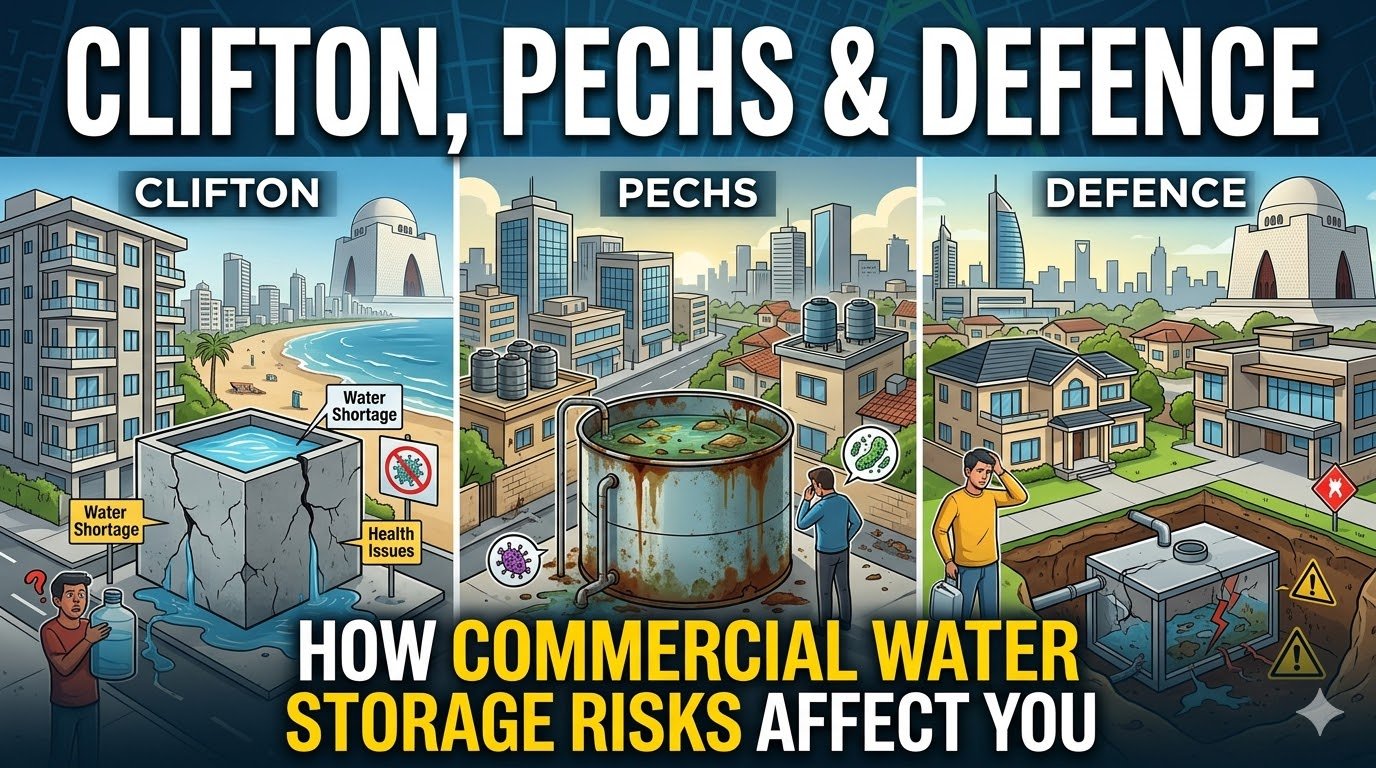
    Defence, Clifton and PECHS are where much of Karachi eats out, sees a doctor, goes to school and works. Every one of those restaurants, clinics, schools and offices runs on water stored in a tank on the premises, and the people using it have no way of knowing when that tank was last cleaned.

    This article looks at water safety in Defence, Karachi and its neighbouring commercial districts from both sides: what you are exposed to as a customer or resident, and what you are responsible for as an owner or manager.

    In brief

    • Piped supply to the south of the city is thin, so businesses here store large volumes from mixed sources.
    • You meet commercial tank water through food, ice, showers, wash basins and ablution areas.
    • Owners and managers carry the duty of care, and food and health premises are inspected.
    • A three-month cleaning cycle with a dated report is the practical standard for premises serving the public.
    • Near the sea, check tank covers often. Salt air corrodes them quickly.

    Why this part of the city depends so heavily on storage

    Piped supply to the south of the city is thin. Dawn reported in July 2025 that DHA was receiving only 4 to 5 million gallons a day, and KWSC named DHA and Clifton among the worst-hit areas during the supply crisis of April and May 2026. Businesses cannot close when the line is dry, so they buy tanker water, run boreholes and build large tanks. The local supply picture is covered in water quality in DHA.

    The result is that commercial premises here store more water, from more varied sources, for longer than the same business would in a city with continuous supply.

    Where you meet commercial tank water

    PremisesHow their tank water reaches youMain concern
    Restaurants, cafes, bakeries, caterersWashing produce and dishes, ice, cooking, hand washingFood-borne and waterborne infection
    Clinics, dental surgeries, laboratoriesHand washing, instrument rinsing, patient useInfection in people who are already unwell
    Schools, nurseries, tuition centresDrinking coolers, wash basins, canteensChildren are the most vulnerable group
    Gyms, salons, spasShowers, basins, foot bathsSkin and eye infections; aerosols from showers
    Offices and shopsKitchenettes, washrooms, ablution areasStaff illness
    MosquesAblution, where water enters the noseThe route by which Naegleria infects
    Apartment blocks above shopsOne shared tank for homes and businessesA fault affects everyone at once

    The point about mosques is specific. Naegleria fowleri infects through the nose, and in a case reported by Dawn in June 2025 the health department traced a patient’s only exposure to ordinary water use at home and ablution at a local mosque.

    The three areas, briefly

    Clifton

    Clifton mixes older apartment blocks and bungalows with dense commercial strips around Boat Basin, Zamzama and the Schon Circle area. Many buildings have large underground RCC cisterns that predate the current tenants. Sea air is hard on metal: lids, hinges and inspection covers corrode faster here, in Gizri and along Seaview, and a rusted cover is an open tank.

    Defence (DHA)

    The commercial areas of DHA, such as Khadda Market, Bukhari and Badar Commercial, are full of restaurants, clinics and offices built over small plots with basement or rooftop tanks. Residential streets have large bungalows with several tanks each. Tanker and borehole water are routine, so sand and mineral scale build up quickly.

    PECHS

    PECHS is older and denser, with bungalows converted into schools, clinics, offices and eateries along its main roads. Tanks designed for one household now serve a business with ten times the daily use. Records of cleaning often do not exist, because the property has changed hands or use several times.

    What goes wrong in a busy commercial tank

    • High turnover hides problems. Water moves through quickly, so it looks clear, while sludge and biofilm keep accumulating underneath.
    • Mixed sources. Piped, tanker and borehole water in the same tank leave sand, scale and whatever each source carried.
    • Nobody owns the job. The tenant assumes the landlord cleans the tank; the landlord assumes the tenant does.
    • Warm, stagnant corners. The UK Health and Safety Executive notes that legionella multiplies between 20 and 45°C, particularly in stagnant water, and recommends that tanks have lids and insect screens and are cleaned periodically. Showers and spray taps turn that water into droplets people breathe in.
    • Open or damaged covers. Mosquitoes, dust and vermin get in. The WHO’s dengue advice is to keep water storage covered and cleaned.

    The contaminants and the illnesses they cause are described in waterborne disease in Karachi.

    Mixed-use buildings: the hardest case

    Much of Clifton, PECHS and the commercial strips of DHA consists of buildings with shops or restaurants at street level, offices or clinics above, and flats on top, all drawing from one underground tank. Three things go wrong in these buildings. Usage is heavy and uneven, so sludge is constantly disturbed. Each occupier assumes another is responsible. And access to the tank is often through one tenant’s premises, so nobody else ever sees it.

    The fix is administrative, not technical. The owner or the building’s management should hold the cleaning schedule, recover the cost through the service charge, give every occupier a copy of the report, and make sure the tank room is not being used as a store. If you are a tenant in such a building, ask to see the last report before you sign or renew.

    If you own or manage premises here

    You carry a duty of care to everyone who uses your water, and in several sectors a regulator checks.

    A practical routine for commercial premises

    1. Clean every tank every three months, and after any flooding, sewage incident or long supply crisis.
    2. Keep the dated service report and photographs on file. It is the first thing an inspector, auditor or insurer will ask for.
    3. Put one named person in charge of the schedule.
    4. Check lids, mesh and the area around the underground hatch every month.
    5. Use only a contractor who can issue a proper tax invoice. Paying an unregistered provider has tax consequences for a business, explained in why SRB and FBR registration matters.
    6. Do not let staff enter an underground tank. Closed tanks kill, and the law on confined spaces in factories reflects that.

    Water safety in Defence, Karachi for residents and customers

    • At home in a flat: ask the union for the date of the last tank cleaning and whether a report exists. This article explains who is responsible.
    • At your child’s school: ask how drinking water is treated and how often tanks are cleaned.
    • Eating out: you cannot inspect a kitchen, but ice and uncooked items carry the most water risk.
    • At the gym or salon: a musty smell from showers or basins is a reason to raise it with the manager.
    • At home in a house: your own tanks are the part you control. Clean them every four to six months, as set out in how often to clean a water tank in Karachi.

    How we work with commercial premises

    Commercial and shared-building jobs start with a free survey, because access, tank count and working hours differ on every site. The cleaning itself follows our eight-step procedure: drainage, ventilation and gas check, jet washing at 3,000+ PSI, vacuum extraction, disinfection, rinse and inspection. We can work at night or on closed days so trading is not interrupted, and multi-tank buildings can be cleaned one tank at a time so the whole site is not left dry.

    Every job ends with a dated report, photographs taken inside the tank, a recommended next-service date and a numbered SRB/FBR tax invoice. Organisations we clean for are listed on our clients page.

    Defence and Clifton are covered by our DHA Phase 2 office, the base for tank cleaning in DHA and Clifton. PECHS is covered from Gulshan-e-Iqbal by the team that handles Gulshan, Jauhar and East Karachi. Households can get a price online.

    Frequently asked questions

    How often should a restaurant or clinic clean its water tank?

    Every three months is a sensible standard for premises serving the public, with an extra cleaning after flooding, a sewage problem or a long supply outage.

    Who is responsible for the tank in a rented shop or office?

    Whoever the tenancy agreement says. If it says nothing, agree it in writing now. In practice the party who controls access to the tank should hold the cleaning schedule.

    Can cleaning be done outside business hours?

    Yes. Both our branches work around the clock, including Sundays and public holidays.

    Will we get a document we can show an inspector?

    Yes: a dated service report with photographs and a tax invoice.

    Is water safety in Defence worse than in other parts of Karachi?

    The underlying supply is the same citywide. What differs is the heavy reliance on tankers and boreholes, the number of commercial premises, and coastal corrosion of tank covers.

    Our restaurant uses only bottled water for drinking. Is the tank still an issue?

    Yes. Produce washing, ice, dish rinsing and staff hand washing all use tank water.

    How quickly do tank covers corrode near the sea?

    It varies with the material and exposure, but steel lids and hinges in Clifton, Gizri and Seaview deteriorate noticeably faster than inland. Inspect them monthly and consider non-metal covers.

    Sources

    Figures in this article were checked in October 2026 against the following:

    About Khan Tank Cleaning

    Khan Tank Cleaning is a Karachi company that does one thing: clean and disinfect water storage tanks. It was started in 2005 by Mateen Khan and now runs branches in DHA Phase 2 and Gulshan-e-Iqbal. Read our background or reach the nearest branch on 0333 0293174 (DHA) or 0340 2717530 (Gulshan), day or night.

  • Heat and Bacteria in Your Water Tank: Why Karachi’s Summer Speeds Up Growth

    Heat and Bacteria in Your Water Tank: Why Karachi’s Summer Speeds Up Growth

    Touch the side of a rooftop tank at three in the afternoon in May and you already understand the problem. The water inside is warm, it has been sitting since the last supply turn, and whatever chlorine it arrived with has gone. Heat, bacteria and a water tank in Karachi are a predictable combination.

    This article explains the science in plain terms, corrects a few exaggerated claims that circulate online, and sets out what a household can do about it.

    In brief

    • Bacteria of concern multiply fastest between about 20 and 45°C. Karachi tank water is in that range for most of the year.
    • Heat sets the speed of growth. Sludge and biofilm supply the food. Removing the food is what you control.
    • Warm water loses its chlorine faster, so stored water has little protection.
    • Shade, a tight lid and a sensibly sized tank all help.
    • Clean before the hot season, not during a crisis in the middle of it.

    What temperature does to bacteria in water

    Most of the bacteria that matter for health grow fastest at around body temperature. Below about 20°C they multiply slowly. Above it, growth speeds up steadily until the high forties. The best-documented example is Legionella: the UK Health and Safety Executive states that it multiplies where temperatures are between 20 and 45°C and nutrients are available, and for that reason advises that cold water be stored and distributed below 20°C.

    Now compare that with Karachi. Average daily highs are around 35°C in May and June, and summer nights stay in the high twenties. For about seven months of the year even the night-time air stays above 20°C, so a rooftop tank never cools below that, and a dark plastic tank in direct sun runs well above the air temperature. By the HSE’s benchmark, Karachi tank water sits in the growth range most of the year.

    A word on “doubling every ten minutes”

    You may have read that bacteria in a hot tank double every ten or twenty minutes. Those figures come from laboratory cultures fed with rich nutrients. In stored water, growth is limited by how much food is available. That is not reassuring news for a dirty tank, though, because sludge and biofilm are the food. The practical lesson is that temperature sets the speed and dirt supplies the fuel. You cannot do much about the first. You can remove the second.

    Karachi’s year, month by month

    These are approximate long-term averages for the city. The last column is our reading of what they mean for a rooftop tank.

    MonthsAverage daily highAverage night lowWhat it means for stored water
    December to FebruaryAbout 28°C13 to 14°CSlowest growth of the year; a good time for the second routine cleaning
    March and April32 to 35°C19 to 23°CTank water moves into the growth range and stays there
    May and JuneAbout 35°C27 to 28°CPeak risk: warm day and night, long storage, heavy demand
    July to September32 to 33°C26 to 28°CStill warm, with added contamination from rain and flooding
    October and November33 to 35°C17 to 22°CA second hot spell by day; nights begin to cool

    The point of the table is the night-time column. Bacteria do not need extreme heat. They need warmth that never lets up, and from April to October Karachi provides it.

    Four ways heat makes stored water worse

    1. Faster growth. Warm water shortens the time bacteria need to multiply, as long as nutrients are present.
    2. Chlorine disappears sooner. The disinfectant added at the filter plant breaks down faster in warm water. The WHO guidelines look for at least 0.2 mg/L of free chlorine at the point of delivery; water stored warm for days has usually lost it.
    3. Biofilm thickens. The slippery layer on tank walls grows faster in warmth and protects the organisms inside it.
    4. Algae bloom. Heat with even a little light produces green growth, which then dies and feeds bacteria.

    The organisms that like warm water

    OrganismWhy warmth mattersHow it reaches people
    LegionellaMultiplies between 20 and 45°C in stagnant water with sludge, scale or biofilmBreathing in fine droplets from showers and taps
    Naegleria fowleriThrives in warm, untreated fresh waterWater entering the nose during bathing or ablution
    E. coli and other gut bacteriaSurvive and can regrow in warm, nutrient-rich sedimentDrinking, food preparation, hands
    PseudomonasGrows readily in biofilm in warm plumbingSkin, eyes and ears during bathing

    Naegleria deserves a special mention because it has killed people in Karachi most years since the first recorded cases in 2012. The US CDC notes that it thrives in warm fresh water and has been found in tap water, and that infection occurs through the nose, not by drinking. Dawn’s report on a June 2025 death quoted the standard public health position: the organism cannot survive in water that is clean, cool and adequately chlorinated. After five deaths in Sindh that year, the health department told residents to clean their tanks before summer and keep water chlorinated.

    Which tanks get hottest

    TankHeat exposureNotes
    Dark or thin-walled plastic tank on an open roofHighestAbsorbs sun all day; lids warp and stop sealing
    Light-coloured, multi-layer plastic or fibre tankHighInsulating layers help; still warm by afternoon
    Rooftop RCC or brick tankModerateThick walls slow heating but hold warmth overnight
    Underground RCC tankLowestCooler and more stable, but collects more sludge and is exposed to seepage

    Exposed pipes on the roof and outside walls heat up too, which is why the first water out of a tap on a summer afternoon can be hot to the touch.

    Why Karachi’s supply pattern makes it worse

    Heat would matter less if water moved through the tank quickly. It does not. A World Bank document describes supply in Karachi as ranging from two hours every two days to four hours a day, so households store several days’ worth. Long outages stretch that further, a link we explore in load shedding and water contamination. And the water often arrives already carrying bacteria and sediment, as our KWSB water supply guide explains. Warm, stagnant, already seeded and sitting on a layer of sludge: that is the situation in an uncleaned tank by June.

    Heat, bacteria and your water tank in Karachi: reducing the heat

    • Shade the tank. A simple roofed frame or shade net over a rooftop tank lowers its temperature noticeably.
    • Choose light colours and insulated walls when replacing a tank. Avoid thin, translucent ones that let light through.
    • Keep the lid tight to block light, dust and insects.
    • Size the tank to the household. A tank far bigger than you need means older, warmer water. Aim for turnover every few days.
    • Insulate or shade exposed pipes where practical.
    • Run a tap for a minute after returning from a trip, to flush water that has been standing in hot pipes.
    • Avoid getting water up the nose from tank-fed taps in summer, particularly for children.

    What you can do about the fuel

    Removing sludge and biofilm takes away what bacteria feed on, and it is the step that makes the biggest difference. Clean before the hot season, and again after the monsoon if the tank was exposed. For most houses that means every four to six months; details are in how often to clean a water tank in Karachi, and the rainy season is covered in our monsoon risk guide.

    A proper cleaning has to strip the biofilm physically. That is the purpose of jet washing at 3,000+ PSI in our cleaning procedure, followed by vacuum extraction of the sludge and disinfection with silver-stabilised hydrogen peroxide, which we describe in this article on how the disinfectant works. Dropping chlorine tablets into a dirty tank is not a substitute, because dirt consumes chlorine before it can disinfect.

    The symptoms to watch in summer

    Repeated stomach upsets, a musty smell, green-tinged water and fast-clogging filters are the usual warnings. The full list is in ten signs your water may be making you sick, and the infections involved are described in waterborne disease in Karachi.

    Booking a pre-summer clean

    April and May are the sensible months. Our branches cover Gulshan-e-Iqbal, Gulistan-e-Jauhar and East Karachi and DHA, Clifton and South Karachi, and the price calculator gives a fixed quote for a standard home.

    Frequently asked questions

    Does hot water in the tank kill bacteria?

    No. Tank water in summer is warm, not hot enough to disinfect. Temperatures of 30 to 45°C encourage growth. Hot water systems are kept at 60°C or above for that reason.

    Is an underground tank safer than a rooftop one in summer?

    It stays cooler, which helps. It also gathers more sludge and is more exposed to seepage, and in most houses its water is pumped to the rooftop tank anyway. Both need cleaning.

    Should I add chlorine to my tank in summer?

    Chlorine tablets used as directed are a reasonable extra precaution, and the health department recommends chlorination. They work properly only in a tank that is already clean.

    Do I need to clean more often in summer?

    Plan the main cleaning just before the hot months. Shared, tanker-fed and unshaded rooftop tanks benefit from a three-month cycle through summer.

    Does painting the tank white help?

    A light, reflective surface absorbs less heat than a dark one, so it helps a little. Shade helps more.

    Is warm tank water dangerous to bathe in?

    Warm water itself is not the problem. The concern is what grows in warm, dirty, unchlorinated water, and that it should not be forced up the nose. Keep the tank clean and take particular care with children.

    Sources

    Figures in this article were checked in October 2026 against the following:

    About Khan Tank Cleaning

    Written by the team at Khan Tank Cleaning, which has worked on Karachi’s water tanks since 2005 under founder Mateen Khan. Some of the organisations we clean for are listed on our clients page. To talk to a branch, use the contact page or call 0333 0293174 (DHA Phase 2) or 0340 2717530 (Gulshan-e-Iqbal).