
Our procedure
How we clean a water tank
The procedure we have refined since 2004 — every step, the equipment, the chemicals and the safety rules behind it. Each step comes with a simple check, so you can hold any tank cleaner to it, not only us.
What a proper clean actually means
Most people picture tank cleaning as removing the dirt they can see: silt on the floor and whatever fell in through a gap in the lid. That is the easy half, and it is often the only half that gets done.
The half that matters is the slimy layer on the walls. Bacteria settle on the inside surfaces and build a film that protects them. Pouring chemical into a full tank kills what is floating in the water but leaves most of that film in place, where it keeps contaminating every new fill. That is why a tank can be “cleaned” in the morning and smell again within a week.
So the order matters: empty the tank, get the sludge out of the building, wash and scrub the walls, and only then disinfect. Disinfecting a dirty wall wastes most of the chemical. Disinfecting a clean wall is what keeps the water safe.
Where the sludge goes matters just as much. The shortcut is to open the outlet and let the loosened sediment run down the supply line. The tank looks empty and the job looks finished, but the dirt has moved into your pipes, pump, geyser and filters. It has to be pumped out and carried away.
The procedure
The water tank cleaning process, step by step
Every tank goes through all eight. The check line is what you can verify yourself without taking anyone’s word for it.
Price or survey
For a house, you get the price from our rate list or on the phone, based on plot size or tank gallons. Flats, apartment buildings, offices and factories get a free survey: we look at the tank, the access and the amount of sludge, then give a written price.
Survey: free, about 20 minutes
How to check: get the price before any work starts. If a cleaner will not give a number until the tank is open, the number is going to move.
Drain the tank
The pump motor is switched off, then a sludge pump empties the tank. The dirty water is sent away from the property, never back down your outlet into the supply line.
20–40 minutes, depending on size
How to check: watch where the water goes. If it disappears down your own outlet pipe, the dirt in it has just gone into your plumbing.
Ventilate before anyone goes in
Underground and closed tanks are aired out before entry, and a second worker stays at the opening the whole time someone is inside. On large commercial and industrial tanks, the air is tested and the worker inside wears a harness attached to a tripod at the hatch.
15–30 minutes, never skipped
How to check: if someone climbs into an underground tank straight away, with nobody waiting at the opening, stop the job. See why.
Remove the sludge
Mud, sand, rust flakes and sediment are scooped and pumped out of the floor and corners, bagged and carried off the property. Corners get extra attention because sediment collects where it is hardest to reach.
30–90 minutes
How to check: ask to see what came out. A tank that has gone a year or more without cleaning produces a visible amount of sludge. If nothing was collected, nothing was removed.
Wash and scrub the walls
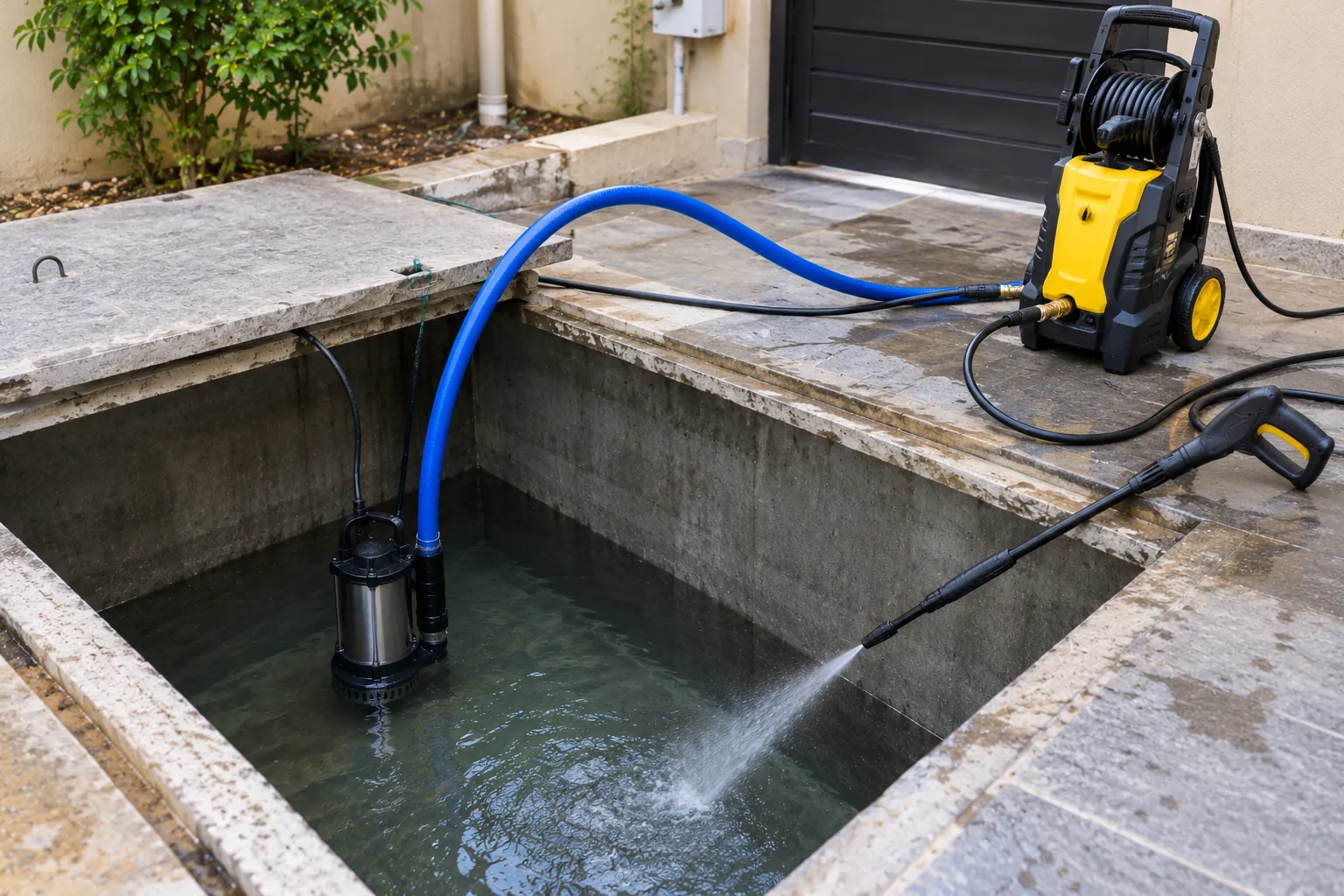
Walls, floor and roof of the tank are washed with a high-pressure washer and scrubbed with brushes to take the slime layer off. Concrete tanks take full pressure. Fiber and plastic tanks get low pressure and soft pads, because a scratched surface collects dirt faster.
45 minutes to 2 hours
How to check: afterwards, the wall should feel clean, not slippery.
Chlorine disinfection
A chlorine solution is applied to every inside surface and left to work before rinsing. Leaving it on long enough is the part that gets rushed: a disinfectant sprayed on and washed straight off has not done its job. More on the chemicals.
Applied in about 15 minutes, then left to work
How to check: ask what the chemical is and see the container. A cleaner should always be able to tell you what is going into your drinking water.
Rinse and check the lid
The tank is rinsed with fresh water until it runs clear. While it is empty we look at the walls and joints for cracks, and check the lid, hinge and cover. A lid that no longer closes properly is the most common reason a freshly cleaned tank gets dirty again within weeks.
20–40 minutes
How to check: close the lid yourself. It should sit flat with no gaps.
You check, then pay
Before we pack up, you look inside the tank. Payment is taken only after that, by cash, bank transfer, JazzCash or EasyPaisa. Buildings and companies receive a tax invoice, and industrial clients can get service documentation for their auditors or health inspectors. If something is not right, see our guarantee.
On the day
How to check: use a torch from the hatch, without climbing in. The floor should be bare and the walls clean.
Equipment
Water tank cleaning equipment
A 400-gallon rooftop tank and a 400,000-gallon factory tank are not the same job. The crew and equipment are matched to the tank, and to the client’s own rules where they have them.
Every job
- Sludge pump
- High-pressure washer
- Brushes, scrubbers and soft pads for fiber tanks
- Ventilation for underground tanks
- Boots, gloves and masks for the crew
- Chlorine disinfectant
Added for large and industrial tanks
- Industrial vacuum for heavy sludge
- Ventilation blower for deep or large tanks
- Gas detector to test the air before entry
- Safety harness and tripod at the hatch
- Site lighting
- Larger crew and the client’s own safety requirements
Chemicals
Water tank cleaning chemicals: what goes into your tank
You are entitled to know exactly what goes into water your family drinks. Here is what we use, and why.
Chlorine disinfection
We disinfect with chlorine: calcium hypochlorite (powder or granules) or sodium hypochlorite (liquid). These are the same disinfectants used to treat city drinking water around the world, and they kill bacteria and other germs left on the tank walls after scrubbing.
Your approved product, if you have one
Some factories, hospitals and food companies require a disinfectant from their own approved list. In that case we use the product you specify and follow your site’s procedure for it.
Rinsed before refilling
After the chlorine has had time to work, the tank is rinsed with fresh water before it goes back into use. A faint chlorine smell in the first fill can happen and fades quickly.
Never mixed with other cleaners
Chlorine must never be mixed with acids or ammonia-based cleaners, because together they give off a toxic gas. In a closed tank that is dangerous for the crew. We use chlorine on its own, from labelled containers.
Applied after scrubbing
Chlorine works on a clean surface. Poured into a dirty tank, most of it is used up by the sludge. That is why disinfection is step six, not step one.
Ask to see the container
Whoever cleans your tank should be able to tell you what the chemical is and show you the container. If they cannot, do not let it go into your water.
Safety
Underground tank safety: the step that gets people killed
An underground tank is a confined space, and the danger inside it is not dirt. Rotting sludge uses up oxygen and can give off harmful gases. The air in a closed concrete tank can become bad enough to make a person collapse within a minute or two, often with no warning smell.
Accidents in tanks and manholes follow the same pattern almost every time. One worker goes in and stops responding. A second goes in to pull him out, without equipment, and collapses too. The rescue attempt is what turns one death into two.
That is why the tank is ventilated before entry, why someone always stays at the opening and never goes in after a colleague, and why large tanks get air testing, a harness and a tripod. Our safety management is certified to ISO 45001, the international standard for health and safety at work.
We also keep your household safe while we work: the pump motor is switched off before draining, the open hatch is never left unattended, and children are kept away from the work area.
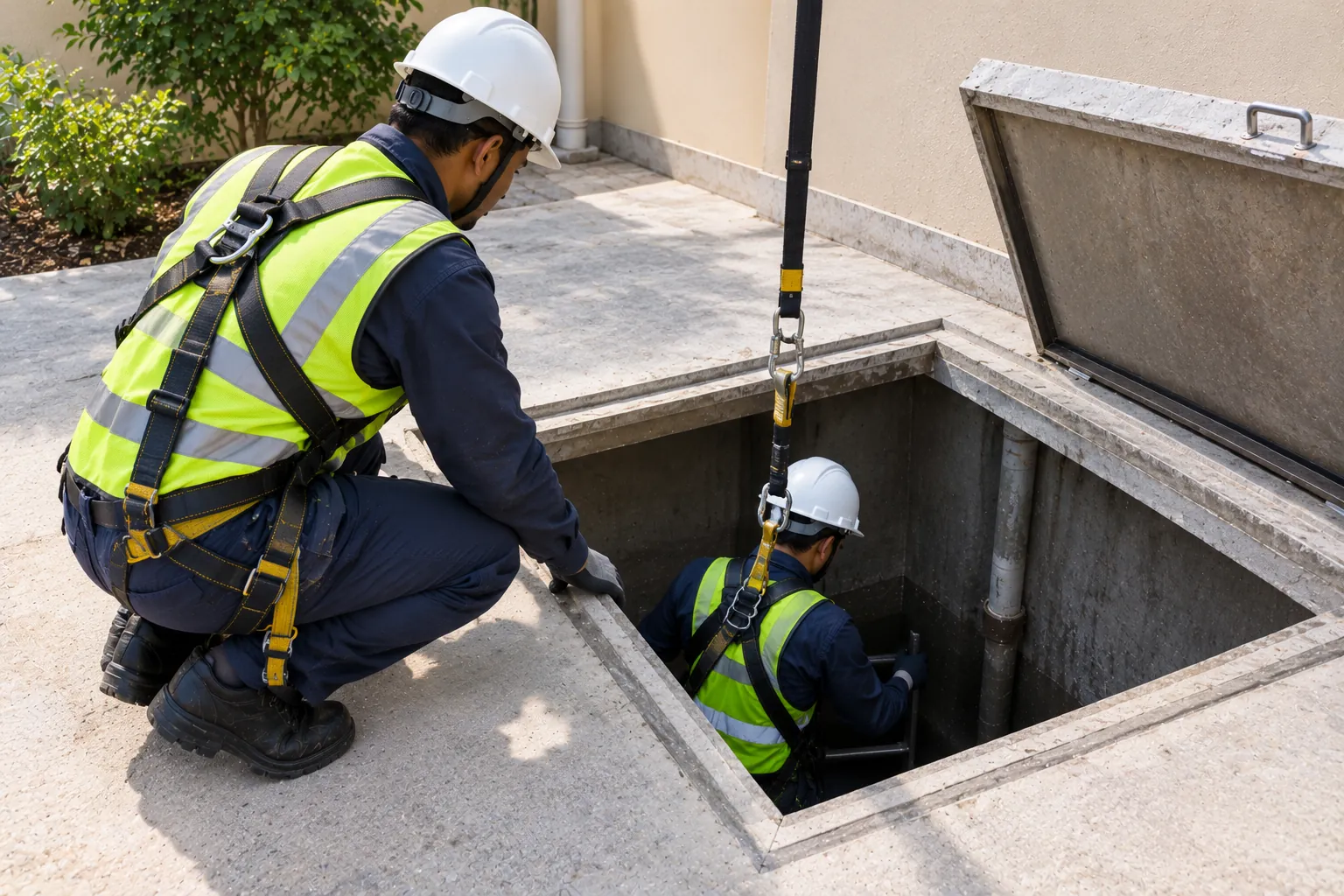
If you take one thing from this page: if you see anyone climb into an underground tank with no airflow and nobody waiting at the opening, stop the job, whoever’s crew it is. And if someone collapses inside, do not go in after them. Call 1122.
Hold us to it
Five questions for whoever cleans your tank
Ask any company, including us. One that does the work properly will be glad you asked.
Ask before they start
- What is the price, before you open the tank?
- Will you clean the underground tank too, and how do you go in safely?
- Which chemical will you use, and can I see it?
- Where will the sludge go?
- Can I check the tank before I pay?
Check after they finish
- Torch from the hatch: the floor should be bare
- The walls should not feel slippery
- A visible amount of sludge came out and left the property
- The lid closes flat with no gaps
- Nothing was flushed down your outlet pipe
Timing
How long it takes
Your water is off only while the tank is drained, cleaned and refilled, and we plan the visit around your supply timing.
| Tank | Typical time | Where the time goes |
|---|---|---|
| Overhead plastic or fiber | 2–4 hours | Washing, disinfection and rinse |
| Underground concrete | 4–8 hours | Ventilation, safe entry and sludge removal |
| Shared building tank | 4–8 hours | Planned around the building’s supply |
| Industrial or multi-tank site | After survey | Planned around your shutdown |
We would rather quote eight hours and take six than quote three and rush the disinfection.
Questions
About the process
Which chemical is used to clean a water tank?
We disinfect with chlorine: calcium hypochlorite or sodium hypochlorite. These are the same disinfectants used to treat city drinking water around the world. The tank is scrubbed first, the chlorine is left to work, and then the tank is rinsed with fresh water before refilling.
Is chlorine safe for a drinking water tank?
Yes, when it is used at the right strength and rinsed out. Chlorine is the most widely used drinking-water disinfectant. A faint chlorine smell in the first fill after cleaning can happen and fades quickly.
Can you use our company's approved chemical instead?
Yes. Some factories, hospitals and food companies require a disinfectant from their own approved list. We use the product you specify and follow your site’s safety rules.
Why is entering an underground tank dangerous?
A closed tank can hold too little oxygen or build up gases from rotting sludge, and a person can collapse within minutes without warning. The usual tragedy is a second person climbing in to help without equipment. That is why tanks are ventilated first and someone always stays at the opening.
Do you use the same equipment on every tank?
No. A house tank needs our routine kit: sludge pump, washer, brushes, ventilation and protective gear. Large commercial and industrial tanks get the full setup, including harness and tripod, gas testing and lighting, plus anything the client’s own safety rules require.
How long does tank cleaning take?
An overhead tank usually takes two to four hours and an underground tank four to eight. Shared building tanks are planned around the building’s supply timing, and industrial jobs get a timeline after the survey.
How do I know the job was done properly?
Look inside before you pay. The floor should be bare, the walls should not feel slimy, the sludge should have been carried away rather than flushed down your pipes, and the lid should close properly. We ask every customer to check before payment.
Have your tank done properly
Check the price online or call the nearest branch, day or night.