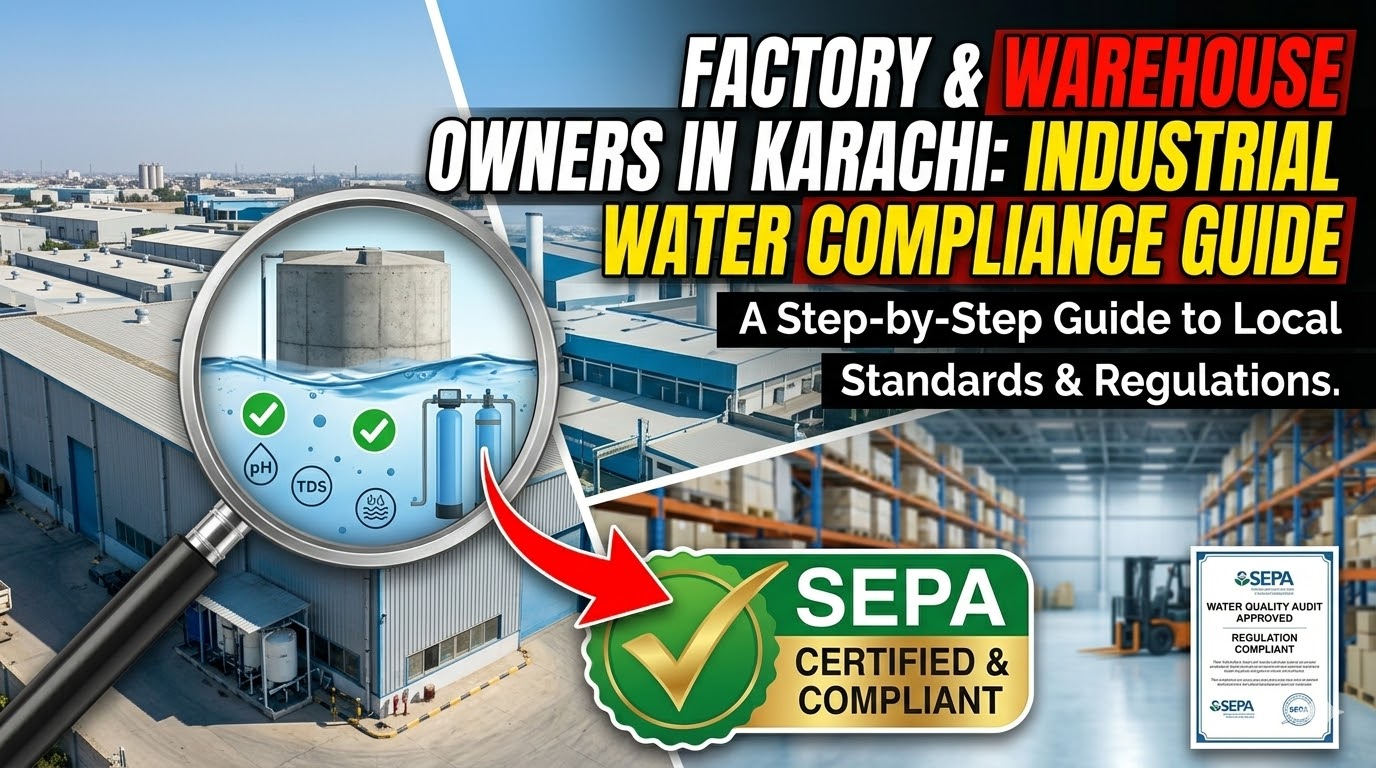
If you own or manage a factory, warehouse, or industrial facility anywhere in Karachi — from the export-processing zones of Korangi to the sprawling SITE area, from Port Qasim’s industrial corridors to the light-manufacturing clusters of Landhi — this guide is written specifically for you.
Industrial water compliance is not just about avoiding fines. In a city where water supply irregularities are a daily reality and the KWSB (Karachi Water & Sewerage Board) delivers water of variable quality, the water stored in your facility’s tanks is the final line of defence between your workers’ health and a contamination crisis. It is also, increasingly, a legal and contractual obligation that buyers, auditors, and export regulators actively scrutinise.
Yet the majority of factory and warehouse owners in Karachi still treat water tank cleaning as an afterthought — something done when the water starts smelling, or when a government inspector shows up unannounced. That approach is no longer acceptable. And, frankly, it is no longer safe.
This guide walks you through everything you need to know: the regulatory landscape, the specific health and operational risks in Karachi’s industrial zones, practical compliance steps, and how to choose the right professional service partner for your facility.
1. Why Industrial Water Quality Is Different — and Why the Stakes Are Higher
Volume and Complexity
A typical residential household in Karachi might store 500 to 1,500 litres of water. A mid-sized factory or warehouse, by contrast, may hold anywhere from 50,000 to 500,000 litres across multiple underground chambers, rooftop tanks, fire suppression reserves, and process-water holding tanks. The sheer volume means that contamination — once it takes hold — spreads rapidly and is far harder to address.
Multiple Points of Risk
Industrial water systems are complex. They include underground concrete chambers (often decades old), overhead plastic or steel tanks, pressure-boost pump stations, and distribution lines that run through production floors, staff canteens, washrooms, and emergency showers. Each junction is a potential contamination point. Biofilm can colonise pipework. Legionella bacteria thrive in stagnant water and warm holding tanks. Sediment accumulation accelerates corrosion and provides organic material for microbial growth.
Regulatory and Contractual Exposure
Pakistan’s industrial sector is governed by a patchwork of water-quality obligations. The Pakistan Environmental Protection Act (PEPA) 1997 and its provincial counterpart, the Sindh Environmental Protection Act (SEPA) 2014, impose duties on industrial operators to manage water quality within their premises. The Sindh Environmental Protection Agency (SEPA) issues Environmental Impact Assessments (EIAs) and Environmental Management Plans (EMPs) that typically include requirements for potable water quality for workers.
Beyond domestic regulation, if your facility is export-oriented or participates in international supply chains — textiles, food processing, pharmaceuticals, leather goods — your buyers’ Codes of Conduct almost certainly include worker welfare provisions that encompass access to clean drinking water. BSCI, SMETA, SA8000, and similar audit frameworks all audit water quality provisions. A failed audit over contaminated drinking water can cost you an export contract worth far more than any cleaning service.
2. The Karachi Factor: Why Local Conditions Create Heightened Risk
KWSB Water Quality and Intermittent Supply
Karachi’s municipal water supply is widely documented as intermittent and, in many areas, microbiologically compromised at the point of delivery. The KWSB supplies water once or twice a week in most industrial zones, forcing facilities to store large volumes for extended periods. Extended storage is one of the primary drivers of bacterial proliferation. Every additional day water sits in a tank without circulation or treatment is a day in which microbial populations can multiply.
Heat and Algae Growth
Karachi’s climate — with ambient temperatures regularly exceeding 40°C in summer — creates near-ideal conditions for algae growth and the proliferation of thermophilic bacteria. Rooftop tanks in direct sunlight can reach water temperatures of 50°C or above. Underground tanks, while cooler, are prone to accumulating sediment and organic matter washed in through poorly sealed access covers — a particular problem in industrial areas where dust, diesel particulates, and chemical residues are present in the atmosphere.
Groundwater Contamination in Industrial Zones
Several of Karachi’s key industrial zones — SITE (Sindh Industrial Trading Estate), Korangi Industrial Area, North Karachi Industrial Zone, and Landhi Industrial Estate — sit above groundwater tables that have been assessed as contaminated by decades of industrial discharge. Facilities that rely on borewell (boring) water as a supplementary supply are particularly exposed. Boring water tanks require specialised cleaning protocols due to the higher levels of dissolved minerals, heavy metals, and biological contamination compared to KWSB-supplied water.
Aging Infrastructure
Much of Karachi’s industrial stock dates from the 1960s through the 1980s. Underground concrete tanks in these facilities often have cracked linings, corroded iron fittings, and compromised access hatches. These structural issues allow surface water, rodents, and insects to enter the tank — all of which introduce biological and chemical contamination. Regular professional inspection is the only reliable way to identify these issues before they cause a health incident.
3. What Industrial Water Compliance Actually Requires
Minimum Cleaning Frequency
The World Health Organisation (WHO) recommends that water storage tanks be cleaned and inspected at least once every six months. For industrial facilities in high-risk environments — which describes most of Karachi’s industrial zones — quarterly cleaning is the more defensible standard, and what many international audit frameworks expect to see documented.
Documented Cleaning Records
This is where many Karachi factories fall short. Cleaning a tank is not sufficient — you must be able to demonstrate to an auditor, inspector, or insurance assessor that the tank was cleaned, when it was cleaned, by whom, using what methods and chemicals, and what the post-cleaning inspection found. A professional service provider should issue a service completion certificate with all of this information. If your current provider does not do this, that is a compliance gap.
Appropriate Cleaning Methods for Industrial Tanks
Industrial tanks — particularly large underground concrete chambers — cannot be adequately cleaned using the bucket-and-brush methods that informal “home-run” services in Karachi typically employ. Effective industrial tank cleaning requires:
- High-pressure jet washing (typically 2,000–3,000 PSI) to remove biofilm, algae, and encrusted deposits
- Industrial vacuum systems to extract sludge without leaving residue
- Confined space entry protocols with oxygen monitoring equipment — essential for underground tanks, which can accumulate toxic gases
- Food-grade disinfectants approved for potable water systems (such as Silver Hydrogen Peroxide or Sodium Hypochlorite at appropriate concentrations)
- Post-cleaning inspection and, where required, water quality testing
Worker Safety During Cleaning
Confined space entry into large underground industrial tanks carries genuine risks of asphyxiation, especially in tanks that have been sealed for extended periods. Any provider cleaning your industrial tanks must be able to demonstrate that their technicians are trained in confined space safety and are equipped with oxygen meters, harnesses, and communication equipment. This is not a box-ticking exercise — it is a life-safety requirement, and as the facility operator, you may bear legal liability if an untrained worker is injured on your premises during a cleaning operation.
4. The Industrial Compliance Checklist: What to Have in Place
| ✅ Industrial Water Compliance Quick-Reference Checklist Tank inventory documented (location, type, capacity, year of installation)Cleaning frequency schedule established (minimum every 6 months; quarterly recommended)Professional cleaning provider contracted with documented confined-space capabilityPost-cleaning certificates filed and accessible for auditWater quality testing conducted after each clean (bacteriological, at minimum)Tank access covers secured and in good repairBoring water tanks on separate treatment/inspection scheduleCleaning records included in your ISO 14001 / OHSAS 18001 / SA8000 documentation where applicableEmergency response plan in place for water contamination incidentsWorkers informed of water quality status and provided with potable water at all production stations |
5. Karachi’s Industrial Zones: Area-Specific Considerations
SITE Area, Baldia & North Karachi Industrial Zone
These are among Karachi’s oldest and most densely packed industrial zones. Facilities here frequently have legacy underground concrete tanks that have never been professionally inspected or lined. If your factory is in SITE or the North Karachi Industrial Zone, our professional water tank cleaning team serving Gulshan, Jauhar, and Central Karachi covers these areas as a priority service zone. We strongly recommend a structural inspection alongside your first professional clean to assess the condition of tank linings and access points.
Korangi Industrial Area & Landhi
Korangi is home to Karachi’s largest concentration of textile, leather, and export-processing factories. International buyer audits are frequent in this zone. If your facility is subject to BSCI, SMETA, or similar social compliance audits, water quality documentation is an active audit point. Our industrial water tank cleaning services for DHA, Clifton, and East Karachi cover Korangi and Landhi with priority scheduling for export-oriented facilities requiring documented compliance services.
Port Qasim Industrial Zone
Port Qasim presents unique challenges: large-scale industrial operations, extensive process-water usage, and — given the coastal location — elevated salinity in some groundwater sources. Facilities here typically have the largest tank capacities in the city, requiring industrial-grade equipment that smaller cleaning services cannot provide. Khan Tank Cleaning has the equipment and team size to handle very large commercial and industrial water storage systems. Contact our DHA & South Karachi branch for Port Qasim service scheduling.
Federal B Industrial Area (FBIA)
The Federal B Industrial Area sits in the heart of the city, surrounded by densely populated residential neighbourhoods. Facilities here are in close proximity to both KWSB mains and groundwater sources, and often supply water to on-site worker accommodation as well as production operations. This dual residential-industrial usage means that water quality standards must meet both industrial compliance requirements and domestic drinking water standards simultaneously. For facilities in FBIA and surrounding areas, our Gulshan-Jauhar service team provides rapid-response scheduling given the proximity to our main office in Gulshan-e-Iqbal.
6. The Hidden Costs of Non-Compliance
Factory and warehouse owners sometimes resist investing in professional water tank cleaning on cost grounds. This is a false economy. Consider the actual cost landscape:
- Worker sick days from waterborne illness (diarrhoea, typhoid, hepatitis A, skin infections) — each lost production day costs multiples of what a cleaning service costs
- Failed social compliance audit — potential loss of export contract or mandatory remediation period
- SEPA enforcement action — fines, production shutdowns, and reputational damage
- Damage to water-using production equipment from sediment and hard-water scaling — industrial boilers, cooling towers, and processing lines are all vulnerable
- Insurance liability if a worker suffers a waterborne illness and the facility cannot demonstrate a documented water management programme
- Litigation risk — increasingly, Karachi workers are asserting workplace health and safety rights
Against these costs, a professional industrial tank cleaning service — conducted quarterly, with full documentation — is not an expense. It is risk management.
7. Choosing the Right Service Provider for Industrial Facilities
Not all tank cleaning companies in Karachi are equipped to handle industrial facilities. Before engaging any provider, ask the following questions:
- Do your technicians have confined space entry training and the necessary oxygen-monitoring equipment? (Essential for any underground tank cleaning)
- What disinfectants do you use, and are they certified safe for potable water systems? (Request the product data sheets)
- Do you issue a post-service completion certificate that can be filed for audit purposes?
- Do you have experience with large-capacity industrial tanks (50,000 litres and above)?
- Can you clean boring (borewell) water tanks in addition to KWSB-supplied storage tanks?
- Do you offer an emergency or rapid-response service in the event of a suspected contamination incident?
- Are you available 24/7? Industrial operations cannot always schedule cleaning during standard business hours.
Khan Tank Cleaning answers yes to every one of these questions. We are Karachi’s most experienced dedicated tank cleaning company — not a side business, but a firm that has built its entire operation around professional water tank cleaning for residential, commercial, and industrial clients across the city.
8. How Khan Tank Cleaning Serves Karachi’s Industrial Sector
Khan Tank Cleaning operates two branches to ensure rapid-response coverage across all of Karachi’s industrial zones:
Branch 1 — Gulshan-e-Iqbal (Main Office): Based in Gulshan-e-Iqbal, our main office serves Central, North, and East Karachi — covering SITE Area, North Karachi Industrial Zone, Federal B Industrial Area, Gulshan, Gulistan-e-Johar, Malir, Landhi, and beyond. For industrial facilities in these zones,
book our Gulshan & Jauhar industrial cleaning team for a same-week site visit.
Branch 2 — DHA Phase 2 (Sub-Office): Our DHA-based office serves South and East Karachi — covering Korangi Industrial Area, Port Qasim, DHA, Clifton, PECHS, Tipu Sultan Road, and the adjacent commercial and industrial zones. For export-facing facilities requiring audit-ready documentation,
contact our DHA & Clifton industrial cleaning team to discuss a compliance-focused cleaning programme.
Both branches operate 24/7 and are equipped for large industrial tank cleaning, confined space entry, boring water tanks, overhead steel and plastic tanks, and all tank types across residential, commercial, and industrial sectors.
We use industrial-grade high-pressure jet washing, heavy-duty vacuum extraction, and Silver Hydrogen Peroxide disinfection — a premium disinfectant that is highly effective against bacteria, viruses, and biofilm while being certified safe for potable water systems. Every job is completed with a service certificate documenting the date, technician, chemicals used, and post-clean inspection findings.
9. Building a Long-Term Water Management Programme for Your Facility
One-off cleaning is better than nothing, but a structured maintenance programme is the gold standard for industrial compliance. Here is a framework you can adapt for your facility:
Quarterly Cleaning (Recommended for Industrial Facilities)
- Schedule cleaning in the first week of each quarter (January, April, July, October)
- File the service completion certificate immediately after each clean
- Conduct a basic bacteriological water test after each clean and retain results
Annual Structural Inspection
- Have tank linings, access hatches, overflow pipes, and inlet screens inspected for integrity
- Address any structural issues — cracks, corrosion, broken covers — before they allow contamination
Incident Response Protocol
- Define the trigger conditions for an emergency clean (unusual odour or taste, visible discolouration, cluster of worker illness)
- Have your service provider’s emergency contact number posted in your facility manager’s office
- Know your alternative water supply options in the event a tank must be taken out of service
Khan Tank Cleaning offers service scheduling support to help you establish and maintain a documented cleaning programme. We work with facilities managers, factory owners, and HSE officers across Karachi’s industrial sector.
Conclusion: Clean Water Is Not Optional — It Is a Foundation of Your Business
Karachi’s industrial sector operates in a challenging environment. Power cuts, water supply irregularities, regulatory complexity, and the pressures of international competition are all daily realities. But clean water — for your workers, your processes, and your compliance obligations — is something you can control.
The cost of a professional tank cleaning programme is modest compared to the costs of a contamination incident, a failed audit, or a workforce illness outbreak. More importantly, providing your workers with safe, clean water is not just a compliance obligation — it is simply the right thing to do.
Whether your facility is a textile export house in Korangi, a pharmaceutical manufacturer in SITE, a cold-storage warehouse in Port Qasim, or a light-manufacturing unit in Federal B Area, Khan Tank Cleaning has the equipment, expertise, and coverage to keep your water storage compliant, documented, and safe.
| 📞 Book Your Industrial Tank Cleaning Today Don’t wait for an audit failure, a contamination incident, or a government inspection to take action. Every day your tanks go uncleaned is a day of compounding risk. 📍 Central & North Karachi (SITE, North Karachi Industrial, Federal B, Gulshan, Johar) | ☎ 0340-2717 530 📍 South & East Karachi (Korangi, Port Qasim, DHA, Clifton, PECHS) | ☎ 0333-0293174 Available 24/7 • Service Completion Certificates Issued • All Industrial Tank Types • Confined Space Certified |
Khan Tank Cleaning Pvt. | Suite-203, Mumtaz Manzil, Gulshan-e-Iqbal, Karachi
www.khantankcleaning.com | raabta@khantankcleaning.com

Mateen Khan is the Founder & Owner of Khan Tank Cleaning, Karachi’s first dedicated professional water tank cleaning company (est. 2005). With 20+ years of industry experience, he leads an ISO 9001 & ISO 45001 certified team that follows a strict 8-step process using industrial equipment and food-grade disinfectants. Mateen is committed to making clean, safe water accessible to every household and business in Karachi.
Leave a Reply