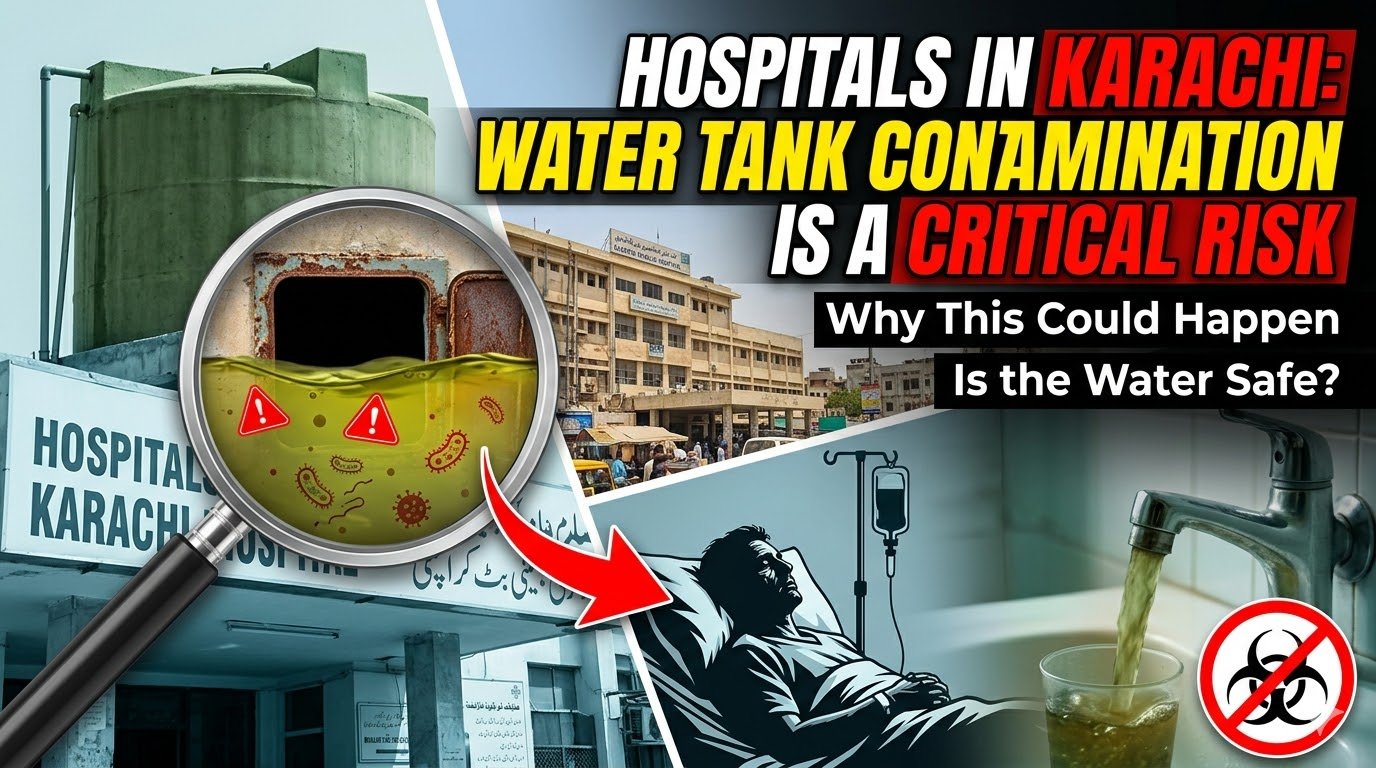
A hospital uses water for almost everything it does: hand washing, cleaning, sterile services, kitchens, laundries, dialysis and patient care. In Karachi that water is stored on site, because the public supply is intermittent, and the people exposed to it include the most vulnerable in the city.
This article is written for administrators, infection control teams and facility managers at hospitals in Karachi, and for clinics, laboratories and care homes. It covers why tank hygiene is a patient safety matter, which organisms are involved, what the regulatory picture looks like, and what a workable plan contains. We are tank cleaning specialists, not clinicians, and nothing here replaces your infection control committee’s judgment.
In brief
- Hospital water is stored on site and reaches patients through taps, showers, equipment and food.
- Legionella and Pseudomonas thrive in warm, stagnant water with sludge and biofilm, and Karachi’s tanks are warm most of the year.
- Healthcare establishments in Sindh are regulated under the Sindh Health Care Commission Act, 2013.
- Clean all tanks at least every three months, one at a time, with records.
- Tank cleaning is one control. Flushing, temperature, disinfection and testing complete the plan.
Why hospital water is a special case
| Factor | Why it raises the risk |
|---|---|
| Patients with weak immune systems | Organisms that healthy people shrug off cause serious infection in newborns, the elderly, transplant, cancer and intensive care patients |
| Large, complex plumbing | Long pipe runs, dead legs and rarely used outlets hold stagnant water |
| Aerosols | Showers, taps, humidifiers and respiratory equipment turn water into droplets that are breathed in |
| Constant demand | A hospital cannot shut down for a day, so tank cleaning gets postponed |
| Tanker dependence | Supply shortfalls are covered by tankers of unknown origin |
| High stakes | A waterborne outbreak in a ward is a clinical, legal and reputational crisis |
The supply behind every hospital in Karachi
The city receives about 650 million gallons of water a day against demand of more than 1,200, and the network loses a large share of it to leaks. Supply arrives in turns at low pressure, which allows contamination into the pipes. When the Pakistan Council of Research in Water Resources tested Karachi’s water for a Supreme Court commission, 107 of 118 samples were unsafe to drink. The full route is described in our guide to KWSB water supply.
The 2026 supply failures showed how exposed large users are. During the crisis of late April and May whole districts were without water for days, and institutions relied on tankers. Every tanker load and every recharge of the mains brings sediment into storage.
The organisms that matter
| Organism | Where it lives | How patients are exposed | Who is most at risk |
|---|---|---|---|
| Legionella | Warm, stagnant water with sludge, scale and biofilm | Inhaling droplets from showers, taps, cooling towers | Older patients, smokers, the immunosuppressed |
| Pseudomonas aeruginosa | Biofilm in tanks, taps and drains | Contact with wounds, burns, lines and ventilator circuits | Intensive care, burns and neonatal patients |
| Faecal bacteria such as E. coli and Salmonella Typhi | Sewage-contaminated supply; tank sediment | Drinking, food preparation, hands | Everyone; severe in children and the frail |
| Naegleria fowleri | Warm, unchlorinated water | Water entering the nose, including ablution | Rare but nearly always fatal |
| Non-tuberculous mycobacteria | Biofilm in water systems | Aerosols and contaminated equipment | Immunosuppressed and surgical patients |
On legionella, the WHO fact sheet states that the bacteria live and grow in water systems at 20 to 50°C, with an optimum of 35°C, that the most common route is inhalation of contaminated aerosols, and that the death rate can reach 40 to 80 percent in untreated immunosuppressed patients. The WHO’s central recommendation is a water safety plan specific to the building, with regular cleaning and disinfection and measures to minimise stagnation.
Karachi’s climate matters here. In much of the world a cold water tank stays below 20°C. Here it does not, for most of the year. The effect of temperature is explained in heat and bacteria in water tanks, and the wider picture of water-related illness in the city in waterborne disease in Karachi.
The regulatory picture
Healthcare establishments in the province fall under the Sindh Health Care Commission Act, 2013, which applies to public and private hospitals, clinics and laboratories. The commission registers and licenses facilities after inspecting them against its standards. Progress has been slow: Dawn reported in July 2025 that between 2018 and 2024 only three public hospitals and 86 private hospitals and clinics had obtained regular licences, out of many thousands that had applied.
Globally the baseline is also low. In 2022 the WHO and UNICEF reported that half of health care facilities worldwide lack basic hygiene services. Accreditation schemes that some Karachi hospitals pursue, such as international hospital accreditation or ISO certification, expect a documented approach to water safety with records. Whatever scheme applies to you, an inspector or surveyor will ask the same thing: show me the schedule and the evidence.
Where the risk concentrates among hospitals in Karachi
- Large public hospitals: very high patient numbers, old buildings, extended plumbing and tight budgets.
- Private hospitals: newer buildings but the same storage, the same supply and the same tankers.
- Small clinics, maternity homes and dialysis centres: often in converted houses with domestic tanks and no one assigned to maintain them.
- Diagnostic laboratories: water quality affects results as well as people.
- Care homes and welfare institutions: frail residents and long stays.
Dental and other clinics in commercial districts are discussed in our area guide to water safety in Defence, Clifton and PECHS.
A water hygiene plan for a health facility
| Element | What it involves |
|---|---|
| Tank inventory | Every underground, rooftop and intermediate tank: size, material, source, areas supplied |
| Named responsibility | A facility manager for the system; the infection control committee for oversight |
| Cleaning schedule | All tanks at least every three months, or more often if your committee requires; high-risk areas first |
| Flushing | Weekly flushing of little-used outlets; removal of dead legs where possible |
| Temperature and disinfection | Hot water kept hot; a chlorine residual maintained in cold water where your plan calls for it |
| Testing | Routine microbiological testing by an accredited laboratory, with legionella testing as your risk assessment dictates |
| After events | Cleaning and flushing after flooding, sewage incidents, long outages, construction or ward reopening |
| Records | Reports, photographs, invoices, test results and corrective actions in one file |
Three months is the interval we recommend for any premises serving the public, and many hospitals choose a shorter cycle for critical areas. The general reasoning is in how often to clean a water tank in Karachi. Tank cleaning is one control among several. It removes the sludge and biofilm in storage. It does not deal with biofilm inside distribution pipework or at outlets, which is why flushing, temperature control and testing belong in the same plan.
Cleaning tanks in a working hospital
- Survey. Tanks, access, isolation valves and the areas each tank feeds are mapped, and the sequence is agreed with the facility and infection control teams.
- Continuity. Tanks are cleaned one at a time, at night or at low-demand hours, so that no clinical area loses supply.
- Safe entry. Ventilation, gas testing, harness and an attendant for every underground or enclosed tank.
- Cleaning. Jet washing at 3,000+ PSI and vacuum extraction of sludge, removed from site.
- Disinfection. Agreed in advance with the hospital. We normally use silver-stabilised hydrogen peroxide or food-grade chlorine; if your infection control policy specifies a product or a chlorine residual, we work to it.
- Rinse, inspection and return to service, with any structural defects photographed.
- Documentation. A dated report for each tank with photographs, plus a numbered SRB/FBR tax invoice.
The standard sequence is on our cleaning procedure page, and how the disinfectants compare is covered in silver hydrogen peroxide for tank disinfection.
Choosing a contractor
- A documented procedure and a sample report you can review before appointing them
- Confined-space safety practice. Hospital staff should never enter a tank.
- Current quality and safety certificates. See why ISO-certified tank cleaning matters.
- Tax registration and proper invoices. See why SRB and FBR registration matters.
- Willingness to work at night and to your infection control team’s instructions
The household parallel
The reasoning that applies to a hospital applies, on a smaller scale, at home.
| In a hospital | In a home |
|---|---|
| A central tank supplies every ward | An underground or rooftop tank supplies every tap |
| Patients with weak immunity are most affected | Infants, the elderly and anyone unwell are most affected |
| A schedule, records and oversight are expected | Nobody checks; it depends on the family |
| Tankers cover the shortfall | Tankers cover the shortfall |
If someone at home is recovering from surgery, undergoing chemotherapy or newly born, treat your own tank with the same seriousness. Our guides to the signs of unsafe water and children’s water safety are a starting point.
Working with us
Healthcare facilities are surveyed free of charge before any quote. Welfare and care institutions named on our clients page include Edhi Homes and Karwan-e-Hayat. Facilities in the south of the city are served by our DHA and Clifton branch and those in the east and centre by our Gulshan and Jauhar branch. For a home tank, the price calculator gives a fixed quote.
Frequently asked questions
How often should hospital water tanks be cleaned?
At least every three months, and more often for critical areas if your infection control committee decides so. Clean immediately after flooding, a sewage incident or a prolonged outage.
Does tank cleaning control legionella?
It removes sludge and biofilm in storage, which is one necessary control. Legionella management also needs flushing, temperature control, disinfection and testing under a water safety plan.
Can tanks be cleaned without interrupting clinical services?
Yes, with planning. Tanks are cleaned one at a time during low-demand hours.
Which disinfectant should a hospital use in its tanks?
That is a decision for your infection control team. We work with silver-stabilised hydrogen peroxide and food-grade chlorine and follow the hospital’s policy.
What documentation will we receive?
A dated service report for each tank with photographs, a recommended next-service date and a tax invoice.
Do small clinics need a water hygiene plan?
A simple one, yes: a list of tanks, a three-month cleaning schedule, treated water for clinical hand washing and instrument rinsing where required, and a file of reports.
Should dialysis and laboratory water be handled differently?
Yes. Those services have their own water treatment systems and standards, managed by clinical engineering. Tank cleaning supports them by improving the feed water but does not replace them.
Sources
References used in this article, checked in October 2026. This article is general information and does not replace clinical or infection control advice.
- Dialogue Earth, 28 July 2017: 91% of Karachi’s water unfit to drink (PCRWR results)
- Dawn, 1 May 2026: Most Karachi areas suffer as water crisis enters second week
- WHO: Legionellosis fact sheet
- Dawn, 27 July 2025: Health facilities registered with the Sindh Healthcare Commission
- WHO and UNICEF, 30 August 2022: Half of health care facilities globally lack basic hygiene services
- UK Health and Safety Executive: Managing legionella in hot and cold water systems
About Khan Tank Cleaning
Khan Tank Cleaning has cleaned residential, commercial and industrial water tanks in Karachi since 2005. The company was founded by Mateen Khan, who still oversees quality control at both branches. More about us, or get in touch: 0333 0293174 for DHA and South Karachi, 0340 2717530 for Gulshan and East Karachi, both answered 24 hours.

Mateen Khan is the Founder & Owner of Khan Tank Cleaning, Karachi’s first dedicated professional water tank cleaning company (est. 2005). With 20+ years of industry experience, he leads an ISO 9001 & ISO 45001 certified team that follows a strict 8-step process using industrial equipment and food-grade disinfectants. Mateen is committed to making clean, safe water accessible to every household and business in Karachi.