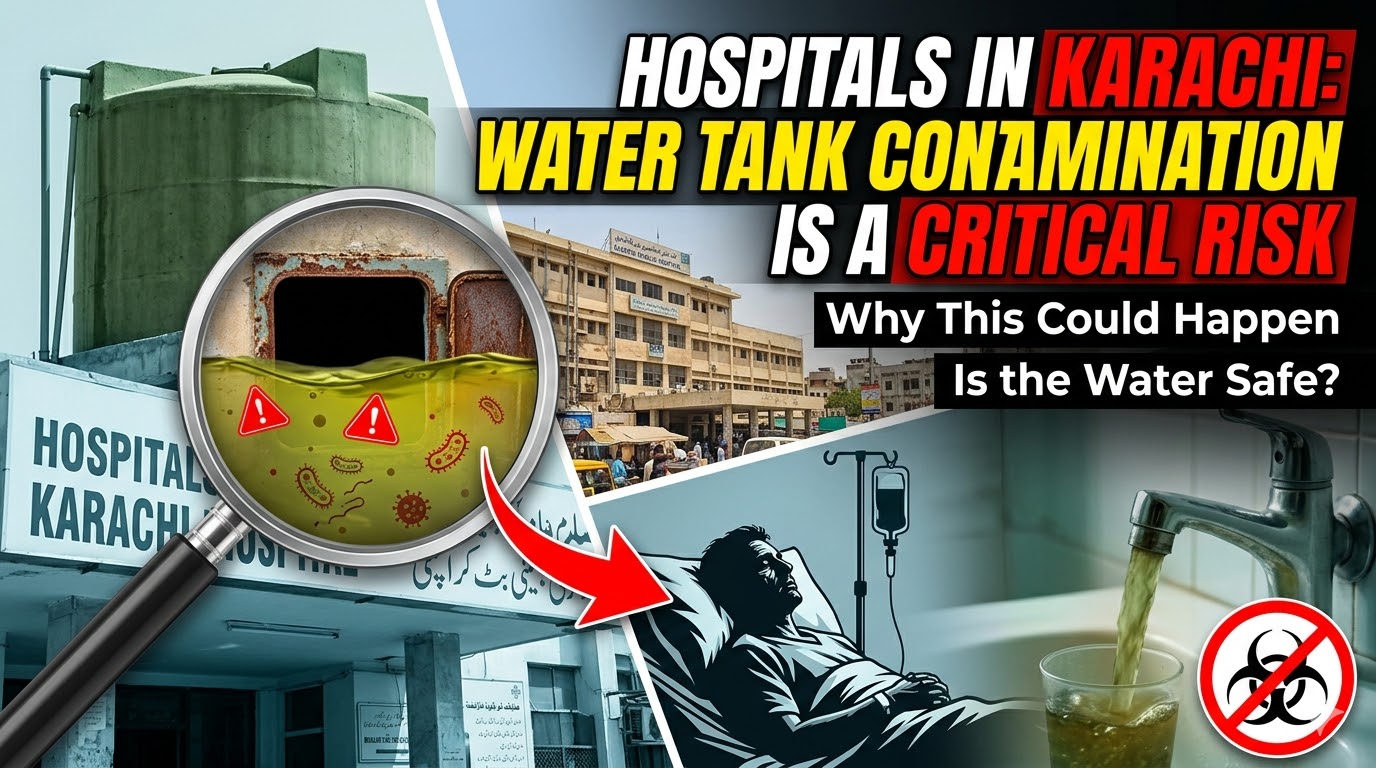
When the Place That Heals You Becomes the Source of Harm – Imagine checking into a hospital for a routine procedure — and leaving with a waterborne infection you did not arrive with. This scenario sounds alarming. Yet it is a documented, global public health problem, and in a city like Karachi, where water infrastructure faces enormous pressure, it is closer to home than most people realise.
Water tank contamination in hospitals is not just a healthcare issue. It is a warning signal for every building in Karachi — residential homes, schools, offices, and apartment complexes included. The same factors that make hospital tanks vulnerable are present in your building’s water system right now.
In this article, we examine the specific water tank risks that exist in Karachi’s hospitals and healthcare facilities — and translate those lessons into urgent, practical action for homeowners and building managers across the city.
Karachi’s Water Infrastructure: The Foundation of the Problem
To understand why hospital water tanks are especially vulnerable, you first need to understand the baseline reality of water supply in Karachi.
Karachi is one of the largest cities in the world — home to over 20 million people — yet its water supply infrastructure has not kept pace with its growth. The Karachi Water and Sewerage Board (KWSB) faces chronic shortfalls: demand far exceeds supply, pipelines are aging, and water pressure fluctuates dramatically across different areas of the city.
The consequences of this gap are felt everywhere — from large hospitals in Clifton and DHA to apartment buildings in Gulshan-e-Iqbal and community clinics in Orangi Town and Landhi. Every building depends on stored water, and every stored water system is only as clean as the tank holding it.
Karachi-Specific Factors That Elevate Tank Contamination Risk
- Intermittent KWSB supply: Water is often supplied once every two to three days in many areas, meaning tanks hold water for extended periods — the longer water sits, the greater the bacterial growth risk
- Heavy reliance on private tankers: Across DHA, Clifton, Gulshan, Jauhar, and North Nazimabad, tanker water of variable quality regularly fills residential and commercial tanks — introducing contaminants from the source
- Extreme summer heat: Karachi’s temperatures regularly exceed 40°C in summer. Heat accelerates bacterial and algal growth in uncovered or poorly insulated rooftop tanks
- Monsoon contamination events: Annual flooding and rainwater infiltration — particularly in low-lying areas like Landhi, Korangi, and Orangi Town — can introduce sewage and surface contaminants into underground sumps
- Aging building stock: Many of Karachi’s older buildings in Saddar, Liaquatabad, and Nazimabad have concrete underground tanks that develop cracks over decades, creating pathways for sewage seepage
- Infrequent professional cleaning: The tank cleaning industry in Karachi is largely informal — many operators use buckets, brushes, and household bleach, leaving biofilm and bacterial colonies largely intact
The Hospital Risk: Why Healthcare Facilities Are Ground Zero
Hospitals represent the most concentrated version of the water contamination risk that exists across all Karachi buildings — and studying what goes wrong in hospitals is a master class in what can go wrong anywhere.
High Patient Volumes, High Vulnerability
A major hospital in Karachi — whether a government facility like Civil Hospital or Jinnah Hospital, or a private facility in areas like DHA or Clifton — may serve hundreds to thousands of patients daily. Many of those patients are already immunocompromised: recovering from surgery, undergoing chemotherapy, battling chronic illness, or in neonatal care.
For healthy adults, exposure to low-level water contamination may cause a stomach upset. For a post-surgical patient or a premature infant in the NICU, the same exposure can be life-threatening. This is why healthcare settings face the most severe consequences of water tank contamination — and why the lessons from hospitals must be applied much more broadly.
Healthcare-Associated Waterborne Infections (HAIs) — A Global Problem With Local Relevance
Healthcare-associated infections (HAIs) linked to contaminated water systems are a recognised global crisis. Among the most dangerous waterborne pathogens in healthcare settings is Legionella pneumophila — the bacterium responsible for Legionnaires’ disease, a severe form of pneumonia. Legionella thrives in water systems with temperatures between 25°C and 45°C — precisely the range found in Karachi’s hot, sun-exposed rooftop tanks for much of the year.
Other pathogens of serious concern in hospital water systems include:
- Pseudomonas aeruginosa: Thrives in stagnant water and biofilm; causes severe lung and wound infections; highly antibiotic-resistant
- Stenotrophomonas maltophilia: Found in hospital water supplies globally; particularly dangerous for patients on ventilators
- Non-tuberculous Mycobacteria (NTM): Biofilm-forming bacteria resistant to standard disinfection; linked to outbreaks in hospital water systems
- E. coli and faecal coliforms: Indicators of sewage contamination; found in Karachi water supplies particularly after monsoon flooding events
- Hepatitis A and E viruses: Transmitted through contaminated water; endemic in Pakistan and a documented risk in Karachi’s water supply
Key insight: These same pathogens are not exclusive to hospitals. They can develop in any building’s water tank that is insufficiently cleaned. Your home’s tank faces the same biological risks — the difference is that in a hospital, the consequences become visible faster because the patients are already vulnerable.
Specific Hospital Scenarios in Karachi: Where the Risk Concentrates
Government Hospitals: Infrastructure Under Extreme Pressure
Karachi’s major government hospitals — Civil Hospital (Saddar), Jinnah Postgraduate Medical Centre, National Institute of Child Health (NICH), and Abbasi Shaheed Hospital — serve enormous patient volumes daily. These facilities rely on large, centralised water storage systems that must supply water for drinking, food preparation, patient washing, surgical scrubbing, and equipment sterilisation.
Many of these hospital buildings are decades old. Their underground concrete tanks often predate modern tank cleaning standards. The combination of high demand, aging infrastructure, intermittent KWSB supply, and — in some cases — reliance on tanker water creates a contamination risk that is as serious as any medical challenge these hospitals face.
Private Hospitals: Newer Buildings, Same Tank Risk
The growth of private healthcare in Karachi — particularly in DHA, Clifton, Gulshan-e-Iqbal, and PECHS — has brought newer hospital buildings. But newer buildings are not immune to tank contamination.
A multi-storey private hospital in DHA or Clifton may have a basement underground sump of 50,000 litres or more, combined with rooftop overhead tanks for gravity-fed supply to upper floors. In Karachi’s heat, a rooftop tank at 40°C+ creates near-ideal conditions for Legionella and other thermophilic bacteria. Without quarterly professional cleaning and a documented water safety plan, even a brand-new facility is at risk within months of opening.
Clinics, Day-Care Centres, and Diagnostic Labs
Smaller healthcare facilities — community clinics in areas like FB Area, North Karachi, and Malir; diagnostic laboratories in Gulshan-e-Iqbal; day-care surgical centres in Clifton and PECHS — often lack dedicated facility management staff. Water tank cleaning may not be on anyone’s maintenance calendar at all.
Yet these facilities handle vulnerable patients — paediatric patients, diabetics, dialysis patients, and the elderly — who face disproportionate risk from contaminated water exposure.
The Gulshan, Jauhar, and East Karachi Connection
Many of Karachi’s busiest secondary healthcare facilities — polyclinics, maternity homes, community hospitals, and specialist centres — are located in or around Gulshan-e-Iqbal, Gulistan-e-Johar, Malir, and FB Area. These areas also house hundreds of thousands of residential families whose home water tanks are at identical risk.
Gulshan and Jauhar have a particular vulnerability: much of the area was developed rapidly in the 1980s and 1990s, meaning a large proportion of the building stock now has aging underground concrete tanks. These older tanks develop microscopic cracks, accumulate decades of biofilm, and in many cases have never been professionally cleaned — only informally ‘washed out’ with buckets.
The lesson from Karachi’s healthcare facilities applies directly to residential buildings in this part of the city: contaminated water does not require a crisis to cause harm. Chronic low-level contamination — the kind that sits invisibly in an uncleaned tank — is responsible for the persistent gastrointestinal illness, skin conditions, and recurring infections that many East Karachi families accept as normal. They should not.
If you live or manage a property in Gulshan-e-Iqbal, Gulistan-e-Johar, Malir, Korangi, FB Area, or surrounding neighbourhoods, Khan Tank Cleaning’s professional water tank cleaning service in Gulshan & Jauhar is your closest, most responsive option. Our trained technicians use industrial-grade jet washing, professional vacuuming, and food-safe Silver Hydrogen Peroxide disinfection — the same standard of care that healthcare facilities demand, applied to your home or building.
DHA, Clifton, and South Karachi: High-End Postcodes, Same Water Risk
DHA and Clifton are home to some of Karachi’s most sophisticated private hospitals — the Aga Khan University Hospital (one of South Asia’s leading tertiary care centres), South City Hospital, Ziauddin Hospital, and a number of specialist clinics and diagnostic centres in Zamzama, Phase V, and Phase VI.
These institutions operate under international accreditation standards and are acutely aware of the waterborne infection risk — which is precisely why they invest in professional water management systems. The best private hospitals in DHA do not rely on informal cleaners to maintain their water tanks.
The same standard should apply to the residential buildings and apartment complexes surrounding them.
In DHA, Clifton, and Defence, the water supply situation has its own specific profile. Many properties in DHA Phases VII and VIII, Bahria Town, and parts of Defence rely primarily or entirely on private water tankers — with no KWSB connection at all. The quality of tanker water in Karachi varies enormously: some suppliers maintain reasonable standards, others deliver water that is microbiologically unsafe from the moment it enters your tank.
A rooftop or underground tank that receives tanker water and is not cleaned professionally at least every six months — ideally every quarter — becomes progressively more contaminated with each delivery. The sludge that accumulates at the bottom of a DHA apartment’s underground sump is not a minor inconvenience. It is a biological hazard that affects every drop of water your family uses.
Khan Tank Cleaning’s dedicated water tank cleaning service in DHA & Clifton covers the full range of tank types found in South Karachi’s high-rise buildings, housing societies, and standalone villas: large underground concrete sumps, rooftop plastic tanks, stainless steel tanks in commercial buildings, and fibre tanks of all brands. We bring the same industrial equipment and certified processes that the healthcare sector demands — to your front door.
The Household Parallel: What Happens in Hospitals Happens in Homes
It is tempting to view hospital water contamination as a distant, institutional problem — something for hospital administrators to worry about. But the biology is identical in your home’s water tank.
Consider this parallel:
| In a Hospital | In Your Home |
| Large centralised tank supplies the entire building | Underground sump or rooftop tank supplies every tap |
| Water sits in storage for hours to days | Water sits in storage for days, sometimes a week or more |
| Patients with weakened immunity are most affected | Children and elderly family members are most vulnerable |
| Accreditation requires documented cleaning schedules | No external requirement — only your family’s health motivates action |
| Tanker water of variable quality is widely used | Tanker water is the primary or supplementary source for millions in Karachi |
The only meaningful difference is that accredited hospitals are required to manage their water tanks professionally. You are not. But your family’s health depends on it just as much.
Warning Signs Your Water Tank Is Compromised
In a hospital setting, patient infections often trigger investigations into water quality. In your home, the warning signs are subtler — and often ignored:
- Recurring gastrointestinal illness: Stomach upsets, diarrhoea, or nausea that come and go without a clear cause — especially in children — can indicate low-level chronic water contamination
- Unusual water smell or taste: A musty, earthy, or chlorine-heavy smell suggests algae growth, biofilm, or chemical imbalance in the tank
- Discoloured water: Yellow, brown, or cloudy water — particularly first thing in the morning — points to sediment, rust, or organic matter in the tank
- Slippery tank walls: Biofilm — a colony of bacteria encased in a protective slime layer — is the primary reason professional cleaning is essential; it is invisible but present in virtually every uncleaned tank
- Skin irritation or recurring eye infections: Bathing in contaminated water can cause dermatitis and conjunctivitis — symptoms that are often misattributed to soap or shampoo
- Frequent illness in young children or elderly relatives: The most vulnerable members of your household will show the effects of contaminated water first
Remember: You do not need visible symptoms to have a contaminated tank. Most households with seriously contaminated tanks have no obvious signs. The contamination builds silently, and the health effects accumulate over time. Do not wait for symptoms. Clean on a schedule.
What Professional Cleaning Actually Involves — And Why It Matters
Hospitals that take water safety seriously do not send someone in with a brush and a bottle of bleach. They use a documented, multi-step process with professional equipment and certified chemicals. Khan Tank Cleaning applies the same standard to every tank it services in Karachi.
The Professional Process — Step by Step
- Complete drainage: Full evacuation of the tank using industrial-grade submersible pumps — no residual standing water is left behind
- High-pressure jet washing (2,000–3,000 PSI): Industrial pressure washers blast away deep-rooted algae, sediment, and biofilm from walls, floor, and corners that manual scrubbing simply cannot reach
- Industrial vacuum extraction: All loosened sludge, sediment, and debris is physically removed — not washed back into the water supply
- Disinfection with Silver Hydrogen Peroxide: A food-safe, internationally approved disinfectant applied to all interior surfaces — effective against bacteria, viruses, and biofilm without leaving harmful residues
- Multiple clean-water rinses: All chemical residues are flushed completely before the tank is refilled
- Confined space safety protocols: Underground tanks require oxygen monitoring, forced ventilation, and appropriate safety equipment — essential for worker safety and non-negotiable in any professional service
- Service completion certificate: A documented record of the service, chemicals used, technician details, and recommended next cleaning date
This is the standard that healthcare settings expect. It should be the standard your family expects too.
Frequently Asked Questions
Q: How often should a residential water tank be cleaned in Karachi?
At minimum, every six months. Given Karachi’s heat, intermittent KWSB supply, tanker water dependency, and monsoon contamination events, quarterly cleaning is strongly recommended for residential properties — and essential for commercial and healthcare settings.
Q: Can a water filter replace the need for tank cleaning?
No. A water filter at your tap addresses what comes through the tap at the point of use. It does not clean the tank itself. Sludge, biofilm, and sediment sitting in the tank continue to degrade water quality and can overwhelm even good-quality filters over time. Both are necessary — but the tank must be cleaned first.
Q: Is the water from our tanker safe to store in our tank?
Tanker water quality in Karachi is highly variable. Even relatively clean tanker water can become unsafe within days of storage in an uncleaned tank, as the biofilm and sediment already present contaminate each fresh delivery. A professionally cleaned tank with a documented service record significantly reduces this risk.
Q: We have both a sump and a rooftop tank. Do both need cleaning?
Yes, always. The sump fills first and pumps water upward to the rooftop tank. Contamination present in the sump will be pumped directly into the overhead tank with every cycle. Both tanks must be cleaned as part of any complete service — and Khan Tank Cleaning always addresses both.
Q: Our building has a large tank serving multiple flats. Who should arrange cleaning?
The building management committee or landlord is responsible for common-area infrastructure, including shared water tanks. If you are a resident with concerns, raise it formally in writing and reference this article — the public health stakes are clear. Khan Tank Cleaning works with building committees across Karachi to set up scheduled, bi-annual cleaning programmes at building-wide rates.
Do Not Wait for a Health Crisis. Act Now.
Hospitals spend enormous resources managing water safety because they know what contaminated water costs — in patient lives, in reputation, and in institutional trust. You may not run a hospital. But you are responsible for the health of everyone who lives in your home or works in your building.
Khan Tank Cleaning is Karachi’s first — and still only — company dedicated exclusively to professional water tank cleaning. We are not plumbers who clean tanks on the side. We are not informal cleaners with buckets. We are trained, equipped, and certified specialists who bring healthcare-grade water safety standards to every residential, commercial, and industrial tank we service.
We serve all of Karachi — 24 hours a day, 7 days a week. Here is how to reach your nearest branch:
📍 Gulshan-e-Iqbal, Gulistan-e-Johar, Malir, FB Area, Korangi, and all East Karachi localities:
Book our professional water tank cleaning service in Gulshan & Jauhar | Call: 0340-2717 530
📍 DHA, Clifton, Zamzama, Defence View, Bahria Town, and all South & West Karachi localities:
Book our professional water tank cleaning service in DHA & Clifton | Call: 0333-0293 174
We service: Homes, flats, apartments, offices, factories, schools, colleges, hostels, housing societies, clinics, hospitals, and all commercial and industrial buildings. No tank is too large or too small.
Clean tank. Safe water. Healthy family. Book today.
Khan Tank Cleaning | Suite-203, Mumtaz Manzil, Gulshan-e-Iqbal, Karachi | khantankcleaning.com

Mateen Khan is the Founder & Owner of Khan Tank Cleaning, Karachi’s first dedicated professional water tank cleaning company (est. 2005). With 20+ years of industry experience, he leads an ISO 9001 & ISO 45001 certified team that follows a strict 8-step process using industrial equipment and food-grade disinfectants. Mateen is committed to making clean, safe water accessible to every household and business in Karachi.
Leave a Reply