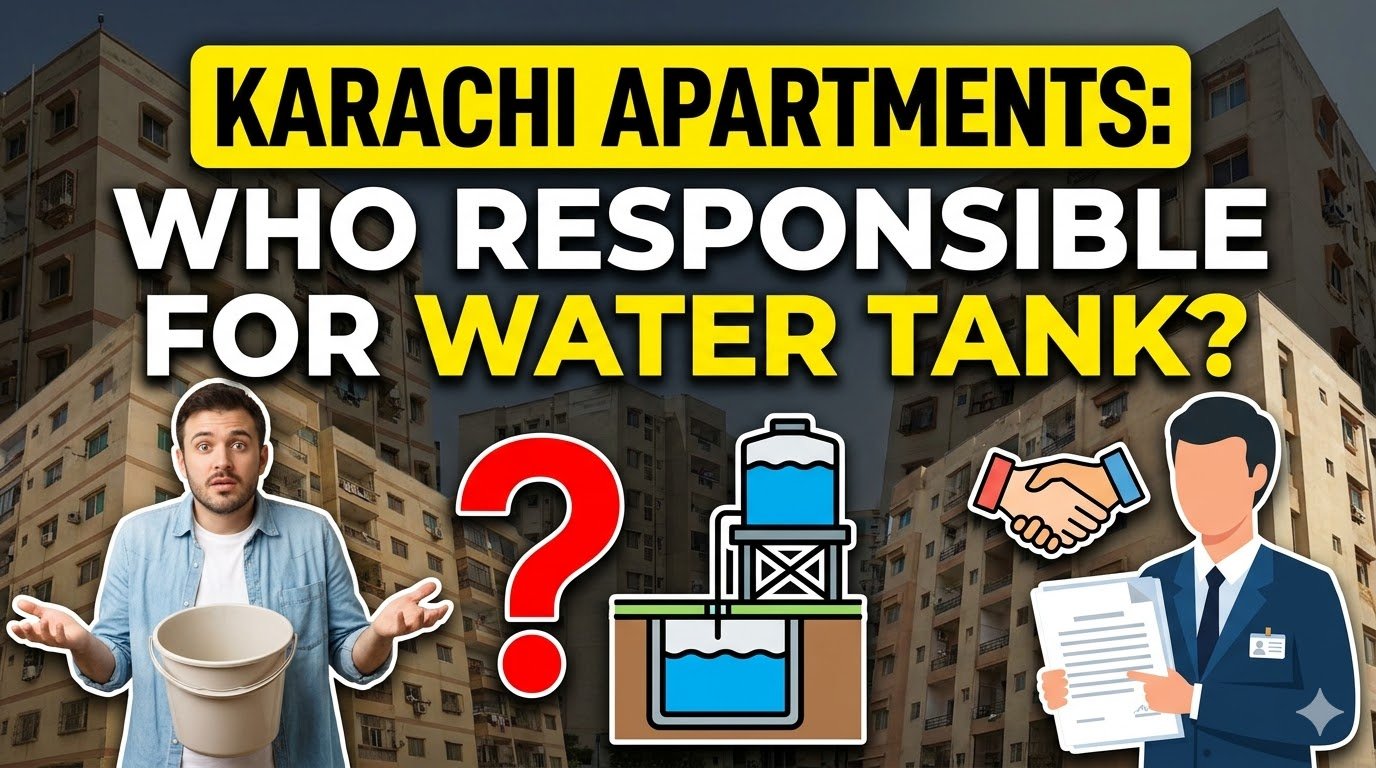
In a house, the answer to who cleans the water tank is obvious. In a block of flats it is the question nobody wants to own. The tenant says it is the landlord’s job, the landlord says it is the union’s, the union says there is no money, and the builder left years ago. Meanwhile forty families drink from the same tank.
This article sets out apartment water tank responsibility in Karachi as it works in practice: who holds the duty in each kind of building, what each party can do, and how to get a shared tank cleaned without a fight. It is general guidance, not legal advice. Your sub-lease, tenancy agreement and the union’s own rules decide the detail.
The short answer
| Your situation | Who is normally responsible for shared tanks | Who pays |
|---|---|---|
| Owner-occupier in a building with a union or association | The union, as manager of common areas | All owners, through maintenance charges |
| Tenant in such a building | The union; your landlord is the member and pays the charges unless your agreement passes them to you | Per the tenancy agreement |
| Building still controlled by the builder | The builder, until common areas are handed over | Builder, usually recovered through maintenance charges |
| Building owned by one landlord | The landlord | Landlord, unless agreed otherwise |
| Portion in a divided bungalow | The owner of the bungalow | Owner, sometimes shared with tenants |
| A tank that serves only your flat | You, or your landlord under the tenancy | As agreed |
The principle behind the table is simple: the party that controls the common areas, collects the maintenance money and holds the keys to the tank room and roof is the party that should arrange the cleaning.
How water works in a Karachi apartment building
Most blocks have an underground tank that fills from the line, from tankers or from a borehole. Pumps lift the water to one or more rooftop tanks, and gravity feeds the flats. Everything is shared. Supply to the city is intermittent and short of demand, as explained in our guide to KWSB water supply, so buildings buy tanker water regularly and store several days’ worth.
The consequences of that arrangement are predictable:
- One contaminated fill, or one dead bird in a roof tank, reaches every household.
- Heavy pumping keeps sludge stirred up.
- Roofs are used for drying clothes, storage and dish antennas, and tank covers get moved, broken or left off.
- Nobody sees inside the underground tank from one year to the next.
- When there is a main line failure, such as the University Road burst of late 2024, the first dirty flow lands in the shared tank.
Local conditions in the city’s densest apartment districts are described in water tanks in Gulshan and Johar.
Apartment water tank responsibility in Karachi, case by case
If you rent your flat
You have two relationships: with your landlord, under the tenancy agreement, and through him with the building. You cannot instruct the union directly, but you can ask your landlord to raise the matter, and you can speak to the union office yourself as a resident. Check what your agreement says about maintenance charges. Whoever pays them, the service they fund should include the tanks.
If you own your flat
You own your unit and a share in the common property, which includes the tanks, pumps and pipes. You are entitled to ask how the maintenance fund is spent and to see records of tank cleaning. If the union is inactive, owners can still act together: agree a date, collect the contribution and appoint a contractor.
If the builder still runs the building
Until a builder hands over the common areas to the residents, he remains responsible for running them, usually while collecting maintenance charges. Ask in writing for the cleaning schedule and the last report. If handover is overdue, that is a wider issue for the owners to pursue with legal advice.
If you live in a portion
A bungalow divided into two or three portions normally shares one underground and one rooftop tank. The owner controls them. If the owner lives elsewhere, the tenants should agree among themselves, tell the owner what is needed, and propose splitting the cost if that gets it done.
If your flat has its own tank
Some flats have a private rooftop tank or drums fed from the shared system. Those are yours to keep clean, and they should be included whenever the building’s tanks are done.
What a neglected shared tank does
The health risks are the same as for any dirty tank, multiplied by the number of households. They are set out in waterborne disease in Karachi. In a building, the tell-tale sign is illness or bad water in several flats at once. Other signs are listed in ten signs your water may be making you sick.
There is a safety risk too. Unions sometimes send the chowkidar or a labourer into the underground tank to save money. Closed tanks can hold gas and too little oxygen. In June 2025, five men died in an underground water tank in Karachi, three of them trying to rescue the others. A union that sends an untrained man down is taking that risk on behalf of every resident.
How to get a shared tank cleaned: seven steps
- Find out the facts. Ask the union or caretaker when each tank was last cleaned, by whom, and whether there is a report.
- Look for yourself. Check the roof tank covers, and look into the tanks from above with a torch. Do not climb in.
- Get a written quote from a professional contractor, based on a survey of the building.
- Put a proposal in writing to the union or in the residents’ group: the date, the cost per flat, what residents need to do on the day.
- Collect contributions or agree payment from the maintenance fund.
- Plan the day. Choose a time just before the supply turn, when the underground tank is low, and tell residents to store a few buckets.
- Keep the report in the union’s file and post the next cleaning date on the notice board.
A proposal with a date and a price is hard to ignore. A complaint is easy to ignore.
What each party can do now
Tenants
- Ask your landlord and the union for the last cleaning date
- Boil or filter drinking water whatever the answer; a filter and a clean tank do different jobs, as set out in water filter versus tank cleaning
- Offer to pay your share if that removes the obstacle
- At renewal, ask for a line in the agreement about tank cleaning
Owners and committee members
- Add tank cleaning to the annual maintenance budget as a fixed item
- Fix the dates for the year: every three months for shared tanks
- Appoint one committee member to hold the reports
- Replace broken covers and keep the roof tank area locked or at least tidy
- Never allow staff to enter the underground tank
Landlords
- Pay maintenance charges on time and ask what they cover
- Give incoming tenants the latest cleaning report
- For buildings you own outright, set a schedule yourself. Our guide for property managers has a maintenance calendar and suggested tenancy wording.
How often should a building’s tanks be cleaned?
Every three months for shared tanks, and straight away after flooding, a sewage leak, a main line failure that brought dirty water, or illness in several flats. The Sindh health department’s minimum for any tank is once a year before summer. The reasoning behind the intervals is in how often to clean a water tank in Karachi.
What a professional cleaning involves in a building
We survey the building first, free of charge, and quote in writing. On the day, the work follows our eight-step procedure: controlled drainage, ventilation and a gas check before anyone enters the underground tank, jet washing at 3,000+ PSI, vacuum extraction of sludge, disinfection, rinse and inspection. An underground RCC tank takes four to eight hours and each rooftop tank two to four. Where there are two rooftop tanks they can be cleaned one after the other so the building is not left dry.
The union receives a dated report with photographs from inside each tank, a recommended next date and a numbered SRB/FBR tax invoice for its accounts. What to look for in any contractor is covered in what to ask before hiring a tank cleaning company.
Our building and flat tank cleaning teams
Apartment buildings in Gulshan-e-Iqbal, Gulistan-e-Johar, Federal B Area, North Nazimabad and the rest of the east and centre are handled by our Gulshan and Jauhar branch on 0340 2717530. Buildings in DHA, Clifton and the south are handled by our DHA and Clifton branch on 0333 0293174. Residential projects named on our clients page include Shamir Residency. If your flat has its own tank, the online calculator gives an instant price.
Frequently asked questions
My landlord refuses to get the tank cleaned. What can I do?
If it is a shared tank, the landlord may not be the right person: approach the union with other residents. If the landlord owns the whole building, put the request in writing with a quote, offer to share the cost, and raise it at renewal. For anything beyond that, take legal advice on your tenancy agreement.
Can a single flat owner arrange cleaning of the shared tank?
Not alone, because it is common property. You need the union’s consent or the agreement of the other owners.
We have an underground tank and rooftop tanks. Do all of them need cleaning?
Yes, on the same visit. Cleaning one and not the others lets the dirty tank recontaminate the clean one.
How much does it cost per flat?
It depends on the number and size of tanks. Divided across the households and spread over the year it is a small part of the maintenance charge. Ask for a survey and a written quote.
How do we know the job was done properly?
Ask for the photographs. The floor and corners of each tank should be visibly clean in the after pictures, and the report should be dated and signed.
Is there a tank cleaning service for whole buildings as well as single flats?
Yes. We clean shared underground and rooftop tanks for apartment buildings after a free survey, and individual tanks for single flats and houses.
Our union has no funds. What then?
Collect a one-off contribution per flat for the first cleaning, then add a fixed tank cleaning line to the monthly maintenance charge so the next three are already paid for.
Who should hold the cleaning report?
The union’s office, with a copy on the notice board or in the residents’ group so everyone can see the date.
Sources
References used in this article, checked in October 2026. This article is general information and not legal advice.
- Geo News, 20 December 2024: University Road main line repaired
- Dawn, 11 June 2025: Five dead after inhaling toxic gases in water tank in Karachi
- Geo News, 13 September 2025: Naegleria claims another life in Karachi, toll hits five in Sindh
- Karachi Water and Sewerage Corporation: What We Do
About Khan Tank Cleaning
This guide is published by Khan Tank Cleaning, a Karachi water tank cleaning company founded in 2005 by Mateen Khan. We work from two branches, DHA Phase 2 and Gulshan-e-Iqbal, and you can read more about the company or contact either branch at any hour. Call or WhatsApp 0333 0293174 (DHA) or 0340 2717530 (Gulshan).

Mateen Khan is the Founder & Owner of Khan Tank Cleaning, Karachi’s first dedicated professional water tank cleaning company (est. 2005). With 20+ years of industry experience, he leads an ISO 9001 & ISO 45001 certified team that follows a strict 8-step process using industrial equipment and food-grade disinfectants. Mateen is committed to making clean, safe water accessible to every household and business in Karachi.