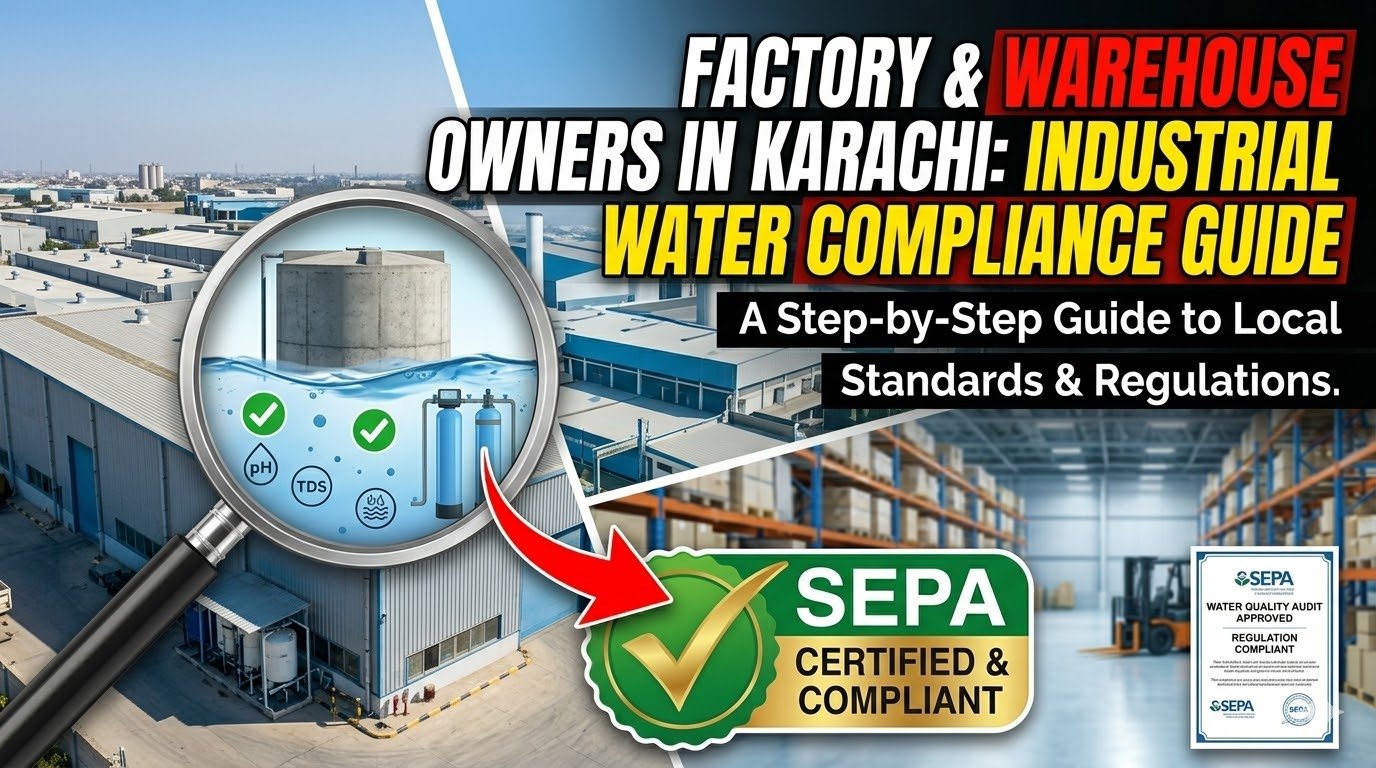
A factory’s water tanks sit at the meeting point of three obligations: the law says workers must have wholesome drinking water, auditors and customers want evidence that it is managed, and the tanks themselves are confined spaces that can kill the people sent to clean them. Most sites handle the first two with a signature on a form and the third not at all.
This guide sets out industrial water compliance for an industrial water tank in Karachi in practical terms: what the Sindh Factories Act requires, what audits look for, how cleaning should be done safely, and how to build a simple water management programme for a factory or warehouse.
In brief
- The Sindh Factories Act, 2015 requires a sufficient supply of wholesome drinking water for workers (section 22).
- The same Act restricts entry into tanks and other confined spaces where dangerous fumes are likely (section 48).
- Auditors want an inventory, a schedule, dated reports and water test results.
- Drinking water tanks should be cleaned every three months; fire and process tanks need their own plan.
- Four workers died in a factory water tank in Landhi in 2022. Confined-space control is not optional.
What Sindh law requires
The main statute is the Sindh Factories Act, 2015. Four of its provisions bear directly on water tanks.
| Section | Requirement | What it means for tanks |
|---|---|---|
| 22, Drinking water | Effective arrangements to provide and maintain, at suitable points, a sufficient supply of wholesome drinking water for all workers; points to be marked; cooled water in hot weather where more than 250 workers are employed | The tanks feeding drinking points must deliver wholesome water, and you need to be able to show how you know |
| 15, Cleanliness | Every factory to be kept clean and free from effluvia from drains and other nuisances | Tank surroundings, drainage and sludge disposal |
| 48, Dangerous fumes | No person to enter any chamber, tank, vat, pit or other confined space where dangerous fumes are likely without the safeguards the section specifies: adequate access, a space made safe from fumes, or breathing apparatus with a rope held from outside | Tank cleaning is confined-space work and must be controlled as such |
| 92, Penalties | Fines for contravention of the health and safety provisions, with further daily fines for continuing offences | Non-compliance has a direct cost |
This is a summary for orientation, not legal advice. Read the Act, and take advice on how it and other laws, including the Sindh Occupational Safety and Health Act, 2017 and environmental regulations on effluent, apply to your site.
What auditors and customers look for
Beyond the law, most factories are audited by someone: a certification body, a brand’s social compliance auditor, a food safety auditor, an insurer or a multinational customer. The questions about water are much the same whoever asks them.
- Is there a list of all water tanks, with location, capacity and use?
- Is there a cleaning schedule, and has it been followed?
- Are there dated records for each cleaning, from an identifiable contractor?
- Is drinking water tested, and are the results on file?
- How is confined-space entry controlled?
- Is the contractor itself competent, registered and insured against its own risks?
Sector standards add their own requirements. Food and beverage plants running HACCP or ISO 22000 treat water as an ingredient and a hazard to be controlled. Pharmaceutical plants work under GMP rules for water systems. Export-oriented textile units face buyer codes of conduct that include drinking water and worker safety. In each case the auditor wants a documented system, not a verbal assurance.
Why industrial tanks are a different job
| Household tank | Industrial tank | |
|---|---|---|
| Size | Hundreds to a few thousand gallons | Tens or hundreds of thousands of gallons; often several tanks |
| Uses | Domestic | Drinking, canteen, process, cooling, boiler feed, fire reserve |
| Sources | Line and occasional tanker | Line, tanker, borehole, sometimes all three |
| Sludge | Silt and rust | Larger volumes; may include process residues |
| Entry risk | Serious | Higher: depth, volume, residual gases, mechanical and electrical hazards |
| Downtime | A few hours without water | Production, canteen and sanitation all depend on it |
| Records | A report for the owner | Evidence for law, audit and customers |
One point is often missed. Fire reserve tanks and seldom-used process tanks hold stagnant water for months. Stagnant, warm water with sludge and scale is what the UK Health and Safety Executive identifies as favouring legionella, which multiplies between 20 and 45°C. Karachi’s stored water is in that range most of the year.
The Karachi factor
- Unreliable bulk supply. The city receives about 650 million gallons a day against demand above 1,200, and industrial areas rely heavily on tankers and boreholes. See our guide to KWSB water supply.
- Repeated network failures. The Dhabeji outages of 2026 hit Korangi and Landhi among other areas, and each recharge of the mains carries silt into tanks.
- Groundwater quality. Borehole water in industrial zones is typically hard and saline, and may be affected by nearby effluent.
- Heat. Large exposed tanks warm quickly. See heat and bacteria in water tanks.
- Power. Outages stop pumps and leave water standing, as covered in load shedding and water contamination.
Confined-space entry: the part that kills
In January 2022, four workers died in the underground water tank of a textile factory in Landhi. One fell in and was overcome by fumes; three colleagues died trying to rescue him. Police said no safety measures had been taken to cover the tank, and the provincial labour minister ordered an inquiry.
This pattern, in which rescuers become victims, is typical of confined-space deaths. Section 48 of the Factories Act exists to prevent it. In practice, safe entry means:
- A permit or written authorisation for each entry
- Isolation of inlets, pumps and electrical equipment
- Forced ventilation before and during the work
- Testing the atmosphere before anyone enters, and continuing to monitor it
- Harness and lifeline, with a tripod or other means of retrieval
- A trained attendant at the opening for the whole job
- A rescue plan that does not depend on someone jumping in
If your tank cleaning is done by your own maintenance staff or by a labour contractor with none of the above, you are carrying that risk yourselves.
How often to clean an industrial water tank in Karachi, and how
| Tank | Suggested interval | Note |
|---|---|---|
| Drinking water and canteen tanks | Every 3 months | Test water after cleaning and at least annually |
| General service tanks (washrooms, cleaning) | Every 3 to 6 months | Shorter if tanker-fed |
| Process water tanks | As your quality system or customer standard requires | Disinfectant must be compatible with the process |
| Fire reserve tanks | Inspect quarterly; clean at least annually | Coordinate with fire safety so cover is maintained |
| Any tank after flooding, contamination or long shutdown | Before return to service |
These are our recommendations, not statutory intervals. The general reasoning is in how often to clean a water tank in Karachi.
The cleaning method scales up from the domestic one: controlled drainage, ventilation and gas testing, jet washing, vacuum extraction of sludge, disinfection, rinse and inspection. Our sequence is on the cleaning procedure page. For industrial jobs the disinfectant is agreed in advance. We normally use silver-stabilised hydrogen peroxide or food-grade chlorine, and if your quality system specifies a particular product we work to that.
A water management programme in six steps
- Inventory. List every tank: location, capacity, material, source, what it supplies, how it is accessed.
- Risk-rank. Drinking and food-contact first; stagnant tanks second.
- Schedule. Fix cleaning dates for the year and put them on the maintenance planner.
- Appoint an owner. One named person, usually in HSE or administration, holds the file.
- Record. For every cleaning: date, contractor, report, photographs, invoice, disinfectant used, defects found and when they were fixed.
- Verify. Laboratory testing of drinking water, and an internal check that the schedule was kept.
Compliance checklist
- Tank inventory is complete and current
- Drinking water points are marked and supplied from cleaned tanks
- Cleaning schedule exists and the last four reports are on file for each tank
- Confined-space procedure is written and followed, including for contractors
- Contractor is SRB and FBR registered and issues tax invoices
- Contractor’s certificates are current and copies are on file
- Water test results are on file
- Tank covers are sound; hatches are secured against falls
- Sludge and wash water are disposed of properly
On the contractor points, see why SRB and FBR registration matters and why ISO-certified tank cleaning matters. How to read a certificate is explained in ISO 9001 and ISO 45001 explained.
Karachi’s industrial zones
- Korangi and Landhi: dense, mixed industry; directly affected by the 2026 supply failures; heavy tanker use.
- SITE and North Karachi: older premises with ageing RCC tanks and pipework.
- Federal B Industrial Area: smaller units in tight plots, often with difficult access.
- Port Qasim and Bin Qasim: large sites, large tanks, long distances from the city’s distribution network.
Korangi, Landhi and the south are covered by our DHA branch; SITE, North Karachi and Federal B Area by our Gulshan branch.
How we work with industrial clients
Industrial sites are always surveyed first, free of charge. The survey covers tank dimensions, sludge depth, access, isolation points, drainage and the client’s own safety rules, and the quote follows in writing. Work is planned around production, typically at night, on a weekly off-day or during a shutdown, and tank by tank so the site is never without water.
Each job produces a dated report with photographs from inside the tank, a recommended next-service date and a numbered SRB/FBR tax invoice. We have cleaned more than 650 industrial tanks, and manufacturing and inspection clients named on our clients page include Mondelez, Shan Foods and SGS. Office staff arranging a cleaning at home can use the online price calculator.
Frequently asked questions
Is there a legal requirement to clean factory water tanks in Sindh?
The Sindh Factories Act, 2015 requires a sufficient supply of wholesome drinking water for workers. It does not set a cleaning interval, but you cannot show the water is wholesome without maintaining the tanks and keeping records.
How often should industrial water tanks be cleaned?
Drinking water tanks every three months, service tanks every three to six months, and process tanks as your quality system requires.
Can our own maintenance team clean the tanks?
Only if they are trained and equipped for confined-space entry and you have a written procedure. Most sites find it safer and simpler to use a specialist contractor.
What records does an auditor expect?
A tank inventory, a schedule, dated service reports with photographs, invoices from a registered contractor, the contractor’s certificates and water test results.
Can cleaning be done without stopping production?
Usually. Tanks are cleaned one at a time, at night or on an off-day, with the sequence agreed at the survey.
Do warehouses fall under the same rules as factories?
It depends on whether the premises meet the Act’s definition of a factory. Whatever the legal position, anyone employing people has a duty to give them safe drinking water, and any tank is a confined space.
Should fire water tanks be cleaned?
Yes, at least annually, with quarterly inspection. Stagnant fire reserve water breeds bacteria and sludge can block pumps and sprinklers. Coordinate the work with whoever is responsible for fire safety so that cover is maintained.
Sources
References used in this article, checked in October 2026. This article is general information and not legal advice.
- The Sindh Factories Act, 2015
- Dawn, 4 January 2022: Four workers die after inhaling toxic fumes in factory’s water tank
- UK Health and Safety Executive: Managing legionella in hot and cold water systems
- Dawn, 1 May 2026: Most Karachi areas suffer as water crisis enters second week
- Karachi Water and Sewerage Corporation: What We Do
About Khan Tank Cleaning
This guide is published by Khan Tank Cleaning, a Karachi water tank cleaning company founded in 2005 by Mateen Khan. We work from two branches, DHA Phase 2 and Gulshan-e-Iqbal, and you can read more about the company or contact either branch at any hour. Call or WhatsApp 0333 0293174 (DHA) or 0340 2717530 (Gulshan).

Mateen Khan is the Founder & Owner of Khan Tank Cleaning, Karachi’s first dedicated professional water tank cleaning company (est. 2005). With 20+ years of industry experience, he leads an ISO 9001 & ISO 45001 certified team that follows a strict 8-step process using industrial equipment and food-grade disinfectants. Mateen is committed to making clean, safe water accessible to every household and business in Karachi.