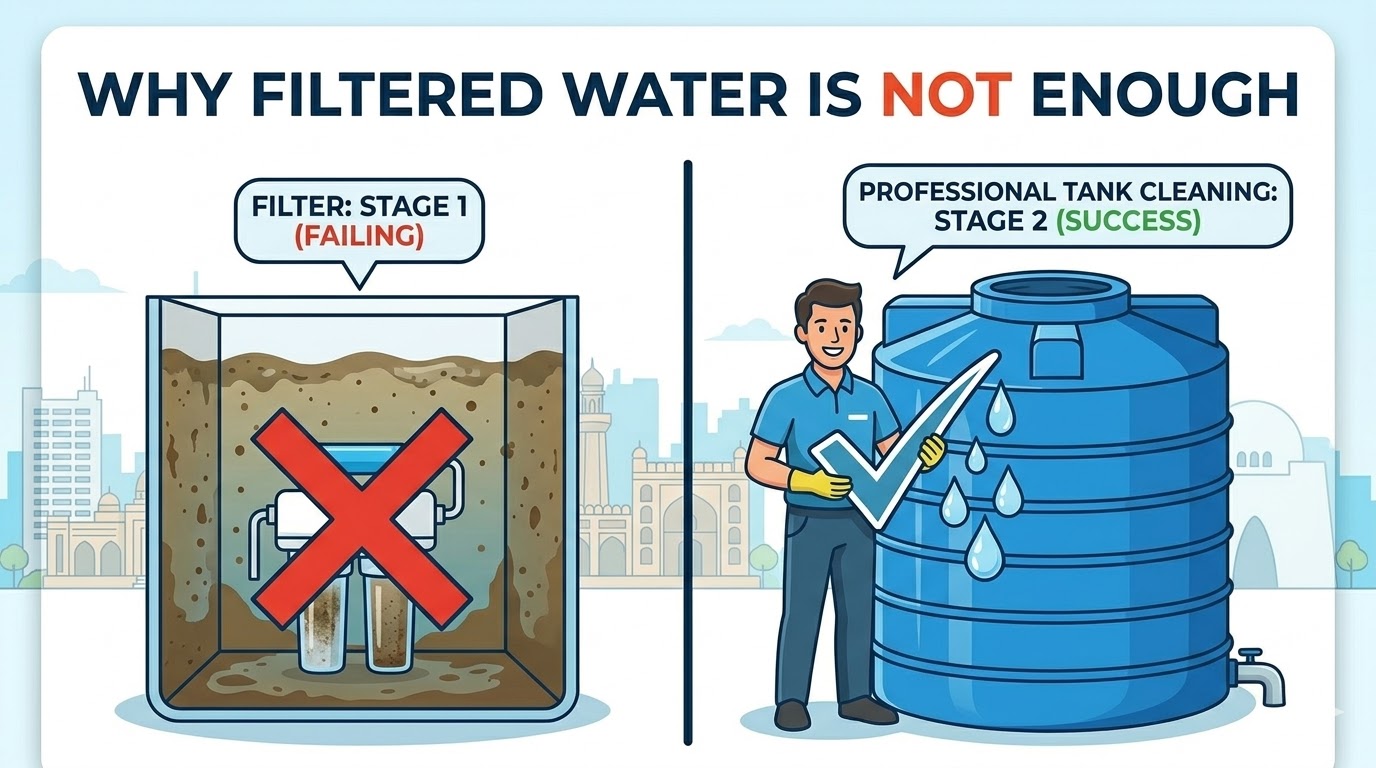
There is a quiet assumption in millions of Karachi homes: if the water has passed through a filter, it is safe. Families spend thousands of rupees on water purifiers, UV filters, and reverse osmosis systems — and feel confident that the health risk has been handled. But here is the problem that almost no one talks about:
Your filter is only as good as what goes into it — and if your water tank hasn’t been professionally cleaned recently, your filter is fighting a battle it was never designed to win.
This article breaks down the science and reality of tank contamination in Karachi, explains exactly why filtration alone is insufficient, and tells you what you actually need to do to protect your household’s water supply.
The Filter Myth: What Your Water Purifier Actually Does
Water purifiers and filters are genuinely useful devices. A good reverse osmosis (RO) system can remove dissolved salts, heavy metals, and many chemical contaminants. A UV filter can neutralise bacteria and viruses in the water that passes through it. A sediment filter catches visible particles and rust.
But all of these systems share one critical design limitation:
They treat the water as it flows through them — not the source it comes from.
If your tank contains a thick layer of sludge at the bottom, biofilm coating the interior walls, algae colonies growing in the corners, and bacterial contamination throughout the stored water — your purifier is receiving a heavily compromised input. Here is what your filter cannot do:
- It cannot remove biofilm — the sticky, protective layer that bacteria build on tank surfaces, which continuously sheds microorganisms and toxins into the water
- It cannot clean your tank walls — where algae, mould, and fungi establish long-term colonies that recontaminate water every time the tank is refilled
- It cannot neutralise sludge — the accumulated sediment, rust, dead organic matter, and microbial waste at the bottom of your tank that dissolves back into the water column over time
- It cannot handle bacterial overload — if bacterial counts in the stored water are extremely high, UV systems may not provide adequate contact time to neutralise all organisms
- It cannot address cross-contamination — if a crack in the tank wall or a poorly sealed inlet is allowing external material to enter, no filter addresses the source
In short: your filter is a treatment device, not a cleaning system. If the tank itself is dirty, filtration is managing — not solving — the problem.
What Is Actually Growing in Your Unclean Water Tank?
Most homeowners imagine a dirty tank simply has some visible grime or discolouration. The biological reality is considerably more alarming.
Biofilm: The Hidden Contamination Layer
Biofilm is a structured community of microorganisms — predominantly bacteria — that attach to surfaces and produce a protective matrix of polysaccharides. Once biofilm establishes itself on your tank’s interior walls, it is extremely resistant to simple rinsing or low-concentration disinfectants. It requires mechanical scrubbing combined with appropriate chemical treatment to fully remove.
Biofilm communities found in water tanks commonly include species capable of causing typhoid fever, urinary tract infections, respiratory infections, and severe gastroenteritis. Standard domestic water filters do not remove biofilm. They are designed to treat water in transit — not to address a biofilm colony growing on a fixed surface upstream.
Sludge Deposits
Every time your tank is filled — whether from KWSB supply or a water tanker — fine particles of sediment, rust, clay, and organic matter are introduced. Over months and years, these particles settle at the bottom and form a thick sludge layer. This sludge contains:
- Dead and living bacterial colonies at very high concentrations
- Rust and heavy metal particles from aging pipeline networks
- Organic matter — including decomposed insects, bird droppings, and plant debris that enter through imperfectly sealed lids
- Chemical residues from disinfection by-products
When water is drawn from the tank — especially when levels are low — this sludge becomes disturbed and particles re-enter the water column. Even a high-quality RO system will struggle when sediment concentrations are high enough to rapidly clog its pre-filters.
Algae and Fungi
In Karachi’s climate, overhead tanks that receive any indirect light or heat are vulnerable to algae growth. Algae produce toxins — including cyanotoxins in certain species — that some water purifiers are not specifically designed to remove. Fungal contamination from airborne spores is also common in tanks with loose or damaged lids, and fungal metabolites can persist in water even after the organisms themselves are filtered out.
Insect and Rodent Contamination
It is more common than most homeowners want to accept: open or poorly sealed tanks in Karachi regularly contain evidence of insect activity (mosquito larvae being the most prevalent concern), small animals, and bird droppings. Mosquito larvae in water tanks are a significant contributor to dengue fever transmission — a public health crisis that Karachi faces each monsoon season.
Why Karachi’s Water Tanks Are Especially Vulnerable
Tank contamination is a concern everywhere — but Karachi’s combination of environmental, infrastructural, and climatic factors makes it especially acute.
Tanker Water Quality Is Not Regulated
A large proportion of Karachi households — particularly in areas like Gulshan-e-Iqbal, Gulistan-e-Johar, North Nazimabad, and Orangi — supplement or replace municipal supply with water tankers. These tankers vary enormously in quality. Many draw from sources with no treatment, some carry residual contamination from previous loads, and their tanks are rarely cleaned to any professional standard.
When tanker water enters your home tank, it introduces whatever biological and chemical load it was carrying. Your purifier may reduce some of this — but the tank wall contamination it deposits begins to compound with every refill.
Residents of these areas have a higher-than-average contamination risk, which is why routine professional tank cleaning is not optional — it is essential. Our water tank cleaning service for Gulshan and Jauhar covers the entire central and eastern zone of Karachi, including Gulshan-e-Iqbal, Johar, North Nazimabad, Federal B Area, Liaquatabad, and surrounding neighbourhoods.
Extreme Heat Accelerates Bacterial Growth
Karachi’s summer temperatures — regularly exceeding 40°C on rooftops — turn overhead tanks into incubators. Most pathogenic bacteria double their population every 20–30 minutes under optimal warm conditions. A tank that tested safe in January can have clinically significant bacterial levels by June, even if no new contamination source was introduced. Heat combined with stagnation is one of the most consistent drivers of rapid tank contamination in the city.
Irregular Supply Means Longer Storage Times
KWSB water supply in many Karachi neighbourhoods is available only one or two days per week. Households store water for extended periods — sometimes 5–7 days at a stretch. The longer water sits in a warm, potentially contaminated tank, the higher the bacterial load grows. This is in direct contrast to how most domestic water filters are designed and tested — against water that has been stored for hours, not days.
DHA, Clifton, and PECHS: Not Immune
It would be a mistake to assume that the tank contamination problem is limited to areas with older infrastructure. Premium residential areas including Defence Housing Authority, Clifton, PECHS, Bahadurabad, and Zamzama face the same fundamental risks — high-rise buildings with rooftop tanks exposed to direct sun, underground tanks in older bungalows that have not been cleaned in years, and private housing societies that do not maintain a regular professional cleaning schedule for shared water tanks.
Khan Tank Cleaning’s DHA and Clifton tank cleaning service brings the same industrial-grade cleaning and disinfection standards to premium properties that we apply across the city — including high-rise apartment tanks, shared society overhead tanks, and large underground cisterns in bungalow-style properties.
The Filter vs. Clean Tank: A Side-by-Side Reality Check
Filter Only vs. Filter + Clean Tank
Filter only: Treats water in transit. Does not remove biofilm, sludge, or tank wall contamination. Requires frequent cartridge/membrane replacement. Provides false sense of complete protection. Filter + professionally cleaned tank: Filter receives clean input water. Cartridges last longer. Bacteria counts at source are low. Biofilm and sludge removed at root. Full-spectrum protection for your household.
The two approaches are not alternatives — they are complementary. A professionally cleaned tank and a good water filter together provide a genuinely safe water supply. A filter alone, sitting downstream of a contaminated tank, provides the appearance of safety without the reality.
The Health Consequences Karachi Families Are Already Experiencing
Waterborne illness is not an abstract risk in Karachi — it is a measurable, ongoing public health burden. Pakistan’s largest city consistently records high rates of the following conditions, many of which are directly or indirectly linked to contaminated water storage:
- Typhoid fever — caused by Salmonella typhi, which survives in stagnant, biofilm-rich water. Karachi sees endemic typhoid year-round, with spikes in summer
- Gastroenteritis and diarrhoeal disease — the leading cause of childhood hospitalisation and mortality in Pakistan, with unsafe water being the primary vehicle
- Hepatitis A and E — both transmitted via faecally contaminated water; Karachi’s cross-contamination between supply and sewage lines makes this a persistent threat
- Dengue fever — the Aedes mosquito breeds in clean, stagnant water, making improperly covered tanks a breeding site even when the water quality itself seems acceptable
- Skin and eye infections — from bathing in water containing elevated levels of bacteria, fungi, and chemical residues from untreated tank water
Every one of these conditions is preventable. And the most impactful single step a Karachi household can take — beyond installing a water filter — is to ensure that the tank feeding that filter is professionally cleaned on a regular schedule.
Why DIY Cleaning Is Not the Answer
When the problem is explained clearly, many homeowners consider cleaning the tank themselves. This is understandable — but there are serious limitations to DIY approaches that must be considered.
- You cannot remove biofilm with household cleaning agents. Biofilm requires mechanical disruption (high-pressure washing) combined with appropriate biocidal agents. Household bleach at domestic concentrations, chlorine tablets, and manual scrubbing with brushes leave significant biofilm intact and may create disinfection by-products that introduce new chemical risks.
- You cannot safely access underground tanks. Underground concrete tanks present confined-space entry hazards. Without proper oxygen monitoring, safety harnesses, and trained personnel, entering an underground tank is genuinely dangerous. Multiple deaths occur each year in Pakistan from this exact scenario.
- You cannot properly vacuum sludge. Industrial wet vacuums designed for tank use extract sludge with a completely different mechanism from manual scooping or rinsing. Manual methods redistribute sludge back into the water; proper vacuuming removes it entirely.
- You cannot verify disinfection. A professional cleaning service uses appropriate biocides and leaves the tank with a measurable, safe disinfectant residual. DIY cleaning has no verification mechanism — there is no way to confirm that the surfaces are genuinely free of bacterial contamination.
These are not reasons to feel helpless — they are reasons to use the professionals who have the right equipment and training.
What a Professional Tank Clean Includes — and Why Each Step Matters
A genuine professional tank cleaning is a methodical, multi-stage process. Here is what it looks like when done properly:
- Complete drainage: All stored water is removed. Cleaning a tank that still contains water is not cleaning — it is dilution.
- High-pressure jet washing: Industrial-grade pressure washers dislodge biofilm, algae, and hard mineral deposits from all interior surfaces — including corners, inlets, and outlet pipe areas — that manual scrubbing cannot fully reach.
- Industrial wet vacuuming: Specialised vacuum systems extract all sludge and debris. This is the critical step that bucket-and-rinse methods fail to replicate. No sludge left behind means no ongoing bacterial reservoir.
- Manual inspection and scrubbing: Trained technicians visually inspect every surface and manually clean areas requiring additional attention, including visible staining, algae patches, and inlet areas.
- Potable-water-safe disinfection: Professional-grade disinfectants approved for water storage use — such as Silver Hydrogen Peroxide — are applied to kill residual bacteria, fungi, and viruses. These are specifically chosen to be safe for human consumption and to leave no harmful residue.
- Final inspection and documentation: The cleaned tank is inspected before being declared ready for use. Any structural issues — cracks, damaged inlet seals, loose lids — are flagged for the homeowner’s attention.
This is the standard that Khan Tank Cleaning applies on every job — whether it is a 200-gallon overhead plastic tank in a Gulshan flat or a 5,000-gallon underground cistern at a DHA bungalow.
How Often Should You Clean, and When Should You Start?
The answer for most Karachi households: every three to six months — and if you have not cleaned your tank in the last six months, you should book a cleaning now, regardless of how good your filter seems to be performing.
Specific situations that require immediate action:
- Any household using tanker water as a primary or supplementary source
- Overhead tanks that have been exposed to direct sunlight through summer months without cleaning
- Any home where a family member has experienced repeated gastrointestinal illness without a clear alternative explanation
- Properties where the tank lid has been loose, damaged, or missing for any period
- Tanks that have never been professionally cleaned since installation
- Post-monsoon season — floodwater contamination risk is real and tank cleaning should be part of every household’s monsoon recovery process
Our Gulshan and Jauhar cleaning team covers all of Karachi’s central and eastern residential zones and can typically schedule same-day or next-day visits. Our DHA and Clifton service operates 24/7 for both residential and commercial clients across the Defence and Clifton corridor and the wider south-western zones of Karachi.
Your Filter Cannot Fix a Dirty Tank.
Only a Professional Clean Can.
Book Khan Tank Cleaning Today — Serving All of Karachi
You have invested in a good water filter. That is a smart decision. Now protect that investment — and your family’s health — by ensuring that the tank feeding your filter is genuinely, professionally clean. Khan Tank Cleaning uses industrial jet washing, professional vacuum systems, and potable-water-safe disinfectants on every job. We are a Karachi-based, Karachi-focused company, and we understand the specific contamination challenges of every neighbourhood in this city.
📍 Gulshan, Jauhar, Gulistan-e-Johar, North Nazimabad & surrounding areas: Book your Gulshan-Jauhar tank clean →
📍 DHA, Clifton, PECHS, Zamzama & surrounding areas: Book your DHA-Clifton tank clean →
📞 24/7 Helpline: 0340-2717530 | 03330293174
🌐 www.khantankcleaning.com — Clean Tank. Safe Water. Healthy Family.
Khan Tank Cleaning — Karachi’s Dedicated Professional Water Tank Cleaning Service

Mateen Khan is the Founder & Owner of Khan Tank Cleaning, Karachi’s first dedicated professional water tank cleaning company (est. 2005). With 20+ years of industry experience, he leads an ISO 9001 & ISO 45001 certified team that follows a strict 8-step process using industrial equipment and food-grade disinfectants. Mateen is committed to making clean, safe water accessible to every household and business in Karachi.
Leave a Reply