Category: Water Health & Safety

Clean water is essential for a healthy home or workplace. In this section, we share helpful information about common water-related health risks, the importance of proper water tank maintenance, and practical tips to keep your stored water safe for everyday use. From contamination risks to hygiene practices, these articles are designed to help residents of Karachi understand how poor water quality can affect their health and what steps they can take to ensure their water remains clean and safe.

  • Is Your Drinking Water Making You Sick? 10 Signs Karachi Families Should Know

    Is Your Drinking Water Making You Sick? 10 Signs Karachi Families Should Know

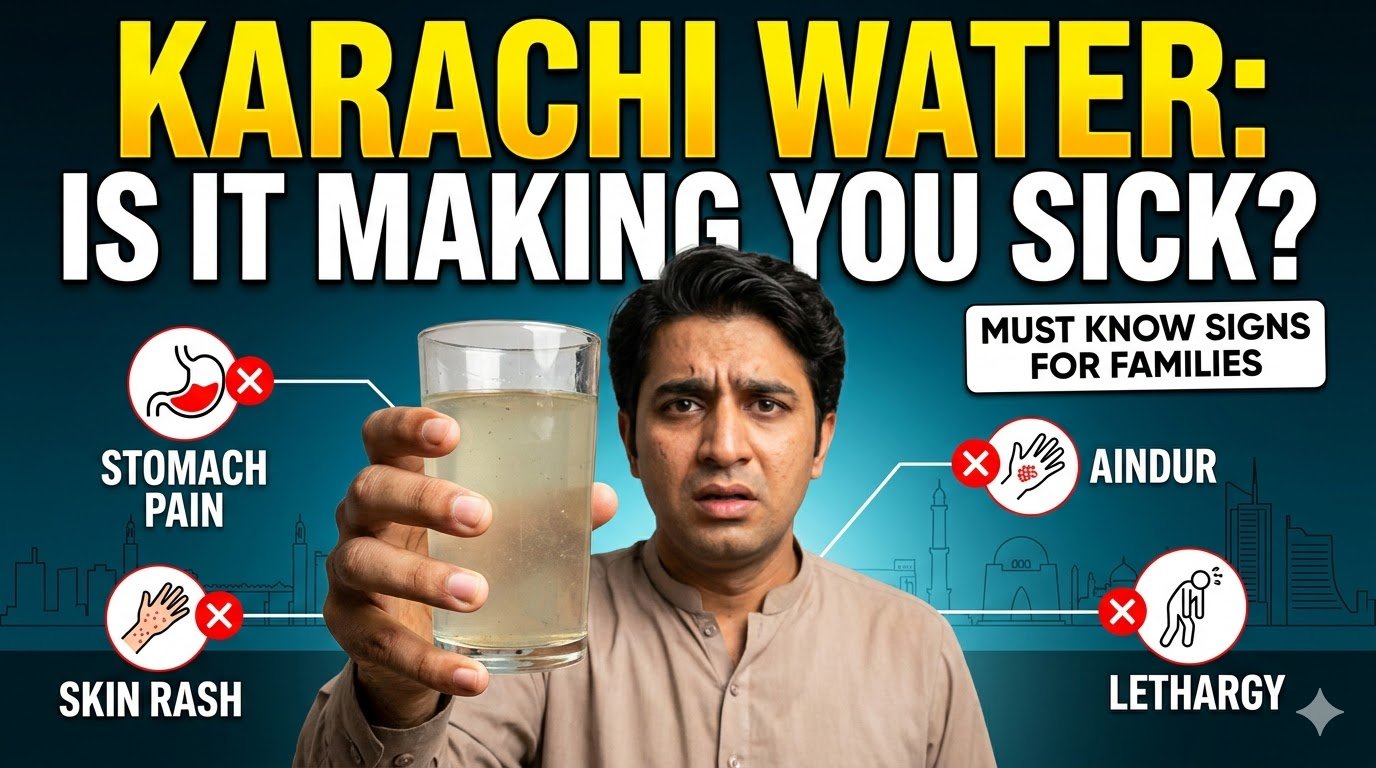
    Water safety in Karachi is hard to judge by eye. The most dangerous contamination has no colour, smell or taste, and the signs people do notice often appear only after a problem has been building for months. Still, there are patterns worth knowing, both in the water and in the household’s health.

    Below are ten warning signs, what each usually points to, and what to do about it. None of them is a diagnosis. Illness needs a doctor, and only a laboratory can confirm what is in the water.

    In brief

    • Clear water is not proof of safe water. The germs that matter are invisible.
    • Repeated stomach illness in one household, or in several flats of one building, is the strongest warning.
    • Colour, smell and grit each point to a different cause, set out in the table below.
    • You can check your own tank in five minutes from the outside. Never climb into an underground tank.
    • If the last cleaning was more than six months ago, or nobody knows, the tank is overdue.

    Why Karachi households need to pay attention

    Karachi gets a little over half the water it needs, and it arrives for a few hours at a time through an ageing network. Every home stores it, usually in an underground tank and again on the roof. Testing has found most samples unsafe: in the 2017 round carried out for the Supreme Court’s commission, 107 of 118 Karachi samples failed. How the water gets that way is covered in our guide to KWSB water supply. The tank is where everything it carries comes to rest.

    Ten warning signs

    1. Stomach upsets that keep coming back

    One bad meal explains one illness. Repeated cramps, nausea or loose motions in the same household, with no obvious food link, point to something everyone shares, and water is the most common shared exposure.

    2. Several people ill in the same week

    When two or more family members fall ill together, look for a common source. In a block of flats, ask the neighbours. If other households are affected, the shared tank is a prime suspect.

    3. A diagnosis of typhoid or hepatitis A or E

    These spread by the faecal-oral route, often through water. A confirmed case in the house is a reason to boil all drinking water and clean both tanks immediately. Our article on typhoid, E. coli and the water tank link explains the route.

    4. Cloudy or coloured water

    Brown or yellow usually means rust and silt, often after a line repair or a long gap in supply. Green suggests algae, which needs light, so check the lid. Milky water that clears from the bottom up is usually just air.

    5. A smell

    Earthy or musty smells point to algae and organic growth. A rotten-egg smell means decay without oxygen, typically in deep sludge. A sewage smell is an emergency: stop drinking the water and have the underground tank inspected for seepage.

    6. An odd taste

    Metallic tastes come from rust and old pipes, salty or bitter tastes from borehole or tanker water, and a strong chlorine taste from recent dosing. Any sudden change is worth investigating.

    7. Rashes or sore eyes after bathing

    Skin and eye irritation that appears after showers and eases when you are away from home can be caused by bacterial growth in stored water, though hard water and soaps are also common culprits.

    8. Slime, sediment or insects in the tank

    Run a finger along the inside wall near the waterline. A slippery film is biofilm. A dark layer on the floor is sludge. Wriggling larvae mean mosquitoes are breeding, and the WHO’s advice for dengue control is to keep water storage containers covered and cleaned.

    9. Filters clogging quickly

    If cartridges that should last months turn brown in weeks, the tank is feeding them sediment. This is covered in water filter versus tank cleaning.

    10. Nobody remembers the last cleaning

    The Sindh health department’s minimum is once a year before summer. If it has been longer than six months, or the date is unknown, treat the tank as overdue.

    Read the signs: a quick reference

    What you noticeMost likely causeFirst step
    Brown water after supply returnsSediment stirred up in the mainsLet it run to waste; clean the tank if it persists
    Green tint or musty smellAlgae from light entering the tankFix or replace the lid; clean
    Rotten-egg smellDeep sludgeClean with sludge removal, not just rinsing
    Sewage smellSeepage into the underground tankStop using for drinking; urgent inspection
    Grit in buckets and filtersSludge reaching the outlet levelClean; check outlet height
    Larvae or insectsOpen or damaged lid, missing meshSeal, screen and clean
    Recurring illness, clear waterMicrobial contamination you cannot seeSee a doctor; boil water; clean and disinfect

    A five-minute tank check

    1. Look at the lids. Do both close fully? Any cracks, gaps or missing covers?
    2. Shine a torch inside from the opening. Can you see the floor? Is there a dark layer or floating matter?
    3. Smell the air at the opening. It should smell of nothing.
    4. Feel the wall of the rooftop tank near the waterline for slime.
    5. Fill a clear glass from a bathroom tap first thing in the morning and hold it to the light.

    Do not climb into an underground tank to check it. Closed tanks can hold gases that overcome a person in seconds. In June 2025, five men died in an underground water tank in Ibrahim Hyderi, three of them while trying to rescue the first two.

    What a neglected tank contains

    • Sludge: silt, rust and organic matter that settle with every fill
    • Biofilm: bacteria attached to the walls in a protective layer
    • Algae: where light enters
    • Scale: mineral crust, heavier with borehole water
    • Whatever the supply delivered: the tank stores it until someone removes it

    Warm weather speeds all of this up, as described in how Karachi’s heat affects tank water, and the weeks after heavy rain are the highest-risk period, covered in our monsoon guide.

    What to do if you spot these signs

    1. Protect drinking water today. Boil it or use a filter you trust.
    2. See a doctor for anyone who is ill, especially children, pregnant women and the elderly. There is more for parents in our children’s water safety guide.
    3. Check the lids and the tank using the five steps above.
    4. Have both tanks cleaned and disinfected. What a proper job involves is on our cleaning procedure page, and this walk-through of a professional cleaning shows what to expect on the day.
    5. Set a schedule so it does not get to this point again. See how often to clean a water tank in Karachi.
    6. Consider a lab test if illness continues after cleaning, to check the supply itself.

    To arrange a cleaning, contact the branch for your area: Gulshan, Jauhar and East Karachi or DHA, Clifton and South Karachi. The online calculator gives a fixed price for standard homes.

    After a cleaning: what should change

    If the tank was the cause, improvements follow a rough order. Smell and colour usually clear within a day or two of refilling. Filter cartridges last noticeably longer over the following weeks. Recurrent stomach upsets should become less frequent over the next month or two, though they rarely stop overnight because food and hands are also sources.

    If nothing changes, the supply itself is the likely problem. At that point a laboratory test of the incoming water, a check of the underground tank for seepage, and stricter treatment of drinking water are the next steps. Water safety in Karachi is a matter of several barriers working together, and the tank is only one of them.

    Signs by water source

    What you notice depends partly on where the water came from.

    SourceTypical signsWhat they suggest
    Piped supplyBrown first flow after outages; fine siltSediment and contamination picked up in the mains
    TankerSand in buckets; quality that changes with each load; sometimes a salty tasteUnknown source; tanker itself rarely cleaned
    BoreholeSalty or bitter taste; white crust on taps; soap that will not latherHard, saline groundwater; scale building up in the tank
    A mixAll of the above, varying week to weekFaster build-up of both sludge and scale

    Frequently asked questions

    My water looks clear. Does that mean it is safe?

    No. The bacteria and viruses that cause typhoid, cholera and hepatitis are invisible at the levels that cause illness. Clear water is a good sign for sediment, not for germs.

    Can I test my water at home?

    Home kits give a rough indication at best. For a reliable result, use an accredited laboratory and follow its sampling instructions exactly.

    The water is only dirty for a few minutes after supply comes. Is that a problem?

    That first flush is sediment from the mains. It settles in your underground tank each time, which is how sludge builds up. Let it run to waste where you can, and keep to a cleaning schedule.

    Will cleaning the tank stop the illness?

    It removes one likely source. If the supply itself is contaminated you still need to boil or filter drinking water, and continuing illness should be discussed with a doctor.

    Is a chlorine smell a bad sign?

    A faint chlorine smell means disinfectant is present, which is good. A strong one after someone has dosed the tank fades in a day or two. No chlorine smell at all is the usual state of stored water in Karachi.

    Only one bathroom has smelly water. Is that the tank?

    Probably not. A problem at a single outlet usually lies in that tap, its pipe or the drain beneath it. Tank problems show at every tap fed from it.

    Sources

    Figures in this article were checked in October 2026 against the following:

    About Khan Tank Cleaning

    Khan Tank Cleaning has cleaned residential, commercial and industrial water tanks in Karachi since 2005. The company was founded by Mateen Khan, who still oversees quality control at both branches. More about us, or get in touch: 0333 0293174 for DHA and South Karachi, 0340 2717530 for Gulshan and East Karachi, both answered 24 hours.

  • Typhoid, E. Coli and Stomach Infections in Karachi: The Water Tank Link

    Typhoid, E. Coli and Stomach Infections in Karachi: The Water Tank Link

    Waterborne disease in Karachi is not a seasonal scare. It is a documented, year-round burden, and the city’s intermittent supply means most of the water people use has spent days in a household tank before it reaches a tap. This article looks at what has actually been measured, how the main infections travel, and where the tank fits in.

    One caution first. A dirty tank is rarely the only source of infection in a home. Food, hands, school and outside meals all play a part. The case for cleaning the tank is that it is one of the few sources you fully control.

    In brief

    • Most Karachi water samples tested in 2017 and again in 2020 to 2021 were unsafe to drink.
    • Typhoid, cholera, hepatitis A and E and most diarrhoea come from sewage reaching drinking water.
    • A household tank does not create these germs. It stores them, along with sludge and biofilm, for months.
    • Boiling protects what you drink. A clean tank protects every other use of water in the house.
    • Illness needs a doctor. Cleaning the tank is prevention, not treatment.

    What the evidence shows

    The international standard is strict: under the WHO Guidelines for Drinking-water Quality, E. coli must not be detectable in any 100 ml sample of drinking water.

    The main infections and how they spread

    InfectionCauseTypical routeWhy it matters in Karachi
    TyphoidSalmonella TyphiWater or food contaminated with human faecesDrug-resistant (XDR) strain established since 2016
    Diarrhoea and gastroenteritisE. coli, Shigella, viruses and othersFaecal contamination of water, food and handsLeading cause of illness in young children
    CholeraVibrio choleraeContaminated waterOutbreaks recorded in Sindh in 2022
    Hepatitis A and EVirusesFaecal-oral, mainly contaminated waterHepatitis E is especially dangerous in late pregnancy
    Giardiasis and cryptosporidiosisProtozoan parasitesContaminated water; cysts resist chlorineCause persistent diarrhoea; removed by cleaning and filtration, not by chlorine alone
    Naegleria infection (PAM)Naegleria fowleriWarm, unchlorinated water entering the noseRare, nearly always fatal; deaths in Karachi most years
    Legionnaires’ diseaseLegionellaBreathing in droplets from contaminated water systemsFavoured by warm, stagnant stored water

    On hepatitis E, the WHO states that the virus is transmitted principally via contaminated water and that up to 20 to 25 percent of women infected in the third trimester can die. On Naegleria, the US CDC is clear that infection happens through the nose and not by swallowing, which is why bathing and ablution water matter as well as drinking water.

    How germs get from the supply into your home

    1. Contamination enters the network. Leaking pipes, low pressure between supply turns and line repairs let dirty groundwater and sewage into treated water. We trace this in our guide to KWSB water supply.
    2. It arrives in the underground tank with the sediment that came down the line, or by tanker.
    3. It settles and attaches. Particles sink to form sludge. Bacteria attach to the walls and build biofilm, a slippery layer that shields them from what little chlorine remains.
    4. Warmth and time do the rest. Water sits for days at temperatures that favour growth, a process described in heat and bacteria in water tanks.
    5. The motor lifts it to the roof tank, where the same thing happens again.
    6. Every tap delivers it, including the ones that bypass your filter.

    Notice that the tank does not create typhoid or cholera. Those organisms come from sewage contamination upstream. What a neglected tank does is hold contaminated water, sediment and biofilm in the house for months after the original event has passed.

    Typical symptoms, in brief

    IllnessCommon symptomsUsual onset after exposure
    GastroenteritisLoose motions, vomiting, cramps, mild feverHours to a few days
    TyphoidFever that climbs over several days, headache, tiredness, abdominal pain, constipation or diarrhoeaOne to three weeks
    CholeraSudden, profuse watery diarrhoea and rapid dehydrationHours to five days
    Hepatitis A and ETiredness, nausea, dark urine, yellow eyes and skinTwo to six weeks
    GiardiasisGreasy, foul-smelling loose stools, bloating, weight lossOne to three weeks

    This table is for orientation only. Many illnesses share these symptoms and only a doctor, usually with a laboratory test, can tell them apart. The long gap between exposure and illness in typhoid and hepatitis is why families often fail to connect the infection with a water problem that happened weeks earlier.

    Who is most at risk

    Why a brush and bleach do not solve it

    Most households that clean their tank use a labourer with a brush and some bleach. It looks clean afterwards, but three things are usually missed. Loosened sludge is rinsed around, not removed. Biofilm in corners, on the ceiling and around pipe entries is untouched. And bleach poured into dirty water is used up by the dirt before it disinfects anything, which is why the WHO’s technical note on cleaning storage tanks puts physical cleaning first and disinfection second. We compare the two approaches in tank wallah versus professional cleaning.

    Reducing the risk of waterborne disease in Karachi

    1. Treat drinking water. Boil it, or use a properly maintained filter. A filter protects one tap only, as discussed in water filter versus tank cleaning.
    2. Keep storage clean. Clean both tanks every four to six months, more often for shared and tanker-fed tanks. See how often to clean a tank in Karachi.
    3. Seal the tank. Tight lids, mesh on vents, a raised hatch on the underground tank.
    4. Vaccinate. The typhoid conjugate vaccine has been part of routine childhood immunisation in Pakistan since 2019.
    5. Wash hands with soap before eating and after the toilet. It is the cheapest protection there is.
    6. Act on warning signs. The list is in signs your drinking water is making you sick.

    Does where you live in Karachi change the risk?

    Every district draws on the same bulk supply, so no area is exempt, but exposure differs. Dense neighbourhoods with shared building tanks spread a single contamination event across many families. Areas at the end of long supply lines, or hit by the 2024 and 2026 main failures, receive more dirty first flow. Districts that depend on tankers add an unknown source. We look at two areas in detail in water tank problems in Gulshan and Jauhar and water quality in DHA.

    What a laboratory test can and cannot tell you

    If illness keeps recurring, a water test is worth the modest cost. Use an accredited laboratory and follow its instructions on sterile bottles, sampling point and delivery time, because a badly taken sample gives a meaningless result.

    • What it can show: whether coliform bacteria and E. coli are present, which indicates faecal contamination; turbidity; total dissolved solids; and, if requested, specific chemicals.
    • What it cannot show: the condition of the tank walls and floor, or whether the result will be the same next week. A sample is a snapshot of one tap on one day.
    • Where to sample: the incoming line or tanker, the underground tank, and a tap fed from the roof. Comparing the three tells you where contamination enters.
    • When to test: before cleaning, to find the source, and a week or two after, to confirm the improvement.

    A clean result from the tap is reassuring. A clean result from the incoming line and a dirty one from the tap points squarely at storage.

    When to see a doctor

    We clean tanks; we do not diagnose illness. See a doctor promptly for fever lasting more than three days, blood in the stool, yellowing of the eyes or skin, signs of dehydration in a child, or any illness in pregnancy. If the doctor confirms typhoid or hepatitis in the household, have the tank cleaned and disinfected as part of the response, and boil all drinking water in the meantime.

    What a professional cleaning does

    Our eight-step procedure removes the reservoir: jet washing at 3,000+ PSI detaches biofilm, vacuum extraction takes the sludge out of the tank, and the surfaces are disinfected with silver-stabilised hydrogen peroxide, or food-grade chlorine where contamination is heavy, before a clear-water rinse. Each job ends with a dated report and photographs. How the disinfectant works is explained in our article on silver hydrogen peroxide.

    Our branches cover DHA, Clifton and South Karachi and Gulshan, Jauhar and East Karachi, and you can get a fixed price online for a standard home.

    Frequently asked questions

    Can a dirty water tank cause typhoid?

    Typhoid comes from water or food contaminated with human faeces. A tank becomes part of the chain when contaminated supply or tanker water enters it and is then stored and used. Cleaning removes that stored contamination.

    How would I know if my tank water has E. coli?

    Only a laboratory test can confirm it. Contaminated water often looks and smells normal, which is why cleaning should follow a schedule and not wait for visible signs.

    Does boiling make tank water safe?

    Boiling makes drinking water safe from germs. It does not help with water used for bathing, brushing teeth or washing food unless that is boiled as well.

    Someone at home has typhoid. What should we do about the water?

    Follow the doctor’s treatment, boil all drinking water, wash hands carefully, and have both tanks cleaned and disinfected.

    Is hepatitis spread through tank water?

    Hepatitis A and E are spread by the faecal-oral route, mainly through contaminated water, so stored water can carry them if the supply was contaminated. Hepatitis B and C are blood-borne and are not spread through water.

    Do chlorine tablets in the tank prevent these diseases?

    Chlorine kills most bacteria and viruses in clear water when dosed correctly, and the health department recommends it. It is far less effective in a tank with sludge and biofilm, and it does not kill Cryptosporidium.

    Sources

    Figures in this article were checked in October 2026 against the following:

    About Khan Tank Cleaning

    This guide is published by Khan Tank Cleaning, a Karachi water tank cleaning company founded in 2005 by Mateen Khan. We work from two branches, DHA Phase 2 and Gulshan-e-Iqbal, and you can read more about the company or contact either branch at any hour. Call or WhatsApp 0333 0293174 (DHA) or 0340 2717530 (Gulshan).

  • How Often Should You Get Your Water Tank Cleaned in Karachi?

    How Often Should You Get Your Water Tank Cleaned in Karachi?

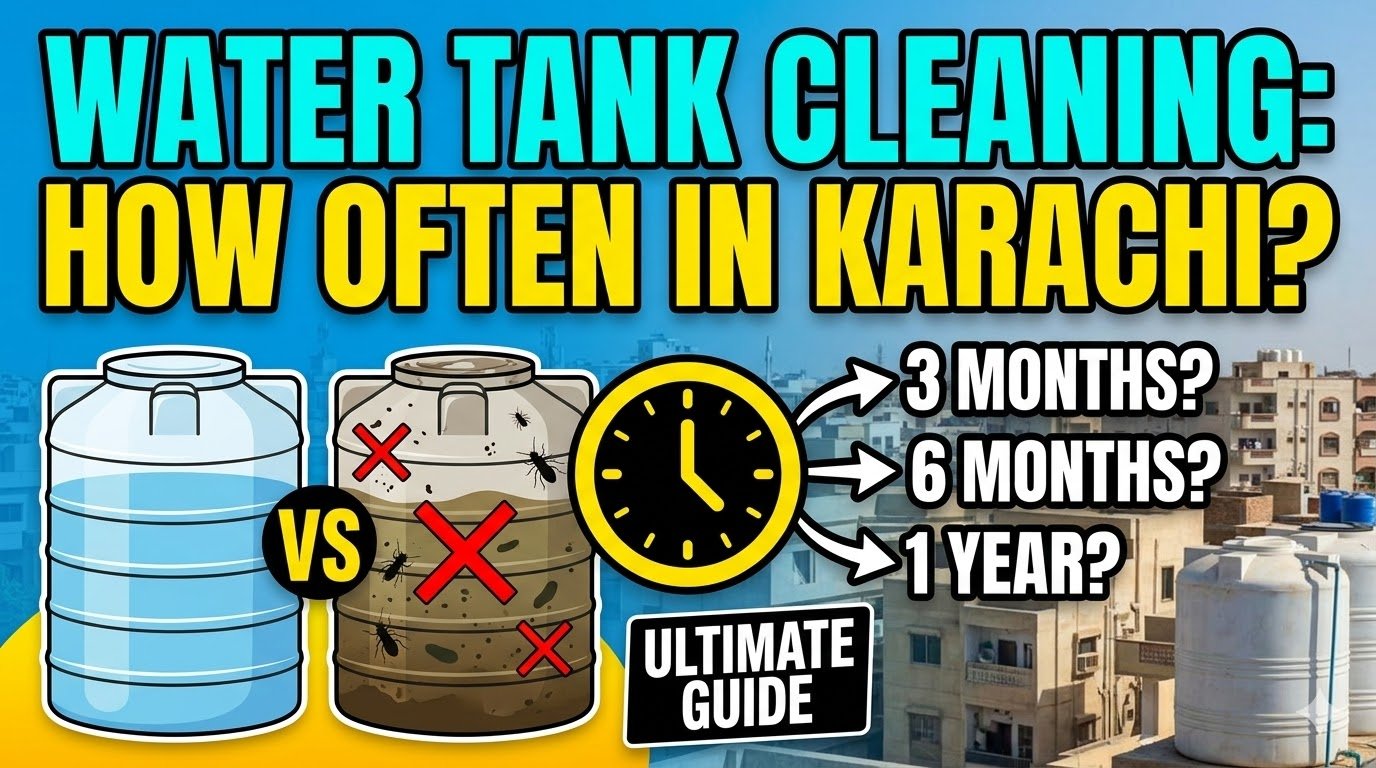
    The short answer on tank cleaning frequency in Karachi: every four to six months for a typical house, every three months for shared or tanker-fed tanks, and at least once a year before summer as an absolute floor. The rest of this article explains where those numbers come from and how to adjust them for your own property.

    The schedule at a glance

    Property and tankRecommended intervalWhy
    House, rooftop plastic or fibre tankEvery 4 to 6 monthsHeats up quickly; lids warp and let dust in
    House, underground RCC tankEvery 6 monthsCollects the most silt; exposed to seepage and flooding
    Tank filled mainly by tankerEvery 3 monthsSource and cleanliness of each load are unknown
    Apartment block, shared tanksEvery 3 monthsHigh turnover, many users, one failure affects every flat
    Restaurants, hotels, schools, clinics, officesEvery 3 months, or as your inspector or auditor requiresDuty of care to the public and staff
    Factories and warehousesEvery 3 to 6 months for drinking water tanks; process tanks per audit scheduleLegal duty to provide wholesome drinking water
    Any tank, official minimumOnce a year, before summerSindh health department advice

    These intervals are our recommendation, based on Karachi’s supply conditions and climate. They are not a legal standard for homes, and you will see other companies quote monthly cleaning. For an ordinary household that is more than is needed.

    Is there an official rule?

    For private homes there is no law setting a cleaning interval. The clearest public guidance came from the Sindh health department after the Naegleria deaths of 2025, when it advised residents to clean underground and overhead tanks annually before summer and to keep water chlorinated. Treat once a year as the minimum, not the target.

    The WHO’s guidance for building water systems is built around regular inspection and maintenance of storage, without a single fixed number, because the right interval depends on the supply. That is the important point for Karachi. A city with continuous, pressurised, chlorinated supply can clean tanks rarely. A city where a World Bank document describes supply as arriving for a few hours every day or two at very low pressure cannot.

    Workplaces are different. The Sindh Factories Act, 2015 requires every factory to make effective arrangements for a sufficient supply of wholesome drinking water (section 22), and food businesses and hospitals answer to their own regulators. For those, see our guides for factories and warehouses, hotels and restaurants and hospitals.

    Why Karachi tanks need cleaning more often than the textbook says

    • Water arrives dirty. Testing has repeatedly found most Karachi samples unsafe, and leaks, low pressure and line repairs add sediment to every fill. Our KWSB water supply guide follows the route.
    • Water is stored for days. Intermittent supply means long residence time in the tank, and any chlorine left in the water is gone well before the next turn.
    • It is warm most of the year. Legionella multiplies between 20 and 45°C according to the UK Health and Safety Executive, which also advises storing cold water below 20°C. A rooftop tank in Karachi rarely gets that cool. See how heat affects stored water.
    • Tankers fill the gaps. Each load brings whatever was in the tanker and at the hydrant.
    • Power cuts disturb the system. Pressure drops and surges stir up sediment in pipes and tanks, as explained in load shedding and water contamination.

    What moves you up or down the schedule

    Clean more often if

    • There is an infant, an elderly person or someone with a weak immune system at home
    • The tank is filled wholly or partly by tanker
    • The lid is cracked, loose or missing, even for a short time
    • The underground tank sits in a low spot or next to a sewer line
    • The building has many residents and high daily turnover
    • You use borehole water, which leaves more scale

    You can stay at the longer interval if

    • Both tanks are sealed, shaded and in good repair
    • Supply in your area is regular and mostly piped
    • The household is small and the tank is sized sensibly, so water turns over every few days
    • The last service report showed little sludge

    Does tank size change the interval?

    Indirectly. A tank that is much larger than the household needs holds water for longer, so it is older and warmer by the time it is used. A tank that is too small runs dry often, which draws the bottom layer into the pipes. Neither changes the calendar much, but both are reasons to stay at the shorter end of the range. If you are replacing a rooftop tank, size it so the water turns over every two to three days.

    How to tell whether your interval is right

    The service report from each cleaning is the best evidence. Look at the photographs of the floor before cleaning:

    • A thin dusting of silt means your interval is about right, and you could stretch it slightly.
    • A continuous layer you could draw a finger through means stay where you are.
    • A thick, dark layer or visible slime on the walls means shorten the interval by a couple of months.

    This is one reason to use a company that documents its work. Without before-and-after photographs, tank cleaning frequency in Karachi becomes guesswork.

    Clean now, whatever the calendar says

    1. Water is cloudy, coloured, or smells earthy, musty or of rotten eggs
    2. Floodwater reached the underground hatch during rain
    3. A main line failure or long outage has just ended in your area and the first water came in dirty
    4. Someone in the house has been diagnosed with typhoid, hepatitis A or E, or repeated stomach infections
    5. You found insects, larvae, a dead animal or droppings in the tank
    6. You have just moved in and do not know the tank’s history
    7. Nobody can remember the last cleaning

    More on reading these symptoms is in signs your drinking water is making you sick.

    A simple yearly plan

    WhenWhat to do
    May to JuneMain cleaning of both tanks before the monsoon and peak heat; repair lids and hatch
    September to OctoberInspect after the rains; clean again if the tank was exposed or is shared
    December to JanuarySecond routine cleaning for houses on a six-month cycle
    Every monthLook inside with a torch, check lids and mesh, note any change in smell or colour

    The pre-monsoon clean is the one not to skip. Our monsoon water risk guide explains why.

    Between cleanings

    • Keep lids closed and intact, with mesh over vents and overflows
    • Do not let the tank run completely dry and then refill at full force, which stirs the sediment
    • After a long supply break, let the first flow go to waste if you can
    • Keep the service report and note the date of the next cleaning
    • Keep boiling or filtering drinking water. A clean tank and a filter do different jobs, as set out in water filter versus tank cleaning

    What a cleaning should include

    Frequency only helps if each cleaning is thorough. A bucket, a brush and bleach every month achieves less than a proper job twice a year. The steps we follow are on our cleaning procedure page: drainage, ventilation and gas testing for underground tanks, jet washing at 3,000+ PSI, vacuum extraction, disinfection, rinse, and a dated report with photographs and a recommended next-service date. A rooftop tank takes two to four hours and an underground RCC tank four to eight. If you are comparing providers, use our questions to ask before hiring a tank cleaning company.

    To book, the instant price calculator covers standard homes, and each branch has its own page: Gulshan, Jauhar and East Karachi and DHA, Clifton and South Karachi.

    What skipping a cleaning costs

    • Filter cartridges and RO membranes that clog early
    • Scale and grit in geysers, washing machines and float valves
    • Sediment drawn into household pipes, where it is far harder to remove than from a tank
    • A longer, harder cleaning job when it is finally done
    • A higher chance of the illnesses described in our article on waterborne disease in Karachi

    Five common mistakes

    1. Cleaning only the rooftop tank. The underground tank feeds it. Clean one without the other and the dirty tank recontaminates the clean one within a fill.
    2. Waiting for the water to look dirty. By then sludge has reached the outlet level, which takes months or years.
    3. Counting a rinse as a cleaning. If no sludge left the property and nothing was disinfected, the calendar has not been reset.
    4. Cleaning straight after the supply turn. A full tank means hundreds of gallons wasted. Book for the day before your turn, when the level is low.
    5. Forgetting after one good job. The supply has not changed, so the tank will be in the same state again in a few months. Put the next date in the phone the day the report arrives.

    Frequently asked questions

    Is cleaning a tank once a year enough in Karachi?

    It is the official minimum, and far better than never. For most homes we recommend twice a year, because supply water here carries enough sediment to build a visible sludge layer in a few months.

    Do plastic tanks need cleaning as often as concrete ones?

    Yes, though for different reasons. Plastic tanks heat up and grow algae if light gets in. Concrete underground tanks gather more silt and are exposed to seepage.

    Is monthly cleaning necessary?

    Not for a household. Some commercial sites with heavy use or strict audit requirements choose monthly or bi-monthly cleaning, but a home tank in good repair does not need it.

    How do I know when the tank was last cleaned?

    A professional service should leave a dated report. If there is none, assume it is overdue and start your schedule from the next cleaning.

    Does a new tank need cleaning?

    Rinse and disinfect a new tank before first use, then treat it like any other. It will collect the same sediment from the same supply.

    Should the underground and rooftop tanks be cleaned together?

    Yes, always on the same visit.

    What is the best month to clean a water tank in Karachi?

    May or June, ahead of peak heat and the monsoon, with a second cleaning in winter for homes on a six-month cycle.

    Sources

    Figures in this article were checked in October 2026 against the following:

    About Khan Tank Cleaning

    Khan Tank Cleaning is a Karachi company that does one thing: clean and disinfect water storage tanks. It was started in 2005 by Mateen Khan and now runs branches in DHA Phase 2 and Gulshan-e-Iqbal. Read our background or reach the nearest branch on 0333 0293174 (DHA) or 0340 2717530 (Gulshan), day or night.

  • Water Filter vs Tank Cleaning: Why Filtered Water Is Not Enough

    Water Filter vs Tank Cleaning: Why Filtered Water Is Not Enough

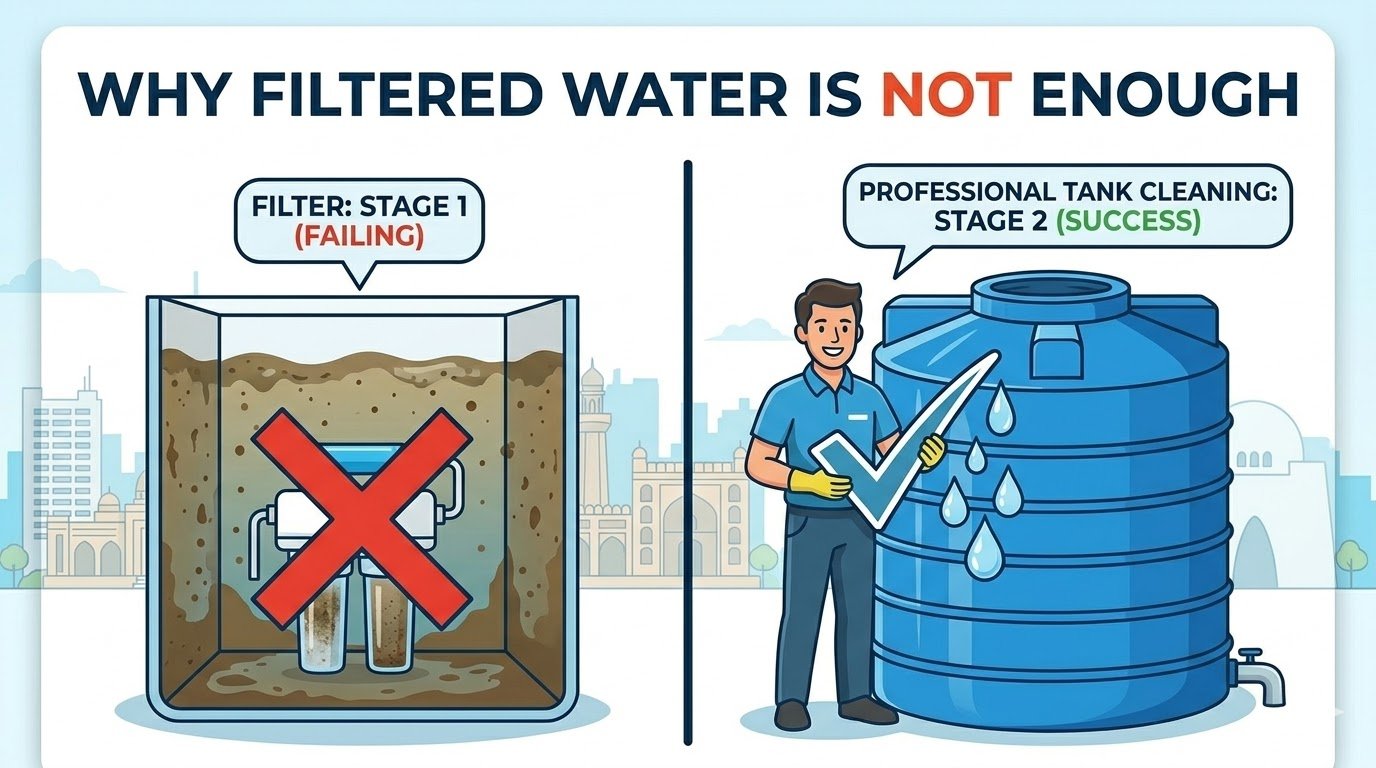
    Many Karachi households have spent good money on an RO unit or a UV filter and reasonably assume the water question is settled. A filter is worth having. It is also doing a different job from tank cleaning, and one does not replace the other.

    This article sets out the water filter vs tank cleaning question plainly: what each type of filter removes, what none of them can do about the tank feeding them, and how to get the most out of both.

    The short answer

    A filter treats the water that passes through one outlet at the moment you use it. Tank cleaning removes the sludge, biofilm and debris from the place where all of the household’s water is stored. If you only filter, every other tap in the house still delivers tank water, and the filter itself works harder and fails sooner.

    What each type of filter does

    Filter typeWhat it is good atWhat it does not do
    Sediment cartridgeTraps sand, rust and visible particlesDoes not kill or remove bacteria and viruses; clogs quickly when the tank is dirty
    Activated carbonImproves taste and smell, reduces chlorineNot a disinfection step; an old carbon cartridge can itself grow bacteria
    UV lampInactivates bacteria and viruses in clear waterLoses effectiveness in cloudy water; removes nothing; needs the lamp and sleeve maintained
    Reverse osmosis (RO)Removes dissolved salts and most contaminants, useful for brackish borehole waterTreats one tap; membranes foul with sediment; storage tank and pipework after the membrane need hygiene too
    Ceramic candleRemoves many bacteria and particles at low costSlow; cracks go unnoticed; needs regular scrubbing

    The WHO treats household water treatment as a useful barrier and stresses that its benefit depends on correct, consistent use. In other words, a filter is only as good as its last cartridge change.

    Which filter suits which Karachi water source

    The right filter depends on where your water comes from, and most Karachi homes use more than one source over a year.

    Your main sourceTypical problemSensible filter setup
    KWSC piped supplySediment and microbial contamination picked up in the networkSediment and carbon stages followed by UV, or boiling
    Tanker waterUnknown origin; may be brackish, may be contaminatedTreat as the worst case: sediment stage plus RO or UV, and boil for children
    Borehole (boring) waterHigh salts and hardness; possible sewage contamination in dense areasRO for drinking; expect heavy scale in the tank and on fittings
    A mix of all threeQuality changes from week to weekRO with UV for drinking, and a strict tank cleaning schedule

    Whatever the setup, it sits at the end of the chain. Everything upstream of it, meaning the underground tank, the rooftop tank and the pipes between them, is untreated.

    Five things no filter can do

    1. Clean the tank. Sludge on the floor and biofilm on the walls stay where they are and keep seeding the water.
    2. Treat the other taps. Bathrooms, the kitchen sink, the washing machine and the garden tap all bypass it.
    3. Protect itself from a dirty supply. Sediment blocks pre-filters and fouls RO membranes, so you pay for cartridges more often.
    4. Keep insects and animals out. A broken lid is a tank problem.
    5. Tell you it has failed. A spent UV lamp or a torn membrane gives water that looks exactly the same.

    Where unfiltered tank water reaches your family

    • Brushing teeth and rinsing the mouth
    • Showers and baths, particularly for small children
    • Wudu, where water is drawn into the nose
    • Washing dishes, fruit and vegetables
    • Ice trays filled from the kitchen tap

    The nose matters more than most people realise. Naegleria fowleri, the amoeba behind several deaths in Karachi each year, infects through the nasal passage, not through drinking. Dawn reported in June 2025 on a patient whose only exposure was ordinary water use at home and ablution at a mosque, and noted that the organism cannot survive in water that is clean, cool and adequately chlorinated. No kitchen filter addresses that route. Clean, disinfected storage does. Parents will find more on everyday exposure in our guide to children and water safety.

    What is in a tank that has not been cleaned

    • Sludge: silt, rust and organic matter delivered with every fill and tanker load.
    • Biofilm: a slippery bacterial layer on the walls that shelters organisms from residual chlorine.
    • Algae: wherever light gets in.
    • Insects and larvae: through gaps in the lid. The WHO’s dengue advice is to keep household water containers covered and cleaned.

    Karachi’s conditions make this build-up faster than in most cities. Supply is intermittent, so water is stored for days; the incoming water is frequently contaminated, as our guide to KWSB water supply explains; and rooftop tanks sit in heat that speeds up bacterial growth. Stagnant, warm water with sludge and scale is also exactly the environment that the UK Health and Safety Executive warns about in its legionella guidance for building water systems.

    Filter only, or filter plus a clean tank

    Filter onlyFilter and clean tank
    Drinking waterDepends entirely on filter conditionCleaner input, wider safety margin
    Bathing, brushing, wuduUntreated tank waterStored in a disinfected tank
    Cartridge and membrane lifeShorterLonger
    Smell and colour around the houseUnchangedUsually resolved
    Mosquito breedingNot addressedAddressed if lids are fixed

    The cost side of water filter vs tank cleaning

    People sometimes frame this as a choice because both cost money. In practice a clean tank lowers the running cost of the filter. Sediment is what blocks pre-filters and fouls RO membranes, and the tank is where the household’s sediment collects. Remove it twice a year and cartridges last closer to their rated life. A filter fed from a tank with an inch of sludge on the floor is being asked to do the tank’s job as well as its own.

    Is tank cleaning enough without a filter?

    No. A clean tank holds whatever the supply or the tanker delivers, and Karachi’s supply regularly fails testing. Monitoring by the Pakistan Council of Research in Water Resources, reported in 2021, put the share of unsafe drinking water samples in Karachi at 93 percent. Keep boiling or filtering what you drink. The honest position is that you need both, and that each makes the other work better.

    Getting the most from your filter

    • Change cartridges on the manufacturer’s schedule, and sooner if flow drops.
    • Replace the UV lamp at the stated interval even if it still glows.
    • Sanitise the RO storage tank and the dispenser tap when you change membranes.
    • If cartridges are clogging in weeks, not months, the tank is telling you something. That is one of the warning signs worth acting on.

    Getting the most from your tank

    Clean it on a schedule: every four to six months for most houses and every three months if you rely on tankers. Our article on tank cleaning frequency in Karachi gives the detail. Bucket-and-bleach scrubbing leaves the biofilm and most of the sludge behind, for reasons we set out in tank wallah versus professional cleaning.

    Our own method is on the cleaning procedure page: jet washing at 3,000+ PSI, vacuum extraction of sludge, disinfection, rinse and a report with photographs. We work across the city from two branches, covering Gulshan, Jauhar and East Karachi and DHA, Clifton and South Karachi, and the price calculator gives a fixed quote for standard homes.

    Is it the tank or the filter? A quick diagnosis

    What you noticeMore likely the tankMore likely the filter
    Bad smell at every tap in the houseYesNo
    Bad taste only from the filtered tapNoYes: an old carbon cartridge or a dirty filter housing
    Brown water after the motor runsYes: sludge is being stirredNo
    Flow from the filter has slowedOften: sediment from the tankAlso possible: cartridge at the end of its life
    Slime inside the filter housingPossibly: biofilm carried from the tankYes: housing not sanitised at cartridge changes
    Stomach upsets despite filtered drinking waterPossible: exposure through other tapsPossible: UV lamp or membrane has failed

    When the signs point both ways, deal with the tank first. A filter serviced while it is still being fed from a dirty tank will be back in the same state within weeks.

    Frequently asked questions

    I have an RO plant. Do I still need to clean the tank?

    Yes. The RO unit protects one tap. The tank supplies every other outlet, and a dirty tank shortens membrane life.

    Does a UV filter kill everything?

    A working UV lamp inactivates bacteria and viruses in clear water. It is less effective when water is cloudy, and it removes no sediment or chemicals.

    Will a clean tank make tap water safe to drink?

    Not on its own. It removes one major source of contamination, but the incoming supply is outside your control. Continue to boil or filter drinking water.

    Why do my filter cartridges turn brown so fast?

    Usually because of sediment in the tank, particularly after a supply break or a tanker delivery. Cleaning the tank typically extends cartridge life.

    Do I need a filter on the main line to protect the tank?

    A coarse sediment filter on the inlet can reduce sand and rust entering the tank, but it needs frequent cleaning in Karachi and does not stop bacteria. It is a help, not a replacement for cleaning.

    Which should I spend on first, a filter or a tank cleaning?

    If you have neither, boil drinking water from today, which costs almost nothing, and have the tank cleaned. Then add a filter suited to your water source.

    Sources

    Figures in this article were checked in October 2026 against the following:

    About Khan Tank Cleaning

    Written by the team at Khan Tank Cleaning, which has worked on Karachi’s water tanks since 2005 under founder Mateen Khan. Some of the organisations we clean for are listed on our clients page. To talk to a branch, use the contact page or call 0333 0293174 (DHA Phase 2) or 0340 2717530 (Gulshan-e-Iqbal).

  • Monsoon Water Risk in Karachi: Why Tanks Are Most Vulnerable in July and August

    Monsoon Water Risk in Karachi: Why Tanks Are Most Vulnerable in July and August

    Karachi’s monsoon is short and violent. Most of the year’s rain falls between July and early September, often in a handful of storms that flood streets within an hour. For stored water this is the riskiest stretch of the year, and the reason is not the rain itself. It is what the rain does to drains, sewers, power and the ground around your tank.

    This guide explains the monsoon water risk in Karachi from the point of view of the tank owner: how contamination gets in, which tanks are most exposed, and a simple before, during and after plan.

    In brief

    • The danger is not rain falling into a tank. It is flooded ground, overflowing sewers and low pressure in leaking mains.
    • Underground tanks with a hatch at floor level are the most exposed.
    • Clean in June, before the rains, and fix the lid and hatch at the same time.
    • After flooding, clean first and disinfect second. Chlorine tablets alone are not enough.
    • Boil drinking water for the whole household through the season.

    Why the rains are a water quality problem

    Sewers and storm drains overflow together

    In heavy rain, sewage and stormwater end up in the same flooded streets. Water mains run through that ground. Karachi’s supply is intermittent and, according to a World Bank project document, often delivered at very low pressure, and the same document estimates that more than half the water put into the network is lost through leaks and other losses. A leaking pipe sitting in flooded, sewage-laden soil with little or no pressure inside it is an open door.

    Underground tanks sit below flood level

    Most Karachi houses have an underground tank with a hatch at or just above ground level. When the lane or courtyard floods, water finds its way in around the lid, through pipe entries and through cracks in old RCC walls. It does not take much floodwater to contaminate a full tank.

    Power fails when it is needed

    Storms bring feeder trips and long outages. Pumping stations stop, pressure in the mains drops, and household motors cannot lift water to the roof, so water sits still for longer. Then supply returns in a surge that carries disturbed sediment with it. We explain this cycle in how load shedding affects water quality.

    Warm, humid weather keeps bacteria active

    Monsoon days are slightly cooler than May and June but still warm enough for rapid bacterial growth in a rooftop tank, a point covered in our article on heat and bacterial growth in tanks. Add fresh organic matter from dirty supply water and the tank has both the temperature and the food.

    Mosquitoes breed in standing water

    Dengue cases in Karachi rise after the rains. An uncovered or loosely covered tank is a ready breeding site, and the WHO advises households to cover, empty and clean water storage containers to deny the mosquito a place to lay eggs.

    What the record shows

    Outbreaks of waterborne disease in Sindh are well documented. During the cholera outbreak of 2022, the WHO reported 234 laboratory-confirmed cases in Sindh between 15 January and 27 May, noted that most water samples tested in Karachi contained coliform bacteria, and named safe drinking water and sanitation as the most effective controls. Typhoid follows a similar pattern, and Karachi accounted for 69 percent of cases in the XDR typhoid outbreak recorded by WHO up to the end of 2018.

    We do not have reliable public figures for how much illness rises in any single monsoon, so we will not quote a percentage. What is predictable is the mechanism: flooded ground, low pressure and leaking pipes put more silt and more sewage-borne bacteria into the supply, and all of it settles in the tank at the end of the line.

    Which tanks are most exposed

    Tank or situationMain monsoon riskWhat to check
    Underground RCC tank in a low-lying laneFloodwater entering around the hatch or through cracksHatch height above ground, lid seal, wall and floor cracks
    Underground tank beside a gutter line or soak pitSewage seepage when the ground is saturatedDistance from sewer lines, damp patches or staining on the inside wall
    Rooftop plastic or fibre tankRainwater, dust and insects through a loose lid; mosquito breedingLid fit, cracks, vent and overflow mesh
    Shared tank in an apartment blockOne contamination event affects every flatWho checks it after rain, and when it was last cleaned
    Tanker-fed tankTanker water of unknown origin when piped supply failsAsk where the tanker filled; clean more often

    Low-lying parts of the city flood first, but no area is exempt. If you live in a block of flats, our article on who is responsible for an apartment building’s tank explains who should be organising the checks.

    How floodwater gets into an underground tank

    Understanding the entry points tells you what to fix. In the tanks we inspect, water gets in by four routes:

    1. Over the top. A hatch that is level with the courtyard floor lets surface water run straight in. A kerb of even four to six inches around the opening stops most of it.
    2. Around the lid. Thin steel covers rust and warp, and concrete slabs chip at the edges. Any visible gap is too much.
    3. Through pipe entries. The hole where the inlet or suction pipe passes through the wall is often left unsealed.
    4. Through the structure. Old RCC develops hairline cracks and honeycombing. When the soil outside is saturated, water pushes through under pressure, and so does anything in that soil.

    The first three are cheap repairs. The fourth needs a mason and sometimes waterproofing, and it is best done when the tank is empty after a cleaning.

    Before the rains: June

    1. Clean the tanks. If you clean once in the year, do it now. A tank that starts the season without sludge and biofilm has far less for incoming contamination to feed. The Sindh health department also advises cleaning tanks before summer each year.
    2. Fix the lid and the hatch. Replace cracked covers. If the underground hatch is flush with the floor, have a raised kerb built around it.
    3. Seal pipe entries and visible cracks. A mason can do this in an hour while the tank is empty after cleaning.
    4. Fit mesh on vents and overflows.
    5. Clear the drain nearest the tank so water runs away from the hatch, not towards it.

    During the rains

    • Keep both tanks closed. Do not open the underground hatch while the area around it is wet or flooded.
    • If the lane is flooded, switch off the motor so it does not pull doubtful water up to the roof tank.
    • Boil all drinking water for the whole household, not only for children.
    • When supply returns after a long gap, let the first flow run to waste if you can.
    • Do not send anyone into an underground tank during or just after flooding. Gas builds up in closed tanks and the risk is real, as we describe in why untrained tank cleaning is dangerous.

    After the rains: do you need to clean again?

    Not always. Use this as a guide:

    • Clean immediately if floodwater reached the hatch, if the water has changed colour or smell, if there is debris floating in the tank, or if several people in the house have fallen ill.
    • Clean within a few weeks if the underground tank is old, sits in a low spot, or you relied on tankers during the rains.
    • Inspect and carry on if the tank was cleaned in June, the lids held, the water is clear and odourless, and the tank floor looks clean when you shine a torch in.

    The symptoms that should prompt action are listed in signs your drinking water is making you sick, and children deserve particular care in this season, as covered in our guide for parents.

    Can chlorine tablets replace a cleaning?

    No, though they have a place. Tablets disinfect the water sitting in the tank. They do not remove silt from the floor or biofilm from the walls, and dirt in the water uses up chlorine before it can do its job. After flooding, the order should be: clean out the dirt, disinfect the surfaces, then refill. The WHO’s own guidance on cleaning and disinfecting storage tanks follows the same sequence of cleaning first and disinfecting second.

    How we handle monsoon call-outs

    The work follows our standard eight-step procedure: drain, ventilate and gas-test underground tanks before entry, jet wash at 3,000+ PSI, vacuum out the silt, disinfect, rinse and report. After flooding we pay particular attention to the floor corners where silt packs down, and to cracks and pipe entries, which we photograph for the service report so you can have them repaired.

    Both branches answer around the clock in the rainy season: DHA, Clifton and South Karachi on 0333 0293174 and Gulshan, Jauhar and East Karachi on 0340 2717530. You can also get an instant price online and book ahead of the rains. For the regular schedule through the rest of the year, see how often to clean a tank in Karachi.

    Monsoon water risk in Karachi for businesses and shared buildings

    Everything above applies with more force where one tank serves many people. Apartment unions, schools, restaurants and clinics should clean before the rains as a matter of routine, inspect after every major storm, and keep the dated service report on file. Our sector guides cover the detail for schools, hotels and restaurants, hospitals and factories.

    Frequently asked questions

    It rained heavily. Should I empty the tank?

    Only if there is a reason to think floodwater got in: water around the hatch, a change in colour or smell, or debris in the tank. Heavy rain on a sealed rooftop tank does not by itself call for a re-clean.

    When is the best time of year to clean a tank in Karachi?

    June, before the monsoon, and again after the rains end if the tank was exposed. Households that clean twice a year usually choose June and the winter months.

    Is rainwater that gets into a rooftop tank harmful?

    Rain itself is fairly clean, but it washes roof dust, bird droppings and debris in with it. The fix is a lid that seals.

    How quickly can you come after flooding?

    Both branches take calls 24 hours a day and aim for same-day visits. After a major storm demand is high, so call early in the day.

    Should I switch off the water motor during heavy rain?

    If the lane or courtyard around the underground tank is flooded, yes. It stops possibly contaminated water being lifted to the roof tank and spread through the house.

    Floodwater got into my underground tank. Can I still use the roof tank?

    Only if it was filled before the flooding and the motor has not run since. Use it sparingly for washing, boil anything you drink, and have both tanks cleaned before pumping again.

    Does a tank need to dry out after monsoon cleaning?

    No. After disinfection and a clear-water rinse it can be refilled straight away.

    Sources

    Figures in this article were checked in October 2026 against the following:

    About Khan Tank Cleaning

    Khan Tank Cleaning has cleaned residential, commercial and industrial water tanks in Karachi since 2005. The company was founded by Mateen Khan, who still oversees quality control at both branches. More about us, or get in touch: 0333 0293174 for DHA and South Karachi, 0340 2717530 for Gulshan and East Karachi, both answered 24 hours.

  • Children and Water Safety in Karachi: What Every Parent Should Know

    Children and Water Safety in Karachi: What Every Parent Should Know

    UNICEF estimates that 53,000 Pakistani children under five die every year from diarrhoea linked to poor water and sanitation, and that around 70 percent of households drink bacterially contaminated water. In Karachi, where piped supply arrives for a few hours at a time and every home stores water for days, a large part of that risk sits in the family’s own tank.

    This guide is about kids’ water safety in Karachi in practical terms: why children are affected first, where they actually come into contact with tank water, what to watch for, and what a parent can do this week. It is written by a tank cleaning company, not by doctors, so for anything medical the advice is simple: see your paediatrician early.

    Why children are affected first

    • Smaller bodies, faster dehydration. A bout of diarrhoea that an adult shrugs off can dehydrate a toddler within a day.
    • Developing immunity. Children under five have had less exposure and less time to build defences against common gut infections.
    • More exposure per kilo. Relative to their weight, children drink more water than adults, and they swallow bath water, suck wet fingers and drink from whichever tap is nearest.
    • Repeat infections add up. UNICEF links repeated episodes of diarrhoea to stunting, which affects almost 44 percent of children in Pakistan.

    The illnesses that matter most

    The World Health Organization lists diarrhoea, cholera, dysentery, typhoid and polio among the diseases carried by microbiologically contaminated drinking water. Three deserve a Karachi parent’s particular attention.

    Diarrhoeal disease

    This is the most common result of unsafe water and the one behind the UNICEF figure above. Most episodes are mild, but in infants the danger is dehydration, not the infection itself. Keep oral rehydration salts (ORS) at home and see a doctor quickly if a young child cannot keep fluids down, becomes unusually sleepy, or passes blood.

    Typhoid

    Karachi was the centre of the extensively drug-resistant (XDR) typhoid outbreak that began in Sindh in 2016. By December 2018, WHO had recorded 5,274 XDR cases, 69 percent of them in Karachi. In response, Pakistan became the first country to add the typhoid conjugate vaccine to routine childhood immunisation, starting in Sindh in 2019. If you are not sure your child has had it, ask your doctor or the nearest EPI centre. The vaccine reduces risk; it does not replace clean water. Our article on typhoid, E. coli and stomach infections in Karachi covers how these infections reach a household.

    Naegleria fowleri

    This is rare but almost always fatal, and Karachi sees deaths from it most years. Sindh recorded five in 2025. The amoeba does not infect through drinking. It enters through the nose when warm, unchlorinated water is forced up it during bathing, swimming or ablution. After the 2025 cases the Sindh health department advised residents to clean underground and overhead tanks at least once a year before summer and to keep water chlorinated. For children, that means supervised bathing, no jumping or dunking in tank-fed tubs and paddling pools, and a tank that is kept clean.

    Where children actually meet tank water

    Many families give their children filtered or boiled water to drink and assume the job is done. The rest of the house still runs on water straight from the tank:

    • Brushing teeth and rinsing the mouth
    • Bath time, when small children swallow water and get it up their noses
    • Washing fruit, salad, bottles, teats and sippy cups
    • Hand washing before meals
    • Ice, and drinks made in a hurry from the kitchen tap
    • School, tuition centres and relatives’ homes, where you do not control the tank at all

    For infants on formula, always prepare feeds with water that has been boiled, and wash and sterilise bottles with boiled water as well. A filter jug is not a substitute for boiling at this age.

    What a neglected tank adds to the problem

    Supply water in Karachi is often contaminated before it reaches the house, as we explain in our guide to what happens to KWSB water before it reaches your tank. A tank that has not been cleaned makes this worse in three ways. Sludge on the floor gives bacteria somewhere to live between fills. A slippery layer of biofilm on the walls protects them from the little chlorine left in the water. And a rooftop tank in a Karachi summer keeps the water warm, which is when bacteria multiply fastest.

    An open or badly fitting lid adds mosquitoes. The WHO’s dengue guidance tells households to cover, empty and clean domestic water storage containers regularly for this reason.

    Signs to take seriously

    In your childIn your water or tank
    Repeated stomach upsets or loose motions with no obvious food causeCloudy, yellowish or greenish water, especially first thing in the morning
    Two or more family members ill in the same weekAn earthy, musty or rotten-egg smell
    Fever that keeps returningGrit or fine sediment in buckets and the washing machine filter
    Skin rashes or sore eyes after bathingA slimy feel on the tank wall, or a lid that does not close

    None of these proves the tank is the cause, and clear water is not proof of safe water. They are reasons to act. The full list is in our article on signs your drinking water may be making you sick.

    Kids’ water safety in Karachi by age

    AgeMain exposureWhat to do
    0 to 6 monthsFormula and bottle washingBoil all water for feeds; sterilise bottles and teats; exclusive breastfeeding avoids the issue entirely
    6 months to 2 yearsFirst cups of water, weaning foods, bath water swallowedBoiled and cooled water only; wash fruit and bowls in boiled or filtered water; supervise baths
    2 to 5 yearsDrinking from any tap, hands in mouth, paddling poolsMake one drinking source the rule; hand washing with soap; do not fill pools from an uncleaned tank
    School ageSchool coolers and taps, tuition centres, street drinksSend a filled bottle from home; teach them not to drink from wash-basin taps

    The first two years carry the most risk. If money or time is short, concentrate effort there: boiled water for everything that goes into the child’s mouth, and a tank cleaned on time.

    Houses, flats and tanker water

    How your home gets and stores water changes what you should worry about.

    • Houses with their own tanks: you control the schedule. The usual gaps are a forgotten underground tank and a rooftop lid that no longer seals.
    • Flats with shared tanks: you depend on the union or builder. One missed cleaning affects every child in the building. Our guide to responsibility for apartment water tanks explains how to raise it.
    • Homes that rely on tankers: the source of each load is unknown, so clean more often and never give tanker water to a child without boiling it.
    • Homes on borehole water: usually salty and hard, sometimes contaminated by nearby sewers. An RO unit helps with the salt; the tank still needs cleaning.

    A parent’s checklist

    1. Boil or properly filter everything a child drinks, including water for formula, and keep the boiled water in a clean covered container.
    2. Find out when the tank was last cleaned. If nobody can remember, treat it as overdue.
    3. Check both lids today. They should close fully, with no cracks and with mesh over the vent and overflow.
    4. Clean on a schedule. Every four to six months suits most houses, and every three months is sensible with an infant at home or a tanker-fed tank. See how often to clean a water tank in Karachi.
    5. Clean after the rains. Underground tanks are at their most exposed during the monsoon. Our monsoon tank guide explains what to check.
    6. In flats, ask the union. Shared tanks are a shared responsibility, and someone should be able to tell you the date of the last cleaning.
    7. Ask the school. Children spend half their day there. Our piece on water hygiene in Karachi’s schools lists the questions worth asking.
    8. Teach the habit. Older children should know which tap or cooler is for drinking and that bath water is not.

    “We have a filter at home”

    Keep it, and keep changing the cartridges on time. A filter treats what passes through one tap. It does nothing for the bathroom, the bucket or the kitchen sink, and a dirty tank clogs it sooner. We compare the two in why filtered water is not enough.

    How a professional cleaning helps, and whether it is safe for children

    A proper cleaning removes what rinsing cannot: jet washing at 3,000+ PSI strips biofilm from the walls, a vacuum takes the sludge out rather than stirring it, and the surfaces are disinfected and rinsed before refilling. The steps are set out on our cleaning procedure page.

    Parents usually ask about the disinfectant. We use silver-stabilised hydrogen peroxide, which breaks down into water and oxygen, and the tank is rinsed until the water runs clear before it is put back into use. There is more detail in our article on silver hydrogen peroxide disinfection. Once the tank has refilled, the water can be used as normal for the whole family. Keep boiling or filtering what children drink, because a clean tank cannot fix the supply that fills it.

    Families in the east of the city are served by our Gulshan and Jauhar branch and those in the south by our DHA and Clifton branch. For a standard house you can get a price in a minute from the online calculator.

    Frequently asked questions

    Is boiled water enough to keep my child safe?

    For drinking, boiling is the most reliable household method against germs. It does not help with bathing, tooth brushing or washing bottles unless you use boiled water for those too, which is why the tank still matters.

    How often should the tank be cleaned if there is a baby in the house?

    We suggest every three months while there is an infant at home, and straight after any flooding, discoloured water or a long supply break.

    Can my child use the water on the day the tank is cleaned?

    Yes, once the tank has been rinsed and refilled. Store a few buckets and some drinking water beforehand, because the tank is out of use for a few hours during the work.

    My child keeps getting stomach infections. Is it the tank?

    It may be one of several causes, including food, school and hand hygiene. See your doctor first. Checking and cleaning the tank removes one likely source and is easy to rule out.

    Is bottled water safer for children than boiled tank water?

    A sealed bottle from a reputable brand is generally safe to drink. Properly boiled water is equally safe and far cheaper. Neither covers bathing, brushing or bottle washing, so the tank still matters.

    Should I worry about bath water for a baby?

    Babies swallow bath water and get it on their faces. Use water from a clean tank, keep it out of the nose and mouth as far as you can, and for newborns many parents add boiled water to the bath.

    What is the single most useful thing a parent can do?

    Boil or filter every drop a young child drinks, and put the tank on a fixed cleaning schedule so it is never a question of memory.

    Sources

    Figures in this article were checked in October 2026 against the following:

    About Khan Tank Cleaning

    This guide is published by Khan Tank Cleaning, a Karachi water tank cleaning company founded in 2005 by Mateen Khan. We work from two branches, DHA Phase 2 and Gulshan-e-Iqbal, and you can read more about the company or contact either branch at any hour. Call or WhatsApp 0333 0293174 (DHA) or 0340 2717530 (Gulshan).