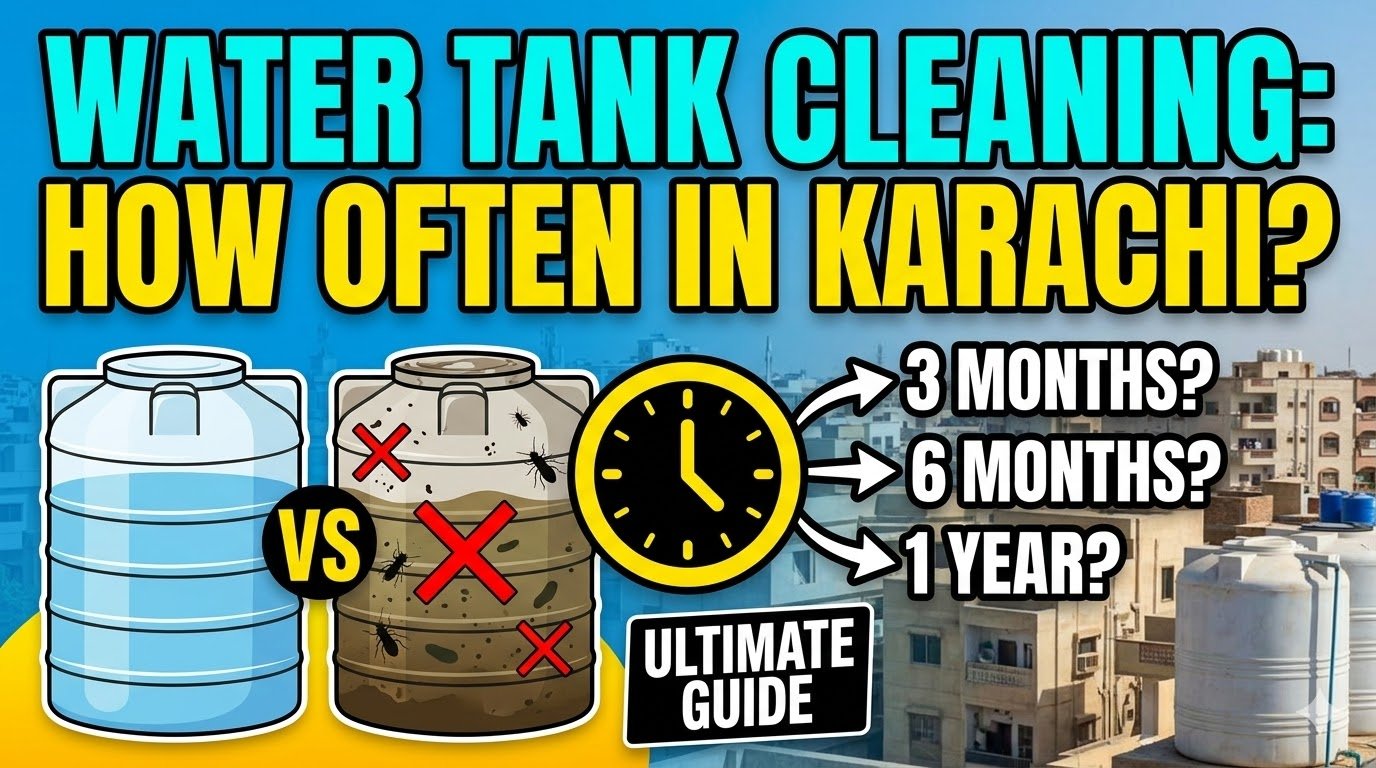
The short answer on tank cleaning frequency in Karachi: every four to six months for a typical house, every three months for shared or tanker-fed tanks, and at least once a year before summer as an absolute floor. The rest of this article explains where those numbers come from and how to adjust them for your own property.
The schedule at a glance
| Property and tank | Recommended interval | Why |
|---|---|---|
| House, rooftop plastic or fibre tank | Every 4 to 6 months | Heats up quickly; lids warp and let dust in |
| House, underground RCC tank | Every 6 months | Collects the most silt; exposed to seepage and flooding |
| Tank filled mainly by tanker | Every 3 months | Source and cleanliness of each load are unknown |
| Apartment block, shared tanks | Every 3 months | High turnover, many users, one failure affects every flat |
| Restaurants, hotels, schools, clinics, offices | Every 3 months, or as your inspector or auditor requires | Duty of care to the public and staff |
| Factories and warehouses | Every 3 to 6 months for drinking water tanks; process tanks per audit schedule | Legal duty to provide wholesome drinking water |
| Any tank, official minimum | Once a year, before summer | Sindh health department advice |
These intervals are our recommendation, based on Karachi’s supply conditions and climate. They are not a legal standard for homes, and you will see other companies quote monthly cleaning. For an ordinary household that is more than is needed.
Is there an official rule?
For private homes there is no law setting a cleaning interval. The clearest public guidance came from the Sindh health department after the Naegleria deaths of 2025, when it advised residents to clean underground and overhead tanks annually before summer and to keep water chlorinated. Treat once a year as the minimum, not the target.
The WHO’s guidance for building water systems is built around regular inspection and maintenance of storage, without a single fixed number, because the right interval depends on the supply. That is the important point for Karachi. A city with continuous, pressurised, chlorinated supply can clean tanks rarely. A city where a World Bank document describes supply as arriving for a few hours every day or two at very low pressure cannot.
Workplaces are different. The Sindh Factories Act, 2015 requires every factory to make effective arrangements for a sufficient supply of wholesome drinking water (section 22), and food businesses and hospitals answer to their own regulators. For those, see our guides for factories and warehouses, hotels and restaurants and hospitals.
Why Karachi tanks need cleaning more often than the textbook says
- Water arrives dirty. Testing has repeatedly found most Karachi samples unsafe, and leaks, low pressure and line repairs add sediment to every fill. Our KWSB water supply guide follows the route.
- Water is stored for days. Intermittent supply means long residence time in the tank, and any chlorine left in the water is gone well before the next turn.
- It is warm most of the year. Legionella multiplies between 20 and 45°C according to the UK Health and Safety Executive, which also advises storing cold water below 20°C. A rooftop tank in Karachi rarely gets that cool. See how heat affects stored water.
- Tankers fill the gaps. Each load brings whatever was in the tanker and at the hydrant.
- Power cuts disturb the system. Pressure drops and surges stir up sediment in pipes and tanks, as explained in load shedding and water contamination.
What moves you up or down the schedule
Clean more often if
- There is an infant, an elderly person or someone with a weak immune system at home
- The tank is filled wholly or partly by tanker
- The lid is cracked, loose or missing, even for a short time
- The underground tank sits in a low spot or next to a sewer line
- The building has many residents and high daily turnover
- You use borehole water, which leaves more scale
You can stay at the longer interval if
- Both tanks are sealed, shaded and in good repair
- Supply in your area is regular and mostly piped
- The household is small and the tank is sized sensibly, so water turns over every few days
- The last service report showed little sludge
Does tank size change the interval?
Indirectly. A tank that is much larger than the household needs holds water for longer, so it is older and warmer by the time it is used. A tank that is too small runs dry often, which draws the bottom layer into the pipes. Neither changes the calendar much, but both are reasons to stay at the shorter end of the range. If you are replacing a rooftop tank, size it so the water turns over every two to three days.
How to tell whether your interval is right
The service report from each cleaning is the best evidence. Look at the photographs of the floor before cleaning:
- A thin dusting of silt means your interval is about right, and you could stretch it slightly.
- A continuous layer you could draw a finger through means stay where you are.
- A thick, dark layer or visible slime on the walls means shorten the interval by a couple of months.
This is one reason to use a company that documents its work. Without before-and-after photographs, tank cleaning frequency in Karachi becomes guesswork.
Clean now, whatever the calendar says
- Water is cloudy, coloured, or smells earthy, musty or of rotten eggs
- Floodwater reached the underground hatch during rain
- A main line failure or long outage has just ended in your area and the first water came in dirty
- Someone in the house has been diagnosed with typhoid, hepatitis A or E, or repeated stomach infections
- You found insects, larvae, a dead animal or droppings in the tank
- You have just moved in and do not know the tank’s history
- Nobody can remember the last cleaning
More on reading these symptoms is in signs your drinking water is making you sick.
A simple yearly plan
| When | What to do |
|---|---|
| May to June | Main cleaning of both tanks before the monsoon and peak heat; repair lids and hatch |
| September to October | Inspect after the rains; clean again if the tank was exposed or is shared |
| December to January | Second routine cleaning for houses on a six-month cycle |
| Every month | Look inside with a torch, check lids and mesh, note any change in smell or colour |
The pre-monsoon clean is the one not to skip. Our monsoon water risk guide explains why.
Between cleanings
- Keep lids closed and intact, with mesh over vents and overflows
- Do not let the tank run completely dry and then refill at full force, which stirs the sediment
- After a long supply break, let the first flow go to waste if you can
- Keep the service report and note the date of the next cleaning
- Keep boiling or filtering drinking water. A clean tank and a filter do different jobs, as set out in water filter versus tank cleaning
What a cleaning should include
Frequency only helps if each cleaning is thorough. A bucket, a brush and bleach every month achieves less than a proper job twice a year. The steps we follow are on our cleaning procedure page: drainage, ventilation and gas testing for underground tanks, jet washing at 3,000+ PSI, vacuum extraction, disinfection, rinse, and a dated report with photographs and a recommended next-service date. A rooftop tank takes two to four hours and an underground RCC tank four to eight. If you are comparing providers, use our questions to ask before hiring a tank cleaning company.
To book, the instant price calculator covers standard homes, and each branch has its own page: Gulshan, Jauhar and East Karachi and DHA, Clifton and South Karachi.
What skipping a cleaning costs
- Filter cartridges and RO membranes that clog early
- Scale and grit in geysers, washing machines and float valves
- Sediment drawn into household pipes, where it is far harder to remove than from a tank
- A longer, harder cleaning job when it is finally done
- A higher chance of the illnesses described in our article on waterborne disease in Karachi
Five common mistakes
- Cleaning only the rooftop tank. The underground tank feeds it. Clean one without the other and the dirty tank recontaminates the clean one within a fill.
- Waiting for the water to look dirty. By then sludge has reached the outlet level, which takes months or years.
- Counting a rinse as a cleaning. If no sludge left the property and nothing was disinfected, the calendar has not been reset.
- Cleaning straight after the supply turn. A full tank means hundreds of gallons wasted. Book for the day before your turn, when the level is low.
- Forgetting after one good job. The supply has not changed, so the tank will be in the same state again in a few months. Put the next date in the phone the day the report arrives.
Frequently asked questions
Is cleaning a tank once a year enough in Karachi?
It is the official minimum, and far better than never. For most homes we recommend twice a year, because supply water here carries enough sediment to build a visible sludge layer in a few months.
Do plastic tanks need cleaning as often as concrete ones?
Yes, though for different reasons. Plastic tanks heat up and grow algae if light gets in. Concrete underground tanks gather more silt and are exposed to seepage.
Is monthly cleaning necessary?
Not for a household. Some commercial sites with heavy use or strict audit requirements choose monthly or bi-monthly cleaning, but a home tank in good repair does not need it.
How do I know when the tank was last cleaned?
A professional service should leave a dated report. If there is none, assume it is overdue and start your schedule from the next cleaning.
Does a new tank need cleaning?
Rinse and disinfect a new tank before first use, then treat it like any other. It will collect the same sediment from the same supply.
Should the underground and rooftop tanks be cleaned together?
Yes, always on the same visit.
What is the best month to clean a water tank in Karachi?
May or June, ahead of peak heat and the monsoon, with a second cleaning in winter for homes on a six-month cycle.
Sources
Figures in this article were checked in October 2026 against the following:
- Geo News, 13 September 2025: Naegleria claims another life in Karachi, toll hits five in Sindh
- World Bank, 2019: Karachi Water and Sewerage Services Improvement Project, project information document
- The Sindh Factories Act, 2015
- UK Health and Safety Executive: Managing legionella in hot and cold water systems
- WHO: Guidelines for Drinking-water Quality
About Khan Tank Cleaning
Khan Tank Cleaning is a Karachi company that does one thing: clean and disinfect water storage tanks. It was started in 2005 by Mateen Khan and now runs branches in DHA Phase 2 and Gulshan-e-Iqbal. Read our background or reach the nearest branch on 0333 0293174 (DHA) or 0340 2717530 (Gulshan), day or night.

Mateen Khan is the Founder & Owner of Khan Tank Cleaning, Karachi’s first dedicated professional water tank cleaning company (est. 2005). With 20+ years of industry experience, he leads an ISO 9001 & ISO 45001 certified team that follows a strict 8-step process using industrial equipment and food-grade disinfectants. Mateen is committed to making clean, safe water accessible to every household and business in Karachi.