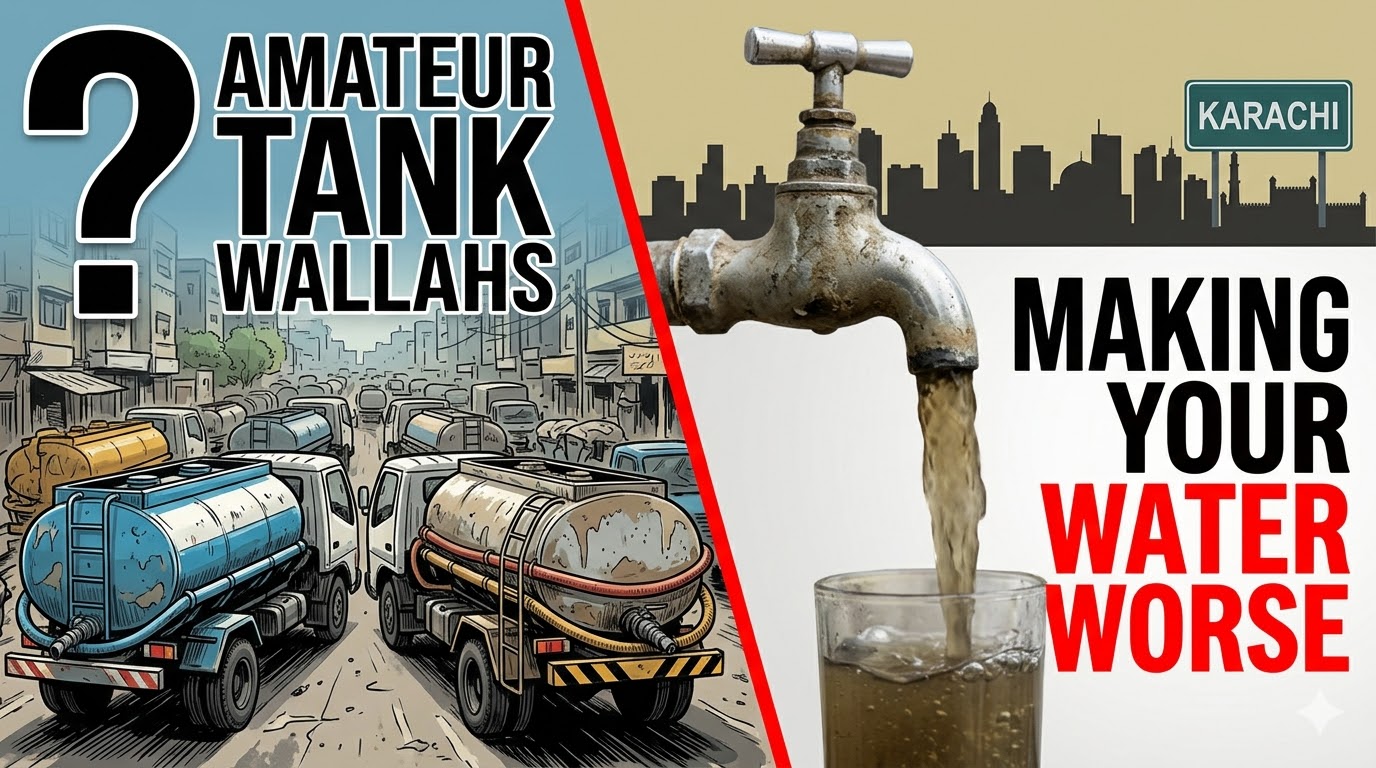
Every week, thousands of Karachi families unknowingly drink, cook with, and bathe in water contaminated not by the municipal supply alone — but by the very people they paid to clean their tanks. The amateur ‘tank wallah’ — the informal labourer who shows up with a bucket, a rag, and little else — has become one of the biggest hidden health threats in Pakistani urban homes.
Karachi’s water infrastructure presents unique challenges. Water is typically stored in rooftop plastic tanks or underground concrete chambers for days at a time before use. In a city where summer temperatures soar past 40°C, standing water becomes a breeding ground for bacteria, algae, and sediment at an alarming rate. Cleaning this storage is not optional — it is essential. But how it is cleaned matters enormously.
This article explains exactly why amateur tank cleaning in Karachi is not just ineffective — it is actively dangerous — and what a genuine professional service looks like.
1. The Amateur ‘Tank Wallah’: Who Are They?
You’ve seen them. They circulate in neighbourhoods like Gulshan-e-Iqbal, Gulistan-e-Johar, North Nazimabad, DHA, and Clifton, often advertising verbally or via a handwritten flyer. They offer cheap rates, same-day availability, and a confident smile. In most cases, their ‘equipment’ consists of:
- A bucket and rope
- A worn scrubbing brush or old cloth
- No protective gear
- No professional disinfectant
- No training in confined space safety
They are not licensed, not trained, and not equipped to handle the biological and chemical realities of a contaminated water tank. Yet their low prices make them attractive, particularly to budget-conscious homeowners who assume that ‘any cleaning is better than none.’ This assumption, as we will show, is dangerously wrong.
2. Six Ways Amateur Cleaners Are Making Your Water Worse
2.1 They Cannot Remove Biofilm — They Spread It
Biofilm is an invisible slime layer produced by colonies of bacteria that attach to tank surfaces. In Karachi’s warm climate, biofilm establishes itself quickly on plastic and concrete surfaces alike. Manual scrubbing with a brush does not remove biofilm — it breaks it up and spreads it across the tank walls. Within 48 hours, the bacterial colonies reassemble and multiply. Only industrial-grade high-pressure jet washing can physically blast biofilm off tank surfaces.
2.2 Sludge Is Moved, Not Removed
Sludge — the dark, heavy sediment that settles at the bottom of your tank — contains heavy metals, dead organic matter, and concentrated bacterial colonies. An amateur will scoop out visible debris, but the remaining sludge suspension is stirred through the water. Professional services use industrial vacuum extraction to physically remove all sediment. Without this step, you are bathing in what was left behind.
2.3 Wrong Chemicals or No Chemicals at All
Many amateur cleaners use household chlorine bleach at incorrect concentrations — either too weak to disinfect or so strong that it contaminates your drinking water with harmful chlorine residue. Reputable professional services use food-grade disinfectants such as Silver Hydrogen Peroxide, which is specifically designed for potable water systems, is effective against bacteria, viruses, and biofilm, and is safe for human consumption at proper concentrations. The amateur simply doesn’t know the difference.
2.4 Underground Tanks Are a Serious Safety Risk
Karachi has tens of thousands of underground storage tanks, common in older residential areas like Nazimabad, PECHS, Saddar, and Liaquatabad. These confined spaces accumulate hydrogen sulphide and carbon dioxide, creating an immediate asphyxiation risk. Amateur cleaners enter without oxygen monitoring equipment, gas detectors, or rescue harnesses. In recent years, multiple incidents of workers collapsing inside confined water tanks have been reported across Pakistan. A professional service deploys oxygen safety systems, forced ventilation, and full body protective equipment before any person enters the space.
2.5 No Before-and-After Verification
An amateur cleaner has no way to verify whether their cleaning was effective. There is no water quality check, no inspection of tank integrity, no documentation. You are trusting your family’s health entirely to a visual inspection performed by an unqualified individual. Professional services conduct systematic inspections and can identify cracks, leakages, and structural issues that could allow ground contamination to enter your tank — a particularly critical issue for underground tanks in older Karachi neighbourhoods.
2.6 They Make Your Water Purifier Work Harder — and Fail Faster
If you have a Reverse Osmosis (RO) or gravity filter installed, you may believe your water is protected regardless of tank cleanliness. This is a costly misunderstanding. A heavily contaminated tank sends turbid, bacteria-laden water to your filter, clogging membranes, exhausting filter media prematurely, and in severe cases, overwhelming the filter entirely. Regular professional tank cleaning actively extends the life of your water purification system.
3. Karachi’s Water Challenge: Why the Stakes Are Higher Here
Karachi faces water quality challenges that make professional tank maintenance more critical than in many other cities:
- Municipal water supply arrives once or twice per week in most areas, meaning stored water sits in tanks for 5–7 days before use
- Average summer temperatures exceed 40°C, dramatically accelerating bacterial growth in stored water
- Water supply lines pass through aging infrastructure prone to cross-contamination and sediment ingress
- Many areas rely on tanker water of uncertain quality, introducing additional microbial loads into tanks
- A significant portion of Karachi’s housing stock uses concrete underground tanks that are particularly prone to algae colonisation and structural seepage
The most common waterborne illnesses reported in Karachi — including gastroenteritis, typhoid, hepatitis A, and skin infections — are directly linked to contaminated stored water. According to public health research, contaminated household water storage is among the leading contributing factors to preventable disease burden in urban Pakistan. Your tank is not a passive container; it is an active part of your family’s daily health.
4. What a Genuine Professional Water Tank Cleaning Looks Like
When you book a professional service, there are clear non-negotiable standards that should be met. At Khan Tank Cleaning, every job follows a structured, multi-step process:
- Full drainage of the tank using appropriate pumping equipment
- Industrial high-pressure jet washing to remove biofilm and hardened deposits from all surfaces
- Industrial vacuum extraction of all sludge and debris — nothing is left behind
- Application of food-grade Silver Hydrogen Peroxide disinfectant as the primary agent, safe for potable water
- Structural inspection of tank walls, base, lid seal, and inlet/outlet connections
- For underground tanks: deployment of oxygen safety systems, gas monitoring, and fall protection before entry
- Post-service refill and final inspection before sign-off
If you are located in the Gulshan-e-Iqbal or Gulistan-e-Johar belt, our dedicated water tank cleaning service in Gulshan and Johar team covers your entire area with priority response times and deep familiarity with the local housing stock, from multi-storey apartment buildings in Johar to older bungalows in Gulshan Block 7 and beyond.
For residents and businesses in DHA, Clifton, and surrounding premium localities, our specialist water tank cleaning service in DHA and Clifton operates with the same rigorous standards — handling everything from single-unit rooftop tanks in Phase 4 and 6 bungalows to large-capacity tanks serving DHA commercial plazas, housing society water supply systems, and farmhouses along the Karachi outskirts.
5. The Real Cost Comparison: Cheap vs. Professional
| Amateur Cleaner (per visit): Rs. 500 – 1,500 |
| Professional Tank Cleaning (per visit): Contact for quote based on tank size |
| Cost of treating one child for typhoid fever (hospitalization): Rs. 20,000 – 80,000+ |
| Cost of replacing a failed RO filter prematurely: Rs. 5,000 – 15,000 |
| Cost of one hospitalisation due to waterborne illness: Rs. 25,000 – 100,000+ |
The maths are not complicated. The question is not whether you can afford a professional service — it is whether you can afford the consequences of skipping one.
6. How Often Should Your Tank Be Cleaned Professionally?
The general guidance from water quality experts is:
- Overhead (rooftop) tanks: Every 3–6 months, more frequently during summer or if the water supply source changes
- Underground tanks: Every 6 months minimum, with structural inspection annually
- Commercial, office, or housing society tanks: Every 3 months, given higher daily throughput and usage patterns
- After any incident of water discolouration, unusual odour, or reported illness in the household: Immediately
Khan Tank Cleaning covers all residential and commercial properties across Karachi. Whether you are in a single-family home in Defence, a multi-storey apartment in Gulistan-e-Johar, a shop in Saddar, or a factory in Korangi, the same professional standards apply.
7. Questions to Ask Before Hiring Any Tank Cleaning Service
Do not hire anyone — including a professional company — without asking these questions:
- Do you use industrial high-pressure equipment or manual scrubbing?
- What specific disinfectant do you use, and is it safe for potable water?
- Do you use vacuum extraction to remove sludge?
- For underground tanks, do you carry oxygen safety and gas monitoring equipment?
- Do you conduct a post-cleaning inspection?
- Are your staff trained and do they use proper protective equipment?
Any hesitation or vague answer to these questions is a red flag. Your family’s water deserves the same scrutiny you would apply to any other health service.
| 💧 Protect Your Family’s Water Today |
| Book a Professional Tank Cleaning Service with Khan Tank Cleaning |
| Khan Tank Cleaning is Karachi’s dedicated professional water tank cleaning company — the only firm in the city exclusively focused on this service. Our trained, equipment-equipped teams operate across all Karachi areas. |
| ✅ Gulshan-e-Iqbal & Gulistan-e-Johar area? |
| Book our Gulshan-Johar branch → khantankcleaning.com/water-tank-cleaning-gulshan-jauhar-karachi |
| ✅ DHA, Clifton & nearby areas? |
| Book our DHA-Clifton branch → khantankcleaning.com/water-tank-cleaning-dha-clifton-karachi |
| ✅ Rest of Karachi? |
| Call us on: 0340-2717530 | Available 24/7 |
| Don’t wait for illness to remind you. Schedule your tank cleaning today. |
Khan Tank Cleaning — Karachi’s First & Only Dedicated Professional Tank Cleaning Company
khantankcleaning.com

Mateen Khan is the Founder & Owner of Khan Tank Cleaning, Karachi’s first dedicated professional water tank cleaning company (est. 2005). With 20+ years of industry experience, he leads an ISO 9001 & ISO 45001 certified team that follows a strict 8-step process using industrial equipment and food-grade disinfectants. Mateen is committed to making clean, safe water accessible to every household and business in Karachi.
Leave a Reply