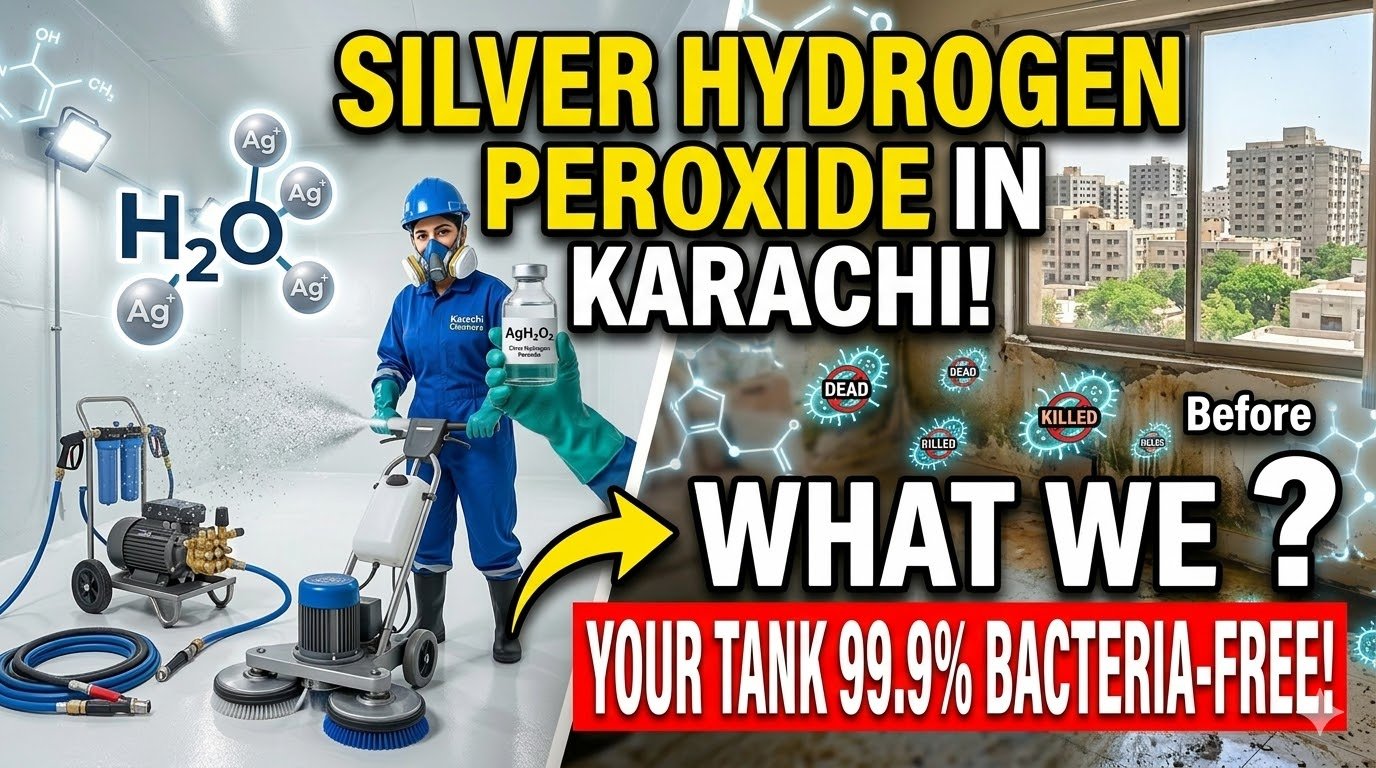
Silver hydrogen peroxide is the disinfectant we use on most of the water tanks we clean. Customers ask what it is, whether it is safe for a drinking water tank, and why we do not simply use chlorine. This article answers those questions as plainly as we can, including the limits of the product.
One point before anything else. No disinfectant, this one included, makes a dirty tank safe. Silver hydrogen peroxide tank disinfection is the second half of a job whose first half is physically removing sludge and biofilm.
In brief
- Silver hydrogen peroxide is hydrogen peroxide stabilised with a trace of silver.
- It disinfects by oxidation and breaks down into water and oxygen.
- It is applied to the surfaces of an emptied, cleaned tank and then rinsed off.
- It leaves no taste or smell, and no lasting residual in the water.
- It is an alternative to chlorine for surface disinfection, not a replacement for cleaning.
What is silver hydrogen peroxide?
It is a solution of hydrogen peroxide (H2O2) with a very small amount of silver added. You will also see it written as silver-stabilised hydrogen peroxide, silver peroxide, or H2O2 with silver. The two components do different things:
- Hydrogen peroxide is the main disinfectant. It is a strong oxidiser, the same chemical used in dilute form as an antiseptic, and after it has reacted it breaks down into water and oxygen.
- Silver is present at trace levels. It stabilises the peroxide so that it does not decompose too quickly, and silver ions have their own antimicrobial effect, which has been known for well over a century.
Commercial products are supplied as concentrates and diluted for use according to the size of the tank and the job.
How it disinfects
Hydrogen peroxide works by oxidation. It damages the cell walls, proteins and genetic material of bacteria, viruses and fungi on contact. Silver ions interfere with the enzymes microbes need to function. Used together, the peroxide does the fast work and the silver slows the peroxide’s breakdown, giving it longer to act on the surface.
It is applied to the emptied, cleaned tank: walls, floor, ceiling and fittings are wetted with the diluted solution, left for the contact time, and then rinsed. It is a surface disinfection step, carried out between cleaning and refilling.
What the regulators say
- Hydrogen peroxide is an approved biocidal active substance in the European Union for several uses, including product-type 5, which is drinking water disinfection (Commission Implementing Regulation (EU) 2015/1730).
- Silver: the WHO Guidelines for Drinking-water Quality set no formal guideline value for silver and state that concentrations of up to 0.1 mg/L can be tolerated without risk to health. The traces left on a rinsed tank surface are far below that.
- Silver on its own: the WHO reviewed silver as a drinking-water disinfectant in 2018 alongside bromine and iodine. Silver alone acts slowly, which is one reason it is used here as a partner to peroxide and not by itself.
- Chlorine remains, in the WHO’s words, the disinfectant of choice for public drinking-water supplies, and it is what the Sindh health department recommends to households.
We mention the last point because some companies present silver hydrogen peroxide as a replacement for chlorine in every situation. It is not. They are different tools.
Silver hydrogen peroxide vs chlorine
| Silver hydrogen peroxide | Chlorine (hypochlorite) | |
|---|---|---|
| Breakdown products | Water and oxygen | Chloride; can form by-products with organic matter |
| Taste and smell after rinsing | None | Can linger if not rinsed well |
| Effect on tank materials | Gentle on concrete, plastic and fibreglass at use dilution | Can corrode metal fittings at high doses |
| Lasting protection in stored water | None once it has broken down | Leaves a residual that keeps working for a time |
| Track record | Widely used for surface and system disinfection | Over a century as the standard for drinking water |
| Cost | Higher | Low |
| Affected by leftover dirt | Yes | Yes, strongly |
Our practice follows from that table. For routine cleaning we use silver hydrogen peroxide, because it leaves no taste or smell and is easy on the tank. For heavily contaminated tanks, for example after sewage seepage or flooding, we use food-grade chlorine at a controlled concentration followed by a full rinse. Both are listed on our cleaning procedure page. What we do not use is industrial acid, raw household bleach or any unlabelled product.
Is it safe for my family?
Used correctly, yes. Three things make it so:
- Dilution. The solution applied to the tank is a fraction of the concentrate’s strength.
- Breakdown. Hydrogen peroxide decomposes to water and oxygen. Nothing persistent is left behind.
- Rinsing. After the contact time the tank is rinsed until the water runs clear, before it is refilled.
After refilling, the water can be used as normal by everyone in the house, including children and pregnant women. The concentrate itself is a different matter: it is corrosive, needs gloves and eye protection, and should never be stored or handled by householders. That is the crew’s job.
What it does not do
- It does not replace cleaning. Sludge and thick biofilm shield bacteria and use up any oxidiser. They have to be removed mechanically first, which is why jet washing and vacuum extraction come before disinfection.
- It does not keep working for months. Once the peroxide has broken down there is no lasting residual in the water. Claims of long-term protection are overstated.
- It does not make incoming water safe. The next fill brings whatever the supply or tanker delivers. Our guide to KWSB water supply explains why that is often contaminated.
- It does not justify a “99.9% bacteria-free” promise. Kill rates of that kind come from laboratory tests on clean surfaces. A real tank is judged by whether the sludge and biofilm are gone and the disinfection step was done properly.
So you still need to treat drinking water and clean on a schedule. See water filter versus tank cleaning and how often to clean a tank in Karachi.
Four common myths
| Myth | Reality |
|---|---|
| “It keeps the tank germ-free for months” | It works on contact and then breaks down. Nothing stays in the water to protect the next fill. |
| “It dissolves sludge and biofilm” | It weakens surface film but cannot get through thick deposits. Those are removed with a jet and a vacuum first. |
| “It is chemical-free” | It is a chemical, and the concentrate is hazardous to handle. What is true is that it leaves no harmful residue after rinsing. |
| “Chlorine is outdated” | Chlorine remains the world’s standard drinking-water disinfectant and is the right choice in some situations. |
Where silver hydrogen peroxide tank disinfection sits in the cleaning sequence
- Survey and written quote
- Controlled drainage
- Ventilation and gas check for underground tanks
- Jet washing at 3,000+ PSI to detach biofilm
- Vacuum extraction of sludge
- Disinfection: silver hydrogen peroxide applied to every internal surface, at a concentration matched to the tank volume, and left for the contact time
- Rinse until clear, and inspection of walls, joints and lid
- Dated report with photographs, and invoice
Each step is described in what happens during a professional tank cleaning.
Why this matters in Karachi
Stored water here is warm for most of the year and often arrives contaminated, conditions in which bacteria regrow quickly on any film left on the walls. The organisms of most concern are described in waterborne disease in Karachi, and the effect of temperature in heat and bacteria in water tanks. Naegleria fowleri, which has caused deaths in Karachi most years since 2012, is controlled by keeping tanks clean and water chlorinated, according to Sindh health department advice. If Naegleria is your main concern, ask us about chlorine disinfection and about keeping a chlorine residual in the tank afterwards.
Questions to ask any provider about their disinfectant
- What is the product called, and can I see the label?
- Is it intended for drinking water tanks?
- How do you decide the dose for my tank?
- How long do you leave it before rinsing?
- How do you rinse, and how do I know it is rinsed out?
More questions of this kind are in what to ask before hiring a tank cleaning company.
Booking a cleaning
We clean and disinfect tanks across Karachi from two branches: DHA, Clifton and South Karachi and Gulshan, Jauhar and East Karachi. For a standard home, the price calculator gives a fixed quote.
Frequently asked questions
Is silver hydrogen peroxide better than chlorine?
It is better on taste, smell and gentleness to the tank. Chlorine is cheaper, has a longer track record and leaves a protective residual. For routine surface disinfection of a cleaned tank either works when dosed and rinsed correctly.
Will my water taste different after the cleaning?
It should not. Hydrogen peroxide leaves no taste or smell once rinsed. Any taste from chlorine, where we have used it, fades within a fill or two.
How soon can we use the water?
As soon as the tank has been rinsed and refilled.
Can I buy it and disinfect the tank myself?
We do not recommend it. The concentrate is hazardous to handle, dosing depends on tank volume, and disinfecting a tank that has not been properly cleaned is largely wasted effort.
Does it remove sludge or scale?
No. Those are removed mechanically. The disinfectant deals with what remains on the cleaned surface.
Is silver peroxide the same thing as silver hydrogen peroxide?
In the cleaning trade, yes. “Silver peroxide”, “H2O2 silver” and “silver and hydrogen peroxide” are all used for silver-stabilised hydrogen peroxide solutions.
Does the silver build up in the tank over time?
No. The amount is tiny and the surfaces are rinsed after each treatment.
Is it used anywhere apart from water tanks?
Yes. Silver-stabilised hydrogen peroxide is used for disinfecting surfaces and water systems in several industries, which is why it is supplied in different strengths.
Sources
Figures in this article were checked in October 2026 against the following:
- European Commission Implementing Regulation (EU) 2015/1730 approving hydrogen peroxide as a biocidal active substance
- WHO: Guidelines for Drinking-water Quality
- WHO, 2018: Alternative drinking-water disinfectants: bromine, iodine and silver
- Geo News, 13 September 2025: Naegleria claims another life in Karachi, toll hits five in Sindh
- WHO Technical Note No. 3: Cleaning and disinfecting water storage tanks and tankers
About Khan Tank Cleaning
Khan Tank Cleaning is a Karachi company that does one thing: clean and disinfect water storage tanks. It was started in 2005 by Mateen Khan and now runs branches in DHA Phase 2 and Gulshan-e-Iqbal. Read our background or reach the nearest branch on 0333 0293174 (DHA) or 0340 2717530 (Gulshan), day or night.

Mateen Khan is the Founder & Owner of Khan Tank Cleaning, Karachi’s first dedicated professional water tank cleaning company (est. 2005). With 20+ years of industry experience, he leads an ISO 9001 & ISO 45001 certified team that follows a strict 8-step process using industrial equipment and food-grade disinfectants. Mateen is committed to making clean, safe water accessible to every household and business in Karachi.