Category: Company Credibility

Learn why Khan Tank Cleaning has been Karachi’s most trusted water tank cleaning service since 2005. Explore our 20+ years of experience, ISO 9001 & ISO 45001 certifications, SRB & FBR registration, real customer reviews, and before & after results from across the city. We don’t just clean tanks — we earn your trust.

  • Our Certifications Explained: What ISO 9001 & ISO 45001 Mean for You

    Our Certifications Explained: What ISO 9001 & ISO 45001 Mean for You

    In Karachi, Anyone Can Show Up With a Bucket. Not Everyone Can Show You a Certificate. If you have ever searched for a water tank cleaning service in Karachi, you will know the experience: dozens of phone numbers, handwritten banners, WhatsApp forwards, and promises of the cheapest rate in town. The market is crowded — and almost completely unregulated.

    That is exactly why certifications matter. When a company holds internationally recognised certifications like ISO 9001 and ISO 45001, it is not just a logo on a brochure. It is proof — verified by independent, third-party auditors — that the company operates to a defined global standard in both quality management and occupational health and safety.

    Khan Tank Cleaning is proud to be among the very few — if not the only — water tank cleaning operators in Karachi to hold both of these internationally recognised certifications. In this article, we want to explain what each certification actually means, why it was hard to earn, and most importantly: what it means for you, your family, and your property every time our team steps through your gate.

    First: Why Should a Tank Cleaning Company Need Certifications at All?

    Fair question. Tank cleaning might seem like a straightforward trade — come in, scrub the walls, spray some chemicals, leave. Why would a job like that require an internationally audited management system?

    Because when done correctly, professional water tank cleaning is far more complex than it appears on the surface. Consider what is actually involved:

    • Chemical handling: Disinfectants like Silver Hydrogen Peroxide must be stored, transported, diluted, and applied according to strict safety and efficacy protocols. The wrong concentration renders the treatment useless. The wrong chemical can permanently damage your tank or contaminate your water supply.
    • Confined space operations: Underground tank cleaning in Karachi requires workers to enter oxygen-depleted, enclosed environments — classified as permit-required confined spaces under international safety standards. Without the correct equipment, oxygen monitoring, and emergency procedures, this work can be lethal.
    • Water safety outcomes: The entire point of the service is to protect public health. A tank that appears clean but has not been properly disinfected is arguably more dangerous than one that was never touched — because it gives a false sense of security.
    • Equipment maintenance: High-pressure jet systems, industrial vacuum pumps, and chemical delivery systems must be maintained to consistent standards. A poorly maintained pump delivers inconsistent pressure. Inconsistent pressure means incomplete cleaning.

    ISO certification forces a company to have documented, audited answers to all of these challenges — not just on paper, but in daily practice. That is the difference between a certified operator and someone who bought a pressure washer.

    ISO 9001:2015 — Quality Management System: What It Means in Plain Language

    ISO 9001 is the world’s most widely recognised quality management standard, published by the International Organisation for Standardisation. Over one million organisations in more than 170 countries hold this certification. But what does it actually require of a company like Khan Tank Cleaning?

    It Means Our Processes Are Documented — And Followed

    Every step of our tank cleaning process — from the initial site assessment to the final post-disinfection checklist — is written down, standardised, and followed the same way by every technician on every job. This is not about bureaucracy. It is about consistency: the guarantee that the family in a DHA Phase 5 villa receives the exact same standard of service as the household in Gulshan Block 13.

    It Means We Monitor and Measure Our Work

    ISO 9001 requires organisations to track performance indicators and use data to drive improvement. For us, this means tracking things like: customer satisfaction scores, re-cleaning requests, complaint resolution times, and equipment calibration records. If a pattern of issues emerges, we are required by our quality system to investigate and correct it — not ignore it.

    It Means There Is an Accountability Chain

    When you book our professional tank cleaning service in Gulshan and Jauhar, or our expert water tank cleaning team in DHA and Clifton, the job is not just assigned to whoever is available. There is a documented responsibility chain: the technician, the team lead, and the quality-responsible manager all have defined roles and are accountable to our ISO 9001 management system.

    It Means We Listen to Customers — Formally

    ISO 9001 mandates a formal process for handling customer feedback and complaints. Every complaint must be logged, investigated, and resolved — with evidence. This is not optional, and it is reviewed by our external auditors during every certification audit. Your feedback is not lost in a WhatsApp message; it becomes part of our quality record.

    In simple terms: ISO 9001 is the guarantee that you will receive a high-quality, consistent service — every time, not just when you are lucky.

    ISO 45001:2018 — Occupational Health & Safety: Why It Matters More Than You Might Think

    While ISO 9001 protects the quality of the service you receive, ISO 45001 protects something equally important: the safety of the people doing the work — and by extension, your safety and property while that work is happening.

    ISO 45001 is the international standard for Occupational Health and Safety Management Systems. It was introduced in 2018 to provide a framework for organisations to proactively improve worker safety, reduce workplace risks, and create safe, healthy working conditions.

    For a water tank cleaning company operating in Karachi, here is what ISO 45001 compliance actually looks like on the ground:

    Confined Space Safety — Karachi’s Most Overlooked Risk

    A significant proportion of tanks in Karachi are underground — installed beneath driveways, in basement plant rooms, or under outdoor courtyards in homes, housing societies, factories, and commercial buildings across DHA, Clifton, Gulshan, Korangi, and beyond.

    Entering and working inside a large underground tank is classified as a confined space entry under ISO 45001. This means:

    • A formal Permit to Work must be issued before entry
    • Atmospheric testing for oxygen deficiency and toxic gases must be conducted
    • Continuous atmospheric monitoring must occur during the job
    • A standby person must remain outside the confined space at all times
    • Emergency rescue procedures and equipment must be in place before work begins

    Without ISO 45001, these steps are optional — and in the unregulated Karachi market, they are almost universally skipped. Workers enter tanks without oxygen monitors, without standby personnel, and without any rescue capability. Every year, workers in Pakistan die in confined space incidents that were entirely preventable.

    Our ISO 45001 certification means these steps are mandatory. They are not suggestions. They are audited requirements.

    Chemical Safety — What Goes Into Your Tank Must Be Handled Correctly

    ISO 45001 requires us to maintain detailed Material Safety Data Sheets (MSDS) for every chemical we use, train our staff in chemical handling and emergency response, and have first-aid protocols ready for chemical exposure incidents. This protects our workers — and it protects you and your family during and after the service.

    Equipment Maintenance and Inspection

    Under ISO 45001, all equipment — pressure washers, vacuum systems, access equipment, personal protective gear — must be inspected on a regular documented schedule. A pressure washer with a faulty hose can cause serious injury. A vacuum pump that has not been serviced correctly can fail in an underground tank. Our safety system catches these issues before they become accidents.

    ISO 45001 means that when our team arrives at your DHA or Clifton property — or your home in Gulshan, Jauhar, or anywhere in Central Karachi — they arrive prepared, protected, and operating under a safety system that has been independently verified to international standards.

    Side by Side: ISO 9001 vs ISO 45001 — At a Glance

    ISO 9001 — Quality ManagementISO 45001 — Safety Management
    Quality Management SystemOccupational Health & Safety
    Consistent, high-quality service deliveryWorker and client safety at every job
    Process documentation & improvementHazard identification & risk control
    Customer satisfaction & complaints handlingIncident prevention & emergency procedures
    Audit trails for accountabilityConfined space & chemical safety protocols
    Applicable to: service qualityApplicable to: team & on-site safety

    Together, these two certifications create a complete management framework: one that ensures you receive consistent, high-quality service, and one that ensures everyone on that job site goes home safely.

    What Certification Actually Involves: It Is Not Easy to Get — or Keep

    One thing that is important to understand about ISO certifications: they are not self-declared. You cannot download a logo from the internet and call yourself ISO certified. The process involves:

    1. Gap Analysis: An assessment of your current operations against the full requirements of the standard — identifying every area that needs to be built or improved.
    2. System Development: Writing and implementing documented procedures, policies, forms, and records for every relevant process. For a service company like ours, this means everything from how we take a customer booking to how we handle a chemical spill.
    3. Internal Audits: Before external certification, your own team audits the system to verify compliance. Non-conformances must be identified and corrected.
    4. External Certification Audit: An accredited third-party certification body conducts a rigorous audit of your entire management system against the standard. Every gap, every missing record, every undocumented procedure is flagged.
    5. Surveillance Audits: Certification is not a one-time achievement. Annual surveillance audits — and full re-certification every three years — ensure that standards are maintained and continuously improved. If your system slips, your certificate is revoked.

    Earning and maintaining both ISO 9001 and ISO 45001 simultaneously is a significant organisational commitment — one that most small cleaning operators in Karachi simply cannot or will not make. That investment is, ultimately, your assurance.

    Why This Matters Specifically in Karachi

    Karachi presents a unique combination of factors that make certified, professional tank cleaning more important here than almost anywhere else in Pakistan:

    An Unregulated Market

    There is no licensing body, no mandatory qualification, and no regulatory requirement for water tank cleaning operators in Karachi. Anyone with a pressure washer and a phone number can offer tank cleaning services. In this environment, certifications are the only independent verification of a company’s competence and commitment to safety.

    High Density, High Stakes

    Karachi’s apartment blocks, housing societies, and shared residential buildings mean that a single contaminated tank can affect dozens or hundreds of people — not just one family. In areas like Clifton, PECHS, Gulshan, or North Karachi, a poorly serviced tank in an apartment building’s rooftop plant room is a public health issue, not just a private one.

    Industrial and Commercial Complexity

    Large commercial buildings, factories in Korangi and SITE, hospitals, schools, and hotels all have complex, large-capacity water storage systems. For these facilities, ISO 45001 is not a nice-to-have — it is the minimum standard any responsible procurement team should require before allowing a contractor onto their site.

    Our DHA and Clifton water tank cleaning service regularly serves commercial and hospitality clients who require certified contractors. And our Gulshan-Jauhar tank cleaning team handles everything from single-family homes to large housing society maintenance contracts — all under the same certified system.

    A Practical Checklist: How to Verify a Tank Cleaning Company’s Credentials

    The next time you are considering any tank cleaning provider — including us — here is what to ask:

    • “Can you show me your ISO certification documents?”A genuine certificate will have an accreditation body logo, a certificate number, a scope of certification, and a validity date. Ask to see it.
    • “Who is the issuing certification body?”Look for a recognised accreditation body. In Pakistan, these include PSQCA-accredited bodies and internationally recognised bodies such as Bureau Veritas, SGS, TÜV, or UKAS-accredited organisations.
    • “Is your certificate current?”ISO certificates expire and must be renewed. A company that earned certification three years ago but has not maintained it is no longer certified — even if they still display the logo.
    • “What chemicals do you use, and can you show the MSDS?”Any competent, certified operator should be able to produce the Material Safety Data Sheet for their disinfectant on request.
    • “Do you have confined space entry procedures for underground tanks?”If the answer is a blank look, do not let that person into your underground tank.

    We welcome these questions. We have the documents, the procedures, and the answers ready — because ISO certification requires us to.

    The Real Cost of Choosing an Uncertified Operator

    We understand that price is a real consideration for Karachi households. Professional, certified tank cleaning costs more than the cheapest quote from an uncertified operator. But consider the actual cost comparison:

    Cheapest uncertified operator: Rs. 1,500–2,500 for a “clean” using diluted bleach and a brush. No disinfection verification. No safety procedures. No accountability. Your family continues drinking from a tank that may look clean but remains microbiologically unsafe.

    A single hospitalisation for typhoid fever: Rs. 30,000–80,000 or more, depending on severity and whether private or public care. Not counting lost income, school days missed, or the emotional toll on the household.

    The certified professional service costs more per visit. It costs far less than the consequences of not having it.

    There is also a property consideration: incorrect chemical application — too strong, wrong type, or incompatibly mixed — can permanently damage plastic or fibreglass tanks, stain concrete surfaces, or corrode metal fittings. Certified operators use the right chemicals at the right concentrations because their quality system demands it. Uncertified operators often have no system at all.

    Book a Certified, ISO-Compliant Tank Cleaning Service Today

    You now know what ISO 9001 and ISO 45001 mean — and what they mean for you. The next step is simple: book a service with the company that has earned them

    Whether you are in Gulshan-e-Iqbal, Gulistan-e-Johar, FB Area, Nazimabad, North Karachi, Malir, or anywhere in Central and East Karachi, our certified Gulshan-Jauhar water tank cleaning team is your closest, fastest, and most qualified option.

    If you are based in DHA Phase 1 through 8, Clifton, Zamzama, Bahadurabad, PECHS, Saddar, Tariq Road, or anywhere in South Karachi, our ISO-certified DHA and Clifton tank cleaning specialists are ready to serve your home, apartment, or commercial property.

    Do not settle for someone with a bucket and a bold claim. Settle for the company that can show you the certificate.

    📞 Gulshan / Jauhar Branch: 0340-2717 530
    📞 DHA / Clifton Branch: 0333-0293174
    🌐  khantankcleaning.com  |  Available 24/7  |  All of Karachi
    ISO 9001:2015 & ISO 45001:2018 Certified

    © Khan Tank Cleaning | Karachi’s ISO 9001 & ISO 45001 Certified Water Tank Cleaning Company

    This article was written for educational and promotional purposes. For service bookings, visit khantankcleaning.com


  • SRB & FBR Registered: Why It Matters When Choosing a Service Company in Karachi

    SRB & FBR Registered: Why It Matters When Choosing a Service Company in Karachi

    How Tax Registration Protects You — and What It Says About the Company You Hire

    A Question Most Karachi Homeowners Never Think to Ask

    When you’re looking for a service company in Karachi — whether for water tank cleaning, pest control, plumbing, or any other home or business service — what do you check first? Most people look at price. Some ask a neighbour for a recommendation. A few check for reviews online.

    Almost nobody asks: “Are you registered with the SRB and FBR?”

    That question might sound like unnecessary bureaucracy. But for any Karachi homeowner or business owner who wants genuine protection, accountability, and professional quality, it is actually one of the most important questions you can ask — and the answer reveals a great deal about the company you are considering hiring.

    Khan Tank Cleaning is fully registered with both the Sindh Revenue Board (SRB) and the Federal Board of Revenue (FBR). In this article, we explain what that means, why it matters to you as a customer, and why it puts us in a completely different category from the hundreds of unregistered informal operators working across Karachi today.

    ✅ Khan Tank Cleaning: Fully SRB & FBR Registered   We serve all of Karachi from two dedicated branches: 📍 Gulshan-e-Iqbal / Jauhar zone → Water Tank Cleaning – Gulshan & Jauhar 📍 DHA / Clifton zone → Water Tank Cleaning – DHA & Clifton Both branches serve the entire city. Both are backed by a fully registered, tax-compliant business.

    1. What Are the SRB and FBR — and What Do They Actually Do?

    Before we explain why registration matters for you as a customer, let’s briefly clarify what these two bodies are.

    The Federal Board of Revenue (FBR)

    The FBR is Pakistan’s primary federal tax authority. It collects income tax, federal sales tax on goods, and customs duties across the country. A business registered with the FBR holds a National Tax Number (NTN) — the fundamental proof that the business is officially recognised by the Government of Pakistan as a legal, tax-paying commercial entity.

    Notably, Karachi alone contributes more than 70% of all federal tax revenue collected in Pakistan. This makes FBR registration in Karachi not just a formality — it’s a meaningful declaration that a business is operating legally in the commercial heart of the country.

    The Sindh Revenue Board (SRB)

    The SRB was established in 2011 under the Sindh Revenue Board Act, 2010, following the 18th Constitutional Amendment that gave provinces greater fiscal authority. The SRB administers and collects Sindh Sales Tax (SST) on services provided within Sindh — and its headquarters are right here in Karachi, at Shaheen Complex on M.R. Kiyani Road.

    For any business providing services in Sindh — including cleaning services, maintenance companies, and facility management firms — registration with the SRB is a legal obligation. The standard Sindh Sales Tax rate on services is 15%. Every registered service company must file returns regularly, maintain accurate business records, and operate transparently under provincial tax law.

    FBR Registration Federal tax authority Issues National Tax Number (NTN) Covers income tax & federal GST Confirms legal business identity nationwide Karachi = 70%+ of national tax baseSRB Registration Provincial tax authority for Sindh Collects Sindh Sales Tax on services 15% standard SST rate on services Mandatory for all service providers in Sindh HQ: Shaheen Complex, Karachi

    2. The Informal Service Market in Karachi — And Why It’s a Risk to You

    Let’s be direct about the reality on Karachi’s streets: the city has a massive informal services economy. In almost every neighbourhood — from Gulshan-e-Iqbal to DHA, from North Nazimabad to Clifton — you will find individuals and small outfits offering tank cleaning, plumbing, electrical work, and pest control.

    Many of these operators are unregistered with both the FBR and SRB. They operate entirely in cash. They issue no receipts. They maintain no business records. And they carry no accountability beyond their own word.

    This creates several very real risks for you as the customer:

    • No legal accountability. If something goes wrong — a tank is damaged, a worker is injured on your property, or the job is done incorrectly — you have no formal recourse. There is no registered business entity to hold responsible. The operator simply walks away.
    • No verified business identity. You cannot confirm who you are dealing with, whether they have the same team next week, or whether the business will exist in six months.
    • No consumer protection. Formal complaints mechanisms — consumer courts, business regulators — require that the service provider be a registered entity. Unregistered operators fall completely outside these protections.
    • No guaranteed quality standards. Registered businesses face scrutiny, maintain records, and have reputations that are traceable and verifiable. Informal operators have no such accountability loop.
    • Potential legal exposure for you. In some circumstances, knowingly engaging an unregistered service provider for commercial premises can create complications under Sindh’s tax compliance framework — particularly for businesses required to document their service expenditures.

    Whether you are a homeowner in Gulistan-e-Johar booking a tank cleaning through our Gulshan-Jauhar branch, or a DHA resident booking through our DHA and Clifton branch — you can verify that you are dealing with a registered, legitimate business. That’s a protection informal operators simply cannot offer.

    3. What SRB & FBR Registration Actually Proves About a Company

    Registration with these tax authorities is not something a company can fake, buy informally, or obtain overnight. The process requires genuine documentation, business verification, and ongoing compliance. Here is what a company’s dual registration actually signals:

    It Proves the Business Is Real

    To register with the FBR, a company must provide its NTN application, verified identity documents for all directors, a registered business address with proof of utility connection, and bank account details. To register with the SRB, the company must have a valid FBR NTN and complete a verified application process with the Sindh Revenue Board. These requirements exist precisely to filter out phantom and informal operators.

    A company with both FBR and SRB registration has cleared these hurdles. It is a real business, with real directors, at a real address, with a real bank account.

    It Proves the Business Is Financially Transparent

    Registered businesses are required to maintain proper financial records, issue invoices, file tax returns regularly, and declare their income. This financial transparency is a strong indicator of a company that takes its operations seriously — and that has something to lose if it acts dishonestly.

    An informal operator, by contrast, maintains no verifiable financial records. There is no paper trail. No accountability. No history of declared work.

    It Proves Long-Term Commitment

    A business that has gone through the effort and commitment of obtaining SRB and FBR registration — and that continues to file returns and maintain compliance — is a business that is planning to be here for the long term. They are not a seasonal operation. They are not going to disappear after one job.

    For a service like water tank cleaning — which you will need every 6 months or so — this matters enormously. You want a company you can call back. A company with a history. A company that will still be operating when you need them next time.

    It Proves They Can Be Held Accountable

    When a company is registered, it has a legal identity. That means if something goes wrong — a dispute over work quality, property damage during a job, or any other issue — you have formal channels through which to seek resolution. You know who the business is. You know where they are registered. You know their directors are identified.

    This accountability layer does not exist with unregistered operators. With them, your only recourse is to hope.

    4. A Karachi-Specific Reality Check: The Stakes Are Higher Here

    The significance of these registrations is particularly high in Karachi — for several reasons specific to this city.

    Karachi’s Service Market Is Large, Competitive — and Largely Unregulated at the Informal Level

    Karachi is a city of over 20 million people. Its service economy is enormous — and so is its informal economy. In neighbourhoods from Orangi Town to Defence, from Landhi to Clifton, the same service can be offered by a registered professional company or by an unregistered individual operating from a mobile phone. The price difference may seem like a saving. The accountability difference is enormous.

    Karachi’s Business Community Needs Documented Expenditure

    For Karachi’s business owners, factories, commercial buildings, and housing societies, engaging a registered service company is not just a quality preference — it’s often a compliance requirement. Businesses need properly documented service invoices for their own FBR returns and internal financial records. An unregistered cleaner cannot provide a valid tax invoice. A registered company like Khan Tank Cleaning can and does.

    The Scale of Karachi’s Informal Services Market Means Consumer Risk Is Real

    In a city of Karachi’s scale, the risks of engaging informal operators are not abstract. Karachi homeowners regularly face situations where an informal service provider has damaged property, performed substandard work, or simply cannot be traced after a bad job. Without registration, there is often nothing to be done.

    Registration does not guarantee perfection — but it creates accountability. And accountability is the foundation of professional service.

    5. What This Means When You Book Khan Tank Cleaning

    When you choose Khan Tank Cleaning for your home or business in Karachi, the SRB and FBR registration is just the beginning of what you can expect.

    1. A proper, documented invoice — every job is issued with a legitimate service invoice. For businesses, this is fully usable in your financial records.
    2. Traceable business identity — you know exactly who you are dealing with. Our registration is verifiable.
    3. Trained, professional staff — our team arrives with industrial equipment, full protective gear, and trained procedure. This level of operation is only sustainable in a properly structured business.
    4. Genuine after-service accountability — if you have any concern after a job, there is a real business to call, with a real management team who can be reached.
    5. Consistent availability — we are a permanent, registered business — not a seasonal operator. Our Gulshan and Jauhar tank cleaning team and our DHA and Clifton tank cleaning team are available 24 hours a day, 7 days a week.
    6. Full city coverage — two registered branches serving all of Karachi, with priority rapid response in their respective zones.

    6. How to Quickly Verify If a Service Company Is SRB/FBR Registered

    Here is a practical guide for Karachi homeowners and businesses — the key steps you can take to verify a service company’s registration status before you hire them:

    • Ask directly: “Are you registered with the FBR and SRB?” — A legitimate company will answer immediately and confidently. An informal operator will often deflect, minimise, or not understand the question.
    • Request their NTN: Ask for the business’s National Tax Number. A registered company has one and can provide it without hesitation.
    • Request their SRB registration number: Similarly, ask for their SRB registration number. This is a distinct identifier issued upon successful registration with the Sindh Revenue Board.
    • Check the FBR Active Taxpayer List (ATL): The FBR maintains a publicly accessible list of active taxpayers at fbr.gov.pk. You can verify whether a company is active on this list.
    • Check the SRB registered taxpayer portal: The SRB’s e-portal at e.srb.gos.pk allows you to verify the active taxpayer status of service providers registered in Sindh.
    • Ask for a proper invoice: A registered company issues invoices that include their NTN and SRB registration number. If a company cannot provide a formal invoice — or offers only a handwritten receipt — that is a significant warning sign.

    Khan Tank Cleaning will provide all of the above on request. We are fully transparent about our registration status — because we have nothing to hide.

    7. The Real Cost of Choosing an Unregistered Cleaner

    Let’s consider a common Karachi scenario. A homeowner in Gulistan-e-Johar finds an informal cleaner offering tank cleaning for a few hundred rupees less than a registered company. They hire him. The tank is cleaned — or appears to be cleaned — with a bucket, a brush, and bleach. No proper vacuum extraction. No industrial disinfection. No invoice issued.

    Three weeks later, one of the following happens:

    • The tank smells musty again — the biofilm was never properly removed.
    • A family member falls ill with a stomach infection — the tank was not properly disinfected.
    • The cleaner cracked the tank lining during scrubbing — and has now switched his phone number.
    • The homeowner needs a service invoice for a building society audit — and has nothing to show.

    In every one of these situations, the “saving” on price has become a cost — in health, in property, or in time. And with an unregistered operator, there is frequently no path to remedy.

    Professional, registered tank cleaning from Khan Tank Cleaning — whether through our Gulshan-Jauhar service branch or our DHA-Clifton service branch — protects you from every one of these outcomes. The price difference is small. The protection difference is significant.

    8. Why This Matters Even More for Karachi Businesses and Commercial Properties

    For commercial clients in Karachi — offices, factories, schools, hospitals, housing societies, restaurants, and industrial facilities — the stakes of choosing an unregistered service company are even higher.

    • Tax documentation: Businesses must document service expenditures for their own tax filings. Only a registered company can provide the valid service invoice needed for this.
    • Audit risk: If your business is audited by the FBR or SRB, you need to demonstrate that services you engaged were from registered providers. Payments to unregistered operators are a compliance red flag.
    • Corporate accountability: Management committees, boards, and shareholders expect that services engaged on behalf of the business are from legitimate, accountable companies — not informal operators.
    • Staff welfare: In a factory, school, or commercial building, water tank quality is not just a personal preference — it’s a duty of care to employees, students, or residents. Professional cleaning, from a registered company with proper procedures, is the only standard that meets this duty.
    • Insurance implications: If an unregistered worker is injured on your commercial premises, liability questions may be complex. A registered company with properly documented staff and procedures is far safer.

    For Karachi’s business community — from a small office in PECHS to a large housing society in DHA Phase 8 — our registered DHA and Clifton branch and registered Gulshan-Jauhar branch provide the professional, documented, and fully compliant service your property deserves.

    Your Quick Checklist: What to Verify Before Hiring Any Service Company in Karachi

    ✅ Before You Hire — Ask These 6 Questions:   ☐  1. Are you registered with the FBR? What is your NTN? ☐  2. Are you registered with the SRB? What is your SRB registration number? ☐  3. Can you provide a formal, itemised invoice for the service? ☐  4. Are your staff trained and using professional equipment? ☐  5. Can I contact you after the job if I have any concerns? ☐  6. Do you have verifiable reviews from previous Karachi clients?   Khan Tank Cleaning answers YES to all six — every time.
    🚰 Book a Registered, Professional Tank Cleaning Today   Don’t take chances with your family’s water — or your business’s compliance. Choose Khan Tank Cleaning: Karachi’s SRB & FBR registered water tank cleaning specialist, trusted by 270+ families and businesses across the city.   📍 Gulshan, Jauhar, Nazimabad, Federal B Area, Malir & nearby areas: Book your professional cleaning → Water Tank Cleaning – Gulshan & Jauhar Branch   📍 DHA, Clifton, PECHS, Saddar, Bahadurabad & nearby areas: Book your professional cleaning → Water Tank Cleaning – DHA & Clifton Branch   📞 Call or WhatsApp 24/7:  0340-2717 530  |  03330293174   ✅ SRB Registered   ✅ FBR Registered   ✅ Industrial Equipment   ✅ Certified Safe Disinfectants   ✅ Formal Invoices Issued   ✅ All of Karachi Covered   You deserve a service company you can trust — and verify. Call Khan Tank Cleaning today.

    Khan Tank Cleaning — Karachi’s First & Most Trusted Dedicated Water Tank Cleaning Specialist

    khantankcleaning.com

    Registered with the Sindh Revenue Board (SRB) & Federal Board of Revenue (FBR)

    © 2025 Khan Tank Cleaning. All rights reserved.

  • From 1 Branch to Karachi-Wide: How We Became the City’s Most Trusted Tank Cleaning Service

    From 1 Branch to Karachi-Wide: How We Became the City’s Most Trusted Tank Cleaning Service

    The City That Never Stops — And Neither Do We – Karachi is a city that runs on hustle. With 20 million+ residents, the mega-city faces one of the most persistent challenges in urban Pakistan: ensuring clean, safe drinking water reaches every home, apartment, and business — every single day.

    Yet for most households, one critical piece of the puzzle is almost always overlooked: the water storage tank sitting on your rooftop or buried underground. While Karachiites invest in RO filters, mineral water deliveries, and costly purification systems, the tanks that hold all that water — often for days at a time — are left uncleaned for months, sometimes years.

    That was the gap Khan Tank Cleaning was founded to fill. And since our early days operating out of a single branch in Gulshan-e-Iqbal, we have grown into Karachi’s most recognized professional water tank cleaning company — now serving the entire city with two dedicated branches and a team that treats every tank as if their own family’s health depends on it.

    In this article, we want to tell you our story — where we started, how we grew, and why that growth matters for your family’s health and safety.

    Where It All Began: Gulshan-e-Iqbal and the Problem Nobody Was Solving

    When Khan Tank Cleaning first opened its doors, our office at Suite-203, Mumtaz Manzil, Gulshan-e-Iqbal was not just an address — it was a statement of intent. Gulshan-e-Iqbal and its neighbouring areas like Gulistan-e-Johar, F.B. Area, Malir, Liaquatabad, and Korangi represent the beating heart of middle-class Karachi: densely populated, high-water-dependency neighbourhoods where tank hygiene directly shapes the health of hundreds of thousands of families.

    At the time, Karachi had no dedicated, full-time professional tank cleaning company. Most providers were doing it as a side job — with buckets, brushes, and little to no understanding of bacterial biofilm, chemical disinfection, or confined-space safety for underground tanks.

    We changed that. From Day 1, we invested in industrial-grade equipment, trained technical staff, and a process built around one goal: not just a visually clean tank, but a microbiologically safe one.

    Our water tank cleaning service in Gulshan and Jauhar Karachi became the flagship operation — covering everything from Gulshan-e-Iqbal and Gulistan-e-Johar to Nazimabad, North Karachi, FB Area, and beyond. The response from residents was immediate: families who had never had their tanks professionally cleaned began to see — and more importantly, taste — the difference.

    Why Karachi’s Water Problem Makes Tank Cleaning Non-Negotiable

    To understand why Khan Tank Cleaning grew the way it did, you need to understand Karachi’s water reality. This is not abstract health advice — this is the lived experience of every household in this city.

    Intermittent Supply Means Longer Storage Times

    Karachi’s water supply — whether from the Karachi Water & Sewerage Board (KWSB) or private tankers — is irregular. Most neighbourhoods receive water once or twice a week. That means your tank holds static water for 5 to 7 days before it is fully cycled. Stagnant water is a breeding ground for algae, bacteria, and pathogens — especially in Karachi’s heat.

    Tanker Water Quality Is Often Unverified

    Tens of thousands of households in DHA, Clifton, Bahria Town, and across Central Karachi depend on privately supplied tanker water. This water comes from various sources, travels through hoses and containers of unknown cleanliness, and is deposited directly into your tank. Without regular professional cleaning, every delivery layer adds to the contamination already sitting at the bottom.

    The Karachi Heat Accelerates Bacterial Growth

    Temperatures in Karachi regularly exceed 40°C in summer. Heat accelerates microbial multiplication dramatically. A tank that might be relatively safe in a cooler climate becomes genuinely dangerous in Karachi’s climate without regular, thorough disinfection using chemicals specifically certified for potable water systems.

    These are not hypothetical risks. Waterborne illnesses — including diarrhea, typhoid, hepatitis A, and cholera — are consistently among the leading causes of preventable hospitalisation in Karachi. And in most cases, the water tank is the last point of contamination that no one checked.

    Growing the Right Way: The Story of Our Second Branch in DHA & Clifton

    As our reputation grew across Central and East Karachi, we began receiving an increasing volume of requests from the city’s southern and western areas — particularly from DHA (Defence Housing Authority), Clifton, Zamzama, Bahadurabad, PECHS, and Saddar.

    DHA and Clifton represent a very different customer profile: high-end residential apartments, luxury villas, large housing societies, commercial plazas, and hospitality businesses — all with larger and more complex tank systems. Underground concrete tanks. Rooftop fibre tanks. Industrial storage for apartment towers. These jobs required not just commitment, but specialized equipment and expertise.

    So we expanded — deliberately, and without compromising the quality that built our name in Gulshan and Jauhar.

    Our professional water tank cleaning service in DHA and Clifton Karachi branch was established with one clear mandate: bring the same industrial-grade standards to South Karachi that East Karachi had come to expect from us.

    This branch now handles the full DHA-Clifton corridor and beyond — including Zamzama, Bahadurabad, Tariq Road, Saddar, PECHS, Karachi Cantonment, Keamari, Garden East, and all surrounding areas. For residents of housing societies in DHA Phase 1 through 8, or apartment complexes in Clifton Blocks 2 through 9, our DHA & Clifton tank cleaning specialists are the closest, fastest, and most experienced team available.

    What Makes Khan Tank Cleaning Different: Not a Side Job — A Dedicated Profession

    Let us be direct: Karachi has many businesses that offer tank cleaning as part of a broader “cleaning services” portfolio. Pest control companies, fumigation services, general maintenance providers — many of them will clean your tank if you call them.

    But here is the critical distinction: they treat it as a side job. We treat it as our entire profession.

    This difference shows up in every aspect of how we work:

    • Industrial High-Pressure Jet Washing: We use commercial-grade high-pressure systems that blast away algae, biofilm, and deep-rooted deposits that no brush or bucket can reach. This is the same equipment used in industrial water treatment facilities.
    • Industrial Vacuum Sludge Removal: Sludge at the bottom of your tank is not just dirt — it is a concentrated reservoir of bacteria. Our industrial vacuuming systems extract it completely, leaving zero residue.
    • Silver Hydrogen Peroxide Disinfection: Our primary disinfectant is Silver Hydrogen Peroxide — a hospital-grade chemical certified safe for potable water systems. It is highly effective against bacteria, viruses, and biofilm while posing no risk to human health. Cheaper operators use diluted bleach or industrial acids that can damage your tank and contaminate your water supply.
    • Confined Space Safety Protocols: Underground tank cleaning in Karachi involves oxygen-depleted confined spaces. Our team is trained and equipped with oxygen safety systems, full-body protective equipment, and forced ventilation — protocols that most side-operation cleaners simply do not have.
    • 24/7 Availability: Whether you have a scheduled service or an emergency — a tank contamination discovered before a wedding, a health scare at a school, or a sudden smell from the tap — we are available around the clock, every day of the year.

    These are not marketing claims. They are the operational standards that have earned us the trust of thousands of households and businesses across Karachi.

    Two Branches, One Standard: City-Wide Coverage Without Compromise

    Today, Khan Tank Cleaning operates with two strategically located branches that together cover every major neighbourhood in Karachi — from Orangi Town and Baldia Town in the west, to Malir and Landhi in the east, to Lyari and Keamari in the south, and to Gulshan-e-Maymar and North Karachi in the north.

    The strategic positioning is intentional: by anchoring a dedicated team in both the Gulshan-Jauhar corridor (Central/East Karachi) and the DHA-Clifton corridor (South Karachi), we can reach virtually any address in the city with faster response times, lower travel overhead, and more scheduling availability than any single-location provider could offer.

    Branch 1: Gulshan-Jauhar — Serving the Heart of Karachi

    Our Gulshan-Jauhar branch is the team closest to residents and businesses in: Gulshan-e-Iqbal, Gulistan-e-Johar, F.B. Area, Nazimabad, North Nazimabad, North Karachi, New Karachi, Liaquatabad, Shah Faisal Town, Malir, Landhi, Korangi, Gulberg, Buffer Zone, Model Colony, Gulzar-e-Hijri, and all adjacent areas.

    Whether you live in a small flat in FB Area or manage a large housing society in Gulshan Block 7, this branch has the equipment and team capacity to handle your tank — overhead or underground, residential or commercial.

    Branch 2: DHA & Clifton — Serving South & Upscale Karachi

    Our DHA and Clifton branch is the specialist team for: DHA Phase 1–8, Clifton Blocks 1–9, Zamzama, Bahadurabad, Tariq Road, PECHS, Saddar, Karachi Cantonment, Garden, Keamari, Karachi Port area, Bahria Town Karachi, and all surrounding localities.

    This team is specifically experienced in the larger, more complex tank systems common in DHA bungalows, apartment towers, commercial buildings, hotels, and industrial facilities. They also handle fibre tanks, stainless steel tanks, and large-capacity underground systems with the same precision as a single-family rooftop tank.

    A Word on Health: The Numbers Karachi Families Need to Know

    It is easy to procrastinate tank cleaning — especially when the water coming out of your tap looks and smells acceptable. But here is what the science tells us:

    • Bacterial contamination in water tanks is invisible — you cannot see E. coli, typhoid bacteria, or Hepatitis A virus in your water.
    • Tanks should be professionally cleaned at minimum every 6 months in a city with Karachi’s climate, water quality, and supply patterns.
    • Standard water filters and purifiers installed after the tank may not fully compensate for heavy microbial loads originating in a dirty tank. Filtration works best when the source water — your stored tank water — is already reasonably clean.
    • Children, the elderly, and those with compromised immune systems are disproportionately vulnerable to waterborne illness from contaminated tank water.

    The cost of a professional tank cleaning is a fraction of the cost of one hospital visit for a waterborne illness. More importantly, it is the preventive step that ensures that visit never becomes necessary.

    What Our Customers Say: Trust Built One Tank at a Time

    “We had been living in our DHA Phase 6 villa for three years and had never cleaned the underground tank. When Khan’s team came in with their equipment and showed us what was inside — we were genuinely shocked. The service was thorough, professional, and worth every rupee. We now book them every six months without question.” — Homeowner, DHA Phase 6

    “Running a hostel in Gulshan-e-Iqbal means I need to be absolutely certain the water is safe for 40+ residents. Khan Tank Cleaning has been our go-to for years. They come on time, they work professionally, and they issue a proper service record. I trust them completely.” — Hostel Manager, Gulshan-e-Iqbal

    These are not isolated stories. From factories in Korangi to apartment buildings in Clifton, from colleges in North Karachi to individual homes in Bahria Town — Khan Tank Cleaning has built its reputation the hard way: through consistent, reliable, professional service.

    Why Now? Don’t Wait for a Symptom to Act

    Here is something we hear too often from new clients: “We only called you because someone in the house fell ill.”

    Please do not let that be your story.

    Tank contamination does not announce itself. There is no alarm that goes off when biofilm builds up on the inner walls of your overhead tank, or when sludge accumulates at the bottom of your underground tank. By the time symptoms appear — stomach infections, skin issues, unexplained illness in children — the contamination has been present for weeks or months.

    Karachi’s summer is particularly unforgiving. With temperatures regularly above 38–40°C, bacterial growth rates in unclean tanks spike sharply. If your tank has not been professionally cleaned in the last six months, it is almost certainly overdue — regardless of how clean your water looks or tastes.

    Both our branches are booking appointments now. Whether you are in Gulshan, Jauhar, North Nazimabad, or across the city in DHA or Clifton, there is a Khan Tank Cleaning team ready to come to you — today, tomorrow, or at a schedule that suits you.

    Book Your Professional Tank Cleaning Today

    Your family deserves clean, safe water — not just filtered water, but water stored in a tank that has been professionally cleaned, disinfected, and certified safe by experienced specialists.

    Khan Tank Cleaning is available 24/7, covers all of Karachi, and brings industrial-grade equipment and certified disinfection chemicals to every job — big or small, overhead or underground, residential or commercial.

    📍 Located in Gulshan, Jauhar, F.B. Area, North Karachi, or East Karachi? → Book our Gulshan-Jauhar water tank cleaning team for fast, local service.

    📍 Based in DHA, Clifton, PECHS, Saddar, or South Karachi? → Contact our DHA & Clifton tank cleaning specialists — available around the clock.

    📞 Call Now: 0340-2717 530 (Gulshan/Jauhar Branch)
    📞 Call Now: 03330293174 (DHA/Clifton Branch)
    🌐 khantankcleaning.com  |  Available 24/7, All of Karachi

    Don’t wait for illness to remind you. Book your professional water tank cleaning today — and give your family the clean water they deserve.

    © Khan Tank Cleaning | Karachi’s First & Most Trusted Dedicated Water Tank Cleaning Company

    This article was written for educational and promotional purposes. For service bookings, visit khantankcleaning.com

  • Why 270+ Karachi Families & Businesses Gave Us 5-Star Reviews

    Why 270+ Karachi Families & Businesses Gave Us 5-Star Reviews

    The Honest Truth Behind Karachi’s Most Trusted Water Tank Cleaning Service. The Water You Trust — Is It Really Safe?

    Every morning in Karachi, millions of families wake up and use water from their storage tanks — for drinking, cooking, brushing teeth, and bathing. But here’s an uncomfortable truth most people don’t want to think about: that water may be making them sick.

    Karachi’s water supply arrives once or twice a week in most neighbourhoods. It sits in overhead tanks and underground chambers — sometimes for days — while sediment, algae, and bacterial biofilm silently build up inside. By the time the water reaches your tap, it has passed through a tank that may not have been cleaned in months, or even years.

    That’s exactly why over 270 families and businesses across Karachi have chosen Khan Tank Cleaning — and why they’ve rewarded us with 5-star reviews. This isn’t marketing. It’s a track record built on real results, professional equipment, and a genuine commitment to protecting the health of Karachi’s residents.

    📍 Two Branches. One Standard of Excellence.   We serve all of Karachi from two dedicated branches: Branch 1 (Gulshan-e-Iqbal / Gulistan-e-Johar area): Water Tank Cleaning in Gulshan & Jauhar Branch 2 (DHA / Clifton area): Water Tank Cleaning in DHA & Clifton Both branches are available 24/7 and cover the entire city — with priority rapid response for their respective zones.

    1. We Understand Karachi’s Water Problem — Better Than Anyone Else

    Karachi is not a generic city. Its water challenges are unique, and they demand a service provider that actually understands them.

    Water supply in Karachi comes through the KWSB (Karachi Water & Sewerage Board) and arrives on a schedule — often just once or twice per week. This means households store water for several days at a time. In areas like Gulshan-e-Iqbal, Gulistan-e-Johar, North Nazimabad, PECHS, and Malir, elevated concrete tanks on rooftops bake in the harsh Karachi sun all day. Heat accelerates bacterial and algal growth inside the tank.

    In areas like DHA, Clifton, Saddar, and Defence, larger underground tanks face their own threat: oxygen-depleted confined spaces where sludge settles at the bottom and harmful gases accumulate — creating conditions that require specialist handling and proper safety systems.

    On top of this, Karachi’s water tankers — which supplement KWSB supply in many areas — often deliver water of inconsistent quality. Each delivery adds new sediment, bacteria, and contaminants into your storage tank.

    This is why Karachi families trust a specialist — not a generalist. Our team doesn’t just clean tanks. We understand the precise conditions inside a Karachi rooftop tank in June versus an underground chamber in a DHA villa. That knowledge difference is exactly what our reviews celebrate.

    2. Industrial Equipment That Most “Cleaners” Don’t Have

    Walk through any neighbourhood in Karachi and you’ll find informal workers offering tank cleaning with a bucket, a brush, and a bottle of bleach. Our 270+ five-star reviewers have often tried those services first — and then called us.

    The difference is night and day. Here is what a professional cleaning at Khan Tank Cleaning actually involves:

    • High-Pressure Jet Washing: Industrial-grade pressure washers blast away deep-rooted algae, biofilm, and calcium deposits that hand scrubbing physically cannot reach. This is standard on every job — for both our Gulshan & Jauhar branch and our DHA & Clifton branch.
    • Industrial Vacuum Extraction: We don’t just rinse sludge around — we completely extract it. Our industrial vacuums remove all settled debris, leaving the tank floor and walls clean, not just rinsed.
    • Silver Hydrogen Peroxide Disinfection: Our primary disinfectant is specifically engineered for potable water systems. It’s highly effective against bacteria, viruses, and biofilm — and completely safe for human consumption. No harsh industrial acids that can damage your tank’s structure.
    • Oxygen Safety Systems for Underground Tanks: For underground and confined space tanks, we use proper ventilation equipment and oxygen monitoring — standard protocol that casual cleaners skip entirely.
    • Full Protective Equipment for Staff: Gloves, boots, full-body coveralls, and industrial lighting. Proper hygiene and worker safety protect your tank from cross-contamination.

    When Karachi residents in DHA get their tank cleaned by our DHA & Clifton water tank cleaning team, they’re not just getting a bucket wash. They’re getting a system — and that system is precisely why the 5-star reviews keep coming.

    3. We Serve Every Type of Property in Karachi

    One of the most common things we hear from new clients is: “I wasn’t sure if you could handle our type of property.” The answer is always yes.

    Khan Tank Cleaning is equipped to professionally clean water tanks for:

    • Residential homes, flats, and apartments — from a small rooftop tank in a Gulshan-e-Iqbal flat to a large underground chamber in a Clifton bungalow.
    • Portions and townhouses — multi-unit properties with shared tanks that need careful handling to avoid disrupting residents.
    • Offices and commercial buildings — where water quality affects staff health and professional reputation.
    • Factories, warehouses, and industrial facilities — large-capacity tanks requiring specialist industrial cleaning procedures.
    • Colleges, hostels, and educational institutions — where clean water is not optional; it’s a duty of care.
    • Housing societies and apartment complexes — centralised tanks serving dozens of families, requiring precision and efficiency to minimise downtime.
    • Boring water tanks — we are one of the very few services in Karachi equipped to properly clean boring water storage systems.

    Whether you’re a homeowner in Gulistan-e-Johar or the manager of a commercial complex in Clifton, both our Gulshan-Jauhar branch and our DHA-Clifton branch are ready to serve you with the same professional standard.

    4. The 5-Star Experience: What Our Customers Actually Say

    Numbers don’t lie — but the stories behind them are even more powerful. Here are the common themes that appear in our 270+ five-star reviews:

    “I didn’t realise how dirty my tank was until I saw what came out.”

    This is the most common reaction from first-time clients. Karachi homeowners who have never had a professional cleaning are genuinely shocked by the amount of sludge, algae, and sediment that our vacuums extract. A bucket-and-brush job would never have uncovered this.

    “They were on time and finished quickly — without disrupting the whole building.”

    In a city like Karachi where everyone is busy, punctuality matters. Our teams arrive within the agreed window, work efficiently, and cause minimal disruption — especially important for apartment buildings and office properties.

    “The water smells and tastes noticeably cleaner afterwards.”

    Many clients report improved water quality immediately after service. This isn’t a coincidence — proper deep cleaning and safe disinfection removes the bacterial biofilm and algae that causes the musty, stale smell that Karachi families so often accept as “normal.”

    “Their staff was professional, polite, and wore proper protective gear.”

    In a market where informal workers often arrive unprepared, our clients appreciate seeing a trained team arrive with industrial equipment, full protective gear, and a clearly professional approach. It reassures families that their home — and water — is being treated with respect.

    “I’ve tried other services but Khan Tank Cleaning is on a different level.”

    This review comes up more than any other. Clients who have previously used budget cleaners or informal workers consistently describe their experience with us as a step-change in quality. Once a family switches to Khan Tank Cleaning, they rarely go back.

    5. The Health Cost of a Dirty Tank — Why This Matters Urgently in Karachi

    Let’s talk directly about what’s at stake.

    Contaminated water is one of the leading causes of disease globally — and in a city like Karachi, where water tankers operate alongside KWSB supply, where summer temperatures push tank interiors to extreme heat, and where many tanks haven’t been cleaned in years, the risk is very real.

    A water tank that hasn’t been professionally cleaned becomes a breeding ground for:

    • Bacterial biofilm — a layer of bacteria that coats the tank walls and re-contaminates water with every refill.
    • Algae — which produces toxins and depletes oxygen in stored water.
    • Sludge and sediment — which harbour harmful pathogens and clog your water filtration systems.
    • Waterborne pathogens — linked to diarrhoea, typhoid, cholera, hepatitis A, and skin infections — all of which remain serious health concerns in Karachi.

    Even if your home has a water filter installed, it may not fully protect you if the tank upstream is heavily contaminated. Filters reduce some particles but may not eliminate all bacteria and viruses present in severely contaminated tank water.

    The question is not whether to clean your tank. It’s how long ago you should have done it.

    6. Serving All of Karachi — With Priority Response Near Our Branches

    Khan Tank Cleaning operates two dedicated branches to ensure the fastest possible response across Karachi’s vast geography.

    Branch 1 — Gulshan-e-Iqbal / Gulistan-e-Johar: Our Gulshan and Jauhar branch provides priority rapid-response service to clients in Gulshan-e-Iqbal, Gulistan-e-Johar, Nazimabad, North Nazimabad, Federal B Area, Liaquatabad, Malir, Shah Faisal Town, Gulshan-e-Maymar, and surrounding areas. We cover the entire city, but if you’re in these central and eastern Karachi neighbourhoods, expect faster response times.

    Branch 2 — DHA / Clifton: Our DHA and Clifton branch provides priority rapid-response service to clients in DHA (Defence Housing Authority), Clifton, Saddar, PECHS, Zamzama, Bahadurabad, Keamari, Karachi Cantonment, and surrounding areas. If you’re in the south and west of Karachi, this is your nearest team.

    No matter where you are in Karachi — from Orangi Town to Landhi, from Korangi to Baldia Town — Khan Tank Cleaning will reach you. We have served clients across every major neighbourhood and housing society in the city.

    7. Transparent Pricing — Affordable for Families and Businesses

    A concern we hear from many new clients is: “Professional cleaning must be expensive.” The reality might surprise you.

    Khan Tank Cleaning believes that every Karachi family — whether in a one-bedroom flat or a large bungalow — deserves access to genuinely professional water tank cleaning at a fair price. Our rates are set to be competitive with the informal market, while delivering a standard that the informal market simply cannot match.

    We provide upfront pricing based on:

    • Tank size and type (overhead, underground, boring)
    • Property type (residential, commercial, industrial)
    • Level of contamination and access requirements

    There are no surprise charges. What we quote is what you pay. And given that a properly cleaned tank can improve the efficiency of your water purifiers, reduce waterborne illness, and protect your family’s health — it’s an investment that pays for itself.

    8. Available 24/7 — Because Water Problems Don’t Keep Business Hours

    Karachi never truly sleeps — and neither do we. Our dedicated support line is staffed 24 hours a day, 7 days a week. Whether you need to book a routine cleaning, have an urgent situation at your property, or simply have a question about your water tank, we have a live representative ready to help.

    This round-the-clock availability is particularly valued by:

    • Commercial and industrial clients who need cleaning scheduled outside of business hours
    • Apartment building managers dealing with water quality complaints from residents
    • Homeowners who discover a tank problem on a weekend or public holiday

    Both our Gulshan-Jauhar team and our DHA-Clifton team can be reached any time of day.

    Why Khan Tank Cleaning Is Karachi’s First — and Most Experienced — Dedicated Specialist

    Many companies in Karachi offer tank cleaning as a side service — a secondary offering alongside pest control, plumbing, or general cleaning. Khan Tank Cleaning is different. We were built as a dedicated, specialist water tank cleaning company from day one.

    This singular focus means:

    • Deeper technical expertise — our staff are trained specifically for tank cleaning, not multi-tasking generalists
    • Better equipment — we invest in industrial tools specifically designed for water storage systems
    • More experience with edge cases — from large factory tanks requiring confined space protocols, to delicate rooftop tanks on older buildings
    • Stronger accountability — because this is all we do, your satisfaction is everything to us

    Our 270+ five-star reviews are the result of years spent building this expertise — one clean tank at a time, across every corner of Karachi.

    How Often Should You Clean Your Tank? (A Karachi-Specific Guide)

    Given Karachi’s climate and water conditions, here is the general guidance we give our clients:

    • Every 6 months — for overhead tanks in most residential properties (more frequently during and after heavy monsoon rains in July–September when water quality drops significantly)
    • Every 3–4 months — for households relying primarily on water tankers, which introduce variable-quality water with every delivery
    • Annually at minimum — for large underground chambers in lower-traffic commercial properties
    • Immediately — if you notice any discolouration, unusual smell, or taste in your water, or if a family member has experienced recurring gastroenteritis or unexplained stomach issues

    If you are not sure when your tank was last professionally cleaned — and you cannot recall a professional team visiting your property — the answer is: it’s time.

    🚰 Book Your Professional Tank Cleaning Today   Don’t wait for symptoms — act now. Join over 270 Karachi families and businesses who have already made the smart choice for cleaner, safer water.   📍 In Gulshan, Jauhar, or nearby areas? Book via our Gulshan-Jauhar branch page 📍 In DHA, Clifton, or nearby areas? Book via our DHA-Clifton branch page 📞 Call us 24/7: 0340-2717 530 | 03330293174   ✅ Professional industrial equipment   ✅ Safe, certified disinfectants   ✅ All property types   ✅ All of Karachi   ✅ 270+ 5-star reviews   Your family’s health is worth one phone call. Call Khan Tank Cleaning today.

    Khan Tank Cleaning — Karachi’s First & Most Trusted Dedicated Water Tank Cleaning Specialist

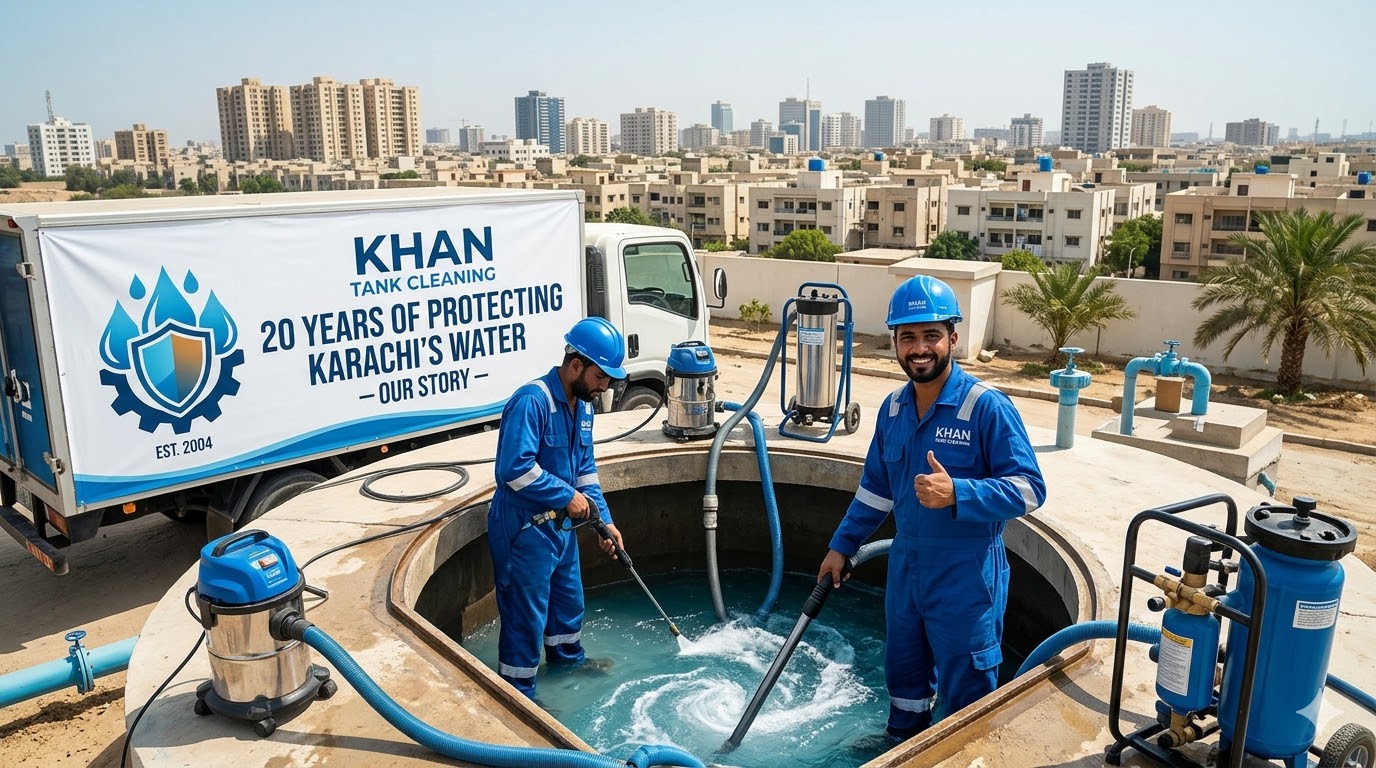
  • Khan Tank Cleaning: 20 Years of Protecting Karachi’s Water — Our Story

    Khan Tank Cleaning: 20 Years of Protecting Karachi’s Water — Our Story

    How one dedicated Karachi company became the city’s most trusted name in water tank cleaning — and why your family’s health depends on what’s inside your tank right now.

    The Water You Trust — But Should You?

    Every morning across Karachi, millions of families wake up and fill a glass of water. They cook with it, bathe in it, brush their teeth with it. They trust it. But here’s the question almost nobody asks: when was the last time your water tank was professionally cleaned?

    If you can’t remember — or if the answer is “never” — you are not alone. And that is exactly the problem Khan Tank Cleaning set out to solve, two decades ago.

    We are Karachi’s first and longest-standing dedicated professional water tank cleaning company. For 20 years, our mission has been a simple one: protect the health of Karachi’s families by keeping their water clean, safe, and free from the invisible dangers that grow inside neglected tanks.

    This is our story. And more importantly, this is why it matters for you.

    Where It All Began: A Problem Nobody Was Solving

    Twenty years ago, Karachi was a city with a water problem nobody talked about openly. The focus was always on supply — would the tanker arrive? Would KWSB release water this week? Would the pump hold out? But one critical link in the chain was completely ignored: what happened to the water after it entered your tank?

    Our founder recognized what health officials already knew but few homeowners understood: stored water is not static water. Inside an unclean tank, microscopic life is constantly evolving. Bacteria multiply. Algae take root. Sludge accumulates at the bottom. Biofilm — a sticky, invisible coating of microorganisms — lines the walls. And every time someone in your home turns on a tap, that contamination flows right along with it.

    There were no professional services addressing this. Some general workers would occasionally offer to “wash” a tank using buckets and a brush — a method that, as we now know, cannot remove biofilm or kill bacteria. It was cleaning in appearance only, not in reality.

    Khan Tank Cleaning was founded to change that. From day one, we invested in industrial equipment, trained our staff in proper sanitation protocols, and committed to doing this — and only this — as our dedicated profession. While other companies treat tank cleaning as a side job, it has always been our entire focus.

    Karachi’s Unique Water Challenge

    To understand why professional tank cleaning matters so much in Karachi specifically, you need to understand how water reaches your home.

    Karachi’s municipal water supply — managed by the Karachi Water & Sewerage Board (KWSB) — is intermittent at best. Most households receive water once or twice a week. This means water must be stored in overhead or underground tanks for days at a time before use. The longer water sits, the greater the opportunity for contamination to grow.

    Compounding this is Karachi’s climate. With temperatures routinely climbing above 40°C in summer, the inside of a rooftop water tank becomes a warm, dark, moist environment — precisely the conditions bacteria and algae need to thrive. Underground tanks face their own hazards: soil seepage, cracks in concrete, and the absence of light create ideal conditions for harmful microorganism growth.

    Then consider Karachi’s dust. Situated on the Arabian Sea coast, the city experiences sand storms, heavy traffic pollution, and industrial particulate matter year-round. This finds its way into tanks through loose lids, aging concrete, and aging plastic. Over time, a layer of sediment and sludge builds at the bottom of your tank — and every time water is drawn, some of that gets disturbed and consumed.

    The result? Waterborne diseases — gastroenteritis, typhoid, cholera, and skin infections — remain alarmingly common in Karachi households. Many cases go undiagnosed or are mistakenly attributed to food. But the water tank is frequently the source. That is why families in areas like Gulshan-e-Iqbal and Gulistan-e-Johar — dense residential neighbourhoods where water storage is universal — are among the highest-risk communities when it comes to tank contamination.

    Building Expertise Over 20 Years: What We Learned

    Two decades of service across every neighbourhood in Karachi has taught us things no textbook can. Here is what we have seen inside thousands of tanks:

    • The ‘visual clean’ is a myth. Many homeowners look into their tank, see clear water, and assume all is well. But bacteria and biofilm are invisible to the naked eye. We have tested tanks with crystal-clear water that harboured dangerous levels of E. coli.
    • Plastic tanks are not immune. Syntex, Bestank, Aqua Plus — regardless of brand, all plastic tanks develop biofilm over time. The material’s porous surface actually makes it easier for organisms to cling and colonise.
    • Underground tanks are the most dangerous. Confined, dark, often cracked, and difficult to access — underground concrete tanks require specialised oxygen safety equipment and trained confined-space entry personnel. This is not a DIY job.
    • Six months is the maximum safe interval. We have cleaned tanks that were ‘cleaned’ just three months prior by unskilled workers, and found extensive sludge and algae buildup. Professional cleaning every six months is the minimum standard for a Karachi household.
    • Your filter cannot save you from a dirty tank. Many families invest in under-sink or inline filters and assume their water is safe. But a filtration system attached to a contaminated tank is fighting a losing battle. The tank must be clean first.

    These insights shaped every aspect of how we operate today.

    Our Method: Why Industrial Equipment Makes All the Difference

    From the very beginning, Khan Tank Cleaning invested in professional-grade equipment that remains beyond the reach of part-time operators. Today, our cleaning process uses a multi-stage approach that sets us apart:

    Stage 1: High-Pressure Jet Washing

    We use industrial-grade high-pressure jet washing systems capable of dislodging deep-rooted algae, biofilm, and stubborn mineral deposits from every surface of your tank — walls, floor, ceiling, and inlet/outlet points. Manual scrubbing with a brush cannot achieve this penetration depth.

    Stage 2: Industrial Vacuuming

    Once the high-pressure wash has broken down contaminants, our industrial vacuum systems extract every trace of sludge and debris, leaving nothing behind. Traditional methods pour the contaminated water out — but residue clings to surfaces. Our vacuum ensures a completely clear tank interior.

    Stage 3: Safe Chemical Disinfection

    We use Silver Hydrogen Peroxide as our primary disinfectant — a hospital-grade, food-safe chemical that is highly effective against bacteria, viruses, and biofilm while being completely safe for human consumption. We do not use harsh industrial acids that can damage tank structure or contaminate your water supply.

    Stage 4: Inspection & Certification

    Before we leave, our team inspects the cleaned tank for structural issues — cracks, seal failures, lid damage — and provides you with a full report. We do not just clean and go. We care about the long-term safety of your water supply.

    Two Branches, One Mission: Serving All of Karachi

    As demand grew across the city, Khan Tank Cleaning expanded into two dedicated service branches, each positioned to serve Karachi with faster response times and deeper local knowledge.

    Branch 1: Gulshan-e-Iqbal & Gulistan-e-Johar

    Our water tank cleaning service for Gulshan-e-Iqbal and Gulistan-e-Johar covers one of Karachi’s most densely populated residential belts. From the busy apartment blocks of Block 13-D to the family homes of Scheme 33, from the congested streets of FB Area to the quieter lanes of Malir and Gulshan-e-Maymar, our team operates with intimate knowledge of local water pressures, tank configurations, and access challenges.

    In areas like Gulshan and Johar, the combination of high-density housing and ageing municipal water infrastructure means contamination risks are particularly elevated. Multi-storey apartment buildings with shared overhead tanks are especially vulnerable — one dirty tank can affect dozens of families simultaneously. Our branch here handles everything from individual rooftop tanks to large building-wide systems, all to the same rigorous standard.

    Branch 2: DHA & Clifton

    Our water tank cleaning service for DHA and Clifton serves Karachi’s coastal premium residential districts — but proximity to the sea brings its own contamination challenges. Salt air accelerates corrosion in metal and concrete tanks. High property values and modern architecture mean tanks are often larger, more complex, or built into landscaped basements. These require the same industrial expertise we bring everywhere, applied with precision.

    From Phase 1 to Phase 8 DHA, from Clifton’s beach-facing towers to the villa communities of Zamzama and Bahadurabad, our DHA and Clifton branch ensures that residents in Karachi’s most sought-after addresses can trust their water completely. We are available 24 hours, 7 days a week — including emergency response for situations where contamination cannot wait.

    Both branches operate across the full city. If you live in North Karachi, PECHS, Korangi, Landhi, Orangi Town, Nazimabad, or any other neighbourhood — we come to you. Distance is not a barrier when health is at stake.

    What Sets Khan Tank Cleaning Apart: 20 Years vs. a Side Job

    Karachi has many operators who offer tank cleaning. Most treat it as a supplementary income — a side task alongside fumigation, painting, plumbing, or general cleaning work. This creates a profound gap in quality and expertise.

    Here is what dedicated 20-year focus looks like in practice:

    • Properly trained technical staff. Our cleaners are not general labourers handed a pressure hose. They are trained in biofilm removal, confined-space safety procedures, chemical handling, and structural inspection.
    • Specialised equipment for every tank type. We handle underground concrete tanks, rooftop plastic tanks of all brands, fiberglass tanks, and stainless steel commercial tanks — each requiring different techniques and tools.
    • Chemical safety expertise. We use disinfectants that are verified safe for potable water. We refuse to use harsh industrial acids that damage tanks and leave chemical residue — a risk with untrained operators.
    • Oxygen safety for confined spaces. Underground tank cleaning requires oxygen monitoring equipment and rescue systems. We carry this equipment on every job. Many operators do not.
    • Residential and commercial capacity. We serve individual homes, apartment buildings, housing societies, factories, colleges, hospitals, and hostels. Our team scales to any job size.
    • Transparent pricing. Our rates are clear and budget-conscious. We do not quote one price and charge another. Twenty years of reputation means we do not need to deceive customers to survive.

    The Health Cost of a Dirty Water Tank

    This is not a scare tactic. These are facts that Pakistan’s own health authorities acknowledge:

    • Contaminated water is one of the leading causes of preventable illness in urban Pakistan.
    • Typhoid fever cases in Karachi spike predictably during and after periods of water supply disruption — precisely because stored water in uncleaned tanks becomes infected.
    • Children under five are disproportionately affected by waterborne diseases, many of which originate in household water storage systems.
    • Even water purification filters cannot compensate for a tank that has not been cleaned — the microbial load simply overwhelms the filter, reducing its effectiveness and lifespan.

    The cost of a professional tank clean is a fraction of a single hospital visit. It is one of the most cost-effective health interventions a Karachi family can make.

    If you are in Gulshan-e-Iqbal, Gulistan-e-Johar, or nearby areas, our Gulshan & Johar branch team can be with you quickly. If you are in DHA, Clifton, or surrounding areas, our DHA & Clifton specialists are on call 24/7 for both scheduled service and emergencies. Do not wait for symptoms to appear.

    20 Years of Trust: What Our Customers Say

    After two decades of service, the most powerful testimony we have is the loyalty of Karachi’s families. Homeowners who first called us when their children were small now call us to service the tanks in their grown children’s homes. Housing societies that brought us in once have kept us on annual retainer ever since. Factories and commercial buildings rely on us to meet health and safety compliance standards.

    We have earned this trust the only way it can be earned — by showing up on time, doing the job properly, and caring about the outcome. Twenty years of that, every single day.

    How Often Should You Clean Your Tank?

    The standard recommendation from health authorities is every six months. In Karachi, given our specific climate and water quality conditions, we consider this an absolute minimum. For households with:

    • Young children or elderly family members: every 3 to 4 months is advisable.
    • Older concrete underground tanks: every 3 months, as cracking and seepage accelerate contamination.
    • Large commercial or apartment building tanks: at minimum every 6 months, with inspection visits in between.
    • Homes that recently experienced unusual taste, odour, or colour in water: immediately.

    If you have never had your tank professionally cleaned — regardless of when you last washed it yourself — book a service today. The interior state of most uncleaned tanks would change the way you think about the water you are drinking.

    Book Your Professional Tank Clean Today

    Your family deserves clean water. Not approximately clean. Not visually clear. Scientifically verified, professionally sanitized, biofilm-free clean.

    Khan Tank Cleaning has protected Karachi’s water for 20 years. We have the equipment, the expertise, the trained staff, and the commitment to do this job properly — every single time, for every type of tank, in every part of the city.

    Right now, your water tank may look fine. But inside, bacteria may already be multiplying. Algae may be clinging to the walls. Sludge may be sitting at the bottom, ready to mix with the water your family drinks tomorrow morning. This is not a distant risk. It is a present one.

    Do not wait. Call us now or book online:

    Or visit our website: www.khantankcleaning.com for pricing, FAQs, and to schedule your service at a time that suits you.

    Khan Tank Cleaning — Karachi’s First. Still the Best.

    Keywords: water tank cleaning Karachi, tank cleaning Gulshan Jauhar, tank cleaning DHA Clifton, professional tank cleaning Karachi, underground tank cleaning, overhead tank cleaning, khantankcleaning.com