
Company Credibility7 min read
Khan Tank Cleaning: Protecting Karachi's Water Since 2004. Our Story
In 2004 a Karachi water tank was cleaned, if at all, by a plumber, a sweeper or a pest control crew doing it on the side. Khan Tank Cleaning was founded that August to make it a trade of its own. This is how that went, set against what happened to the city's water.
By Mateen Khan, founder
Updated · 10 sources
Quick answer
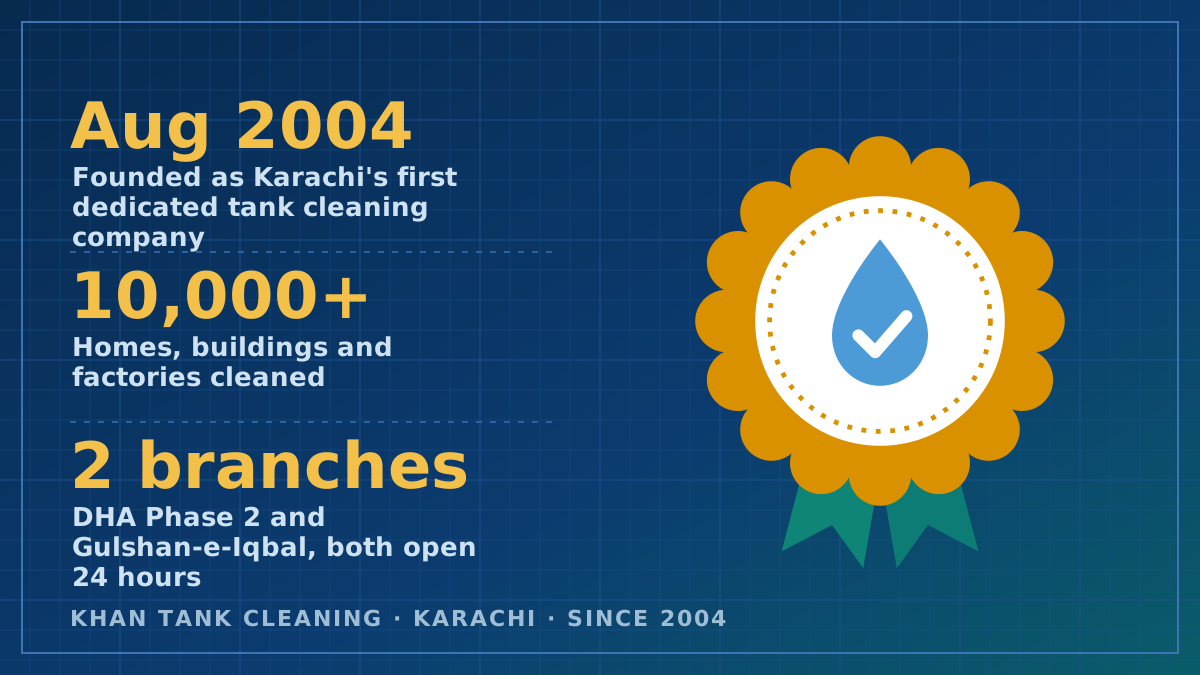
Khan Tank Cleaning was founded in Karachi in August 2004 by Mateen Khan as the city's first company dedicated only to water tank cleaning. It built one eight-step procedure for every tank, published its prices, registered with the SRB and FBR, and was certified to ISO 9001 and ISO 45001. Today it works from two branches, DHA Phase 2 and Gulshan-e-Iqbal, both open 24 hours, and has cleaned more than 10,000 homes, buildings and factories.
- Founded as Karachi's first dedicated tank cleaning company
- Aug 2004
- Homes, buildings and factories cleaned
- 10,000+
- DHA Phase 2 and Gulshan-e-Iqbal, both open 24 hours
- 2 branches
In this guide 9 sections
Khan Tank Cleaning started in August 2004 with one idea: that cleaning water tanks should be a trade in its own right, done with proper equipment by people who do nothing else. Twenty-two years later we work from two branches, DHA Phase 2 and Gulshan-e-Iqbal, and clean tanks for households, apartment buildings, schools, hotels and factories across the city.
This is the Khan Tank Cleaning history in Karachi, told plainly: where we began, what changed in the city's water over those years, what we learned from it, and how we work today.
August 2004: a trade that did not exist
The company was founded by Mateen Khan, who still owns it and oversees the work at both branches. In 2004, if a family in Karachi wanted their tank cleaned, they called a plumber, a sweeper, the building's janitorial staff or a pest control company doing it on the side. Nobody did it as a dedicated service and nobody had a set way of doing it. Sludge was flushed down the outlet, walls were given a quick brush, and workers climbed into closed underground tanks with no thought for the air inside.
The founding idea was to make it a proper job instead. That meant three decisions which still define the company: do only tank cleaning, use the equipment that removes what a brush cannot, and follow the same procedure on every tank.
The city's water over the same twenty years
Our own story makes more sense set against what was happening to Karachi's water. The need for clean storage grew every year, because the supply feeding it kept falling behind.
Karachi's water and the company, 2004 to 2026
- 2004Company foundedKarachi's first dedicated tank cleaner
- 2016–18XDR typhoid5,274 cases, 69% in Karachi
- 2017PCRWR testing107 of 118 samples unsafe
- 2023KWSB becomes KWSCSame network, new Act
- 2024–26Main failuresUniversity Road, then Dhabeji
| Year | What happened in Karachi's water | Why it matters for stored water |
|---|---|---|
| August 2004 | Khan Tank Cleaning founded as Karachi's first dedicated tank cleaning company | Tank cleaning starts to be treated as a trade, not a side job |
| 2005 | Hub and Pipri III treatment plants commissioned, the most recent plants on KWSC's published list | Treatment capacity has barely grown since, while the population has |
| 2016 to 2018 | Drug-resistant (XDR) typhoid outbreak in Sindh; WHO counts 5,274 XDR cases, 69 percent in Karachi | Showed how far sewage contamination had entered drinking water |
| 2017 | PCRWR tests for a Supreme Court commission find 107 of 118 Karachi samples unsafe | The first widely reported citywide evidence |
| 2023 | KWSB reconstituted as the Karachi Water and Sewerage Corporation | Same network, new structure |
| 2024 | 84-inch University Road main damaged during BRT work; 150 MGD short for about two weeks | Dirty first flow into thousands of tanks |
| 2025 | Five Naegleria deaths in Karachi by September; residents advised to clean tanks before every summer | Clear public advice to households |
| 2026 | Line No. 5 replacement and burst lines at Dhabeji in April and May, a grid fault shutting 10 of 21 pumps at the end of May; K-IV still under construction | Supply remains at about 650 MGD against demand above 1,200 |
The sources for these events are listed at the end. The supply system itself is explained in our guide to KWSB water supply.
The method, and what it replaced
Each part of the way we work answers a weakness in how tanks were, and often still are, cleaned in Karachi.
What the method replaced
Before 2004
- Sludge flushed down the outlet
- A quick brush of the walls
- Chemical poured into a dirty tank
- Climbing into a closed tank with no airflow
- Cash and a handshake
Our procedure
- Sludge pump; sludge carried off the property
- Walls washed and scrubbed
- Chlorine after cleaning, then a fresh-water rinse
- Ventilation and a second worker at the opening
- You check the tank before paying; tax invoice
- A sludge pump in place of the open outlet. The tank is drained with a pump, so dirty water and sludge are never pushed back into the household's pipes, and the sludge is carried off the property.
- Washing and scrubbing in place of a quick brush. The slippery layer on the walls has to come off before any disinfectant can work. Concrete is washed at high pressure; fiber and plastic tanks get low pressure and soft pads.
- Chlorine after cleaning, then a rinse, in place of a bucket of chemical. We disinfect with calcium or sodium hypochlorite, the same family used to treat city water, and rinse with fresh water before refilling. The reasoning is in our article on tank disinfectants.
- Ventilation in place of "the boy goes down". Underground tanks are aired out before anyone enters, and a second worker stays at the opening whenever someone is inside. Large tanks get the full confined-space setup.
- The customer's own eyes in place of a handshake. You look inside the tank before you pay, and the lid and cover are checked on every job.
Today those pieces form the eight-step procedure on our website, and this article walks through a visit step by step.
Putting the business on a formal footing
Doing the work properly was half of it. The other half was being a company that customers, and especially institutions, could check.
- Tax registration. We are registered with the Sindh Revenue Board and the Federal Board of Revenue, so buildings, schools, hospitals and companies receive a proper tax invoice. What that means for a customer is covered in why SRB and FBR registration matters.
- ISO 9001 and ISO 45001. Under Mateen Khan's leadership the company was certified to the quality management and occupational health and safety standards. Our certifications explained sets out what each one covers and how to verify a certificate.
- Published prices. Customers know the cost before anyone arrives. House prices go by plot size, from Rs 4,000 for both tanks up to 100 square yards, and are on our price page with a calculator; nothing is added on the day.
Who we clean for
Most of our work is still houses and flats, and in total we have cleaned tanks at more than 10,000 homes, buildings and factories. Alongside households, the organisations on our clients page include Avari Tower, IBA, SZABIST, UBL, Mondelez, Shan Foods, SGS, TPL, Edhi Homes and World-Inn Hotel.
Different clients need different things from the same job. A family wants clean water and a tidy courtyard. A factory needs documentation its auditor will accept. A hotel needs the work done overnight. We have written separate guides for factories and warehouses, hotels and restaurants and apartment buildings.
Two branches, all of Karachi
Karachi is a large city to cross, so the company works from two bases: DHA Phase 2 for the south and Gulshan-e-Iqbal for the east, centre and north. Either branch takes jobs anywhere in the city; the nearer one reaches you faster.
The company today
| Branch | Address | Phone | Main areas |
|---|---|---|---|
| DHA and Clifton | Office-6, Plot-6-C, Phase 2, DHA, Karachi 75400 | 0333 0293174 | DHA, Clifton, Defence View, Gizri, Seaview, Korangi, Saddar, Landhi, Malir |
| Gulshan and Jauhar | Suite-203, Mumtaz Manzil, Block 16, Gulshan-e-Iqbal, Karachi 75300 | 0340 2717530 | Gulshan-e-Iqbal, Gulistan-e-Johar, Scheme 33, Nazimabad, North Nazimabad, Federal B Area, New Karachi, North Karachi, SITE, PECHS |
Both branches use the same procedure and both answer 24 hours a day, including Sundays and public holidays. How the two-branch structure serves customers is described in how we built a trusted tank cleaning service.
What two decades have taught us
- Clear water proves nothing. Sludge sits on the floor and film on the walls while the water above looks fine. What we find inside Karachi's tanks describes the usual picture.
- The underground tank is the one people forget, and the one that collects the most.
- A filter is not a substitute for a clean tank. It treats one tap.
- The lid matters as much as the cleaning. A tank with a broken cover is dirty again in weeks.
- Schedules beat emergencies. Cleaning every six months prevents most of the urgent call-outs. See how often to clean a tank in Karachi.
- Safety cannot be optional. No job is worth sending someone into an unventilated tank.
- Customers should not have to take our word for it. That is why you look inside the tank before you pay.
What we still cannot do
It is worth being honest about the limits. We cannot fix the supply. A tank we clean today will be refilled tomorrow with whatever the line or the tanker delivers, which is why we tell every customer to keep boiling or filtering drinking water. We do not carry out structural repairs, though we point out every crack and corroded fitting we find. And we cannot make a tank stay clean without a lid that seals.
Where we go from here
Karachi's water shortage is not about to end. The K-IV project is still under construction, the World Bank has estimated that 55 to 60 percent of the network's water is lost to leaks and other losses, and households will be storing water for years to come. Our plan is unexciting: keep the method consistent across both branches, keep the paperwork straight, and keep explaining to customers what we find. This blog is part of that. If you want to know what others say about the work, see our reviews and how to check them.
You can read more about the company, or contact either branch at any hour.
Questions people ask
When was Khan Tank Cleaning founded?
In August 2004, in Karachi, by Mateen Khan. It was the city's first company dedicated only to water tank cleaning.
How many branches does Khan Tank Cleaning have?
Two: DHA Phase 2 (Office-6, Plot-6-C, Phase 2, DHA) and Gulshan-e-Iqbal (Suite-203, Mumtaz Manzil, Block 16). Both answer 24 hours a day, every day.
Does Khan Tank Cleaning do anything other than tank cleaning?
No. Cleaning and disinfecting water storage tanks is the whole business.
Which areas do you cover?
All of Karachi. The DHA branch is closest for DHA, Clifton, Gizri, Seaview, Korangi, Saddar, Landhi and Malir; the Gulshan branch for Gulshan, Gulistan-e-Johar, Scheme 33, Nazimabad, North Nazimabad, Federal B Area, New Karachi, North Karachi, SITE and PECHS.
Who owns Khan Tank Cleaning?
Mateen Khan, who founded the company in August 2004 and still oversees the work at both branches.
Is Khan Tank Cleaning the same as other tank cleaning companies with similar names?
No. Khan Tank Cleaning has two branches only: Office-6, Plot-6-C, DHA Phase 2 (0333 0293174) and Suite-203, Mumtaz Manzil, Block 16, Gulshan-e-Iqbal (0340 2717530). We are not affiliated with any similarly named company.
Sources
The events in the timeline were checked in November 2026 against:
- Karachi Water and Sewerage Corporation: What We Do Pipri-III and Hub treatment plants, 2005; supply of about 650 MGD.
- WHO Disease Outbreak News, 27 December 2018: Typhoid fever – Pakistan 5,274 XDR typhoid cases from November 2016; 69% in Karachi.
- Dialogue Earth, 2017: 91% of Karachi's water unfit to drink PCRWR found 107 of 118 Karachi samples unsafe.
- Karachi Water and Sewerage Corporation Act, 2023 Repeals the KWSB Act 1996 and creates the Corporation.
- Dawn, 16 December 2024: Many areas in Karachi go dry again as repairs on damaged line restart 84-inch University Road main damaged during BRT Red Line work; 150 MGD shortfall for about two weeks.
- Geo News, 13 September 2025: Naegleria claims another life in Karachi Five Naegleria deaths in Karachi in 2025 by mid-September; residents advised to clean tanks before summer.
- Dawn, 1 May 2026: Most Karachi areas suffer as water crisis enters second week Line No. 5 replacement and burst 72-inch lines at Dhabeji; 650 MGD supplied against demand of over 1,200 MGD.
- Dawn, 31 May 2026: Karachi water crisis deepens as power outage hits Dhabeji Pumping Station 10 of 21 pumping units shut down after a grid transformer fault.
- The Express Tribune, 16 December 2025: City's water woes to drag on for more years K-IV about 65% complete; completion expected by December 2026.
- World Bank, 2019: Karachi Water and Sewerage Services Improvement Project, project information document Non-revenue water estimated at 55–60%.
- Founded the company in August 2004
- ISO 9001 & ISO 45001
- SRB & FBR registered
Mateen founded Khan Tank Cleaning in Karachi in August 2004, the city's first company dedicated only to water tank cleaning. He set the eight-step procedure every crew still follows, led the company to ISO 9001 and ISO 45001 certification, and oversees the work at the DHA Phase 2 and Gulshan-e-Iqbal branches. He writes every guide on this blog.