Every morning, millions of residents across Gulshan-e-Iqbal and Gulistan-e-Johar wake up, turn on the tap, and use that water to brush their teeth, boil their chai, cook their meals, and bathe their children. Most never stop to ask a simple but deeply important question: Where exactly has that water been sitting — and what is growing inside the tank that holds it?
The answer is uncomfortable. And it is one that too few families in these densely populated neighbourhoods are having.
This is the hidden water problem that nobody talks about — and in a city like Karachi, where municipal water supply is irregular, infrastructure is aging, and summer temperatures regularly push past 40°C, the consequences of ignoring a dirty water tank can range from stomach infections and diarrhoea to typhoid and hepatitis.
Why Gulshan-e-Iqbal and Gulistan-e-Johar Are Especially Vulnerable
Both Gulshan-e-Iqbal and Gulistan-e-Johar are among Karachi’s most densely populated residential zones. They are home to thousands of apartment blocks, housing societies, individual bungalows, and commercial buildings — each with at least one overhead or underground water storage tank.
These neighbourhoods face a unique combination of challenges that makes water contamination more likely than almost anywhere else in the city:
- Irregular KWSB supply — Water is delivered once or twice a week in most blocks, meaning tanks sit full and stagnant for days at a time.
- Aging underground pipelines — Many of the water supply lines running beneath the streets of Gulshan and Johar are decades old, prone to micro-leakages that introduce soil bacteria and contaminants into the supply.
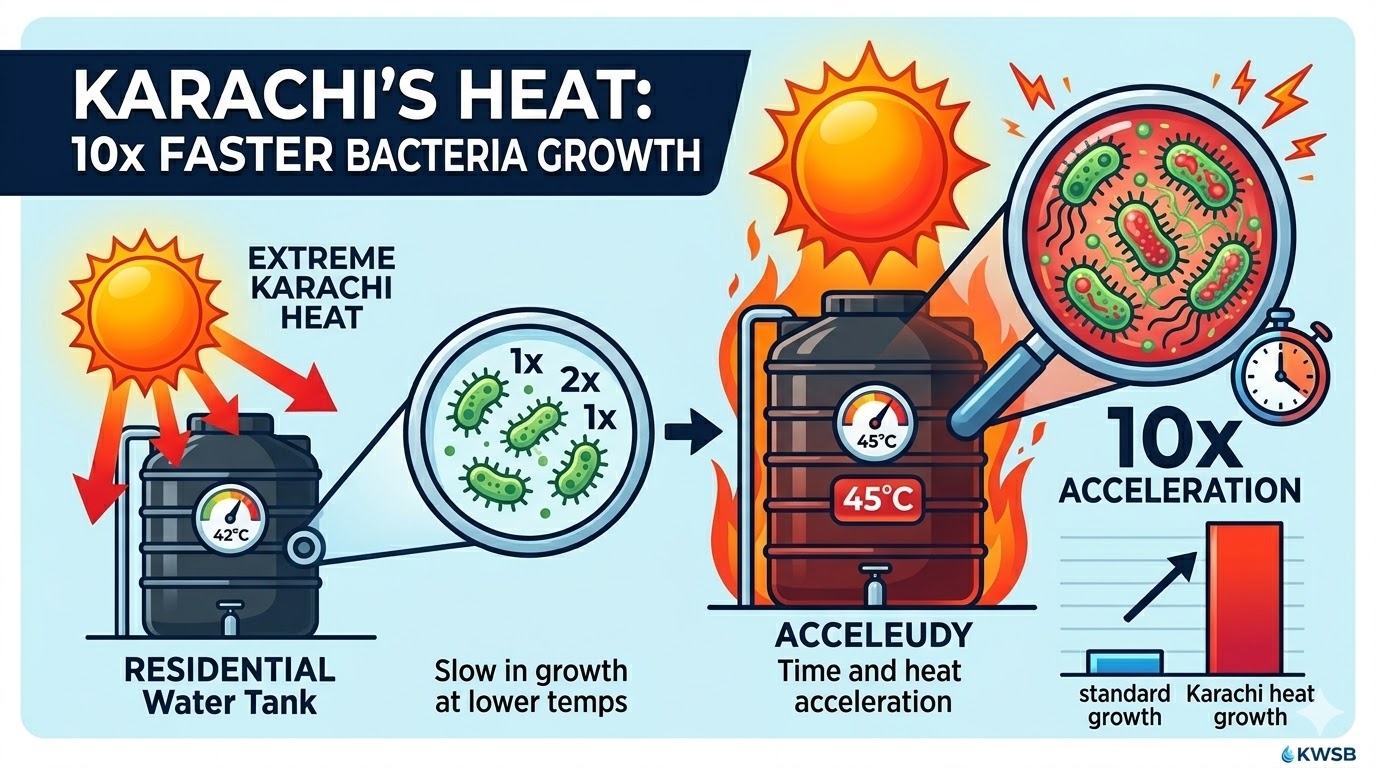
- High ambient temperatures — Karachi summers create the perfect breeding environment for algae, biofilm, and bacteria inside tanks that are not regularly cleaned.
- High-rise density — Multi-storey apartment buildings often have large shared underground sumps or rooftop tanks that serve dozens of families, yet rarely receive professional cleaning.
- Rapid urban growth — New construction, borehole water mixing with mains supply, and illegal connections are common in the area, all of which affect water quality.
| The World Health Organization estimates that contaminated drinking water causes over 485,000 deaths globally each year. In Pakistan, waterborne diseases are among the leading causes of preventable illness — and a dirty water tank inside your own home is often where the contamination begins. |
What Is Actually Growing in Your Tank Right Now?
Most homeowners assume that because they cannot see anything floating in their water, the tank must be clean. This assumption is dangerously wrong.
Water tanks that have not been professionally cleaned develop multiple layers of contamination over time:
1. Sludge and Sediment at the Base
Every time water enters your tank, it carries fine particles of sand, rust, clay, and organic matter. Over months, these particles settle at the bottom, forming a thick layer of sludge. This sludge is a rich breeding ground for anaerobic bacteria — bacteria that thrive in low-oxygen environments and produce harmful byproducts.
2. Algae Growth on Tank Walls
In tanks that receive any light exposure — even indirect light through a poorly sealed lid — algae begins to grow along the walls. Green or black algae colonies alter the taste and smell of water and create an environment where harmful organisms can flourish.
3. Biofilm — The Invisible Threat
Biofilm is a thin, slippery layer of bacteria that adheres to the inner surfaces of your tank. It is completely invisible to the naked eye, and it cannot be removed by simply draining and refilling the tank. Biofilm is resistant to standard chlorination and requires high-pressure mechanical cleaning to eliminate. It is one of the primary sources of E. coli, Legionella, and other harmful pathogens in home water supplies.
4. Rust and Chemical Leaching
Steel and older fiber tanks corrode over time. Rust particles contaminate the water and can cause long-term health effects with regular consumption. In older buildings across Gulshan-e-Iqbal, steel tanks that have never been inspected are silently shedding rust into the water supply.
The Symptoms You Are Probably Ignoring
Contaminated tank water does not always announce itself with an obvious smell or colour change. In many cases, the water looks and smells perfectly normal — yet it is making your family ill in ways that are easy to misattribute. Watch for these warning signs:
- Recurring stomach upsets or loose motions — especially in children — with no clear dietary cause
- Unexplained fatigue or nausea that comes and goes
- A faint musty, earthy, or metallic taste in tap water
- Skin irritation, rashes, or dryness that flares up after showering
- Hair fall that has worsened over recent months
- Water that looks slightly discoloured when collected in a white container
- A slight odour from the tap, particularly when water has sat overnight in pipes
If any of these sound familiar, there is a very good chance your water tank is overdue for a professional clean. Our water tank cleaning service in Gulshan-e-Iqbal and Gulistan-e-Johar is specifically designed to address every one of these contamination sources.
How Long Has It Been Since Your Tank Was Last Cleaned?
Ask yourself honestly: when was the last time your water tank received a thorough professional cleaning? Not a manual wash-and-rinse by a helper — but a real, high-pressure jet wash with industrial vacuuming and chemical disinfection?
For most households in Gulshan-e-Iqbal and Gulistan-e-Johar, the honest answer is: never. Or many years ago.
Health authorities recommend cleaning domestic water tanks at least every six months. In Karachi, given the quality of incoming supply water and the heat, every three to four months is even better for families with young children, elderly residents, or anyone with a compromised immune system.
| If you cannot remember when your tank was last properly cleaned — it has been too long. Every additional month is another month of sediment building up, biofilm expanding, and algae taking hold. |
Why a Water Filter Is Not Enough
One of the most common misconceptions among Karachi homeowners is this: “We have an RO or filter at home, so our water is fine.”
Filters treat water at the point of use. They do not clean the tank that stores the water before it reaches the filter. If your tank contains sludge, biofilm, and algae, your filter is working overtime to compensate — and in many cases, it simply cannot keep up. The result is that heavily contaminated water still reaches your taps.
Furthermore, most households only filter their drinking water — the water used for cooking, bathing, brushing teeth, and washing vegetables comes directly from the uncleaned tank. All of these are exposure pathways for waterborne illness.
A clean tank and a good filter work together. One without the other leaves your family exposed.
The Karachi Factor: Why Standard Cleaning Methods Fall Short
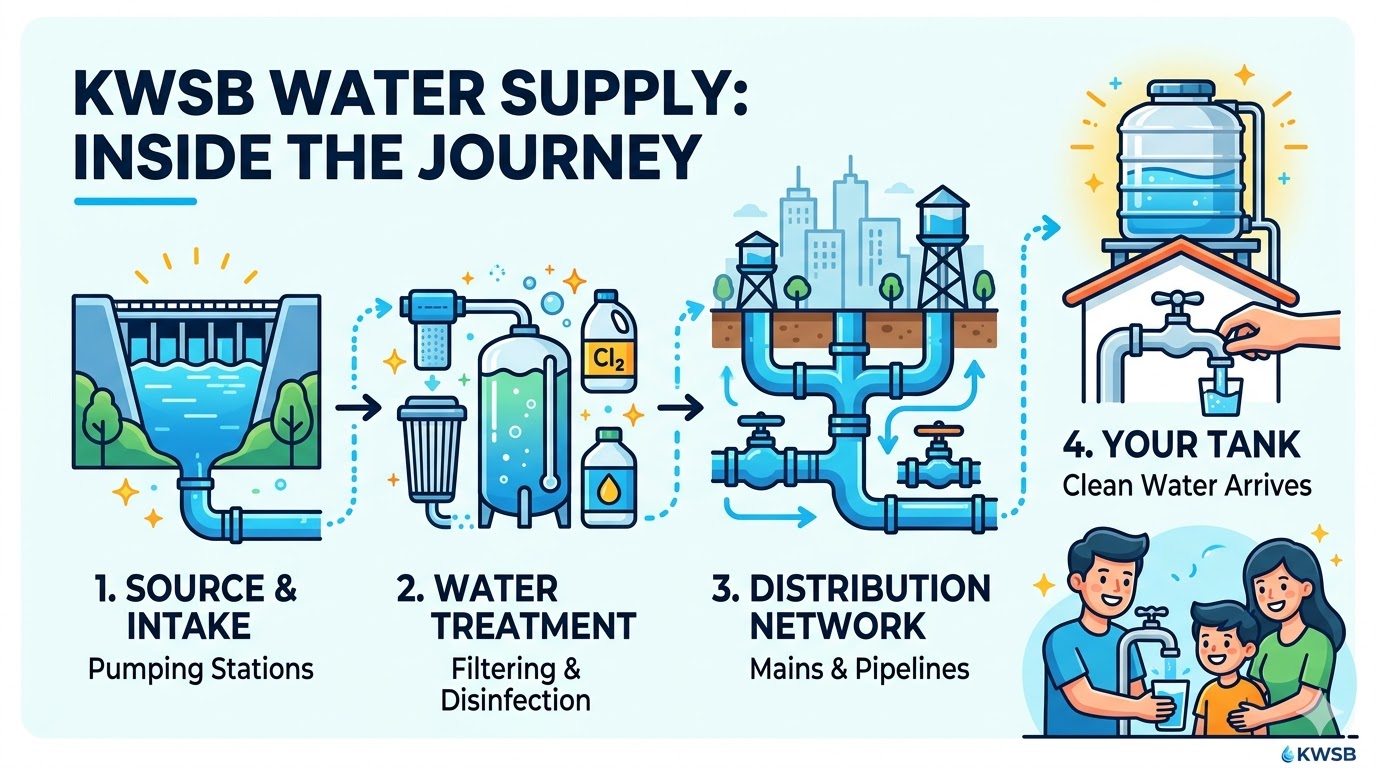
Karachi is not an ordinary city, and its water supply challenges are not ordinary either. The combination of KWSB water — which arrives through aging mains carrying sediment and bacteria — mixed with borehole water (common across many parts of Gulshan and Johar) means that the incoming water itself often carries a higher-than-average contamination load.
On top of this, Karachi’s extreme summer temperatures mean that tanks heat up significantly, dramatically accelerating bacterial growth. A tank that might stay relatively clean for six months in a cooler city may require cleaning every three months in Karachi’s climate.
Many residents rely on informal workers who clean tanks by manually scrubbing with a brush and rinsing with a bucket. While this removes visible dirt, it leaves behind:
- Biofilm firmly adhered to tank walls
- Sludge residue in corners and at the base
- No chemical disinfection to kill pathogens
- No verification that the tank is genuinely safe after cleaning
Professional tank cleaning services — like those provided by our Gulshan-e-Iqbal and Gulistan-e-Johar branch — use industrial-grade high-pressure jet washing, mechanical vacuuming, and safe chemical disinfection (including Silver Hydrogen Peroxide) to achieve a genuinely clean tank. This is not something a bucket and brush can replicate.
Not in Gulshan or Johar? We Cover All of Karachi
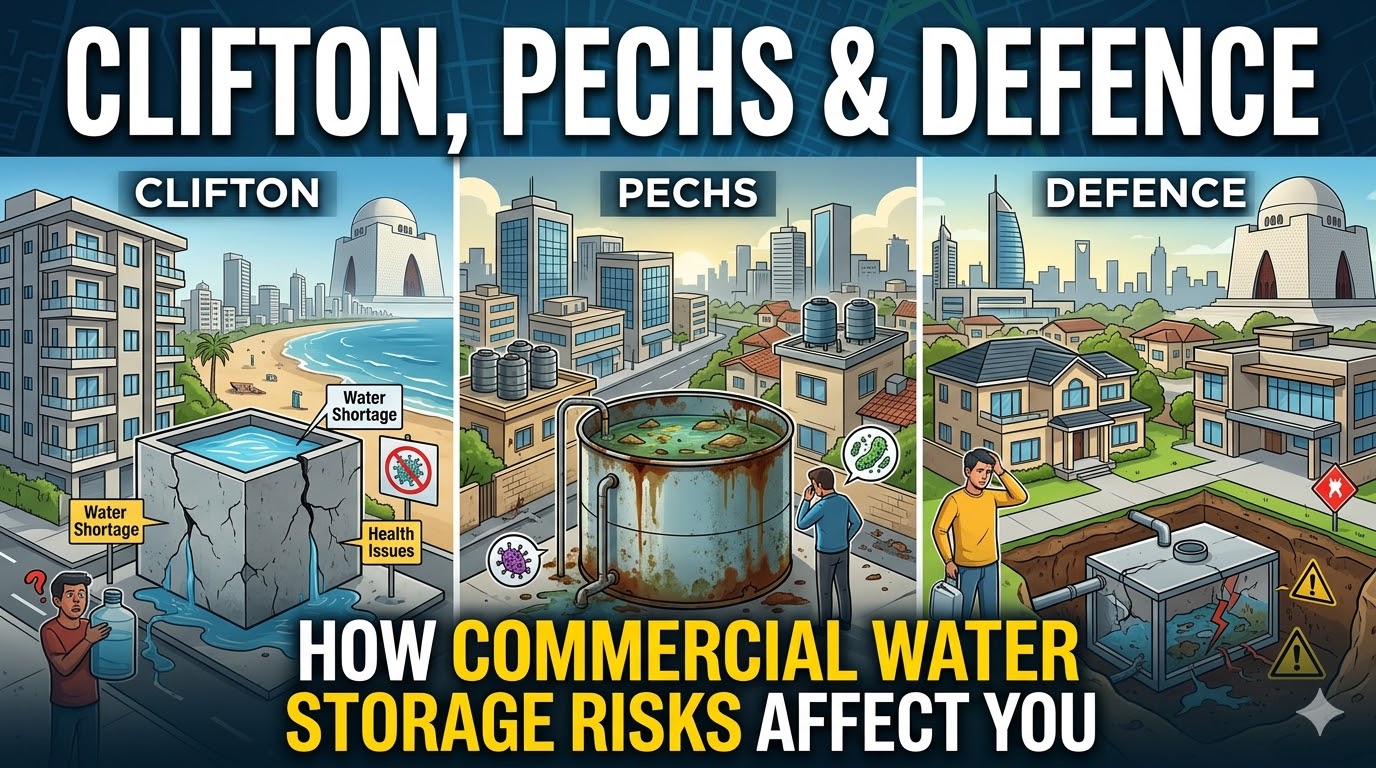
While our Gulshan-Johar branch is specifically equipped to serve the eastern zones of the city with rapid response times, we also operate a dedicated branch serving DHA, Clifton, and surrounding areas. Residents and businesses in Defence, Clifton, Zamzama, Bahadurabad, PECHS, Saddar, and Tariq Road can book our professional water tank cleaning service in DHA and Clifton, which brings the same high-pressure jet washing and disinfection technology to the southern and central parts of the city.
Whether you are a homeowner in a Gulshan apartment block or a business owner managing a commercial building in Clifton, Khan Tank Cleaning has a dedicated team near you, ready to respond quickly to your booking. Our two-branch structure across Karachi means no long travel times, no delays, and faster service for customers across the city.
What Does a Professional Tank Clean Actually Involve?
If you have never had a professional tank cleaning done, it is worth understanding exactly what the process looks like — and why it is so different from what a helper does with a broom and a bucket.
Our full professional cleaning process includes:
- Complete drainage of the tank using high-capacity pumping equipment
- High-pressure jet washing of all interior surfaces — walls, floor, and corners — to break down biofilm, sludge, and algae deposits
- Industrial-grade vacuuming to extract all loosened debris and residue without leaving anything behind
- Manual inspection and scrubbing of any remaining deposits, particularly around inlet and outlet pipes
- Chemical disinfection using Silver Hydrogen Peroxide or food-safe chlorine compounds — safe for human consumption and effective against bacteria, viruses, and fungi
- A final rinse and inspection before the tank is returned to service
For underground tanks — common in many older Gulshan-e-Iqbal properties — our team also employs confined space entry protocols including oxygen safety systems and proper ventilation, ensuring worker safety and a thoroughly cleaned enclosed space.
We service all tank types: overhead plastic tanks (Bestank, Aqua Plus, Syntex, and all fibre variants), underground concrete sumps, steel tanks, and large commercial storage systems. For more about our full-service approach, visit our Gulshan-e-Iqbal & Gulistan-e-Johar service page.
How Often Should You Clean Your Tank in Karachi?
A simple guide for Karachi households:
| Household type / situation Recommended frequency |
| Standard family home (overhead tank) Every 6 months |
| Home with young children or elderly residents Every 3-4 months |
| Home using borehole / boring water (mixed supply) Every 3 months |
| Apartment building / shared underground sump Every 3-4 months |
| Commercial property (office, restaurant, school) Every 2-3 months |
| After any sewage leak, flood, or contamination event Immediately |
The Cost of Not Cleaning: Medical Bills vs. Service Fees
Many homeowners delay tank cleaning because they see it as an unnecessary expense. The real calculation, however, works the other way.
A single episode of typhoid in a family requires doctor visits, laboratory tests, prescription medication, and days of lost work and school. A single hospitalisation for severe gastroenteritis can cost many times more than a full year’s worth of professional tank cleaning.
Beyond the direct medical costs, there is the ongoing toll of subclinical illness — the persistent fatigue, the recurring stomach problems, the diminished immunity — that slowly erodes quality of life without ever producing a single clear diagnosis, because nobody connects the symptoms to the tank sitting on the roof.
Professional tank cleaning is not an expense. It is an investment in your family’s health — and one of the most cost-effective health decisions you can make as a homeowner in Karachi.
💧 Book Your Professional Tank Clean Today
Your family deserves clean water — not water that has been sitting in a tank full of sludge, biofilm, and bacteria for months. If you live in Gulshan-e-Iqbal, Gulistan-e-Johar, or the surrounding areas of eastern Karachi, Khan Tank Cleaning’s dedicated branch is ready to serve you quickly, professionally, and at rates that suit your budget.
Our team is available 24 hours a day, 7 days a week. We service residential homes, apartment complexes, commercial buildings, offices, factories, schools, and hostels across Karachi. There is no tank too big or too small.
| 📞 Gulshan-e-Iqbal & Gulistan-e-Johar Branch: 0340-2717 530 |
| 📞 DHA & Clifton Branch: 0333-0293174 |
| 🌐 www.khantankcleaning.com |
Book your clean via our Gulshan & Johar service page or our DHA & Clifton service page. Clean water starts with a clean tank — and a clean tank starts with one phone call.
Khan Tank Cleaning — Karachi’s Most Trusted Professional Water Tank Cleaning Company
Head Office: Suite-203, Mumtaz Manzil, Block-16, Gulshan-e-Iqbal, Karachi