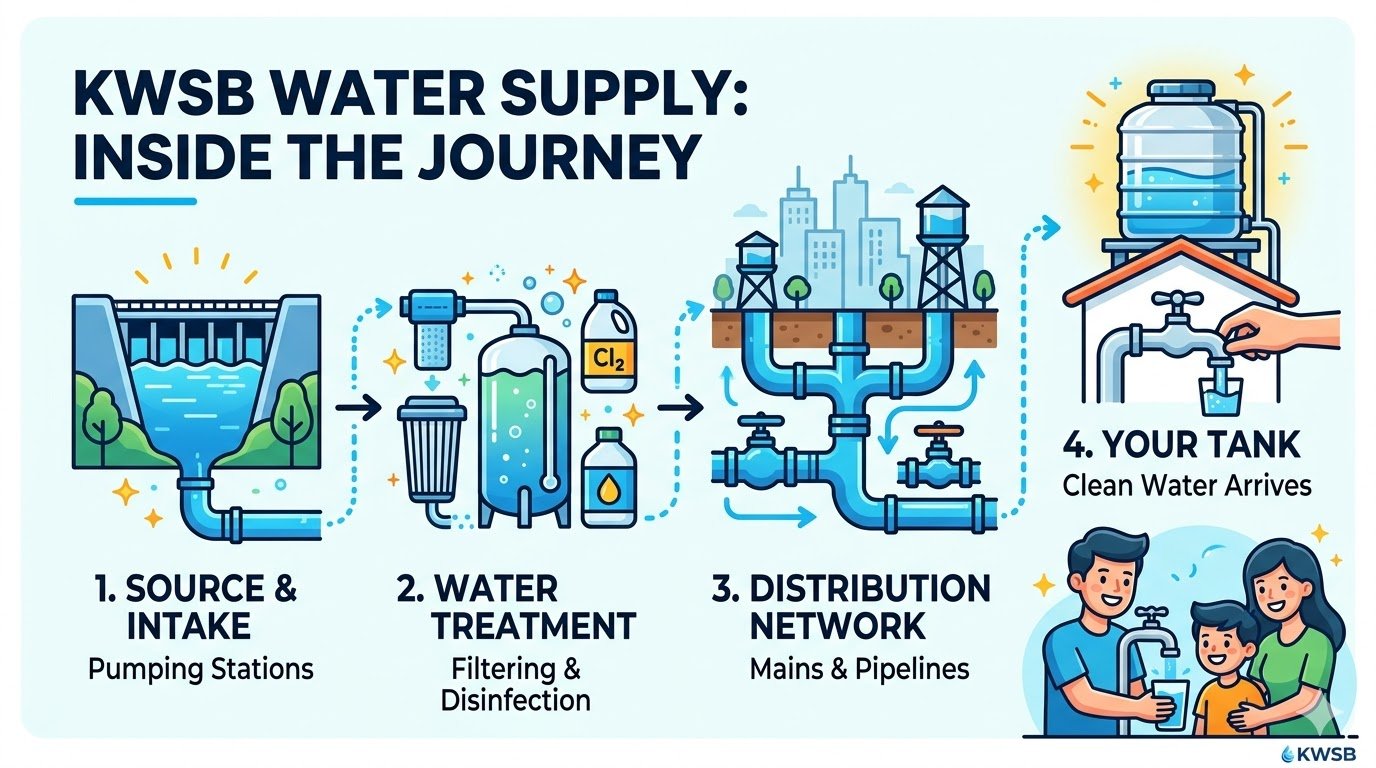
Most of Karachi still calls it the KWSB water supply, although the utility has been the Karachi Water and Sewerage Corporation (KWSC) since the Karachi Water and Sewerage Corporation Act, 2023. Whatever name is on the bill, the water follows the same route: roughly 120 kilometres from the Indus at Keenjhar Lake, through canals, the Dhabeji pumping station, filter plants and thousands of kilometres of city pipes, and finally into a storage tank that belongs to you, not to the utility.
This guide follows that route stage by stage, using KWSC’s own published figures and dated reporting, shows where water quality is lost along the way, and is honest about which part of the journey a household can actually control. We have cleaned water tanks across Karachi since 2005, so the last stage is the one we know first-hand.
KWSB water supply at a glance
- Supply: about 650 million gallons per day (MGD), according to KWSC.
- Demand: 1,080 MGD on KWSC’s own page; more than 1,200 MGD in 2025 and 2026 press reporting.
- Sources: the Indus via Keenjhar Lake (about 580 MGD) and Hub Dam (about 70 MGD).
- Filtration: KWSC states that about 440 MGD of the roughly 640 MGD it supplies is filtered.
- Delivery: intermittent. A 2019 World Bank project document describes supply ranging from two hours every two days to four hours a day, at very low pressure.
- Last stop: your underground or overhead tank, where the water can sit for days before anyone drinks it.
KWSB or KWSC: who supplies Karachi’s water now?
The Karachi Water and Sewerage Board (KWSB) was reconstituted as the Karachi Water and Sewerage Corporation under the 2023 Act, with the Mayor of Karachi as chairman. The pipes, pumping stations, filter plants and staff are the same ones the Board operated. People still search for “KWSB water supply”, complaint slips and older bills still carry the old name, and both names refer to the same supply. In this guide we use KWSC for anything current and KWSB where an older source used it.
Where does Karachi’s water come from?
Karachi has no large freshwater source of its own. Almost everything is imported from two places, and KWSC puts the present combined supply at approximately 650 MGD.
| Source | How it reaches Karachi | Supply (KWSC figure) |
|---|---|---|
| Indus River via Keenjhar (Kalri) Lake, Thatta district | Canals and conduits from Keenjhar to Gujjo and on to the Dhabeji pumping station, then pumped towards the city | About 580 MGD |
| Hub Dam, north-west of the city | A 22.4 km canal from the dam, treated at the Hub filter plant | About 70 MGD, dependent on rainfall in the catchment |
| Haleji Lake and the Dumlottee wells | Karachi’s original schemes: the wells date from 1881, Haleji from 1943 and 1953 | Historic. Around 20 MGD and 8 MGD when built |
Keenjhar Lake and the Indus
Keenjhar is the main reservoir. Water released from the Indus at Kotri Barrage reaches the lake by feeder canal, and from there it is carried towards Dhabeji. A senior KWSB official told Dialogue Earth in 2017 that the first drop reaching Keenjhar from the Indus takes 17 days to travel to Karachi. The exact figure matters less than what it implies: a long chain with many places for something to go wrong, and no quick way to make up a shortfall.
Hub Dam
Hub Dam fills from rain, so its contribution rises and falls with the monsoon. In good years the dam fills; in dry years the western districts that depend on it are the first to run short. A new Hub Canal with a stated capacity of 100 MGD was inaugurated on 13 August 2025 to serve the Central, Keamari and West districts.
Karachi water demand vs supply: the numbers
You will see different figures quoted for Karachi’s water gap. They differ mainly because demand estimates have grown with the population while bulk supply has barely moved.
| Source and year | Demand | Supply | Shortfall |
|---|---|---|---|
| KWSB official quoted by Dialogue Earth, 2017 | Up to 1,100 MGD | 450 to 480 MGD | More than 600 MGD |
| KWSC website (figure as published) | 1,080 MGD | About 650 MGD | 430 MGD |
| The Express Tribune, December 2025 | 1,200 MGD | 650 MGD | 550 MGD |
| Dawn, 1 May 2026 | More than 1,200 MGD | 650 MGD | About 550 MGD |
On the most recent figures the city receives a little over half of what it needs. The difference is covered by tankers, boreholes, hydrants and rationing, which is why most neighbourhoods receive water on a schedule rather than around the clock.
Will K-IV close the gap?
K-IV is the project meant to bring an additional 260 MGD from Keenjhar in its first stage. The original 2025 deadline was missed. In May 2026 the federal minister for water resources told the National Assembly that about 67.9 percent of the work was complete, with completion targeted for December 2026. Bulk water arriving at the edge of the city is only half the job: separate augmentation works inside Karachi are needed to carry it to neighbourhoods, and those are still under construction. Even on schedule, K-IV narrows the gap rather than closing it.
Stage 1: The canal journey from Keenjhar to Dhabeji
From Keenjhar the raw water travels through canals and conduits to Gujjo and then to Dhabeji. KWSC rates the total conveyance capacity between Gujjo and Dhabeji at 515 MGD.
At this point it is raw surface water. An open channel collects silt, organic matter and whatever drains into it from the land alongside, which is the reason the water has to be treated before it is fit for supply. Nothing a household does can change this stage, but it explains why the water that eventually reaches a tank always carries some fine sediment, even on a good day.
Stage 2: Dhabeji pumping station
Dhabeji is where the Indus water is lifted and sent on to the city. It is also the system’s most obvious single point of failure: the pumps depend on uninterrupted power, and the large-diameter lines leaving the station carry a major share of Karachi’s daily supply.
The most recent example came in late April 2026. KWSC shut a key conduit to connect a newly laid 72-inch pipeline replacing the deteriorated Line No. 5 near Dhabeji, which Dawn reported as an initial shortfall of 250 MGD, roughly 40 percent of daily supply. A power breakdown then burst three 72-inch lines, adding a further 140 MGD shortfall. Korangi, Malir, Jinnah Town, Saddar, DHA and Clifton were named by KWSC as the worst-hit areas, and the crisis ran into a second week.
For a homeowner the outage itself is only part of the problem. When pumping stops, lines lose pressure, and when it restarts the first water through carries whatever was disturbed inside them. We cover that mechanism in detail in our guide to how power cuts and pressure loss contaminate stored water.
Stage 3: Filter plants, and what filtration cannot do
From the bulk system, water goes to KWSC’s treatment plants. Conventional treatment means coagulation, settling, sand filtration and then chlorination. These are the plants KWSC lists:
| Filter plant | Capacity | Commissioned |
|---|---|---|
| Gharo I and II | 20 MGD | 1944, 1953 |
| COD Hill (two plants) | 115 MGD | 1962, 1971 |
| Pipri I, II and III | 98 MGD | 1971, 1978, 2005 |
| North East Karachi (NEK) Old | 25 MGD | 1978 |
| North East Karachi (NEK) K-II | 100 MGD | 1998 |
| Hub | 80 MGD | 2005 |
| Total rated capacity | 438 MGD |
Two things follow from that table. First, rated treatment capacity is well below the roughly 650 MGD entering the system, and KWSC itself puts filtered water at about 440 MGD. Second, most of that capacity was commissioned before 2000, and the oldest plant dates from 1944.
The larger limitation is that treatment only protects water up to the plant gate. Chlorine added there is used up as the water travels and waits. The WHO Guidelines for Drinking-water Quality recommend a free chlorine residual of at least 0.2 mg/L at the point of delivery for exactly this reason. Water that sits in pipes between supply turns, and then in a tank for several days, has usually lost that protection by the time it reaches a tap.
Stage 4: The distribution network
After treatment the water enters a city network that KWSB described in 2017 as about 10,000 kilometres of pipeline, a mix of old iron mains and newer high-density polyethylene lines. This is the stage where treated water is most often spoiled.
Leaks and losses
A 2019 World Bank project document for the Karachi Water and Sewerage Services Improvement Project gives a conservative estimate of non-revenue water, meaning physical leaks plus commercial losses and theft, of around 55 to 60 percent. A leak is a two-way opening. While the line is pressurised, water escapes. When the pressure drops, whatever surrounds the pipe can be drawn in.
Intermittent supply and low pressure
The same document describes availability ranging from two hours every two days to four hours per day at very low pressure. Pipes that are empty or barely pressurised for most of the week sit in ground that, in much of the city, also carries sewer lines. Many households then fit a suction motor directly on the supply line to pull more water during their turn, which lowers pressure in the street main further and increases the chance of drawing in contaminated groundwater through nearby leaks.
Main line failures
On 29 November 2024 the 84-inch main on University Road burst during BRT Red Line construction. Three consecutive leakages followed, and Geo News reported a shortage of 150 MGD before the line was fully repaired about three weeks later. Gulistan-e-Jauhar, several blocks of Gulshan-e-Iqbal, Bahadurabad, Tariq Road, Garden, Lyari, Saddar and Lines Area were among the affected areas. Every repair of this kind involves cutting into a main in an open excavation, and the first supply afterwards is rarely clean.
What testing has found
The most widely cited citywide test was carried out in 2017 by the Pakistan Council of Research in Water Resources (PCRWR) for a Supreme Court judicial commission. Of 118 samples collected in Karachi, 107 (90.7 percent) were unsafe for drinking, 104 (88.1 percent) contained coliform bacteria, and 40 showed faecal contamination with E. coli. The samples came mostly from surface water sources, with some groundwater and reverse osmosis plants. The WHO standard is that E. coli must not be detectable in any 100 ml sample of drinking water.
That study is now several years old, and a single round of sampling cannot describe every street. It is consistent, though, with the World Bank document, which sets a baseline of only 20 percent of water samples complying with quality standards.
Stage 5: Your storage tank
Because supply is intermittent, almost every Karachi property stores water. The usual arrangement is an underground tank that fills during the supply turn, a motor, and an overhead tank that feeds the taps. KWSC’s responsibility ends at your connection. Everything after it, including both tanks, belongs to the owner, or in a block of flats to the union or builder, a question we deal with in who is responsible for an apartment building’s water tank.
The tank is also where everything the water picked up on the way finally settles. This is what we find when we open tanks that have not been cleaned for a long time:
- Sludge on the floor: silt, rust flakes and organic matter that settle a little more with every fill.
- Biofilm on the walls: a thin, slippery bacterial layer that survives rinsing and ordinary scrubbing.
- Algae: wherever light gets in through a cracked lid, a missing cover or a translucent plastic tank.
- Scale: mineral deposits from hard water and borehole water, which give bacteria a rough surface to hold on to.
- Things that fell in: insects, lizards, birds and debris, almost always through a lid that does not seal.
Heat makes all of this worse. Stored water in a rooftop tank warms quickly in a Karachi summer, and our article on how heat speeds up bacterial growth inside a tank explains why the same tank is a bigger risk in June than in January. The weeks during and after the rains are the other high-risk period, covered in our monsoon water risk guide.
Why supply risk differs by area
The whole city draws from the same bulk system, but each area’s exposure depends on which main it sits on, how often its turn comes, and how its buildings store water.
Gulshan-e-Iqbal, Gulistan-e-Jauhar and the University Road corridor
These areas were directly affected by the 2024 University Road failure, and they have a high share of apartment blocks where one shared tank serves dozens of families. Local conditions are covered in our piece on water tank problems in Gulshan-e-Iqbal and Gulistan-e-Jauhar, and our Gulshan-e-Iqbal branch handles tank cleaning in Gulshan, Jauhar and East Karachi.
DHA, Clifton and Saddar
These areas were among the worst hit when Line No. 5 was offline in 2026, and many homes here rely on tankers between supply turns. Houses tend to have large underground tanks that hold water for long periods. See what DHA residents are really drinking for the local picture. Our DHA Phase 2 branch covers water tank cleaning in DHA and Clifton.
Korangi, Malir, Landhi and Shah Faisal Colony
KWSC named these districts among the areas that suffered most in the 2026 outage. Long gaps between turns mean longer storage and more dependence on tanker water of unknown origin.
Central, Keamari and West districts
The western side of the city depends heavily on Hub Dam, which is why its supply swings with the rains and why the new Hub Canal was built for these districts.
What contaminated water does to health
According to the World Health Organization, microbiologically contaminated drinking water can transmit diarrhoea, cholera, dysentery, typhoid and polio. Karachi has direct experience of this. In the extensively drug-resistant (XDR) typhoid outbreak that began in Sindh in November 2016, WHO recorded 5,274 XDR cases out of 8,188 typhoid cases by December 2018, and 69 percent of them were in Karachi. Safe water and sanitation were at the top of WHO’s recommendations.
Young children and older people are affected first and worst. We go through the illnesses and their link to stored water in typhoid, E. coli and stomach infections in Karachi, and the early warning signs in signs your drinking water is making you sick.
What you can control: a tank checklist
You cannot repair the canal, the pumps or the street main. You can make sure your own storage does not add to the problem.
- Seal the lid. A tight, intact cover on both tanks keeps out light, insects and animals. Replace cracked or warped lids rather than weighting them down with a brick.
- Screen the vent and overflow. Fit fine mesh so air can pass and mosquitoes cannot.
- Check the underground tank’s surroundings. The hatch should sit above ground level so wash water and rain cannot run in, and no sewer line or gutter should run beside the tank wall.
- Let the first water go after an outage. When supply returns after a long gap or a line repair, run the first few minutes to waste or to the garden if you can, rather than straight into the tank.
- Clean on a schedule. For most Karachi homes we recommend every four to six months, and every three months for shared building tanks and areas with very irregular supply. Our guide to how often to clean a water tank in Karachi explains how to choose.
- Clean after an event. Book a clean after a main line failure in your area, after the monsoon, or whenever the water turns cloudy, coloured or foul-smelling.
- Still treat what you drink. A clean tank removes one source of contamination. It does not make incoming supply water safe to drink, so keep boiling or filtering drinking water. The two do different jobs, as we explain in why a water filter alone is not enough.
How we clean the last stage
Khan Tank Cleaning has cleaned water tanks in Karachi since 2005. Our eight-step cleaning procedure is the same on every job: survey and written quote, controlled drainage, ventilation and a gas check before anyone enters an underground tank, jet washing at 3,000+ PSI to cut biofilm off the walls, vacuum extraction of the sludge, disinfection, a clear-water rinse, and a dated service report with photographs taken inside the tank.
For disinfection we use silver-stabilised hydrogen peroxide, which breaks down into water and oxygen and leaves no taste, with food-grade chlorine at a controlled concentration reserved for heavily contaminated tanks. Our article on silver hydrogen peroxide tank disinfection explains how it works, and what happens during a professional tank cleaning walks through a visit from start to finish. A rooftop tank usually takes two to four hours and an underground RCC tank four to eight.
If you want a price before you call, the instant price calculator gives one for standard homes, and the quote is the final price.
Frequently asked questions
Is KWSB the same as KWSC?
Yes. The Karachi Water and Sewerage Board became the Karachi Water and Sewerage Corporation under the 2023 Act. It is the same utility with the same network.
Where does KWSB water come from?
From two sources: the Indus River via Keenjhar Lake in Thatta district, which KWSC says provides about 580 MGD, and Hub Dam, which provides about 70 MGD when it holds enough water.
How much water does Karachi need, and how much does it get?
Recent reporting puts demand at more than 1,200 MGD against a supply of about 650 MGD, a shortfall of roughly 550 MGD. KWSC’s own website gives demand as 1,080 MGD.
Is KWSB tap water safe to drink?
Do not assume so. The 2017 PCRWR testing found 107 of 118 Karachi samples unsafe, and intermittent supply through leaking pipes gives treated water many chances to be recontaminated. Boil or properly filter the water you drink, and keep the tank it is stored in clean.
Why is the water dirty when supply comes back after a break?
When a line is shut or loses pressure, sediment and biofilm inside it are disturbed and dirty water can enter through leaks. The first flow after restoration carries that into your tank, where it settles on the floor.
When will the K-IV project be completed?
The current official target is December 2026 for the first 260 MGD stage, with work reported at about 67.9 percent complete in May 2026. Distribution works inside the city will take longer.
How often should a water tank be cleaned in Karachi?
Every four to six months for a typical house, every three months for shared apartment tanks or areas with very irregular supply, and straight away after discoloured water, a major line failure or the monsoon.
Sources
Figures in this article were checked in October 2026 against the following:
- Karachi Water and Sewerage Corporation: What We Do (supply, sources, conveyance capacity, filter plants)
- Karachi Water and Sewerage Corporation Act, 2023
- Dawn, 1 May 2026: Most Karachi areas suffer as water crisis enters second week
- The Express Tribune, 16 December 2025: Two decades on, Karachi still waiting for K-IV water supply
- ProPakistani, 20 May 2026: completion date announced for K-IV
- The Express Tribune, 13 August 2025: New Hub Canal inaugurated
- Geo News, 20 December 2024: University Road main line repaired
- Dialogue Earth, 28 July 2017: 91% of Karachi’s water unfit to drink (PCRWR results, pipeline length, 17-day figure)
- World Bank, 2019: Karachi Water and Sewerage Services Improvement Project, project information document
- WHO: Drinking-water fact sheet and Guidelines for Drinking-water Quality
- WHO Disease Outbreak News, 27 December 2018: Typhoid fever, Pakistan
About Khan Tank Cleaning
This guide is published by Khan Tank Cleaning, a Karachi water tank cleaning company founded in 2005 by Mateen Khan. We work from two branches, DHA Phase 2 and Gulshan-e-Iqbal, and you can read more about the company or contact either branch at any hour. Call or WhatsApp 0333 0293174 (DHA) or 0340 2717530 (Gulshan).

Mateen Khan is the Founder & Owner of Khan Tank Cleaning, Karachi’s first dedicated professional water tank cleaning company (est. 2005). With 20+ years of industry experience, he leads an ISO 9001 & ISO 45001 certified team that follows a strict 8-step process using industrial equipment and food-grade disinfectants. Mateen is committed to making clean, safe water accessible to every household and business in Karachi.