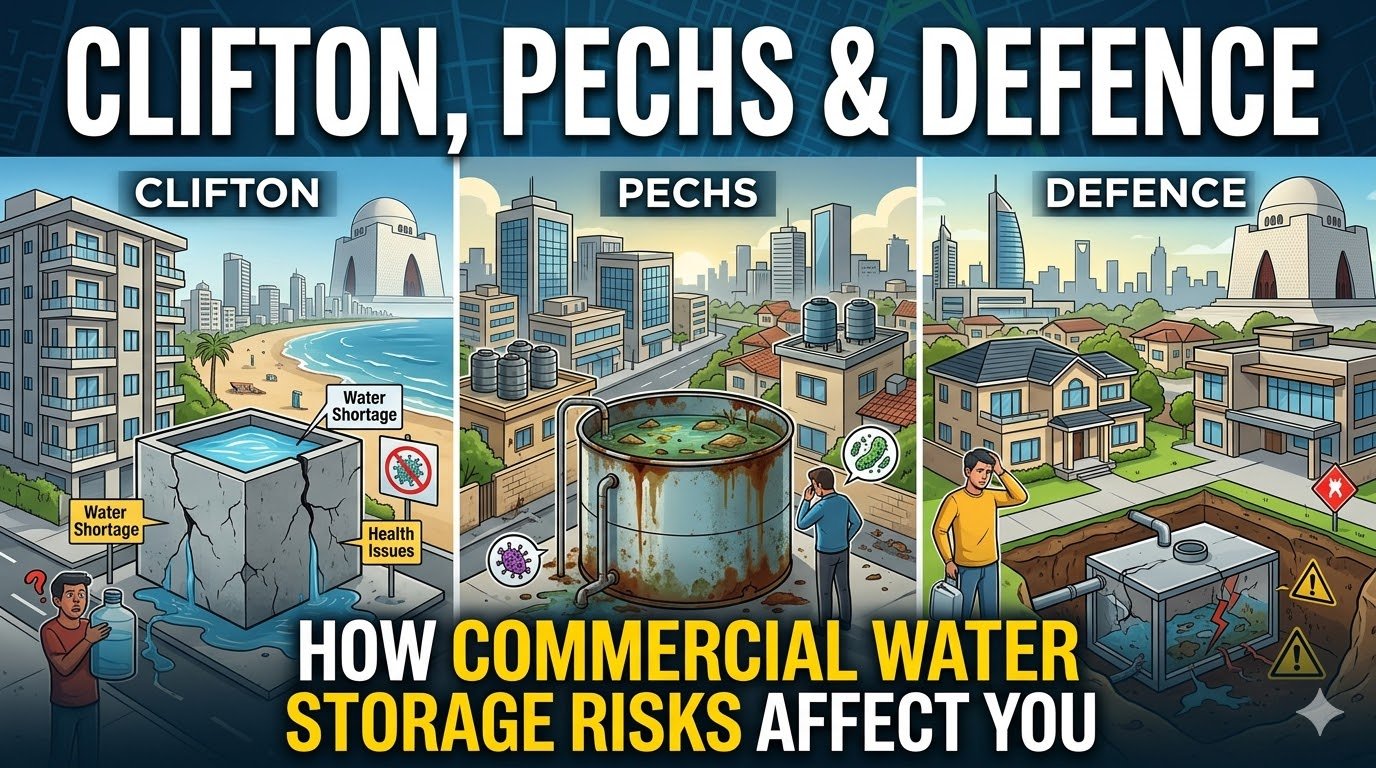
Defence, Clifton and PECHS are where much of Karachi eats out, sees a doctor, goes to school and works. Every one of those restaurants, clinics, schools and offices runs on water stored in a tank on the premises, and the people using it have no way of knowing when that tank was last cleaned.
This article looks at water safety in Defence, Karachi and its neighbouring commercial districts from both sides: what you are exposed to as a customer or resident, and what you are responsible for as an owner or manager.
In brief
- Piped supply to the south of the city is thin, so businesses here store large volumes from mixed sources.
- You meet commercial tank water through food, ice, showers, wash basins and ablution areas.
- Owners and managers carry the duty of care, and food and health premises are inspected.
- A three-month cleaning cycle with a dated report is the practical standard for premises serving the public.
- Near the sea, check tank covers often. Salt air corrodes them quickly.
Why this part of the city depends so heavily on storage
Piped supply to the south of the city is thin. Dawn reported in July 2025 that DHA was receiving only 4 to 5 million gallons a day, and KWSC named DHA and Clifton among the worst-hit areas during the supply crisis of April and May 2026. Businesses cannot close when the line is dry, so they buy tanker water, run boreholes and build large tanks. The local supply picture is covered in water quality in DHA.
The result is that commercial premises here store more water, from more varied sources, for longer than the same business would in a city with continuous supply.
Where you meet commercial tank water
| Premises | How their tank water reaches you | Main concern |
|---|---|---|
| Restaurants, cafes, bakeries, caterers | Washing produce and dishes, ice, cooking, hand washing | Food-borne and waterborne infection |
| Clinics, dental surgeries, laboratories | Hand washing, instrument rinsing, patient use | Infection in people who are already unwell |
| Schools, nurseries, tuition centres | Drinking coolers, wash basins, canteens | Children are the most vulnerable group |
| Gyms, salons, spas | Showers, basins, foot baths | Skin and eye infections; aerosols from showers |
| Offices and shops | Kitchenettes, washrooms, ablution areas | Staff illness |
| Mosques | Ablution, where water enters the nose | The route by which Naegleria infects |
| Apartment blocks above shops | One shared tank for homes and businesses | A fault affects everyone at once |
The point about mosques is specific. Naegleria fowleri infects through the nose, and in a case reported by Dawn in June 2025 the health department traced a patient’s only exposure to ordinary water use at home and ablution at a local mosque.
The three areas, briefly
Clifton
Clifton mixes older apartment blocks and bungalows with dense commercial strips around Boat Basin, Zamzama and the Schon Circle area. Many buildings have large underground RCC cisterns that predate the current tenants. Sea air is hard on metal: lids, hinges and inspection covers corrode faster here, in Gizri and along Seaview, and a rusted cover is an open tank.
Defence (DHA)
The commercial areas of DHA, such as Khadda Market, Bukhari and Badar Commercial, are full of restaurants, clinics and offices built over small plots with basement or rooftop tanks. Residential streets have large bungalows with several tanks each. Tanker and borehole water are routine, so sand and mineral scale build up quickly.
PECHS
PECHS is older and denser, with bungalows converted into schools, clinics, offices and eateries along its main roads. Tanks designed for one household now serve a business with ten times the daily use. Records of cleaning often do not exist, because the property has changed hands or use several times.
What goes wrong in a busy commercial tank
- High turnover hides problems. Water moves through quickly, so it looks clear, while sludge and biofilm keep accumulating underneath.
- Mixed sources. Piped, tanker and borehole water in the same tank leave sand, scale and whatever each source carried.
- Nobody owns the job. The tenant assumes the landlord cleans the tank; the landlord assumes the tenant does.
- Warm, stagnant corners. The UK Health and Safety Executive notes that legionella multiplies between 20 and 45°C, particularly in stagnant water, and recommends that tanks have lids and insect screens and are cleaned periodically. Showers and spray taps turn that water into droplets people breathe in.
- Open or damaged covers. Mosquitoes, dust and vermin get in. The WHO’s dengue advice is to keep water storage covered and cleaned.
The contaminants and the illnesses they cause are described in waterborne disease in Karachi.
Mixed-use buildings: the hardest case
Much of Clifton, PECHS and the commercial strips of DHA consists of buildings with shops or restaurants at street level, offices or clinics above, and flats on top, all drawing from one underground tank. Three things go wrong in these buildings. Usage is heavy and uneven, so sludge is constantly disturbed. Each occupier assumes another is responsible. And access to the tank is often through one tenant’s premises, so nobody else ever sees it.
The fix is administrative, not technical. The owner or the building’s management should hold the cleaning schedule, recover the cost through the service charge, give every occupier a copy of the report, and make sure the tank room is not being used as a store. If you are a tenant in such a building, ask to see the last report before you sign or renew.
If you own or manage premises here
You carry a duty of care to everyone who uses your water, and in several sectors a regulator checks.
- Food businesses are licensed and inspected by the Sindh Food Authority under the SFA Act, 2016. Between July 2025 and January 2026 the authority reported 47,875 inspections and improvement notices, and 370 food outlets sealed, across Sindh. See our guide for hotels and restaurants.
- Clinics and hospitals answer to the Sindh Healthcare Commission. See water tank contamination in hospitals.
- Schools are responsible for the water their pupils drink. See water hygiene in schools and universities.
- Workplaces covered by the Sindh Factories Act, 2015 must provide a sufficient supply of wholesome drinking water (section 22).
- Landlords and building managers should settle in writing who cleans the tank. See our guide for property managers.
A practical routine for commercial premises
- Clean every tank every three months, and after any flooding, sewage incident or long supply crisis.
- Keep the dated service report and photographs on file. It is the first thing an inspector, auditor or insurer will ask for.
- Put one named person in charge of the schedule.
- Check lids, mesh and the area around the underground hatch every month.
- Use only a contractor who can issue a proper tax invoice. Paying an unregistered provider has tax consequences for a business, explained in why SRB and FBR registration matters.
- Do not let staff enter an underground tank. Closed tanks kill, and the law on confined spaces in factories reflects that.
Water safety in Defence, Karachi for residents and customers
- At home in a flat: ask the union for the date of the last tank cleaning and whether a report exists. This article explains who is responsible.
- At your child’s school: ask how drinking water is treated and how often tanks are cleaned.
- Eating out: you cannot inspect a kitchen, but ice and uncooked items carry the most water risk.
- At the gym or salon: a musty smell from showers or basins is a reason to raise it with the manager.
- At home in a house: your own tanks are the part you control. Clean them every four to six months, as set out in how often to clean a water tank in Karachi.
How we work with commercial premises
Commercial and shared-building jobs start with a free survey, because access, tank count and working hours differ on every site. The cleaning itself follows our eight-step procedure: drainage, ventilation and gas check, jet washing at 3,000+ PSI, vacuum extraction, disinfection, rinse and inspection. We can work at night or on closed days so trading is not interrupted, and multi-tank buildings can be cleaned one tank at a time so the whole site is not left dry.
Every job ends with a dated report, photographs taken inside the tank, a recommended next-service date and a numbered SRB/FBR tax invoice. Organisations we clean for are listed on our clients page.
Defence and Clifton are covered by our DHA Phase 2 office, the base for tank cleaning in DHA and Clifton. PECHS is covered from Gulshan-e-Iqbal by the team that handles Gulshan, Jauhar and East Karachi. Households can get a price online.
Frequently asked questions
How often should a restaurant or clinic clean its water tank?
Every three months is a sensible standard for premises serving the public, with an extra cleaning after flooding, a sewage problem or a long supply outage.
Who is responsible for the tank in a rented shop or office?
Whoever the tenancy agreement says. If it says nothing, agree it in writing now. In practice the party who controls access to the tank should hold the cleaning schedule.
Can cleaning be done outside business hours?
Yes. Both our branches work around the clock, including Sundays and public holidays.
Will we get a document we can show an inspector?
Yes: a dated service report with photographs and a tax invoice.
Is water safety in Defence worse than in other parts of Karachi?
The underlying supply is the same citywide. What differs is the heavy reliance on tankers and boreholes, the number of commercial premises, and coastal corrosion of tank covers.
Our restaurant uses only bottled water for drinking. Is the tank still an issue?
Yes. Produce washing, ice, dish rinsing and staff hand washing all use tank water.
How quickly do tank covers corrode near the sea?
It varies with the material and exposure, but steel lids and hinges in Clifton, Gizri and Seaview deteriorate noticeably faster than inland. Inspect them monthly and consider non-metal covers.
Sources
Figures in this article were checked in October 2026 against the following:
- Dawn, 9 July 2025: Cabinet approves loan for KWSC to end water shortage in DHA, Clifton
- Dawn, 1 May 2026: Most Karachi areas suffer as water crisis enters second week
- Dawn, 5 June 2025: Young man dies of Naegleria fowleri in Karachi
- UK Health and Safety Executive: Managing legionella in hot and cold water systems
- WHO: Dengue fact sheet
- APP, 23 February 2026: Sindh Food Authority board meeting and inspection figures
- The Sindh Factories Act, 2015
About Khan Tank Cleaning
Khan Tank Cleaning is a Karachi company that does one thing: clean and disinfect water storage tanks. It was started in 2005 by Mateen Khan and now runs branches in DHA Phase 2 and Gulshan-e-Iqbal. Read our background or reach the nearest branch on 0333 0293174 (DHA) or 0340 2717530 (Gulshan), day or night.

Mateen Khan is the Founder & Owner of Khan Tank Cleaning, Karachi’s first dedicated professional water tank cleaning company (est. 2005). With 20+ years of industry experience, he leads an ISO 9001 & ISO 45001 certified team that follows a strict 8-step process using industrial equipment and food-grade disinfectants. Mateen is committed to making clean, safe water accessible to every household and business in Karachi.