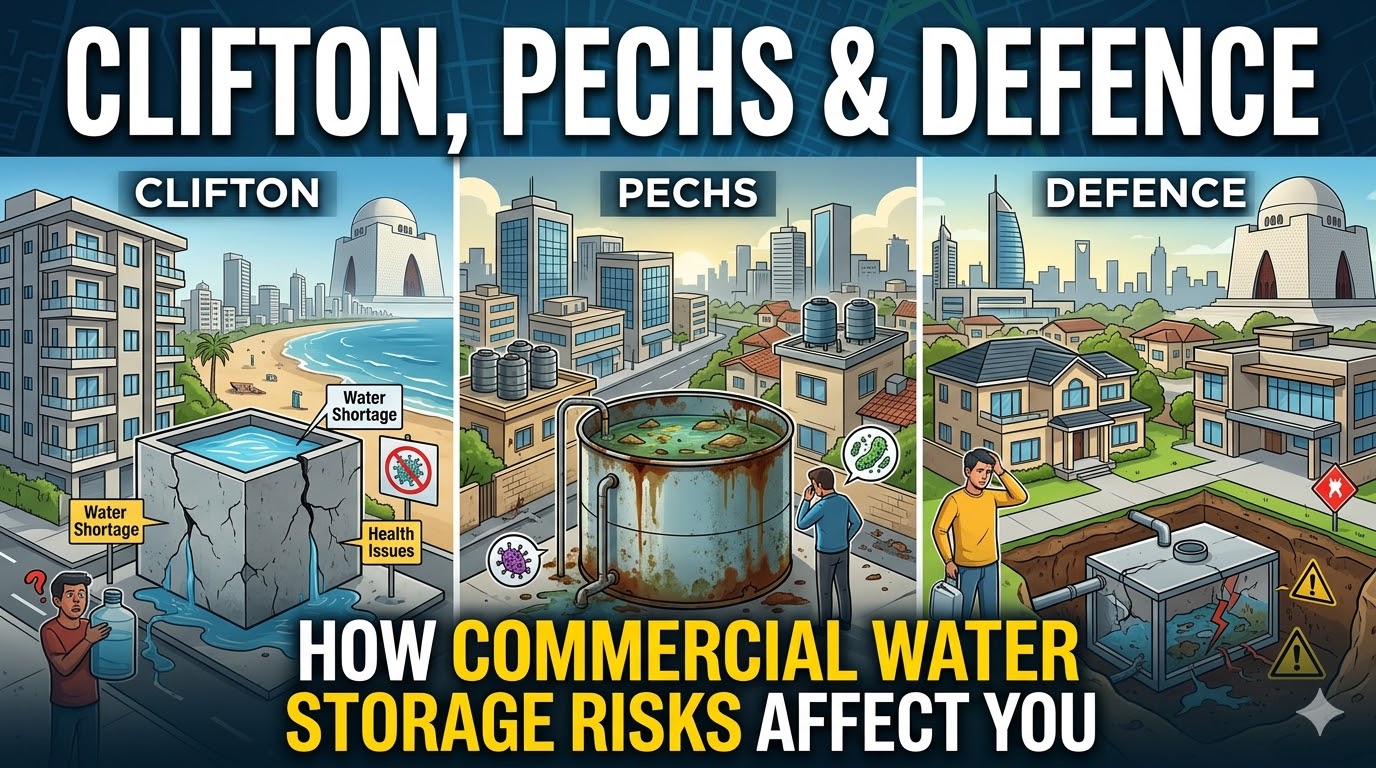
If you live or run a business in Clifton, PECHS, or Defence Housing Authority (DHA), you are likely surrounded by high-rise apartments, large housing societies, and multi-tenant commercial buildings. What you may not think about, however, is what is sitting inside your water storage tank — and how it is quietly affecting your health, your appliances, and your daily life.
Karachi’s water supply carries some of the highest levels of sediment, bacterial contamination, and biological growth in Pakistan. When that water sits in a storage tank for days — as it routinely does in most Karachi homes and commercial buildings — it does not stay the same. It changes. And not for the better.
This guide explains the specific water storage risks facing residents and property owners in Clifton, PECHS, and Defence, and what you should be doing right now to protect your family or your business.
Why Karachi’s Water Is a Unique Challenge
Unlike cities with reliable, pressurised municipal water supply, Karachi depends on intermittent bulk water delivery. Water is supplied once or twice a week in most areas — sometimes less frequently in peak summer months — which means storage is not a choice. It is a necessity.
Every home, apartment block, commercial building, and factory in Karachi has at least one storage tank: typically an underground RCC (reinforced concrete) cistern, an overhead plastic or fiber tank, or both. The water sits in these tanks for extended periods, often in conditions that accelerate contamination:
- Karachi’s heat — temperatures regularly exceeding 38°C in summer — accelerates bacterial growth
- High humidity creates ideal conditions for algae and biofilm formation inside tanks
- Sediment-heavy water supply from the Karachi Water and Sewerage Board (KWSB) introduces particulate matter that settles at the bottom of storage tanks
- Old or poorly sealed RCC tanks in older DHA and Clifton properties allow ground contamination to enter
- Shared water systems in apartment blocks mean contamination in one unit’s supply can affect the entire building
In Karachi’s climate, a water tank that has not been professionally cleaned within the last six months is likely harbouring bacterial colonies, biofilm, and accumulated sludge — even if the water looks and smells normal to you.
The Specific Risks in Clifton, PECHS & Defence
These three areas are among Karachi’s most developed and densely occupied residential and commercial zones. That density, combined with the nature of the water infrastructure in these neighbourhoods, creates some distinct risk factors.
Clifton: Older Buildings, Large Underground Tanks
Clifton’s residential stock includes many older properties built in the 1970s, 80s, and 90s — often with large underground RCC cisterns that were constructed before modern waterproofing standards were in place. These tanks are prone to:
- Hairline cracks that allow soil bacteria and ground seepage to enter
- Interior surface deterioration that creates rough surfaces where biofilm adheres
- No natural light or ventilation — ideal conditions for anaerobic bacterial growth
Clifton’s beachside location also means higher ambient humidity year-round, which accelerates biological growth inside tanks. Newer high-rise towers along the Clifton seafront have large shared overhead tanks that, when not regularly cleaned, distribute contaminated water across dozens of units simultaneously.
PECHS: High-Density Residential & Commercial Mix
PECHS (Pakistan Employees Cooperative Housing Society) is one of Karachi’s most densely populated areas, with a mix of older bungalows converted to multi-floor apartments, commercial buildings, clinics, restaurants, and schools. The water risks here are compounded by:
- Higher water demand from commercial premises putting pressure on shared storage systems
- Restaurants and food businesses using tank water in food preparation — a serious public health risk if tanks are unclean
- Frequent construction in the area causing sediment and dust contamination of exposed tanks
- Many aging buildings with no record of when their tanks were last professionally cleaned
DHA (Defence): Large Properties, High Expectations
DHA is home to some of Karachi’s largest residential properties and most premium commercial real estate. Despite the upmarket perception, DHA properties face water storage challenges that are equally serious — and often more complex:
- Large bungalows often have multiple tanks — underground cisterns, rooftop tanks, and garden storage — each requiring separate cleaning
- DHA Phase 1 through 4 properties are decades old; concrete tanks in these phases often have significant deterioration
- Many DHA residents use water filtration systems or water purifiers — but these do not compensate for a contaminated storage tank upstream of the filter
- High water usage from larger households means faster contamination cycling
Our professional water tank cleaning service in DHA & Clifton is specifically equipped for the tank types, property sizes, and contamination profiles typical of this area — from confined underground RCC tanks in Phase 4 bungalows to rooftop overhead tanks in Clifton high-rises.
What Happens Inside an Uncleaned Water Tank
The contamination process in a neglected water tank is gradual but serious. Here is what typically builds up inside:
Sludge & Sediment
Every time KWSB water enters your tank, it carries dissolved and suspended particles. Over months and years, this settles as a thick layer at the bottom of the tank. This sludge is a breeding ground for bacteria and provides nutrients for biological growth.
Biofilm
Biofilm is a layer of microorganisms — including dangerous bacteria like E. coli and Legionella — that attaches itself to the walls and floor of a tank. It cannot be removed by simply draining the tank or using household bleach. Industrial-grade high-pressure jet washing is required to physically dislodge and remove it.
Algae
In tanks exposed to any natural or artificial light — including overhead plastic tanks — algae can flourish. Algae changes the taste and smell of water and provides a food source for bacteria.
Chemical Contamination
Deteriorating concrete in older tanks can leach minerals into stored water. Rust from steel fittings adds iron contamination. In some older DHA and Clifton properties, paint or sealant used on tank interiors decades ago may not have been food-safe — and those surfaces are now degrading into the water supply.
You may be drinking filtered water — but if your storage tank is contaminated, your filter is working against a much higher pathogen load than it was designed for. Many common household filters are not effective against the bacterial concentrations found in a neglected Karachi water tank.
Health & Business Consequences You Cannot Afford to Ignore
The consequences of contaminated water storage go well beyond a bad taste or occasional stomach upset.
- Waterborne diseases — typhoid, hepatitis A, gastroenteritis, dysentery — are directly linked to contaminated water storage and remain a significant public health issue in Karachi
- Skin infections and eye irritation from bathing in bacterially contaminated water
- For commercial properties: restaurant fines, reputational damage, and liability if customers or tenants become ill due to unsafe water
- Reduced lifespan of water heaters, washing machines, and plumbing fittings due to sediment and biological contamination
- Blocked water filters that fail prematurely because they are handling an excessive contamination load
For property owners in PECHS and DHA managing rental properties, multi-tenant buildings, or commercial premises, the liability implications of providing contaminated water to tenants or customers are considerable — and increasingly, tenants are aware of their rights.
How Often Should Your Tank Be Cleaned in These Areas?
The standard recommendation from water quality experts is every six months. In Karachi’s specific conditions — particularly in Clifton, PECHS, and DHA — there is a strong case for quarterly cleaning for:
- Commercial properties: restaurants, cafes, clinics, schools, hospitals, and offices with high water usage
- Large residential buildings and housing societies with shared water systems
- Properties with old RCC underground tanks that have not been inspected recently
- Any property where water filtration or purification systems are installed — clean tanks extend filter life and effectiveness significantly
For most residential homes in these areas, a minimum six-month professional cleaning cycle is essential. Annual cleaning, which many Karachi residents currently practice (if at all), is simply not sufficient given local water quality and climate conditions.
Our water tank cleaning team serving Gulshan, PECHS & central Karachi can advise on the right cleaning schedule based on your specific tank type, property, and water usage profile.
What Professional Tank Cleaning Actually Involves
Many Karachi residents have experienced the informal ‘tank cleaner’ — typically an individual who arrives with a brush, drains the tank manually, gives the interior a scrub with household bleach, and declares the job done. This approach has significant limitations.
A properly executed professional tank clean involves:
- Full drainage and removal of all stored water
- Industrial vacuum extraction of sludge and sediment from the tank floor
- High-pressure jet washing of all interior surfaces to physically remove biofilm — something manual scrubbing cannot achieve
- Application of a food-grade disinfectant: Silver Hydrogen Peroxide or food-grade chlorine at controlled concentrations
- Full rinse and inspection before sign-off
- Documented procedure — a formal record you can produce to demonstrate compliance if required
For underground tanks, which are common in Clifton and DHA properties, proper confined-space entry protocols are also required: oxygen level testing, safety harnesses, and emergency rescue equipment. An informal operator without this equipment is putting your property and their worker at risk.
Khan Tank Cleaning has been providing professional, certified tank cleaning in Karachi since 2005. We hold ISO 9001 and ISO 45001 certifications, and we are fully registered with the Sindh Revenue Board (SRB) and Federal Board of Revenue (FBR). Whether your property is in Clifton, PECHS, DHA, or anywhere across Karachi, we bring industrial-grade equipment and certified processes — not brushes and buckets.
Serving Clifton, PECHS & Defence — Two Branches, All of Karachi
Khan Tank Cleaning operates two strategically located branches to serve residents and businesses across Karachi. Both branches provide the same certified service, equipment, and standards — with the same-day availability you need in an emergency.
DHA Phase 2 Branch — Serving Clifton, DHA, Korangi & South Karachi
Our DHA & Clifton water tank cleaning branch is the primary service point for all properties in DHA Phase 1 through 8, all blocks of Clifton, Gizri, Saddar, Kiamari, Korangi Industrial Area, Landhi, Malir, and the surrounding areas. Call: 0333-0293174 — available 24/7, same-day service.
Gulshan-e-Iqbal Branch — Serving PECHS, Gulshan, Jauhar & East Karachi
Our Gulshan & PECHS water tank cleaning branch covers all blocks of Gulshan-e-Iqbal and Gulistan-e-Johar, PECHS, Nazimabad, North Karachi, Federal B Area, Liaquatabad, North Nazimabad, Shahrah-e-Faisal, and all of East and Central Karachi. Call: 0340-2717530 — available 24/7, same-day service.
⚠️ Book Your Professional Tank Clean Today — Don’t Wait Until Someone Gets Sick
If you live in Clifton, PECHS, DHA, or anywhere in Karachi, ask yourself honestly: when did you last have your water tank professionally cleaned? Not wiped out by a handyman — professionally cleaned with industrial equipment, food-grade disinfectants, and a documented procedure?
If the answer is more than six months ago — or if you cannot remember — your family or your business is at risk right now. Contaminated water storage is not a visible problem. Your water can look, smell, and taste perfectly normal while containing bacterial colonies that cause typhoid, hepatitis, and gastroenteritis.
The good news: this is one of the easiest health risks to eliminate. A professional tank clean from Khan Tank Cleaning takes a few hours, causes minimal disruption to your water supply, and gives you six months of confidence that the water your family is using is genuinely safe.
📞 DHA & Clifton: Call 0333-0293174 | 📞 PECHS, Gulshan & East Karachi: Call 0340-2717530
Available 24/7. Same-day service across all of Karachi. ISO 9001 & ISO 45001 certified. SRB & FBR registered. Official invoicing provided.
🛡️ Trusted by thousands of Karachi homes and businesses since 2005.
Published by Khan Tank Cleaning | khantankcleaning.com | ISO 9001 & ISO 45001 Certified | SRB & FBR Registered
Leave a Reply