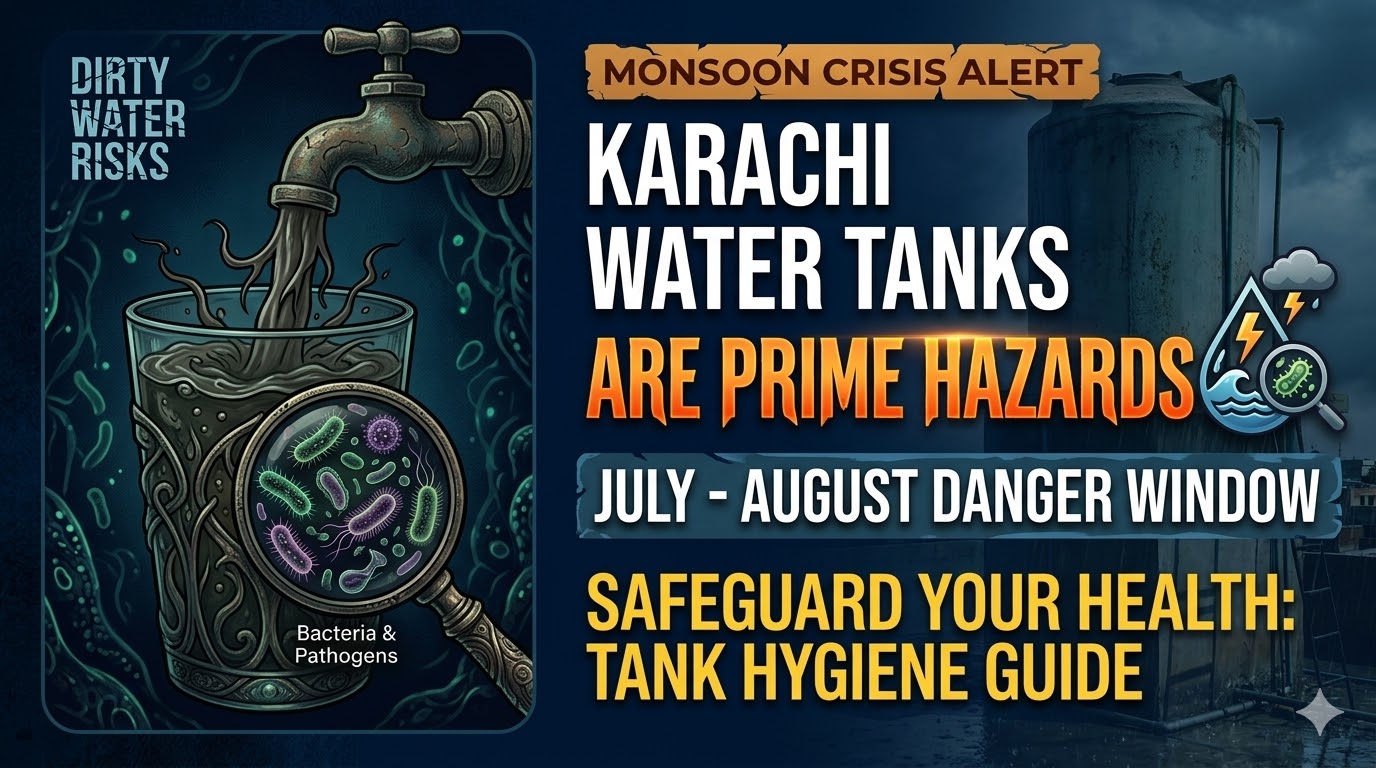
The rains arrive. The humidity soars. And deep inside your water tank, conditions become ideal for the bacterial explosion that causes cholera, typhoid, and severe gastroenteritis. Here is what Karachi homeowners need to know — and do — before July arrives.
Karachi’s Monsoon Is Not Just a Weather Event — It Is a Health Event
For most Karachi families, the monsoon season brings a mix of relief and disruption: cooler evenings, flooded streets, erratic power supply, and — almost invariably — a spike in stomach infections, diarrhoea, and fever cases that fills clinics across the city every July and August.
Doctors attribute this surge to the usual seasonal suspects: contaminated street food, stagnant floodwater, and poor sanitation. These are real factors. But there is a less visible, more consistent culprit sitting on the roof of your house or buried beneath your courtyard — your water storage tank.
The monsoon season fundamentally changes the conditions inside Karachi’s household water tanks. Humidity, temperature fluctuations, infrastructure stress, and flooding combine to create what water safety experts describe as a “contamination peak” — the period of highest bacterial activity in stored water. For families who have not had their tanks professionally cleaned before July, this peak can directly translate into preventable illness.
This article explains exactly why July and August are the most dangerous months for Karachi’s water tanks, what is happening inside them during the monsoon, and what you need to do to protect your household.
Why July–August Are the Most Dangerous Months for Your Tank
To understand what makes the monsoon uniquely dangerous for tank water, you need to understand the four factors that drive bacterial growth in stored water — and how the monsoon pushes each one to its worst extreme.
Factor 1: The Humidity–Condensation Cycle
During Karachi’s monsoon, relative humidity regularly exceeds 80–90%. This creates a condensation cycle on the interior walls of water tanks — particularly overhead plastic and fiber tanks — where moisture accumulates and then drips back into the stored water. This condensation is unfiltered and can carry airborne fungal spores, dust particles, and bacteria directly into your water supply.
In underground RCC tanks, the humidity problem manifests differently. High ambient humidity causes moisture infiltration through hairline cracks and porous concrete walls that were previously dry. Any bacteria present in the surrounding soil — including E. coli from nearby sewage seepage — can enter the tank through these pathways during heavy rain.
Factor 2: Temperature Volatility — The Danger Is Not Heat, It Is the Swing
Most people assume that because July and August bring cooler temperatures than May and June, the bacterial risk in tanks decreases. This is incorrect. The danger is not peak heat — it is temperature cycling.
During the monsoon, Karachi experiences repeated cycles of intense solar heating (when clouds part) followed by rapid cooling during rain. Overhead tanks can swing between 28°C and 42°C within a single day. These temperature cycles accelerate the metabolic rate of bacteria already present in biofilm and sediment, causing rapid population bursts followed by die-offs that release bacterial toxins into the water. Even dead bacteria release endotoxins (lipopolysaccharides) that can cause fever and inflammatory responses in humans.
Why this matters: A tank that might take three weeks to reach dangerous bacterial levels in cooler conditions can reach the same contamination level within five to seven days during active monsoon temperature cycling. If your tank was cleaned in January or February, it may be critically overdue by July.
Factor 3: Infrastructure Failure and Cross-Contamination Surges
Karachi’s water distribution infrastructure is under its greatest annual stress during the monsoon. Heavy rainfall causes:
- Sewage system overflow: Karachi’s combined stormwater and sewage drainage system is overwhelmed during heavy rain events. Sewage overflow contaminates groundwater and low-lying water mains, dramatically increasing the bacterial load entering tanks from the supply side.
- Pressure drops in supply lines: When KWSB supply pressure drops — which happens frequently during load-shedding spikes that accompany monsoon weather — negative pressure can cause back-siphonage, pulling contaminated groundwater or sewage directly into supply pipes and from there into your tank.
- Flooded underground tanks: Underground RCC tanks in low-lying areas of Karachi — parts of Orangi, Korangi, Landhi, and sections of Gulshan-e-Iqbal — can experience direct surface water infiltration during severe flooding, introducing raw floodwater contaminated with sewage, chemicals, and debris directly into the household water supply.
Factor 4: Extended Load-Shedding and Stagnation
Karachi’s load-shedding schedule intensifies during the monsoon as demand for power spikes while grid supply is disrupted by storm damage. Extended power outages mean water pumps are inactive for longer periods — 12 to 18 hours in some residential areas. During these outages, water sits stagnant in tanks at warm temperatures with no circulation. Stagnation time is one of the most reliable predictors of bacterial concentration: the longer water sits still in a warm, dark, contaminated tank, the more dangerous it becomes.
The Pathogens That Peak in Karachi During Monsoon
The following pathogens are specifically associated with elevated incidence during Karachi’s monsoon season and are directly linked to contaminated household water tank storage:
Vibrio cholerae (Cholera)
Cholera cases in Karachi spike predictably every monsoon season. Vibrio cholerae is transmitted almost exclusively through contaminated water and survives well in warm, stagnant tank environments. The bacterium can reach infectious doses rapidly in conditions created by monsoon-affected tanks. Symptoms — profuse watery diarrhoea and severe dehydration — can become life-threatening within hours, particularly in children and the elderly.
Salmonella typhi (Typhoid)
Typhoid case reports increase across Karachi every July and August. Salmonella typhi can persist for weeks in tank sediment and is resistant to low concentrations of chlorine. It enters tanks through contaminated supply water, particularly during the pressure drops and pipe failures that characterise monsoon season. Families in Karachi’s densely populated neighbourhoods — where sewage and water infrastructure are in close proximity — are at greatest risk.
E. coli and Coliform Bacteria
Faecal coliform contamination — a direct indicator of sewage cross-contamination — increases in urban water systems during and after heavy rainfall. E. coli strains in monsoon-affected tanks can cause gastroenteritis that mimics simple food poisoning: stomach cramps, vomiting, and diarrhoea that many families dismiss as a seasonal stomach bug. In children and immunocompromised individuals, pathogenic E. coli strains can cause haemolytic uraemic syndrome, a serious condition affecting the kidneys.
Leptospira (Leptospirosis)
Leptospirosis is a monsoon-specific waterborne disease that is significantly underdiagnosed in Karachi. It is caused by bacteria carried in the urine of rodents — particularly rats, which thrive in Karachi’s flood-affected areas — and enters water supplies through floodwater contamination. Underground tanks are particularly vulnerable. The disease presents with sudden fever, headache, and muscle aches, and can progress to liver and kidney failure in severe cases.
Karachi Health Alert: According to Sindh health records and academic studies on urban Pakistan, waterborne disease cases in Karachi increase by 40–60% during the July–August monsoon period compared to the preceding months. The most commonly cited household risk factor is contaminated water storage, not contaminated supply.
Monsoon Risk by Neighbourhood: How Your Area Affects Your Tank
Not all of Karachi faces identical monsoon water risk. Infrastructure age, drainage quality, elevation, and housing density all influence how severely the monsoon affects your tank. Here is a breakdown by the areas our two branches serve:
DHA, Clifton, Saddar, Korangi and South Karachi
DHA’s newer phases have comparatively modern water infrastructure, but older phases (Phase 1–4) rely on aging mains that are particularly susceptible to pressure-loss contamination during heavy rain. Clifton’s high-rise buildings often have rooftop tanks and shared underground cisterns that serve multiple floors simultaneously — making a single contamination event a building-wide health risk. Korangi and Landhi are in low-lying industrial zones that experience significant flooding, with underground tanks especially vulnerable to direct floodwater infiltration.
Households in these areas should prioritise a pre-monsoon clean from our DHA and Clifton water tank cleaning team. Our DHA branch covers DHA Phase 1–8, Clifton, Gizri, Punjab Colony, Saddar, Korangi, Malir, and surrounding areas — call 03330293174 for immediate same-day service.
Gulshan-e-Iqbal, Gulistan-e-Johar, Nazimabad, North Karachi and East Karachi
Gulshan-e-Iqbal and Gulistan-e-Johar experience some of the most severe annual monsoon flooding in Karachi, particularly in low-lying blocks adjacent to the Lyari River drainage corridor. Underground RCC tanks in these areas are at direct risk of floodwater infiltration during extreme rainfall events. The density of housing in North Nazimabad, Liaquatabad, and North Karachi Township means that sewage and water mains are in very close proximity — creating high cross-contamination risk during any pipe pressure fluctuation.
East Karachi residents have dedicated access to our Gulshan and Jauhar branch water tank cleaning service, which covers all blocks of Gulshan-e-Iqbal and Gulistan-e-Johar, Nazimabad, Federal B Area, SITE, PECHS, New Karachi, North Karachi, Bahria Town, and surrounding areas. Call 03402717530 — same-day emergency service is available 24/7.
Wherever you are in Karachi, professional water tank cleaning services from Khan Tank Cleaning are accessible within the day. Both branches operate around the clock.
Warning Signs Your Monsoon Tank Contamination Has Already Begun
By the time contamination becomes visible or smellable, bacterial concentrations in your tank are already at dangerous levels. However, these warning signs should be treated as emergency indicators requiring immediate professional attention:
- Musty, earthy, or sulphurous odour from taps: Indicates anaerobic bacterial activity, algae decomposition, or hydrogen sulphide production in tank sediment.
- Slightly cloudy or discoloured water: A sign of elevated sediment, algae growth, or high bacterial turbidity — particularly common in post-rain supply water entering a dirty tank.
- Yellow or brownish tinge: Rust from corroded pipes or tank fittings, often made worse by pressure fluctuations during monsoon supply disruptions.
- Slippery or slimy feel on tank walls (if accessible): Classic biofilm indicator. Biofilm is the primary bacterial reservoir in any water storage tank.
- Recurring stomach issues in household: If two or more family members experience diarrhoea, nausea, or fever within the same week, waterborne contamination from the household tank is a primary suspect.
- More than six months since last professional clean: In Karachi’s monsoon conditions, a tank that was cleaned in January or earlier is at significant risk of reaching dangerous contamination levels by July.
Critical reminder: You cannot rely on appearance or smell alone to assess tank safety. Most dangerous bacterial contamination — including typhoid and cholera — is odourless and colourless at the concentrations needed to cause infection. Professional cleaning is required on schedule, not just when the water looks or smells bad.
Why Pre-Monsoon Cleaning in June Is the Most Important Clean of the Year
If you can only have your tank professionally cleaned once a year — which is, itself, less than the recommended twice-yearly schedule — the single most important time to do it is during June, before the monsoon arrives. Here is why:
- You start the high-risk period with a clean baseline. A professionally cleaned and disinfected tank eliminates the existing biofilm reservoir, sediment, and bacterial population. When contaminated supply water or humidity-driven infiltration begins during July, the tank has no pre-existing bacterial colony to amplify the incoming contamination.
- Silver Hydrogen Peroxide residual effect. Our food-grade disinfectant provides a residual antibacterial effect on tank surfaces after the clean, offering an additional defensive layer during the first weeks of the monsoon — the period of greatest contamination risk from supply-side events.
- You can monitor effectively. A family that knows their tank was professionally cleaned in June can assess any illness or water quality change against a known baseline. A family with an unknown cleaning history cannot.
- Bookings are concentrated — act early. Demand for professional tank cleaning in Karachi surges in late June and early July as families respond to news of the first monsoon-related cholera or typhoid cases. Booking your clean in June avoids the rush and ensures same-day availability.
Why DIY Tank Cleaning Is Especially Inadequate During Monsoon Season
Many Karachi homeowners rely on informal cleaning — a manual scrub with bleach by a local laborer — and consider this adequate. During ordinary conditions, this provides minimal protection. During and after the monsoon, it is dangerously insufficient for the following specific reasons:
- Monsoon-driven contamination is deeper: Floodwater infiltration and high-humidity condensation introduce bacteria deep into the porous surface of RCC concrete tanks, into inlet pipe residue, and into any crack or joint. Manual scrubbing with brushes cannot reach or dislodge contamination at this depth.
- Household bleach is neutralised by organic matter: Post-monsoon tank water contains elevated levels of organic matter — soil particles, algae, and debris introduced by supply-side events. Organic matter chemically neutralises chlorine-based bleach before it reaches the bacteria it is meant to kill.
- No vacuum extraction means recontamination: Any manual clean that does not include industrial vacuum extraction leaves loosened sludge in the tank. During the monsoon, when water agitation from supply refills is frequent and pump cycling is irregular, this residue constantly stirs back into the water column.
- No safety equipment for confined space entry: Underground RCC tanks accumulate methane and hydrogen sulphide gas — both more concentrated in warm, wet monsoon conditions. Entry without oxygen monitoring and ventilation equipment is genuinely life-threatening. Informal cleaners who enter these tanks without proper safety gear put their lives — and yours — at risk.
Khan Tank Cleaning’s ISO-certified 8-step tank cleaning procedure — involving industrial jet washing at 3,000+ PSI, vacuum sludge extraction, and Silver Hydrogen Peroxide disinfection — is specifically designed to address the depth and type of contamination that monsoon conditions produce. It is the professional standard your family’s health requires.
What Khan Tank Cleaning’s Monsoon Service Involves
Every tank cleaning service we perform follows this ISO 9001-audited eight-step process, with specific attention to the contamination types associated with monsoon conditions:
- Site Assessment: We evaluate tank type, size, access, and any visible signs of monsoon-related damage or infiltration before work begins. You receive an exact scope and price upfront.
- Controlled Complete Drainage: All water is drained and safely discharged — no contaminated water is recycled back.
- High-Pressure Jet Washing (3,000+ PSI): Industrial washers blast all walls, floor, ceiling, and fittings — removing biofilm, algae colonies, mineral scale, and the organic matter that accumulates during monsoon supply disruptions.
- Industrial Vacuum Extraction: All loosened sediment, sludge, and debris are completely removed. Nothing is left to resettle in fresh water.
- Silver Hydrogen Peroxide Disinfection: EPA and FDA approved for potable water. Penetrates and destroys residual biofilm. More effective against monsoon-specific contamination than chlorine-based products. Breaks down into water and oxygen — zero toxic residue.
- Thorough Rinse: Complete rinse cycle ensures no chemical residue before refilling.
- Senior Technician Quality Inspection: Every surface is inspected against our ISO 9001 standards before the tank is cleared for refilling.
- Official Documentation: You receive a full service report and a tax-compliant invoice (SRB/FBR registered). This is a certified, documented service — not a cash transaction.
Our teams carry full safety equipment — oxygen monitoring devices, forced ventilation, harnesses, and protective gear — for all underground RCC tank work. This is non-negotiable under our ISO 45001 Occupational Health & Safety certification.
Recommended Cleaning Schedule Around Monsoon Season
Based on water safety best practices for Karachi’s climate and infrastructure conditions, Khan Tank Cleaning recommends the following annual schedule:
- Twice-yearly residential clean: Ideally in June (pre-monsoon) and December (post-winter). This ensures your tank enters the two highest-risk periods — monsoon and the first cold months — in a clean, disinfected state.
- Quarterly commercial and institutional clean: Hotels, hospitals, schools, and office buildings should clean every three months, with a mandatory clean before July regardless of when the last service occurred.
- Immediate clean if: any household member is diagnosed with typhoid, cholera, or a waterborne gastrointestinal illness; if the tank has been visibly affected by flooding; if water taste, odour, or appearance changes; or if the tank has not been professionally cleaned for more than six months.
Frequently Asked Questions About Monsoon Tank Safety in Karachi
If it rains heavily, should I empty and reclean my tank immediately after?
If your underground tank may have been exposed to floodwater — indicated by water entering from around the access hatch, unusual floating debris, or a sudden change in water colour — then yes, an immediate professional clean is warranted. Contact us for a same-day emergency service. For overhead tanks that were professionally cleaned before monsoon, heavy rainfall alone does not typically require an emergency reclean unless visible contamination is observed.
Can I use water purification tablets instead of cleaning the tank?
Purification tablets and chlorine drops treat water in the tank but do not clean the tank itself. Biofilm on tank walls and sediment at the bottom are physical structures — not free-floating bacteria — and are not eliminated by chemical dosing of the water column. The bacteria within biofilm are shielded from contact with purification chemicals. Tablets are a short-term interim measure only, not a substitute for professional cleaning.
How quickly can Khan Tank Cleaning attend after I call?
Both our branches offer same-day service, 24 hours a day, seven days a week. During the monsoon peak in July and August, we recommend calling as early in the day as possible to secure a same-day slot. You can also book in advance through our online estimate form to guarantee your preferred date.
Is it safe for children and pregnant women to use the water after the clean?
Yes. Our Silver Hydrogen Peroxide disinfectant is EPA and FDA approved for potable water systems and breaks down completely into water and oxygen with no chemical residue. A thorough post-disinfection rinse is a mandatory step in our ISO-certified process before the tank is cleared for refilling. The water is safe for all household members, including infants, pregnant women, and the elderly.
Act Now — Before the Monsoon Turns Your Tank Into a Health Risk
Every monsoon season, Karachi’s hospitals and clinics see the same pattern: a sharp rise in cholera, typhoid, and gastrointestinal illness cases in July and August, followed by weeks of treatment, recovery, and expense that could have been prevented by a single professional tank clean in June.
Do not wait for your family to become part of that statistic. Khan Tank Cleaning has been protecting Karachi households since 2005 with ISO-certified processes, food-grade disinfection, and industrial equipment that delivers genuine results — not just a visual impression of cleanliness.
Book your pre-monsoon clean today. Both our branches are open 24/7 with same-day availability. Tell us your tank type and size — we quote immediately, transparently, and without obligation.
DHA, Clifton, Saddar, Korangi, Malir & South Karachi Call: 03330293174 | Book online: Tank Cleaning — DHA & Clifton Branch Available 24/7 | Same-day pre-monsoon slots filling fast
Gulshan-e-Iqbal, Jauhar, Nazimabad, North Karachi, SITE & East Karachi Call: 03402717530 | Book online: Tank Cleaning — Gulshan & Jauhar Branch Available 24/7 | Same-day pre-monsoon slots filling fast
Get your free, no-obligation quote at khantankcleaning.com/estimate. Protect your family from Karachi’s most preventable seasonal health risk — book your tank clean before July arrives.
Khan Tank Cleaning | ISO 9001 & ISO 45001 Certified | SRB & FBR Registered | Serving Karachi Since 2005
DHA Branch: 03330293174 | Gulshan Branch: 03402717530 | khantankcleaning.com

Mateen Khan is the Founder & Owner of Khan Tank Cleaning, Karachi’s first dedicated professional water tank cleaning company (est. 2005). With 20+ years of industry experience, he leads an ISO 9001 & ISO 45001 certified team that follows a strict 8-step process using industrial equipment and food-grade disinfectants. Mateen is committed to making clean, safe water accessible to every household and business in Karachi.
Leave a Reply