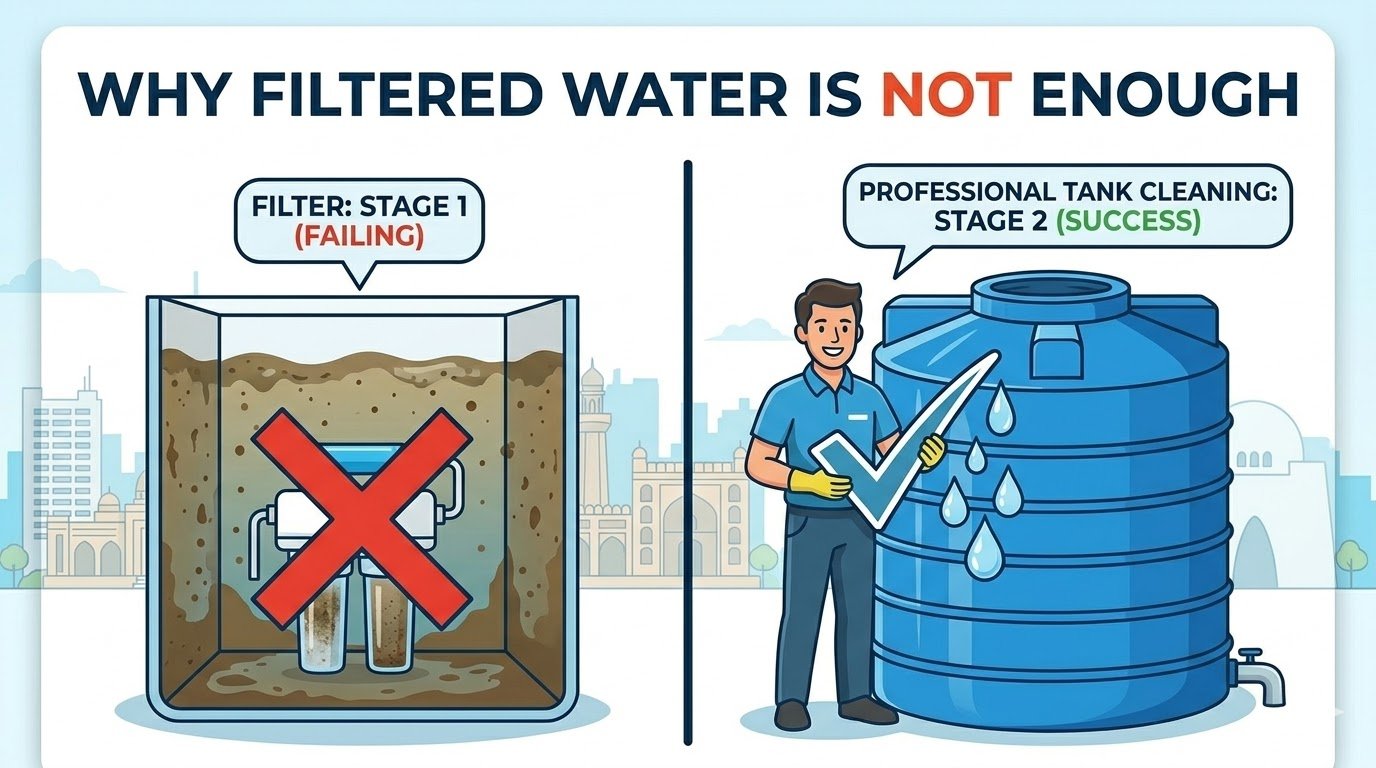
Many Karachi households have spent good money on an RO unit or a UV filter and reasonably assume the water question is settled. A filter is worth having. It is also doing a different job from tank cleaning, and one does not replace the other.
This article sets out the water filter vs tank cleaning question plainly: what each type of filter removes, what none of them can do about the tank feeding them, and how to get the most out of both.
The short answer
A filter treats the water that passes through one outlet at the moment you use it. Tank cleaning removes the sludge, biofilm and debris from the place where all of the household’s water is stored. If you only filter, every other tap in the house still delivers tank water, and the filter itself works harder and fails sooner.
What each type of filter does
| Filter type | What it is good at | What it does not do |
|---|---|---|
| Sediment cartridge | Traps sand, rust and visible particles | Does not kill or remove bacteria and viruses; clogs quickly when the tank is dirty |
| Activated carbon | Improves taste and smell, reduces chlorine | Not a disinfection step; an old carbon cartridge can itself grow bacteria |
| UV lamp | Inactivates bacteria and viruses in clear water | Loses effectiveness in cloudy water; removes nothing; needs the lamp and sleeve maintained |
| Reverse osmosis (RO) | Removes dissolved salts and most contaminants, useful for brackish borehole water | Treats one tap; membranes foul with sediment; storage tank and pipework after the membrane need hygiene too |
| Ceramic candle | Removes many bacteria and particles at low cost | Slow; cracks go unnoticed; needs regular scrubbing |
The WHO treats household water treatment as a useful barrier and stresses that its benefit depends on correct, consistent use. In other words, a filter is only as good as its last cartridge change.
Which filter suits which Karachi water source
The right filter depends on where your water comes from, and most Karachi homes use more than one source over a year.
| Your main source | Typical problem | Sensible filter setup |
|---|---|---|
| KWSC piped supply | Sediment and microbial contamination picked up in the network | Sediment and carbon stages followed by UV, or boiling |
| Tanker water | Unknown origin; may be brackish, may be contaminated | Treat as the worst case: sediment stage plus RO or UV, and boil for children |
| Borehole (boring) water | High salts and hardness; possible sewage contamination in dense areas | RO for drinking; expect heavy scale in the tank and on fittings |
| A mix of all three | Quality changes from week to week | RO with UV for drinking, and a strict tank cleaning schedule |
Whatever the setup, it sits at the end of the chain. Everything upstream of it, meaning the underground tank, the rooftop tank and the pipes between them, is untreated.
Five things no filter can do
- Clean the tank. Sludge on the floor and biofilm on the walls stay where they are and keep seeding the water.
- Treat the other taps. Bathrooms, the kitchen sink, the washing machine and the garden tap all bypass it.
- Protect itself from a dirty supply. Sediment blocks pre-filters and fouls RO membranes, so you pay for cartridges more often.
- Keep insects and animals out. A broken lid is a tank problem.
- Tell you it has failed. A spent UV lamp or a torn membrane gives water that looks exactly the same.
Where unfiltered tank water reaches your family
- Brushing teeth and rinsing the mouth
- Showers and baths, particularly for small children
- Wudu, where water is drawn into the nose
- Washing dishes, fruit and vegetables
- Ice trays filled from the kitchen tap
The nose matters more than most people realise. Naegleria fowleri, the amoeba behind several deaths in Karachi each year, infects through the nasal passage, not through drinking. Dawn reported in June 2025 on a patient whose only exposure was ordinary water use at home and ablution at a mosque, and noted that the organism cannot survive in water that is clean, cool and adequately chlorinated. No kitchen filter addresses that route. Clean, disinfected storage does. Parents will find more on everyday exposure in our guide to children and water safety.
What is in a tank that has not been cleaned
- Sludge: silt, rust and organic matter delivered with every fill and tanker load.
- Biofilm: a slippery bacterial layer on the walls that shelters organisms from residual chlorine.
- Algae: wherever light gets in.
- Insects and larvae: through gaps in the lid. The WHO’s dengue advice is to keep household water containers covered and cleaned.
Karachi’s conditions make this build-up faster than in most cities. Supply is intermittent, so water is stored for days; the incoming water is frequently contaminated, as our guide to KWSB water supply explains; and rooftop tanks sit in heat that speeds up bacterial growth. Stagnant, warm water with sludge and scale is also exactly the environment that the UK Health and Safety Executive warns about in its legionella guidance for building water systems.
Filter only, or filter plus a clean tank
| Filter only | Filter and clean tank | |
|---|---|---|
| Drinking water | Depends entirely on filter condition | Cleaner input, wider safety margin |
| Bathing, brushing, wudu | Untreated tank water | Stored in a disinfected tank |
| Cartridge and membrane life | Shorter | Longer |
| Smell and colour around the house | Unchanged | Usually resolved |
| Mosquito breeding | Not addressed | Addressed if lids are fixed |
The cost side of water filter vs tank cleaning
People sometimes frame this as a choice because both cost money. In practice a clean tank lowers the running cost of the filter. Sediment is what blocks pre-filters and fouls RO membranes, and the tank is where the household’s sediment collects. Remove it twice a year and cartridges last closer to their rated life. A filter fed from a tank with an inch of sludge on the floor is being asked to do the tank’s job as well as its own.
Is tank cleaning enough without a filter?
No. A clean tank holds whatever the supply or the tanker delivers, and Karachi’s supply regularly fails testing. Monitoring by the Pakistan Council of Research in Water Resources, reported in 2021, put the share of unsafe drinking water samples in Karachi at 93 percent. Keep boiling or filtering what you drink. The honest position is that you need both, and that each makes the other work better.
Getting the most from your filter
- Change cartridges on the manufacturer’s schedule, and sooner if flow drops.
- Replace the UV lamp at the stated interval even if it still glows.
- Sanitise the RO storage tank and the dispenser tap when you change membranes.
- If cartridges are clogging in weeks, not months, the tank is telling you something. That is one of the warning signs worth acting on.
Getting the most from your tank
Clean it on a schedule: every four to six months for most houses and every three months if you rely on tankers. Our article on tank cleaning frequency in Karachi gives the detail. Bucket-and-bleach scrubbing leaves the biofilm and most of the sludge behind, for reasons we set out in tank wallah versus professional cleaning.
Our own method is on the cleaning procedure page: jet washing at 3,000+ PSI, vacuum extraction of sludge, disinfection, rinse and a report with photographs. We work across the city from two branches, covering Gulshan, Jauhar and East Karachi and DHA, Clifton and South Karachi, and the price calculator gives a fixed quote for standard homes.
Is it the tank or the filter? A quick diagnosis
| What you notice | More likely the tank | More likely the filter |
|---|---|---|
| Bad smell at every tap in the house | Yes | No |
| Bad taste only from the filtered tap | No | Yes: an old carbon cartridge or a dirty filter housing |
| Brown water after the motor runs | Yes: sludge is being stirred | No |
| Flow from the filter has slowed | Often: sediment from the tank | Also possible: cartridge at the end of its life |
| Slime inside the filter housing | Possibly: biofilm carried from the tank | Yes: housing not sanitised at cartridge changes |
| Stomach upsets despite filtered drinking water | Possible: exposure through other taps | Possible: UV lamp or membrane has failed |
When the signs point both ways, deal with the tank first. A filter serviced while it is still being fed from a dirty tank will be back in the same state within weeks.
Frequently asked questions
I have an RO plant. Do I still need to clean the tank?
Yes. The RO unit protects one tap. The tank supplies every other outlet, and a dirty tank shortens membrane life.
Does a UV filter kill everything?
A working UV lamp inactivates bacteria and viruses in clear water. It is less effective when water is cloudy, and it removes no sediment or chemicals.
Will a clean tank make tap water safe to drink?
Not on its own. It removes one major source of contamination, but the incoming supply is outside your control. Continue to boil or filter drinking water.
Why do my filter cartridges turn brown so fast?
Usually because of sediment in the tank, particularly after a supply break or a tanker delivery. Cleaning the tank typically extends cartridge life.
Do I need a filter on the main line to protect the tank?
A coarse sediment filter on the inlet can reduce sand and rust entering the tank, but it needs frequent cleaning in Karachi and does not stop bacteria. It is a help, not a replacement for cleaning.
Which should I spend on first, a filter or a tank cleaning?
If you have neither, boil drinking water from today, which costs almost nothing, and have the tank cleaned. Then add a filter suited to your water source.
Sources
Figures in this article were checked in October 2026 against the following:
- Dawn, 5 June 2025: Young man dies of Naegleria fowleri in Karachi
- Geo News, 24 August 2021: PCRWR monitoring of drinking water in 29 cities
- WHO: Dengue fact sheet
- UK Health and Safety Executive: Managing legionella in hot and cold water systems
- WHO: Drinking-water fact sheet
About Khan Tank Cleaning
Written by the team at Khan Tank Cleaning, which has worked on Karachi’s water tanks since 2005 under founder Mateen Khan. Some of the organisations we clean for are listed on our clients page. To talk to a branch, use the contact page or call 0333 0293174 (DHA Phase 2) or 0340 2717530 (Gulshan-e-Iqbal).

Mateen Khan is the Founder & Owner of Khan Tank Cleaning, Karachi’s first dedicated professional water tank cleaning company (est. 2005). With 20+ years of industry experience, he leads an ISO 9001 & ISO 45001 certified team that follows a strict 8-step process using industrial equipment and food-grade disinfectants. Mateen is committed to making clean, safe water accessible to every household and business in Karachi.