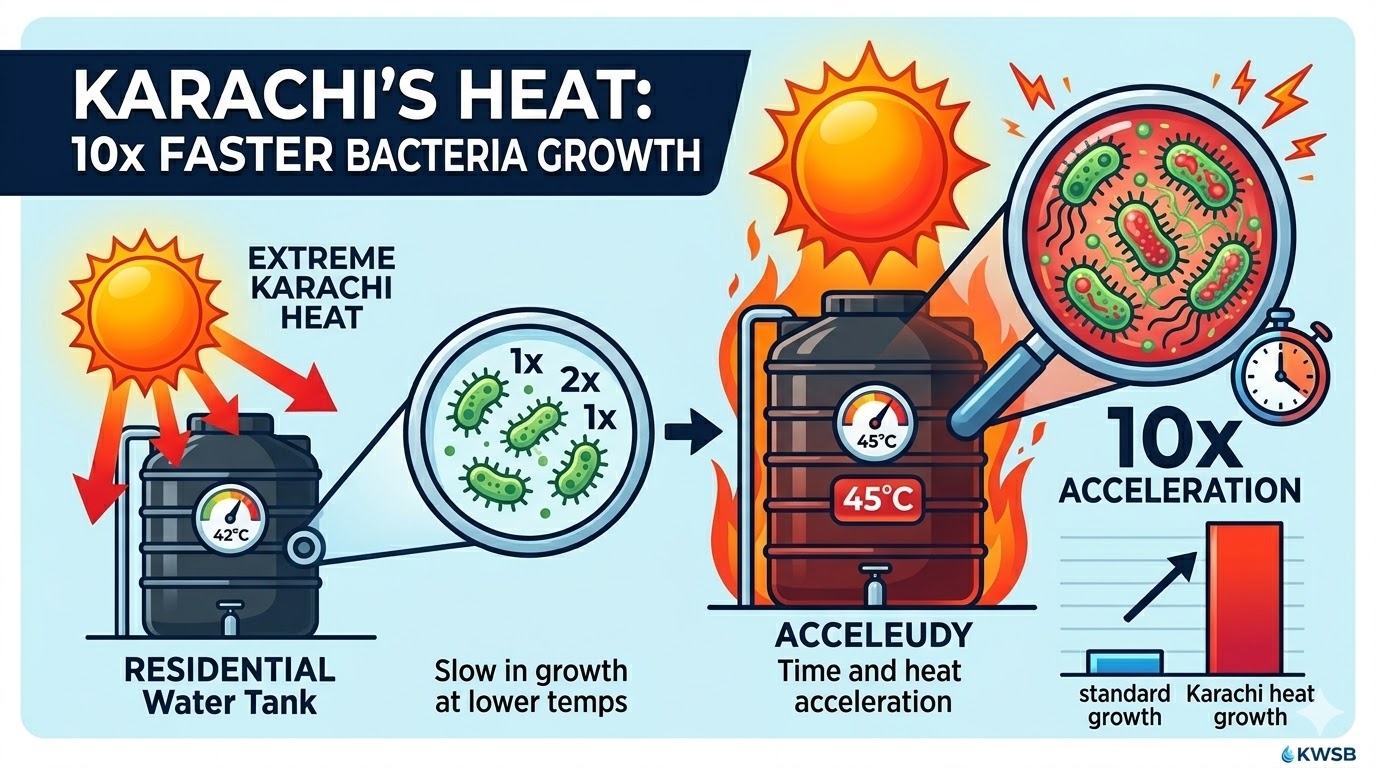
Picture this: You wake up on a sweltering Karachi morning in May. The temperature outside is already pushing 42°C. You brush your teeth, make chai, and use water for your family — all from your overhead or underground tank. What you cannot see is what is quietly multiplying inside that tank while you sleep.
Bacteria. Biofilm. Algae. And in Karachi’s specific climate, they are growing at a rate that would alarm even a microbiologist.
This is not a scare tactic — it is microbiology combined with local geography. Karachi’s unique combination of extreme heat, high humidity during the monsoon, inconsistent municipal water supply, and ageing infrastructure creates what experts describe as a perfect breeding environment for waterborne pathogens.
In this article, we explain exactly why heat accelerates bacterial growth in water tanks, what makes Karachi uniquely dangerous, and what you must do right now to protect your family.
The Science: How Heat Supercharges Bacterial Growth
To understand the threat, you need to understand one basic principle of microbiology: bacteria reproduce faster when the temperature is higher. This is not a subtle difference — it is dramatic and exponential.
The Doubling Time Effect
Common waterborne bacteria such as E. coli, Salmonella, Legionella, and Pseudomonas have a phenomenon called “doubling time” — the time it takes for a colony to double in size. Here is how temperature changes everything:
| Bacterial Doubling Time vs. Temperature 20°C (moderate climate): Doubling time ~60 minutes 30°C (warm climate): Doubling time ~20 minutes 37°C–42°C (Karachi summer): Doubling time ~10–12 minutes At 42°C — a temperature Karachi commonly reaches from April through June — a single bacterium can become over 16 million organisms within 4 hours. |
That is the “10x faster” effect in real numbers. When the temperature in your rooftop tank climbs during Karachi’s peak summer, bacterial colonies that might take two days to reach dangerous levels in a cooler climate reach them in a matter of hours.
The Danger Zone: 25°C to 50°C
Microbiologists refer to the temperature band between 25°C and 50°C as the “danger zone” for water storage. This is the range in which the most dangerous waterborne pathogens thrive, replicate fastest, and produce the most harmful toxins.
In Karachi, your rooftop overhead tank sits in direct sunlight for 10–14 hours a day during summer. Water temperature inside these tanks routinely reaches 35°C to 45°C — sitting squarely in the middle of this danger zone.
Why Karachi Is Uniquely Dangerous: 6 Local Factors
While bacterial growth in water tanks is a problem across Pakistan, Karachi’s specific conditions make this issue significantly worse than most other cities. Here is what makes our city uniquely vulnerable:
1. Extreme Temperatures and Direct Sun Exposure
Karachi is one of the hottest major cities in South Asia. From April to August, temperatures regularly exceed 38°C, with peak days crossing 45°C. Rooftop tanks — the most common water storage solution in Karachi homes and apartment buildings — are exposed to direct sunlight for most of the day.
A black or dark-coloured plastic tank absorbs heat rapidly. Internal water temperatures can exceed ambient air temperature by 5°C to 10°C. This means when it is 40°C outside in areas like Gulshan-e-Iqbal or Gulistan-e-Johar, your tank water may be sitting at 45°C to 50°C — optimal conditions for pathogen multiplication.
2. Infrequent Water Supply and Long Stagnation Periods
Karachi’s municipal water supply from KWSB (Karachi Water and Sewerage Board) is notoriously irregular. Most households receive water once every two to four days. This means water sits stagnant in your tank for 48 to 96 hours at a time — in extreme heat — before being replaced.
Stagnant, warm water is a breeding ground. The longer water sits without circulation, the faster bacteria proliferate. Unlike running water, stagnant water allows sediment to settle and biofilm to form on tank walls, creating permanent colonies that survive even when fresh water is added.
3. High Humidity During Monsoon Season
Karachi’s monsoon season (July to September) brings a secondary threat. High humidity combined with warm temperatures creates ideal conditions for mould, algae, and certain bacteria that thrive in humid environments. Tank lids and inlet pipes are especially vulnerable to contamination during this period, allowing external pathogens to enter the tank.
Coastal areas such as DHA and Clifton experience higher baseline humidity year-round due to their proximity to the Arabian Sea, making this a persistent challenge rather than a seasonal one.
4. Aging Infrastructure and Sediment Accumulation
Many water tanks in Karachi — particularly in older neighbourhoods like PECHS, Nazimabad, Liaquatabad, and Saddar — have not been professionally cleaned in years, or ever. Over time, sediment, rust particles, algae, and organic matter accumulate at the bottom. This sludge layer acts as a nutrient-rich substrate for bacterial colonies, insulating them even when the water above is treated or replaced.
Heat accelerates the decomposition of this organic matter, producing further nutrients that feed bacterial growth and cause the unpleasant taste and smell many Karachi residents have come to mistakenly accept as “normal.”
5. Biofilm: The Hidden Enemy
One of the most dangerous threats in Karachi’s water tanks is biofilm — a thin, slimy layer of bacterial communities that adhere to tank walls, inlets, and outlets. Biofilm is not removed by simply replacing the water or adding chlorine tablets.
In warm climates like Karachi’s, biofilm develops faster and becomes significantly thicker than in cooler regions. Studies on biofilm formation show that at temperatures above 35°C, biofilm communities can establish themselves on surfaces within 24 to 48 hours. Once established, they release planktonic bacteria back into the water and can resist standard disinfection methods.
This is why industrial-grade high-pressure jet washing is essential — not optional. Standard bucket-and-brush cleaning, which many informal services in Karachi offer, cannot penetrate or remove biofilm effectively.
6. Contaminated Municipal Supply as a Starting Point
The water entering your tank is often already carrying a bacterial load. Karachi’s distribution network has thousands of kilometres of ageing pipes, many of which have leaks and cross-contamination points. By the time water reaches your tank, it may contain bacteria, heavy metals, and other contaminants.
When contaminated water enters a hot tank, bacterial populations that were already present in small numbers explode into dangerous concentrations within hours. Your tank, in effect, amplifies the contamination it receives.
The Diseases You Are Risking Right Now
The bacteria thriving in Karachi’s hot, stagnant water tanks are directly linked to serious, sometimes fatal illnesses. These are not theoretical risks — they are documented public health problems in our city every year:
- Typhoid Fever: Caused by Salmonella Typhi, typhoid is endemic in Karachi. The bacteria are transmitted primarily through contaminated drinking water and can survive in warm stagnant tanks.
- Gastroenteritis and Diarrhoea: E. coli and Salmonella strains cause severe diarrhoeal illness, particularly dangerous for children under five and elderly family members. Karachi hospitals report thousands of such cases every summer.
- Cholera: Vibrio cholerae spreads through faecally contaminated water. Cholera outbreaks in Karachi — particularly in densely populated areas — have been linked to contaminated tank water.
- Skin and Eye Infections: Pseudomonas and Staphylococcus bacteria in contaminated tank water cause skin rashes, folliculitis, and eye infections — symptoms many Karachi residents experience without connecting them to their water source.
- Legionnaires’ Disease: Legionella bacteria — which thrive between 25°C and 45°C — can cause a severe form of pneumonia. This pathogen is particularly associated with warm water storage systems and is more common than most people realise.
| A Note on Water Filters |
Neighbourhood Spotlight: Which Areas of Karachi Are Most at Risk?
While no part of Karachi is immune, certain neighbourhoods face higher risk due to a combination of tank type, sun exposure, water supply frequency, and building density:
Gulshan-e-Iqbal and Gulistan-e-Johar
These densely populated neighbourhoods in Karachi East are home to hundreds of thousands of families living in multi-storey apartments, flats, and townhouses. Rooftop tanks in this area experience prolonged sun exposure, and the irregular KWSB water supply means water routinely sits stagnant for 2–4 days at a time. The combination of heat and stagnation creates severe bacterial accumulation. If you live in this part of the city, our water tank cleaning service in Gulshan and Johar is available throughout the area — from Gulshan blocks to Johar Chowrangi and beyond.
DHA and Clifton
The upscale coastal belt of Defence Housing Authority and Clifton presents a different but equally serious challenge. While many properties here are newer, their proximity to the Arabian Sea means persistent humidity — which accelerates tank corrosion, mould growth, and algae formation. Larger residential properties and commercial buildings often have high-capacity storage tanks that have not been cleaned in years despite their premium setting. Our dedicated tank cleaning service in DHA and Clifton uses industrial-grade equipment suited for both large underground reserves and elevated rooftop tanks common in this area.
PECHS, Nazimabad, North Karachi, and Beyond
Older residential areas across Karachi Central, West, and South face the additional risk of ageing tank infrastructure. Many concrete underground tanks in these areas have cracks and uneven surfaces that harbour bacteria even after surface cleaning. Sludge accumulation in these tanks can be years old, creating a persistent source of contamination regardless of how frequently fresh municipal water is added.
How Often Should You Clean Your Tank in Karachi?
Given Karachi’s heat and water quality challenges, the recommended cleaning frequency is significantly higher than the national average:
| Recommended Cleaning Frequency for Karachi Residential overhead tanks: Every 3 months (more often in summer) Underground tanks: Every 4–6 months Commercial & industrial: Monthly or quarterly depending on usage Post-monsoon inspection: Mandatory after every rainy season |
Many Karachi homeowners clean their tanks once a year — or less. In Karachi’s climate, this is far from sufficient. A tank left for 12 months in Karachi’s heat without cleaning can accumulate the same level of contamination as one left for several years in a temperate climate.
What Professional Cleaning Actually Does (and Why DIY Falls Short)
This is where the difference between professional and DIY or informal cleaning becomes critical. Many homeowners pour some bleach in the tank, let it sit, and drain it — believing the tank is now clean. It is not.
Why Standard DIY Methods Fail in Karachi’s Conditions
- Bleach tablets and chlorine solutions do not penetrate biofilm. They kill bacteria in the water column but leave the biofilm layer on tank walls completely intact, ready to repopulate the water within days.
- Manual scrubbing with brushes cannot reach corners, inlet pipes, and outlet channels — the exact locations where bacteria concentrate most.
- Without industrial vacuuming, sludge at the bottom of the tank remains. This sludge is a dense bacterial colony. Adding clean water on top of undisturbed sludge simply re-contaminates the water.
- Informal services in Karachi often lack the equipment and training to address confined-space underground tank cleaning safely — creating risk for both the workers and the tank structure.
What Khan Tank Cleaning’s Professional Service Provides
Khan Tank Cleaning uses a multi-step industrial process specifically designed for Karachi’s challenging conditions:
- High-Pressure Jet Washing: Industrial-grade pressure washing that reaches every corner, surface, and crevice — removing biofilm, algae, and calcified deposits that manual methods leave behind.
- Industrial Vacuuming: Complete sludge extraction from the tank floor, leaving no residue that can re-contaminate fresh water.
- Silver Hydrogen Peroxide Disinfection: A hospital-grade disinfectant that is highly effective against bacteria, viruses, and biofilm — and safe for human consumption. Far more effective than household bleach in Karachi’s heat conditions.
- Confined Space Safety Systems: For underground tanks, oxygen safety equipment and forced ventilation systems are used — protecting workers while ensuring a thorough deep-clean.
- All Tank Types: Overhead, underground, plastic, fiber, concrete, stainless steel — all brands including Bestank, Aqua Plus, and Syntex — cleaned to the same professional standard.
Serving All of Karachi — With Priority Coverage in Key Areas
Khan Tank Cleaning operates across the entire city from two strategically located branches. Our Gulshan and Johar branch provides priority coverage to Karachi East — including Gulshan-e-Iqbal, Gulistan-e-Johar, FB Area, Malir, Korangi, Shah Faisal Town, and surrounding neighbourhoods. Our DHA and Clifton branch serves the coastal and southern belt — including Defence Housing Authority, Clifton, Saddar, PECHS, Bahadurabad, Zamzama, and adjacent areas.
Wherever you are in Karachi — from Orangi Town to Bahria Town, from North Karachi to Kemari — our teams are available for both scheduled and emergency service, 24 hours a day, 7 days a week.
| Your Family’s Health Cannot Wait for a Convenient Reminder The heat in Karachi is not going anywhere. And right now, at this very moment, bacteria in your uncleaned tank are doubling every 10–12 minutes. By the time you finish reading this article, the colony count in a neglected tank may have increased by millions. Khan Tank Cleaning is Karachi’s most experienced professional tank cleaning company — the first and only firm dedicated exclusively to this service. We have the equipment, the trained staff, and the local knowledge to protect your family’s water. Book Your Professional Tank Cleaning Today Gulshan & Johar area: Water Tank Cleaning — Gulshan & Johar DHA, Clifton & South Karachi: Water Tank Cleaning — DHA & Clifton Available 24/7 | All Tank Types | Residential & Commercial | All Areas of Karachi Khan Tank Cleaning — 0340-2717 530 | 03330293174 |
Khan Tank Cleaning is Karachi’s first and most trusted professional water tank cleaning company. Head Office: Suite-203, Mumtaz Manzil, Block-16, Gulshan-e-Iqbal, Karachi. Service available across all areas of Karachi for residential, commercial, and industrial tanks.
Leave a Reply