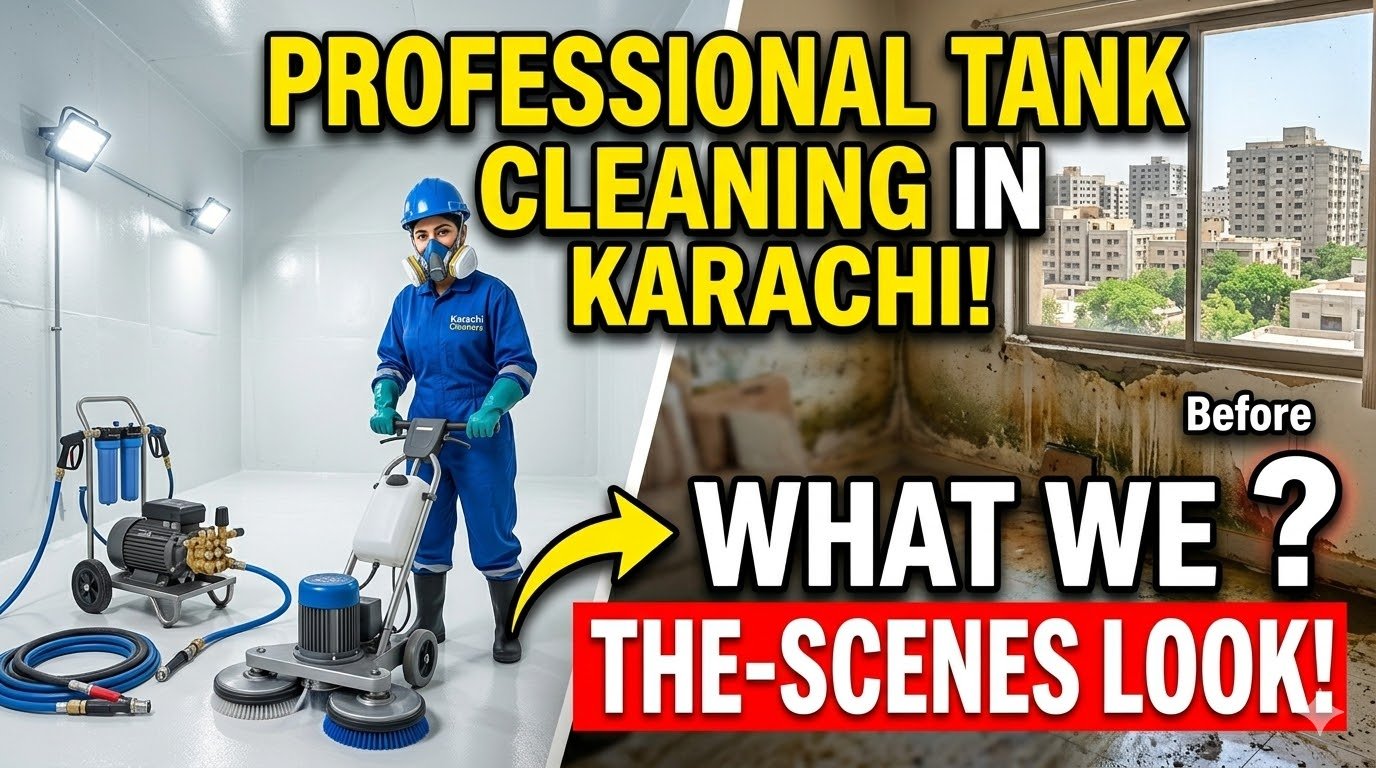
If you have only ever seen a tank cleaned with a brush and a bucket, a professional visit looks quite different. There is more equipment, more time spent before anyone touches the tank, and paperwork at the end. This article walks through professional tank cleaning in Karachi exactly as our crews carry it out, with the time each stage takes, so you know what to expect and what to check.
The visit at a glance
| Step | What happens | Typical time |
|---|---|---|
| 1. Survey and written quote | Tank measured, sludge depth and access checked, price confirmed in writing | About 20 minutes |
| 2. Controlled drainage | Tank drained to a safe level, water directed to a drain, pump protected | 20 to 40 minutes |
| 3. Ventilation and gas test | Air blown in, atmosphere tested, harness and attendant in place | 15 to 30 minutes |
| 4. Jet washing | Walls, floor and ceiling cut clean at 3,000+ PSI | 45 minutes to 2 hours |
| 5. Vacuum extraction | Sludge and debris vacuumed into a container and removed | 30 to 90 minutes |
| 6. Disinfection | Disinfectant applied to every internal surface and left for the contact time | 15 minutes plus contact time |
| 7. Rinse and inspection | Rinsed until clear; walls, joints, lid and cover checked | 20 to 40 minutes |
| 8. Report and invoice | Dated report with photographs, next-service date, tax invoice | Same day |
In total, a rooftop plastic or fibre tank takes two to four hours and an underground RCC tank four to eight. Shared building tanks are similar to large underground tanks, and industrial or multi-tank sites are quoted after a survey. The same sequence is set out on our cleaning procedure page.
Before the crew arrives
- Pick the day. The best time is just before your supply turn, when the tank is low, so little water is wasted.
- Store what you need. Fill buckets and drinking-water containers for the hours the tank is out of use.
- Switch off the motor and any automatic pump controller.
- Clear access to the underground hatch and the roof.
- Tell the neighbours if the tank is shared.
For a standard home no site visit is needed beforehand. The price comes from the property type, tank location and size, and you can get it from the online calculator. Commercial and industrial sites get a free survey first.
Step 1: Survey and written quote
The crew leader measures the tank, checks how deep the sludge is, notes the position of the hatch and works out where the vacuum hose and drain line will run. He also looks at what the tank is made of, because that decides the pressure used later. You receive the price in writing before any work starts, and that figure is the final price.
Step 2: Controlled drainage
The remaining water is pumped down to a workable level and sent to a drain, not across the courtyard or into the street. The supply outlet is protected so dirty water does not enter the household pipes, and the motor is safeguarded against running dry. If you want to save usable water for washing floors or plants, say so before this step.
Step 3: Ventilation and gas test
This step applies to underground and sealed tanks, and it is never skipped. Fresh air is blown into the tank, the air inside is tested, and nobody goes near the opening until that is done. The person entering wears a harness attached to a tripod, and a second person stays at the hatch for the whole job.
The reason is simple. Closed tanks can hold gases and too little oxygen, and people die in them every year. In June 2025, five men died in an underground water tank in Karachi, three of them would-be rescuers. The WHO’s technical note on tank cleaning gives the same two instructions we follow: blow fresh air into the tank, and keep someone outside. If a crew skips this step at your home, stop the job.
Step 4: Jet washing
Water at 3,000+ PSI is worked systematically across the walls, floor and ceiling. This is what removes biofilm, the thin, slippery layer of bacteria that a brush only smears. It also lifts algae, scale and packed silt in corners and around pipe entries.
Pressure is matched to the material:
| Tank type | How it is treated |
|---|---|
| Underground RCC (concrete) | Full pressure; extra passes on rough or pitted surfaces where film holds on |
| Rooftop RCC or brick | Full pressure; joints and plaster checked for loose material |
| Plastic (polyethylene) | Reduced pressure; non-abrasive pads for stubborn patches |
| Fibreglass (Syntex, Bestank and similar) | Reduced pressure to protect the inner gel coat |
| Stainless steel | Moderate pressure; weld seams and fittings inspected |
Step 5: Vacuum extraction
Everything the jet has loosened, along with the settled sludge, sand and rust, is vacuumed into a container and taken off the property. The floor corners get a second look, because that is where silt compacts. This is the step manual cleaning cannot copy. Without a vacuum, sludge is stirred into the water and much of it stays in the tank or goes down the outlet. We compare the two methods in tank wallah versus professional cleaning.
Step 6: Disinfection
With the surfaces physically clean, disinfectant is applied to every internal surface at a concentration matched to the tank’s volume, and left for its contact time. Our standard product is silver-stabilised hydrogen peroxide, which breaks down into water and oxygen and leaves no taste. For heavily contaminated tanks we use food-grade chlorine at a controlled concentration. We do not use industrial acids, raw household bleach or unlabelled products. How the disinfectant works, and its limits, are covered in silver hydrogen peroxide for tank disinfection.
Step 7: Rinse and inspection
The tank is rinsed until the water runs clear. Then the crew inspects the structure: walls and floor for cracks, joints and pipe entries for gaps, and the lid, hinge and inspection cover for damage. Faults are photographed. We do not carry out structural repairs, but you will know exactly what needs fixing and why.
Step 8: Report and invoice
On the same day you receive a dated service report with the photographs taken inside the tank, a recommended date for the next service, and a numbered SRB/FBR tax invoice. Keep the report. It is your record for the next cleaning, and for landlords, unions and businesses it is the document an inspector or auditor will ask for. Why the invoice matters is explained in SRB and FBR registration.
What can make a job take longer
- A full tank. Draining a tank that was filled yesterday adds time and wastes water. Schedule around the supply turn.
- Deep, compacted sludge in a tank that has not been cleaned for years.
- Difficult access: a hatch under a parked car, a roof reached by a narrow stair, a tank room used for storage.
- Heavy scale from borehole water, which needs more passes.
- Poor ventilation readings. If the air in an underground tank is not safe, the crew ventilates for longer. That delay is the system working as it should.
- Several tanks on one property.
None of these changes the price once it has been quoted in writing.
After the cleaning
- Refill and use the water as normal. There is no waiting period once the tank has been rinsed.
- Run each tap for a minute to clear the pipes.
- Carry out any lid or crack repairs the report recommends before the next rains.
- Note the next-service date. For most homes that is four to six months away; see how often to clean a tank in Karachi.
- Keep treating drinking water. A clean tank does not change what the supply delivers, as our KWSB water supply guide explains.
How to tell a proper job from a quick rinse
- Air was blown into the underground tank and someone stayed at the hatch.
- You saw the sludge that came out.
- The walls near the waterline are no longer slippery to the touch.
- The floor is visible and clean in the after photographs, including the corners.
- The final rinse water ran clear.
- You were handed a dated report and an invoice.
If you are comparing companies, the questions in what to ask before hiring a tank cleaning company will separate those who work this way from those who do not. For what crews usually find when they open a tank, see what we find in Karachi’s water tanks.
Why professional tank cleaning in Karachi takes this much care
The city’s water arrives intermittently, at low pressure, through a network that loses more than half of what enters it, and is then stored for days in the heat. Sediment and bacteria collect in tanks faster here than in cities with continuous supply. A method that leaves a film on the walls or an inch of sludge on the floor simply restarts the cycle. That is the reason for the equipment, the sequence and the time.
Booking
Both branches work 24 hours, including Sundays and public holidays: DHA, Clifton and South Karachi on 0333 0293174 and Gulshan, Jauhar and East Karachi on 0340 2717530.
Frequently asked questions
How long will we be without water?
Two to four hours for a rooftop tank and four to eight for an underground RCC tank, plus the time your tank takes to refill.
Do you need water or electricity from us?
The crew will tell you what is needed when you book. Some water is required for jet washing and rinsing, which is one reason to schedule the job around your supply day.
Is the tank safe to use straight after?
Yes. The disinfectant is rinsed out before refilling.
Can you clean the underground and rooftop tanks on the same visit?
Yes, and it is the sensible way to do it. Cleaning only one leaves the other to recontaminate it.
Will you repair cracks or replace the lid?
We report and photograph defects so you can have them repaired. The cleaning visit does not include structural work.
How many people come, and do I need to supervise?
A crew, not one man, because nobody enters an underground tank without a second person at the hatch. You do not need to supervise, but be present at the start to agree the scope and at the end to see the tank and receive the report.
What happens to the sludge?
It is vacuumed into a container and taken off the property, not left in the drain outside your gate.
Can the work be done at night?
Yes. Both branches operate around the clock.
Sources
External references used in this article, checked in October 2026:
- Dawn, 11 June 2025: Five dead after inhaling toxic gases in water tank in Karachi
- WHO Technical Note No. 3: Cleaning and disinfecting water storage tanks and tankers
- World Bank, 2019: Karachi Water and Sewerage Services Improvement Project, project information document
About Khan Tank Cleaning
This guide is published by Khan Tank Cleaning, a Karachi water tank cleaning company founded in 2005 by Mateen Khan. We work from two branches, DHA Phase 2 and Gulshan-e-Iqbal, and you can read more about the company or contact either branch at any hour. Call or WhatsApp 0333 0293174 (DHA) or 0340 2717530 (Gulshan).

Mateen Khan is the Founder & Owner of Khan Tank Cleaning, Karachi’s first dedicated professional water tank cleaning company (est. 2005). With 20+ years of industry experience, he leads an ISO 9001 & ISO 45001 certified team that follows a strict 8-step process using industrial equipment and food-grade disinfectants. Mateen is committed to making clean, safe water accessible to every household and business in Karachi.