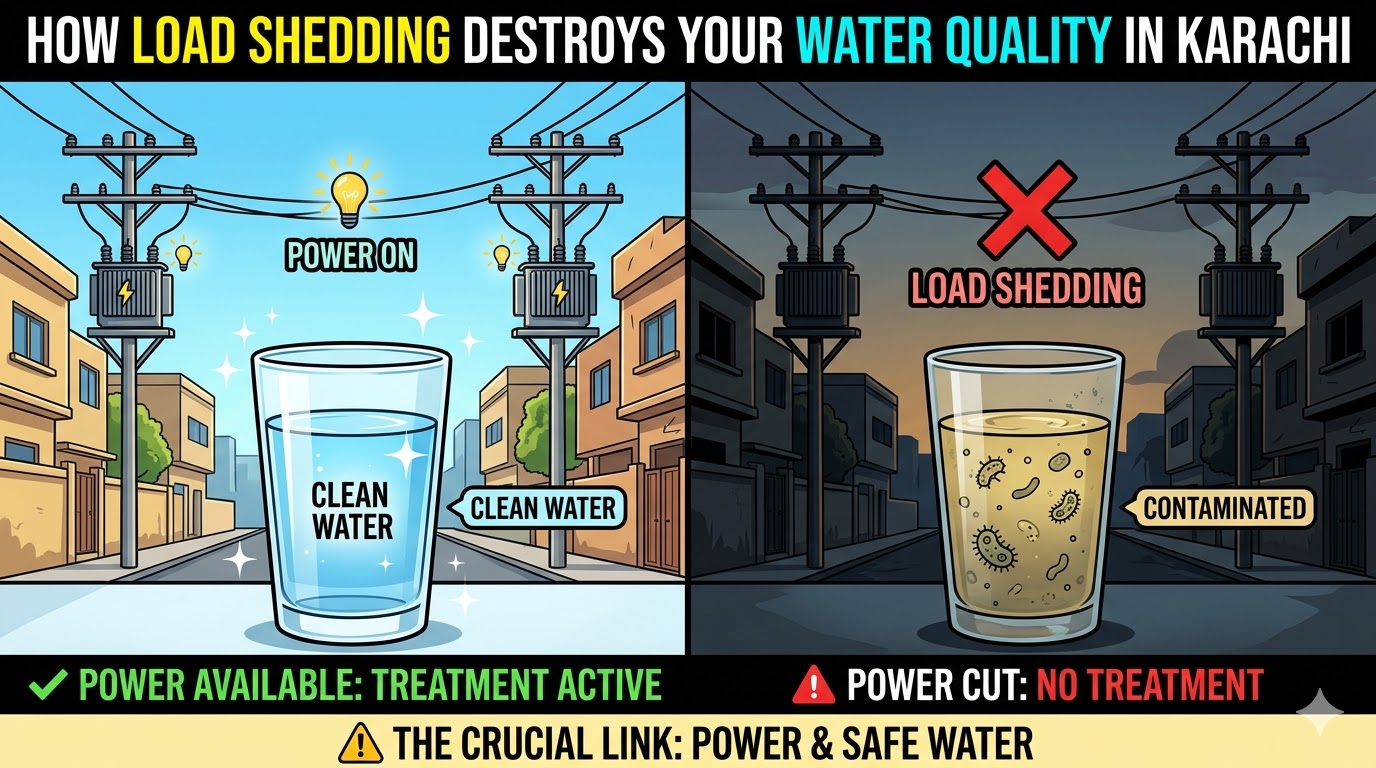
Every Karachi resident knows the drill. The electricity cuts out — sometimes for two hours, sometimes for eight — and life grinds to a halt. While most of us focus on the obvious inconveniences (no fans, no air conditioning in the brutal heat, stalled homework), there is a silent, invisible crisis quietly unfolding in your water storage tank. One that could be making your family sick right now.
Load shedding in Karachi is not just an inconvenience. It is a water contamination event that occurs every single time the power goes off. In this article, we explain exactly how unscheduled power outages damage your water quality, why Karachi’s specific conditions make the problem worse, and what you need to do to protect your household.
1. Understanding Karachi’s Water Supply Chain — and Where It Breaks
Before we discuss load shedding’s impact, it is important to understand how water reaches your home in the first place. Karachi’s water supply chain involves multiple pumping stations, storage reservoirs, and distribution lines managed by the Karachi Water and Sewerage Corporation (KWSC). Water travels from the Indus River, Hub Dam, and Keenjhar Lake through filtration plants before reaching neighbourhood distribution lines — and ultimately, your overhead or underground storage tank.
This entire chain depends on electricity. When load shedding hits, the chain breaks at multiple points simultaneously:
- Municipal pumping stations shut down, reducing or stopping water flow to your area.
- Your building’s motor or submersible pump cannot operate, so water cannot be transferred from the underground tank to the overhead tank.
- Pressure in the supply line drops to zero or near-zero, creating a vacuum effect in the pipes.
- When power finally returns, the sudden pressure surge can dislodge sediment, rust, and biofilm built up inside aging pipelines — pushing it directly into your storage tank.
| Key Fact: In many areas of Karachi — from Gulshan-e-Iqbal to Gulistan-e-Johar to DHA — residents experience 6–12 hours of load shedding daily during peak summer months. That is 6–12 hours of pump failure, pressure fluctuations, and stagnation — every single day. |
2. The Five Ways Load Shedding Contaminates Your Tank Water
2.1 Stagnant Water Becomes a Bacterial Breeding Ground
When pumps stop working, water in your tank simply sits still. Stagnant water is warm (especially in Karachi’s climate, where summer temperatures regularly exceed 40°C), dark, and nutrient-rich from dust and organic particles that settle in any tank over time. This is the perfect environment for bacteria like E. coli, Salmonella, Legionella, and various coliform bacteria to multiply exponentially. Studies show that bacterial counts can double in stagnant water every 20 minutes under warm conditions.
2.2 Vacuum Effect Draws Sewage and Groundwater Into Supply Pipes
This is the most alarming and least-discussed effect. When electricity is cut and pump pressure drops to zero, the supply pipes experience negative pressure — a vacuum. In Karachi, where many underground water supply lines run in close proximity to sewage lines (many of which are aging and cracked), this vacuum can literally suck sewage water backwards into your drinking water supply. By the time power returns and water flows again, the contamination is already in your pipes — and heading into your tank.
This phenomenon, known as back-siphonage, is well-documented and particularly severe in densely built areas like Orangi Town, Korangi, Landhi, and parts of North Karachi where infrastructure is older and more vulnerable.
2.3 Algae Blooms Accelerate Without Circulation
Water in motion resists algae growth. Water that sits still, especially in tanks that are not perfectly sealed (which describes the vast majority of tanks in Karachi), quickly develops algae colonies. These colonies not only make water smell and taste foul, they release toxins and provide the substrate on which dangerous bacteria thrive. A single load shedding period in summer can trigger visible algae growth within 24–48 hours in an uncleaned tank.
2.4 Sludge Layers Are Disturbed and Resuspended
Every water tank accumulates a layer of sediment, rust particles, mineral deposits, and organic sludge at its base. When your motor suddenly turns on after a power cut, the surge of water agitates this sludge layer, mixing it back into the water column. Your household then consumes this sediment-rich water — potentially for hours before it settles again. Over time, this repeated cycle means your household is regularly drinking water with elevated levels of heavy metals, rust, and organic matter.
2.5 Disinfectant Residuals Break Down During Outages
Municipal water from KWSC is treated with chlorine to kill pathogens. However, chlorine is a volatile compound — it dissipates quickly in warm, stagnant water. During a 6–8 hour load shedding period in Karachi’s summer heat, the chlorine residual in stored water can drop to near zero. This means the water in your tank loses its protection against pathogens precisely when bacterial growth is at its fastest.
3. Karachi-Specific Factors That Make the Problem Much Worse
Load shedding affects cities across Pakistan, but Karachi has a set of local conditions that dramatically amplify the water quality damage:
- Extreme Heat: Karachi’s coastal humidity and temperatures of 38–45°C in summer create ideal conditions for bacterial and algal growth in tanks. A contamination event that takes days elsewhere takes hours here.
- Aging Infrastructure: Many residential areas — including parts of North Nazimabad, Liaquatabad, Malir, and Orangi Town — are served by water supply pipes that are 30–50 years old. These pipes are far more vulnerable to back-siphonage and sediment dislodging during pressure fluctuations.
- High-Density Living: Apartment buildings, shared housing societies, and multi-storey buildings common in areas like Gulshan-e-Iqbal, Gulistan-e-Johar, PECHS, and DHA Phase 1-6 all share central tanks, meaning one contamination event affects dozens of families simultaneously.
- Irregular Water Supply: Even without load shedding, many Karachi areas only receive water once or twice a week. This means tanks are often at maximum capacity and sitting for longer periods — greatly increasing the risk of contamination.
- Poor Tank Maintenance Culture: Most Karachi homeowners have never had their water tank professionally cleaned. Without proper cleaning, the buildup of sludge, biofilm, and scale that load shedding agitates is far thicker and more dangerous.
| Did You Know? Waterborne diseases including typhoid, hepatitis A, gastroenteritis, and cholera are among the most common causes of emergency hospital visits in Karachi. A significant proportion of these cases are linked to contaminated household water storage — the very tanks sitting in your building right now. |
4. The Health Consequences Your Family Faces
Contaminated tank water does not announce itself. It often looks clear. It may smell faintly off or it may smell fine. Yet the pathogens it carries can cause:
- Typhoid Fever — caused by Salmonella typhi, extremely common in Karachi, can be life-threatening without treatment
- Hepatitis A — a viral infection spread through contaminated water, causing liver inflammation
- Severe Gastroenteritis — vomiting, diarrhea, and dehydration, particularly dangerous for children and the elderly
- Cholera — bacterial infection causing acute watery diarrhea, historically associated with contaminated water sources
- Skin Rashes and Eye Infections — from bathing or washing in bacterially contaminated water
- Chronic Digestive Issues — long-term consumption of low-level contaminated water can cause persistent gut problems
Children under 12 and elderly adults are the most vulnerable. Even if healthy adults in your home seem fine, your children or elderly parents may be silently suffering the effects of poor water quality.
5. Why Your Water Filter Is Not Enough
Many Karachi homeowners feel reassured by their Reverse Osmosis (RO) or UV water filter. We understand the logic — but it is dangerously incomplete. Here is why:
- Filters only treat the water you drink — not the water you cook with, wash dishes with, brush your teeth with, or bathe in.
- Heavily contaminated water entering the filter can overwhelm its capacity and reduce its effectiveness against pathogens.
- Sludge and sediment from uncleaned tanks clog and damage filters, shortening their lifespan and increasing maintenance costs.
- Biofilm growing inside a dirty tank can eventually spread to your filter’s housing and tubing, contaminating even filtered water.
The filter is the last line of defence. A clean water tank is the first line of defence — and the most important one.
6. How Often Should You Clean Your Tank in Karachi?
Given Karachi’s specific conditions — extreme heat, irregular water supply, frequent load shedding, and aging infrastructure — the recommended professional cleaning schedule is more aggressive than international guidelines:
- Minimum: Every 6 months for households in areas with relatively stable water supply and newer infrastructure.
- Recommended: Every 3–4 months for households in areas with frequent load shedding, older infrastructure, or shared central tanks (housing societies, apartment buildings).
- After any flooding or unusual water colour/smell: Immediately, regardless of the last cleaning date.
7. Professional Tank Cleaning: What It Actually Involves
Many Karachi residents assume that tank cleaning means someone climbs in and scrubs the walls. Professional cleaning is far more comprehensive and significantly more effective than any DIY approach.
A proper professional cleaning service — like the one offered by Khan Tank Cleaning’s water tank cleaning service in Gulshan and Jauhar Karachi — includes:
- Complete draining of the tank using high-powered vacuum systems
- High-pressure jet washing to remove biofilm, algae, and sludge from all interior surfaces — including corners and seams that manual scrubbing cannot reach
- Industrial vacuuming to extract all loosened debris without leaving residue behind
- Disinfection with Silver Hydrogen Peroxide — a hospital-grade disinfectant that is highly effective against bacteria, viruses, and biofilm, and is completely safe for potable water systems
- Secondary disinfection where required for tanks with severe contamination
- Final inspection and safety check before the tank is refilled
For households in DHA, Clifton, and the Defence area, Khan Tank Cleaning’s professional water tank cleaning in DHA and Clifton Karachi applies the same industrial-grade process with equipment specifically suited to the underground tanks, elevated rooftop tanks, and large-capacity storage systems common in that part of the city.
The difference between professional cleaning and bucket-and-brush methods is not minor. Industrial high-pressure jet systems reach areas no person can access. Industrial vacuums remove sludge without spreading it through the tank. And crucially, bacterial biofilm — the thin, invisible film of bacteria that adheres to tank walls and is the primary source of ongoing contamination — can only be effectively destroyed by high-pressure washing combined with proper disinfection. Manual scrubbing leaves biofilm behind. Every single time.
8. Specific Areas of Karachi Most at Risk
While load shedding affects all of Karachi, certain areas face compounded risk due to infrastructure age, water supply irregularity, or building density:
- Gulshan-e-Iqbal, Gulistan-e-Johar, Federal B Area, North Nazimabad — high-density residential areas with older water supply networks and long load shedding schedules. Shared tanks in apartment complexes amplify contamination risk.
- DHA Phases 1–8, Clifton, Bath Island — large underground tanks, extended supply lines, and high-value properties where the consequences of contaminated water (on both health and property) deserve serious attention.
- Korangi, Landhi, Malir, Shah Faisal Town — areas with aging infrastructure, proximity of water and sewage lines, and frequent irregular water supply episodes.
- PECHS, Bahadurabad, Tariq Road, Saddar — older commercial and residential buildings where tank maintenance has historically been neglected.
If your home or business is in Gulshan, Jauhar, or surrounding areas, Khan Tank Cleaning’s dedicated branch ensures fast response times and deep familiarity with the specific infrastructure conditions of your neighbourhood.
If you are in DHA, Clifton, or the Defence/Clifton corridor, our DHA and Clifton branch serves your area with the specialised equipment needed for the larger-scale underground and elevated tank configurations prevalent there.
9. What You Can Do Between Professional Cleanings
Professional cleaning is essential and irreplaceable. Between scheduled cleanings, the following steps will help reduce contamination risk during load shedding events:
- Inspect your tank lid and cover regularly. Any gap, crack, or missing seal allows insects, dust, and bird droppings to enter — especially critical after power fluctuations cause water level changes.
- Check your tank’s water colour and smell after every major load shedding event. Discolouration, cloudiness, or unusual odour are immediate warning signs.
- Install a high-quality float valve to prevent overflow, which can introduce external contamination.
- Consider a small UV disinfection unit as a supplementary measure for particularly high-risk periods such as monsoon season or prolonged load shedding.
- Keep records of your last professional cleaning date and schedule the next one before the 6-month mark — not after you notice a problem.
10. The True Cost of Not Cleaning Your Tank
Some homeowners delay professional tank cleaning because of the perceived cost. Consider what contaminated water actually costs:
- Medical bills for typhoid treatment in Karachi average Rs. 15,000–50,000 per case, not including hospitalisation.
- Hepatitis A treatment can run significantly higher, with serious cases requiring months of care.
- Lost workdays and school days multiply the economic impact across your household.
- Damage to water filters, geysers, and washing machines from sediment and scale accelerates servicing costs and shortens appliance lifespan.
Professional tank cleaning is not an expense. It is one of the most cost-effective health investments a Karachi homeowner can make — and one of the most frequently overlooked.
| Do Not Wait for Someone in Your Family to Fall Ill Your water tank has been silently affected by every load shedding event this year. Bacteria, biofilm, sludge, and sediment are building up right now — and your family is consuming this water daily. Khan Tank Cleaning is Karachi’s dedicated, professional water tank cleaning company. We are not a side business or a part-time operation — water tank cleaning is all we do, and we have been doing it longer and better than anyone else in the city. We use industrial high-pressure jet washing, professional vacuum systems, and Silver Hydrogen Peroxide disinfection to deliver results that bucket-and-brush approaches simply cannot match. Our trained technicians serve all areas of Karachi, with two dedicated branches: |
📍 Gulshan | Jauhar | Federal B Area | North Nazimabad | Gulshan-e-Maymar & surrounding areas:
Book Your Tank Cleaning — Gulshan & Jauhar Branch
📍 DHA | Clifton | Defence | Zamzama | Bath Island | Korangi & surrounding areas:
Book Your Tank Cleaning — DHA & Clifton Branch
| 📞 Call / WhatsApp: 0340-2717530 | 03330293174 Available 24 hours, 7 days a week. Serving all residential, commercial, and industrial clients across Karachi. |
Clean tank. Pure water. Healthy family. Book today.
Khan Tank Cleaning | khantankcleaning.com | Professional Water Tank Cleaning Karachi
Leave a Reply