Author: admin

  • What to Ask Before Hiring a Tank Cleaning Company in Karachi (Red Flags Included)

    What to Ask Before Hiring a Tank Cleaning Company in Karachi (Red Flags Included)

    In a city like Karachi — where KWSB water supply arrives once or twice a week, where underground tanks sit in the heat for days, and where boring water carries sediment and bacteria — the cleanliness of your water tank is not a luxury. It is a matter of public health.

    Yet every year, thousands of Karachi households suffer from waterborne illnesses — typhoid, diarrhea, gastroenteritis — that trace directly back to uncleaned or poorly cleaned water tanks. The tragedy is that most of these cases are entirely preventable.

    Unfortunately, not all tank cleaning companies in Karachi are equal. Many are side businesses run by untrained workers with a bucket and a brush. Some use industrial chemicals that damage your tank lining and leave residue in your drinking water. Others quote a suspiciously low price — and deliver suspiciously low quality.

    So before you hand over access to your water tank to any service provider, ask the right questions. This guide will walk you through exactly what to ask — and the red flags to watch out for.

    1. Are They a Dedicated Tank Cleaning Company — Or Is It a Side Job?

    The first and most important question you should ask is: Is water tank cleaning your primary business?

    Many workers in Karachi offer tank cleaning as an add-on to pest control, plumbing, or general cleaning. While they may seem convenient, their lack of specialisation shows in the results.

    A dedicated, professional tank cleaning company will have trained staff, specialised equipment, and a defined cleaning process. They will be able to tell you exactly how they clean, what chemicals they use, and how long the job will take.

    🚩 Red Flag: “We do it on the side”

    If the company primarily offers fumigation, painting, or general labour and also offers tank cleaning, walk away. Their staff likely has no formal training in water tank hygiene or confined space safety.

    Khan Tank Cleaning, for instance, describes itself as a dedicated water tank cleaning company in Karachi — not a general cleaning service. Their teams cover all of Karachi, with a branch focused on water tank cleaning in Gulshan and Jauhar and another serving water tank cleaning in DHA and Clifton.

    2. What Equipment Do They Use? (Bucket vs. Industrial-Grade)

    This is where you can quickly separate professional services from amateur ones. Ask them directly:

    In Karachi’s climate — with high temperatures and infrequent water supply — tanks accumulate algae, biofilm, sludge, and dangerous bacteria at an accelerated rate. Scrubbing with a brush simply cannot reach biofilm colonies embedded in corners or crevices.

    🚩 Red Flag: “We use brushes and detergent”

    Manual scrubbing with basic chemicals does not eliminate bacteria at a microbial level. It removes visible dirt but leaves behind the invisible contamination that causes illness. This is particularly dangerous for families using unfiltered tank water for bathing, brushing teeth, or cooking.

    Professional companies use industrial-grade high-pressure jet washers and vacuum extraction systems. For disinfection, look for the use of Silver Hydrogen Peroxide or other WHO-approved potable water disinfectants — not harsh industrial acids, which can corrode your tank and leave toxic residues.

    3. Do They Have Experience With Your Specific Tank Type?

    Karachi homes have a wide variety of water tanks — and each requires a different cleaning approach:

    • Overhead plastic tanks (Sintex, Aqua Plus, Bestank, Fiber)
    • Underground concrete tanks (common in older Gulshan, North Nazimabad, Saddar homes)
    • Rooftop concrete tanks in older housing societies
    • Boring water tanks and large commercial storage systems

    Underground tanks present unique dangers: confined space entry, risk of suffocation from accumulated gases, and the need for oxygen safety systems. Ask the company whether they have certified confined space entry equipment before permitting anyone to enter your underground tank.

    🚩 Red Flag: No Confined Space Safety Protocol

    If a team arrives to clean your underground tank without oxygen safety systems, rescue equipment, and proper ventilation, this is a serious safety hazard — not just for the workers but a liability for you as the property owner. Refuse the service.

    4. What Disinfectants Do They Use — And Can They Prove It?

    This is a question many homeowners skip — and one of the costliest omissions.

    Ask the company: “Can you show me the disinfectant you will use, and confirm it is safe for drinking water tanks?”

    There are two major concerns in Karachi specifically:

    • Industrial acids — Some cheap services use strong hydrochloric or muriatic acid. While these kill bacteria, they also corrode plastic and cement tanks, shorten tank lifespan, and can leave residues that are harmful if consumed.
    • Unverified chlorine concentrations — Over-chlorination can cause its own health risks and leave your water tasting and smelling terrible for days.

    🚩 Red Flag: Cannot Name Their Disinfectant

    A professional company will immediately and confidently name the disinfectant they use, explain why they chose it, and confirm it is approved for potable water systems. If they are evasive or say “don’t worry, it’s safe,” that is not an acceptable answer for water your family will drink.

    For residents of DHA, Clifton, and surrounding areas — where high-density residential buildings share large communal tanks — disinfectant quality matters even more. Khan Tank Cleaning’s DHA and Clifton branch specifically uses Silver Hydrogen Peroxide as its primary disinfectant, chosen for its effectiveness against bacteria, viruses, and biofilm, while remaining fully safe for human consumption.

    5. Do They Provide a Written Service Record or Certificate?

    A professional tank cleaning company should offer you written documentation of the service performed. This should include:

    • Date and time of cleaning
    • Name of technician(s)
    • Tank type and approximate volume
    • Cleaning process followed
    • Disinfectants used
    • Next recommended cleaning date

    This documentation is important for several reasons:

    • Health accountability: If someone in your household falls ill after a cleaning, you need a paper trail.
    • Maintenance scheduling: Karachi’s environment means tanks should ideally be cleaned every 3 to 6 months. Documentation helps you track this.
    • Property management: For landlords managing flats, apartments, or commercial properties in areas like Gulshan-e-Iqbal, Gulistan-e-Johar, or Korangi, a service record protects you legally.

    🚩 Red Flag: No Written Record Offered

    If a company cannot or will not provide any written proof of the service they performed, that is a sign they lack both professionalism and accountability. You have no way to verify what was done — or to hold them responsible if problems arise.

    6. Are They Available 24/7 and How Quickly Can They Respond?

    Karachi households rarely have water available on demand. When water does come — often at odd hours — and if you notice signs of tank contamination such as a foul smell, visible discolouration, or illness in your household, you need a tank cleaning service that can respond quickly.

    Ask:

    For homeowners in areas like Gulshan-e-Iqbal, Gulistan-e-Johar, Federal B Area, and Malir — areas served by Khan Tank Cleaning’s Gulshan and Jauhar branch — proximity matters. A team that is based nearby can respond faster and knows the local water conditions, pipeline age, and common contaminants in your zone.

    🚩 Red Flag: “We’ll Come Whenever” With No Specific Commitment

    Vague availability with no defined response times is a red flag. It may mean the company is understaffed, poorly organised, or operates on an informal basis. When your household is without clean water, vague commitments are unacceptable.

    7. What Areas Do They Serve — And Do They Know Your Locality?

    This may seem like a minor point, but it matters more than you think.

    Karachi is a vast city with dramatically different water infrastructure across its neighbourhoods. The water arriving in a DHA villa tank is different from what enters an underground tank in Orangi Town or a rooftop tank in Saddar. Local knowledge — of water quality, pressure patterns, common contamination types — helps a technician do a more thorough job.

    Ask:

    Khan Tank Cleaning maintains two dedicated branches to serve Karachi better: one for East Karachi areas including Gulshan, Jauhar, FB Area, and surroundings, and one for South Karachi areas including DHA, Clifton, Zamzama, and Bahadurabad. Both branches cover all of Karachi, while prioritising rapid response in their respective zones.

    8. Is the Pricing Transparent — Or Suspiciously Cheap?

    Price is often the deciding factor for Karachi homeowners — and it is exactly what many unscrupulous companies exploit.

    Here is a practical rule:

    “If a price sounds too good to be true in Karachi, it almost certainly is.”

    When comparing prices, ask for a complete breakdown:

    • What does the price include — draining, scrubbing, vacuuming, and disinfection?
    • Is the disinfectant included or extra?
    • Are there additional charges for large tanks, underground tanks, or multi-story access?

    🚩 Red Flag: “Flat Price, No Questions Asked”

    A company that quotes you a single flat rate without asking about your tank size, type, location (ground floor vs. rooftop), or last cleaning date is either cutting corners or will add hidden charges later. A legitimate company needs this information to quote accurately.

    9. Quick Checklist: Before You Book Any Tank Cleaning in Karachi

    Use this checklist before hiring:

    1. Is tank cleaning their primary, dedicated business?
    2. Do they use industrial high-pressure jet washers and vacuum systems?
    3. Can they handle your specific tank type (underground, overhead, fiber, concrete)?
    4. Can they name the disinfectant and confirm it is safe for drinking water?
    5. Do they provide a written service record upon completion?
    6. Are they available 24/7 with a defined response commitment?
    7. Do they have experience in your specific area of Karachi?
    8. Is their pricing transparent with a full breakdown?
    9. Do they have verifiable customer reviews or references?
    10. Do their underground tank teams carry confined space safety equipment?

    Don’t Risk Your Family’s Health.

    Book a Professional Tank Cleaning Service Today.

    You now know exactly what to look for — and what to avoid. The question is: does the tank cleaning company you are considering actually meet these standards?

    Khan Tank Cleaning does. As Karachi’s only fully dedicated water tank cleaning company, we serve every corner of this city with properly trained technicians, industrial-grade equipment, and WHO-compliant disinfectants. Whether you live in a flat in Gulshan-e-Iqbal or Gulistan-e-Johar, or a villa or apartment in DHA or Clifton, we have a branch nearby ready to serve you — quickly, professionally, and transparently.

    We serve: Residential homes, apartments, commercial offices, factories, hostels, schools, and more — across all of Karachi.

    Available: 24 hours, 7 days a week.

    Call us now: 0340-2717530 | 03330293174

    → Book Your Tank Cleaning Service at khantankcleaning.com

    Your water should be clean. Your family deserves nothing less.

  • Is Your Drinking Water Making You Sick? Signs Karachi Families Must Know

    Is Your Drinking Water Making You Sick? Signs Karachi Families Must Know

    Every day, millions of Karachi families turn on their taps, fill a glass, and drink — trusting that the water is safe. But what if it isn’t? What if the very water you’re drinking, cooking with, and giving to your children is slowly harming your health?

    This is not a distant possibility. It is a reality for many households across Karachi — from the busy lanes of Gulshan-e-Iqbal and Gulistan-e-Johar to the upscale streets of DHA and Clifton. And in most cases, the source of the problem isn’t the KW&SB supply line or the tanker — it is the storage tank sitting quietly on your rooftop or buried beneath your home, never properly cleaned, quietly breeding bacteria and contaminating every drop that passes through it.

    If you or your family members have been experiencing unexplained stomach issues, recurring illness, or strange-tasting water, your tank may be to blame. In this article, we’ll walk you through the key warning signs of water contamination, explain why Karachi’s specific conditions make this problem especially serious, and show you exactly what you need to do about it.

    Why Karachi’s Water Is Under Constant Threat

    Karachi is Pakistan’s largest city — and arguably one of the hardest places in the country to guarantee safe water at the tap. Several factors unique to the city compound the problem:

    1. Irregular and Infrequent Water Supply

    Most Karachi households do not receive water daily. Many areas receive municipal supply only two to three times per week, sometimes even less. This forces families to store large volumes of water in overhead or underground tanks — tanks that are often left uncleaned for months or even years at a time.

    The longer water sits stagnant in an unclean tank, the more opportunity bacteria, algae, and other pathogens have to multiply. What comes out of your tap isn’t fresh water — it’s water that has been sitting in potentially contaminated storage for days.

    2. Tanker Water of Unknown Quality

    In many neighbourhoods — Orangi Town, Surjani, North Karachi, Korangi, and even parts of Gulshan and Jauhar — families regularly top up their tanks with water from private tankers. The source and treatment quality of this water is often completely unknown. Even if the tanker water itself is relatively clean, it mixes with whatever is already sitting at the bottom of your tank: sludge, sediment, biofilm, and bacteria.

    3. Ageing Pipe Infrastructure

    Karachi’s water distribution infrastructure is decades old in many parts of the city. Cracked pipes, cross-connections with sewage lines, and pressure drops during supply hours mean that contaminants can enter the water before it even reaches your storage tank. Once contaminated water enters your tank, it doesn’t clean itself.

    4. Heat and Humidity Accelerate Bacterial Growth

    Karachi’s climate — hot and humid for much of the year — creates near-ideal conditions for bacterial growth inside water tanks. At temperatures above 25°C, bacteria like E. coli and Salmonella can double in population every 20 minutes under the right conditions. An unclean tank in Karachi’s summer heat is essentially a bacteria incubator sitting above your kitchen.

    10 Warning Signs Your Drinking Water May Be Making You Sick

    Not all water contamination is obvious. The most dangerous pathogens — bacteria, viruses, and parasites — are invisible, tasteless, and odourless in many cases. However, there are signs that something is wrong. Here is what to watch for:

    1. Recurring Stomach Issues with No Clear Cause

    If members of your household — particularly children — frequently experience stomach aches, nausea, vomiting, or loose stools without any obvious dietary cause, contaminated water should be your first suspect. Waterborne bacteria like E. coli, Shigella, and Salmonella are leading causes of gastrointestinal illness and are commonly found in poorly maintained water tanks.

    Pay special attention if multiple family members fall ill at the same time with similar symptoms — this pattern strongly suggests a shared water source as the culprit.

    2. Frequent Bouts of Diarrhoea

    Diarrhoea is one of the most direct indicators of waterborne contamination. While it may seem like a minor inconvenience for adults, diarrhoeal illness caused by contaminated water is a leading cause of childhood mortality in Pakistan. If your household experiences more than one or two unexplained diarrhoea episodes per month, have your water tested and your tank inspected immediately.

    3. Typhoid or Hepatitis A Diagnoses in the Household

    Both typhoid fever and Hepatitis A are waterborne diseases transmitted via the faecal-oral route. If someone in your home has been diagnosed with either condition, it is critical to investigate your water source. Typhoid in particular is endemic in many parts of Karachi — and contaminated household water tanks are among the most common routes of transmission.

    4. Unusual Colour in Your Water

    Any discolouration in your tap water — yellow, brown, greenish, or cloudy — is a clear sign of contamination. Brown or yellowish water often indicates rust or sediment from corroded pipes or tanks. Greenish water can suggest algae growth inside the tank. Cloudy water may indicate bacterial contamination or fine suspended particles.

    Never drink or cook with discoloured water. Contact a professional tank cleaning service immediately.

    5. Foul, Musty, or Rotten Smell

    Water should have no smell. If your water carries a musty, earthy, sulphurous (like rotten eggs), or otherwise unpleasant odour, it is a serious warning sign. A musty or earthy smell often indicates algae or fungal growth inside the tank. A sulphurous odour may indicate the presence of sulphate-reducing bacteria, which thrive in stagnant, oxygen-deprived environments like the bottom of an uncleaned underground tank.

    6. Strange or Bitter Taste

    Clean water is essentially tasteless. If your water tastes metallic, bitter, chlorine-heavy, or simply ‘off,’ it could indicate contamination from corroded tank walls, bacterial byproducts, or chemical residue. A salty or brackish taste may also indicate ground contamination affecting underground tanks, which is common in several coastal and low-lying areas of Karachi.

    7. Skin Rashes or Eye Irritation After Bathing

    Contaminated water doesn’t only cause harm when consumed — it can also affect your skin and eyes. If family members regularly develop skin rashes, itching, or eye irritation after bathing or washing, the water used may contain bacteria, algae, or chemical contaminants. Children with sensitive skin are particularly vulnerable.

    8. Visible Slime, Sediment, or Residue in the Tank

    If you have ever opened your water tank or seen the inside through a hatch, look carefully. A healthy, clean tank should have smooth, clean walls and clear water. If you see dark sludge at the bottom, a slimy biofilm coating the walls, green or black algae growth, or floating particles — your tank is contaminated and needs professional cleaning immediately.

    This sludge is not just unsightly. It is a reservoir of pathogens that continuously contaminates every litre of water stored in the tank.

    9. Water Filters Clogging or Failing Prematurely

    This is an often-overlooked sign. If your under-sink filter cartridges, reverse osmosis membranes, or inline filters are becoming dark, clogged, or ineffective much faster than their rated lifespan, it strongly suggests that the water entering the filter is heavily laden with sediment, bacteria, and organic matter — almost always sourced from an unclean storage tank.

    Your filter is working overtime to compensate for a dirty tank. The solution is not more frequent filter changes — it is a properly cleaned and disinfected tank.

    10. It Has Been More Than 6 Months Since Your Last Tank Cleaning

    Even if you haven’t noticed any of the above symptoms yet, this one fact alone should concern you: water health experts recommend cleaning household water tanks every 3 to 6 months. If you cannot remember the last time your tank was cleaned — or if it has never been professionally cleaned — the risk of contamination is very real, even if the water currently looks and tastes acceptable.

    Contamination is often silent. By the time symptoms appear, the bacteria may have been growing in your tank for months.

    What Grows Inside an Uncleaned Water Tank?

    To understand why regular tank cleaning is essential, it helps to understand what actually accumulates inside an unclean tank over time.

    • Bacteria: E. coli, Salmonella, Shigella, Legionella, and Pseudomonas are among the most common bacterial contaminants found in poorly maintained tanks. These cause everything from stomach illness and diarrhoea to serious respiratory infections.
    • Algae: Algae growth gives water a greenish tint and a musty taste. Certain types of algae produce toxins (cyanotoxins) that can cause liver damage and neurological symptoms with prolonged exposure.
    • Biofilm: Biofilm is a thin, slimy layer of bacteria and organic matter that coats the interior walls of your tank. It is extremely difficult to remove without professional high-pressure cleaning. Biofilm acts as a ‘shelter’ for bacteria, protecting them from chlorine and other disinfectants — meaning even if you add bleach to your tank, biofilm colonies will survive and continue contaminating the water.
    • Sludge and Sediment: Heavy particles, sand, rust, and organic debris settle at the bottom of your tank as sludge. Water drawn from the tank passes through this sludge layer, picking up contaminants along the way.
    • Protozoa and Parasites: Giardia and Cryptosporidium are parasitic organisms that can survive in water tanks for extended periods. They are resistant to standard chlorination and cause severe gastrointestinal illness.

    Are Karachi’s Different Areas Equally at Risk?

    Not all neighbourhoods face identical water challenges — but all are at risk. Here’s a brief breakdown:

    Gulshan-e-Iqbal, Gulistan-e-Johar, and Surrounding Areas

    These densely populated areas are among Karachi’s most active residential zones. Many buildings here — from single-family homes to large apartment complexes — rely heavily on overhead plastic tanks that receive water from tankers and municipal supply. The combination of high population density, variable supply quality, and warm temperatures makes these neighbourhoods particularly susceptible to tank contamination.

    If you live in Gulshan, Jauhar, North Nazimabad, FB Area, or nearby, our water tank cleaning service in Gulshan and Jauhar team is positioned to serve you quickly and professionally across the entire eastern and central Karachi region.

    DHA, Clifton, and South Karachi

    It would be a mistake to assume that higher-income neighbourhoods are immune to water contamination. While properties in DHA, Clifton, and PECHS may have newer infrastructure and larger tanks, size is actually a risk factor: larger tanks that are infrequently cleaned accumulate more sludge, more biofilm, and harbour more bacteria. Many underground concrete tanks in these areas have not been professionally cleaned in years, if ever.

    Khan Tank Cleaning’s professional tank cleaning team serving DHA, Clifton, and South Karachi uses industrial-grade high-pressure jet washing and Silver Hydrogen Peroxide disinfection to safely and thoroughly clean all tank types — including large underground concrete chambers, rooftop plastic tanks, and stainless steel storage systems.

    Korangi, Malir, Landhi, and Industrial Areas

    These areas often face the most inconsistent water supply and rely heavily on tanker water. Underground tanks in these neighbourhoods can go years without cleaning. The health risks are significant, particularly for children and elderly residents.

    Orangi Town, North Karachi, New Karachi, and Baldia

    Water supply irregularity in these areas means tanks are filled to capacity as infrequently as once or twice a week — leaving water sitting stagnant for extended periods. Stagnant water is contaminated water. Professional tank cleaning is not a luxury in these neighbourhoods — it is a basic public health requirement.

    Why Household Filters Alone Are Not Enough

    Many Karachi homeowners feel reassured by having a water filter installed — whether it’s an under-sink reverse osmosis unit, an inline filter, or a countertop purifier. These filters are valuable. But they do not eliminate the need for a clean water tank. Here’s why:

    • Filters treat the water that flows through them — not the water still sitting in the tank. A heavily contaminated tank continues to breed bacteria 24 hours a day, regardless of what filtration is installed at the point of use.
    • Biofilm and sediment overwhelm filter capacity. Heavily contaminated incoming water clogs filters faster, reduces their effectiveness, and leads to premature failure.
    • You use unfiltered water in many ways. Brushing teeth, washing vegetables, bathing children, making ice — most of these activities involve direct contact with your tank water, not filtered water.
    • Filters do not remove all pathogens. Standard household filters are not effective against all bacteria, viruses, and protozoa. Only a properly cleaned and disinfected tank, combined with a filter, provides full protection.

    The safest approach is a layered one: a professionally cleaned and disinfected tank, maintained regularly, combined with a quality point-of-use filter for drinking water. This is the standard Khan Tank Cleaning recommends to all its clients.

    How Professional Tank Cleaning Works — and Why It Matters

    You may have seen local workers offering to ‘wash’ tanks for a few hundred rupees, arriving with a bucket and a scrubbing brush. This approach, while better than nothing, leaves behind the very contaminants that cause illness: biofilm, deep-rooted algae, bacterial colonies in corners and crevices, and sludge embedded in microscopic surface roughness.

    A professional tank cleaning service uses a systematic, multi-step process:

    • Complete drainage: All stored water is fully removed from the tank — including the sludge-laden bottom layer that many informal cleaners simply redistribute.
    • High-pressure jet washing: Industrial-grade high-pressure water jets are used to dislodge and remove algae, biofilm, mineral deposits, and organic matter from all interior surfaces — walls, floor, ceiling, and corners. This step cannot be replicated by manual scrubbing.
    • Industrial vacuuming: All loosened debris, sludge, and sediment is extracted completely, leaving no residue behind.
    • Safe chemical disinfection: Food-grade disinfectants are applied to kill all remaining bacteria, viruses, and pathogens on the tank’s interior surfaces. Khan Tank Cleaning uses Silver Hydrogen Peroxide — a highly effective disinfectant that eliminates bacteria and biofilm while being completely safe for potable water systems and human health.
    • Inspection and sign-off: The tank is inspected before being refilled to confirm it meets hygiene standards.

    Khan Tank Cleaning is one of Karachi’s most experienced and dedicated tank cleaning companies — focused exclusively on water tank cleaning rather than treating it as a side job. Our teams serving Gulshan, Jauhar, and central Karachi as well as DHA, Clifton, and south Karachi are trained, equipped, and available 24/7 to serve residential homes, apartment buildings, offices, schools, factories, and housing societies.

    How Often Should You Clean Your Water Tank in Karachi?

    Given Karachi’s climate, water supply conditions, and infrastructure realities, here is the recommended cleaning schedule:

    • Minimum: Every 6 months for all households.
    • Recommended: Every 3 months for homes with young children, elderly residents, or immunocompromised individuals.
    • Immediately: If you notice any of the warning signs listed earlier in this article — discolouration, odour, illness — or if your tank has not been cleaned in over a year.
    • After any flood, heavy rain, or sewage incident: Karachi’s monsoon season frequently causes flooding that can introduce contaminants into underground tanks. Clean your tank immediately after any such event.

    Don’t wait for symptoms to appear. By the time the water is visibly or detectably contaminated, it has likely been unsafe for weeks or months.

    The Real Cost of Not Cleaning Your Tank

    Some homeowners hesitate to invest in professional tank cleaning, thinking of it as an unnecessary expense. Consider the actual cost of not cleaning:

    • Medical bills for treating typhoid, hepatitis, diarrhoeal illness, or skin infections — easily Rs. 5,000 to Rs. 50,000 or more per episode
    • Lost work and school days for family members who fall ill
    • Replacement of water filter cartridges that clog prematurely due to tank contamination
    • Potential structural damage to tanks from unchecked algae and mineral buildup
    • The immeasurable cost of preventable illness in children

    Compare this to the relatively modest cost of a professional tank cleaning service — and the choice becomes very clear. Prevention is always cheaper than treatment, and no family in Karachi should be drinking water from a tank that has not been properly cleaned and disinfected.

    Don’t Wait Until Someone Gets Sick

    Book Your Professional Tank Cleaning Today

    Your family’s health depends on the quality of the water they drink every single day. You may be filtering it, boiling it, or adding chlorine tablets — but none of these measures are fully effective if the tank storing your water is contaminated at the source.

    Khan Tank Cleaning is Karachi’s dedicated professional water tank cleaning company. Unlike services that treat tank cleaning as a side job, we are specialists — with properly trained staff, industrial-grade equipment, and a proven process that meets health and hygiene standards. We serve all types of tanks — overhead plastic, underground concrete, stainless steel, and fiber — for homes, apartments, offices, factories, schools, and housing societies.

    We cover all of Karachi, with two dedicated branches for faster, more responsive service:

    ✔ Branch 1 — Gulshan, Jauhar & Central/East Karachi: Book your tank cleaning in Gulshan, Jauhar, Gulshan-e-Iqbal, North Nazimabad, FB Area, Nazimabad, PECHS, and surrounding areas

    ✔ Branch 2 — DHA, Clifton & South Karachi: Book your tank cleaning in DHA, Clifton, Zamzama, Bahria Town, Defence, Saddar, Bahadurabad, and surrounding areas

    Both branches serve all of Karachi — your location is never a barrier.

    📞  Call us now: 0340-2717-530  |  0333-0293174

    24/7 availability • All Karachi areas • Residential & Commercial

    Visit us: www.khantankcleaning.com

    Because clean water isn’t a luxury — it’s a right every Karachi family deserves.

  • Typhoid, E. Coli & Stomach Infections in Karachi — The Water Tank Link

    Typhoid, E. Coli & Stomach Infections in Karachi — The Water Tank Link

    Why your home’s water storage tank could be the hidden source of your family’s recurring illnesses — and what to do about it.

    The Health Crisis No One Is Talking About in Karachi

    Every year, thousands of Karachi families make repeat visits to their doctor complaining of the same symptoms: stomach cramps, diarrhoea, nausea, high fever, and fatigue that just won’t go away. The diagnosis is often typhoid, E. coli infection, gastroenteritis, or some unnamed ‘stomach bug’. The prescription is antibiotics. The cycle repeats two or three months later.

    Most families blame the water supply — KWSB pipelines, old infrastructure, the tanker water they sometimes rely on. These are real concerns. But here is what very few doctors or engineers will tell you plainly: in the majority of residential cases in Karachi, the contamination is not coming from the supply — it is coming from inside your own storage tank.

    The water that enters your tank may already carry low levels of bacteria. But what happens inside an unclean tank over days and weeks transforms that marginal risk into a serious health hazard. Understanding this link is the first step toward protecting your family — and it starts with knowing what is actually growing inside your water tank right now.

    What Is Actually Growing in Your Unclean Water Tank?

    A water storage tank — whether it is an underground RCC cistern or an overhead plastic tank on your roof — creates conditions that are almost perfectly engineered for bacterial growth:

    • Warm temperature: Karachi’s climate means water in overhead tanks can reach 30–40°C during the summer months. Most harmful bacteria, including E. coli and Salmonella, multiply most aggressively between 25°C and 40°C.
    • Darkness: Tanks are sealed and dark, preventing the natural disinfecting effect of sunlight that occurs in open water bodies.
    • Stagnation: Water sits for hours or days before use, allowing bacteria to multiply from small populations to dangerous concentrations.
    • Sediment layer: A layer of sludge, rust, sand, and organic material at the bottom of the tank serves as a nutrient-rich breeding ground for pathogens.
    • Biofilm: A thin, invisible layer of microbial communities coats the inner walls of the tank. This biofilm is extremely resistant to simple rinsing and even household bleach. It is the primary reservoir of bacterial contamination.

    Within this environment, the following pathogens are routinely found in laboratory analyses of uncleaned Karachi household tanks:

    1. Escherichia coli (E. coli)

    E. coli is the most commonly detected contaminant in Karachi household water tests. While many strains are harmless, pathogenic varieties — particularly E. coli O157:H7 — cause severe gastroenteritis, bloody diarrhoea, abdominal cramping, and in vulnerable individuals, kidney failure. Children under five and the elderly face the greatest risk. E. coli thrives in the biofilm on tank walls and in bottom sediment, and is not eliminated by standard municipal chlorination once it has established itself inside your tank.

    2. Salmonella typhi (Typhoid)

    Typhoid fever is caused by Salmonella typhi, a bacterium transmitted almost exclusively through contaminated water and food. Karachi consistently reports typhoid case rates that are among the highest in South Asia. A 2019 outbreak of ‘extensively drug-resistant’ (XDR) typhoid in Karachi — which attracted international attention — was directly linked to water contamination. Salmonella can survive for several weeks in tank sediment and enters your water system every time water is drawn from the tank.

    3. Legionella pneumophila

    Legionella is less commonly discussed in Pakistan but is increasingly documented in urban water systems. It grows in stagnant warm water and biofilm, and can be inhaled as aerosols from taps, showers, and humidifiers. It causes Legionnaires’ disease — a severe form of pneumonia — and Pontiac fever. Commercial buildings, hospitals, and hotels in Karachi are at particular risk, but residential tanks with old, uncleaned biofilm are equally susceptible.

    4. Cryptosporidium and Giardia

    These microscopic parasites are resistant to chlorine treatment and survive in cold and warm water. They cause persistent diarrhoea and intestinal cramping — symptoms often dismissed as a ‘stomach bug’ or IBS. They enter tanks through contaminated source water and remain viable in sediment for months.

    Karachi’s Specific Water Quality Challenges

    Karachi’s water situation is unlike most other Pakistani cities, and these specific factors dramatically increase the health risk posed by unclean storage tanks.

    Aging and Damaged Water Infrastructure

    Much of Karachi’s water distribution network was built during the 1960s and 1970s. Pipes are corroded, joint seals are failing, and cross-contamination between sewage and water lines is not an uncommon event during pressure drops. This means the water entering your tank may already carry bacterial loads that exceed WHO safety limits. Any storage in an unclean tank multiplies this problem exponentially.

    Frequent Supply Disruptions and Tanker Water

    Most Karachi residents rely on a combination of KWSB piped supply and private tanker water. Tanker water quality is almost entirely unregulated — multiple studies have found dangerously elevated coliform counts in commercially delivered tanker water. When this water is stored in an already-contaminated tank, the result is a compound health risk that no water filter alone can adequately address.

    The Karachi Climate — Heat as a Catalyst

    Average temperatures in Karachi exceed 30°C for more than half the year. In peak summer, overhead tanks in direct sunlight can reach water temperatures of 38–42°C. This is the optimal temperature range for bacterial replication. A single E. coli bacterium can divide into over one million cells within seven hours under these conditions. Without regular professional cleaning, summer in Karachi is essentially a period of continuous bacterial cultivation inside your tank.

    Dense Urban Population and Cross-Contamination Risk

    In densely built neighbourhoods — particularly in areas like Gulshan-e-Iqbal, Gulistan-e-Johar, Nazimabad, and North Karachi, where our Gulshan branch serves thousands of households — shared underground tanks and high-density apartment buildings create additional cross-contamination risks. A single inadequately cleaned tank in a multi-storey building can supply contaminated water to dozens of families simultaneously.

    How Tank Contamination Causes Typhoid and E. Coli in Your Home

    Here is the mechanism that connects an unclean water tank to a typhoid diagnosis, explained simply:

    1. Contaminated water enters the tank from the municipal supply, a tanker, or through a damaged inlet pipe. It carries low but detectable levels of bacteria.
    2. Bacteria colonise the tank walls within 24–48 hours, forming a thin biofilm layer. This biofilm is invisible to the naked eye and does not produce any odour or taste change in the water — yet.
    3. Over days and weeks, the biofilm thickens. Sediment accumulates at the bottom. Bacterial populations in the water column increase. The risk profile of the stored water shifts from marginal to dangerous.
    4. Every litre of water drawn from the tank carries bacteria from the biofilm and sediment. This water is used for drinking, cooking, making tea, washing vegetables, and brushing teeth — all transmission routes for typhoid and E. coli.
    5. Illness results. The family visits a doctor. They are treated with antibiotics. They return home. They drink from the same tank. The cycle continues.

    The critical insight here is that antibiotics treat the person — they do not clean the tank. Until the source of contamination is eliminated, no course of treatment provides lasting protection.

    Important: A water filter at the tap helps reduce risk but does not solve the underlying problem. Filters cannot remove biofilm from tank walls or sediment from the tank floor. The only effective solution is professional tank cleaning with industrial-grade equipment and certified disinfection.

    Why ‘Washing’ the Tank Yourself Is Not Enough

    Many homeowners in Karachi do periodically have their tanks ‘cleaned’ — usually by a local laborer with a brush, a bucket, and some bleach. While this is better than nothing, it falls far short of what is required to genuinely eliminate bacterial contamination. Here is why:

    • Household bleach at typical concentrations is not effective against established biofilm. Biofilm acts as a physical shield for bacteria living within it, protecting them from contact with disinfectant chemicals. Studies show that bleach must penetrate the biofilm matrix to kill the bacteria underneath — and household bleach, applied by brush, simply does not achieve this.
    • Manual scrubbing can dislodge some sediment but cannot clean the microscopic pores and surface irregularities of RCC (reinforced concrete) tanks where bacteria embed themselves deeply.
    • Rinsing with municipal water introduces new bacteria in the very process of trying to remove old ones.
    • No vacuum extraction means loosened sludge remains in the tank and resettles to the bottom — contaminating the freshly ‘cleaned’ water within hours.

    This is why Khan Tank Cleaning’s process — which includes 3,000+ PSI high-pressure jet washing, industrial vacuum extraction, and Silver Hydrogen Peroxide disinfection — produces results that informal cleaning simply cannot replicate. Silver Hydrogen Peroxide is EPA and FDA approved for potable water and is formulated specifically to penetrate and destroy biofilm, eliminating the bacterial reservoir that drives recurring illness.

    The Risk in Your Neighbourhood — Across Karachi

    Bacterial tank contamination is a city-wide problem, but some areas of Karachi face elevated risk due to specific infrastructure and supply challenges.

    DHA, Clifton, Saddar, Korangi & South Karachi

    Properties in DHA — particularly older phases — rely heavily on large underground RCC cisterns that, if not cleaned professionally, accumulate years of biofilm and sediment. Clifton’s high-rise apartment buildings often have shared roof tanks serving multiple floors, amplifying the risk to all residents. Families in these areas concerned about water-borne illness should consider our professional tank cleaning service in DHA and Clifton, which operates 24/7 and offers same-day emergency attendance. Call 03330293174 for an immediate free assessment.

    Gulshan-e-Iqbal, Gulistan-e-Johar, Nazimabad & East Karachi

    Gulshan-e-Iqbal and Gulistan-e-Johar are among Karachi’s most densely populated residential areas. The combination of high-density housing, older water infrastructure, and frequent supply disruptions creates a particularly challenging water quality environment. Households in Gulshan, Johar, Federal B Area, PECHS, Liaquatabad, New Karachi, and North Karachi can access our dedicated water tank cleaning service in Gulshan and Jauhar. Call 03402717530 for same-day service.

    Both branches of Khan Tank Cleaning cover all of Karachi. Whether you are in Bahria Town, Malir, Landhi, SITE, or any other area of the city, contact us for professional water tank cleaning services in Karachi and we will dispatch the nearest available team to your property.

    How Often Should You Clean Your Tank in Karachi?

    The general recommendation from water safety experts for tropical climates is a minimum of every six months. In Karachi, given the specific factors outlined above, we recommend the following:

    • Overhead plastic/fiber tanks: Every 4–6 months. These heat up most rapidly and are most susceptible to accelerated bacterial growth.
    • Underground RCC tanks: Every 6 months minimum. These accumulate the most sediment and are the most difficult to clean effectively without professional equipment.
    • Commercial tanks (hotels, hospitals, offices): Every 3–4 months, or more frequently depending on usage and regulatory requirements.
    • Immediately if: you notice any change in taste, odour, or colour of your water; if a household member has been diagnosed with typhoid or a waterborne illness; if the tank has not been professionally cleaned for more than a year; or if you have recently moved into a property and have no knowledge of prior tank maintenance.

    What a Professional Tank Clean Actually Involves

    Khan Tank Cleaning follows a documented 8-step process that is audited under our ISO 9001 certification. Here is what happens when our team arrives at your property:

    • Site Assessment: Tank type, size, access points, and visible contamination level are evaluated. We give you an exact scope and cost before any work begins.
    • Controlled Drainage: All water is drained safely — no contaminated water is recycled back into the system.
    • High-Pressure Jet Washing (3,000+ PSI): Industrial jet washers blast all internal surfaces — walls, floor, and ceiling — breaking up calcified mineral deposits, algae growth, and deeply embedded biofilm.
    • Industrial Vacuum Extraction: All loosened sludge, sediment, and debris are completely removed by industrial vacuum. Nothing is left to resettle.
    • Chemical Disinfection: Silver Hydrogen Peroxide — food-grade, EPA and FDA approved for potable water — is applied to all surfaces. It penetrates remaining biofilm and eliminates 99.9% of bacteria, including E. coli, Salmonella, and Legionella. It breaks down harmlessly into water and oxygen with zero toxic residue.
    • Thorough Rinse: The tank is thoroughly rinsed to ensure zero chemical residue before refilling.
    • Quality Inspection: A senior technician inspects all surfaces to confirm cleanliness meets our ISO 9001 standards.
    • Service Documentation: You receive an official service report and a tax invoice (SRB/FBR compliant). This is not a cash job — it is a certified, documented, accountable service.

    Our technicians carry full safety equipment — oxygen masks, harnesses, and protective gear — particularly for underground RCC tanks, which are classified as confined spaces under occupational health regulations. This is why our ISO 45001 (Occupational Health & Safety) certification matters for your protection as well as our team’s.

    The Real Cost of Not Cleaning Your Tank

    Some families hesitate before booking a professional tank clean, viewing it as an unnecessary expense. Consider the actual costs of not cleaning:

    • Medical bills: A single course of typhoid treatment with specialist consultation, blood tests, and antibiotics can easily cost Rs. 5,000–15,000 or more per episode — and typhoid frequently requires hospitalisation for severe cases.
    • Recurring illness: Families with contaminated tanks often experience two to four illness episodes per year, per family member. Across a family of five, the annual medical cost far exceeds the cost of two professional tank cleans.
    • Lost productivity: Typhoid requires 1–3 weeks of recovery. Stomach infections cause missed school and work days. The economic cost to a household is substantial.
    • Antibiotic resistance: The XDR (extensively drug-resistant) typhoid strain that emerged in Karachi is directly linked to repeated, unnecessary antibiotic use driven by recurring infection from unclean water. Preventing the infection is now more important than ever as treatment options narrow.
    • Appliance and plumbing damage: Sediment-laden water damages washing machines, water heaters, geysers, and plumbing fixtures over time, adding repair and replacement costs.

    A professional tank clean is not a cost — it is a health investment that pays for itself many times over.

    Protect Your Family: Book a Professional Tank Clean Today

    If you have been dealing with recurring stomach infections, typhoid diagnoses, or simply have not had your tank professionally cleaned in the past six months, the time to act is now — before the next illness, not after it.

    Khan Tank Cleaning has been Karachi’s most trusted water tank cleaning company since 2005. We are ISO 9001 and ISO 45001 certified, SRB and FBR registered, and we have cleaned over 10,000 tanks across the city. Our industrial-grade process genuinely eliminates the bacterial contamination that informal cleaning leaves behind — and we back every job with official documentation.

    We operate two dedicated branches to serve all of Karachi:

    DHA, Clifton, Saddar, Korangi & South Karachi Call: 03330293174 | Book online: Water Tank Cleaning — DHA & Clifton Branch Same-day service available 24/7

    Gulshan, Jauhar, Nazimabad, North Karachi & East Karachi Call: 03402717530 | Book online: Water Tank Cleaning — Gulshan & Jauhar Branch Same-day service available 24/7

    You can also get a free, no-obligation quote for your home or business by visiting khantankcleaning.com/estimate. Tell us your tank type and size, and we will respond immediately.

    Your family’s health is not worth the risk. The bacteria in an unclean tank do not wait — and neither should you. Contact Khan Tank Cleaning today.

    Frequently Asked Questions

    How do I know if my water tank is contaminated?

    In many cases, you cannot tell from the water’s appearance alone. Contaminated water often looks, smells, and tastes normal — especially in the early stages of bacterial growth. The most reliable indicators are recurring stomach infections in your household, a visible sludge layer at the tank bottom, a musty or earthy smell from taps, or the passage of more than six months since the last professional clean. If any of these apply, we recommend booking a professional assessment immediately.

    Is it safe for children and babies if we use tap water during or after the clean?

    After a Khan Tank Cleaning service, your water is safe for all household use, including for infants and young children. Our Silver Hydrogen Peroxide disinfectant breaks down completely into water and oxygen — there is no chemical residue. We also conduct a thorough rinse cycle and a quality inspection before declaring the tank ready for refilling. You will receive documentation confirming the service has been completed to our ISO standards.

    How long does a tank cleaning take?

    A standard residential overhead or underground tank cleaning takes 1–3 hours, depending on tank size and condition. Commercial and industrial tanks may require longer. Our team will give you a specific time estimate when they complete the initial site assessment before beginning work.

    Do you serve areas outside DHA and Gulshan?

    Yes. Both our branches cover all of Karachi. Our DHA branch covers south and central Karachi including Clifton, Saddar, Korangi, Malir, and Landhi. Our Gulshan branch covers east and central Karachi including Nazimabad, Federal B Area, SITE, PECHS, North Karachi, Bahria Town, and all surrounding areas. If you are unsure which branch is nearest to you, call either number and we will direct you.

    Can a water filter replace the need for tank cleaning?

    No. A water filter at the point of use reduces bacterial load in the water that passes through it, but it has no effect on the biofilm, sediment, or bacterial reservoir inside your storage tank. Every litre of water stored and drawn from a contaminated tank carries health risk — regardless of what filtration is installed downstream. Filters and tank cleaning are complementary — tank cleaning addresses the source, while filters provide an additional layer of protection.

    Khan Tank Cleaning | ISO 9001 & ISO 45001 Certified | SRB & FBR Registered | Serving Karachi Since 2005

    DHA Branch: 03330293174 | Gulshan Branch: 03402717530 | khantankcleaning.com

  • How Often Should You Get Your Water Tank Cleaned in Karachi?

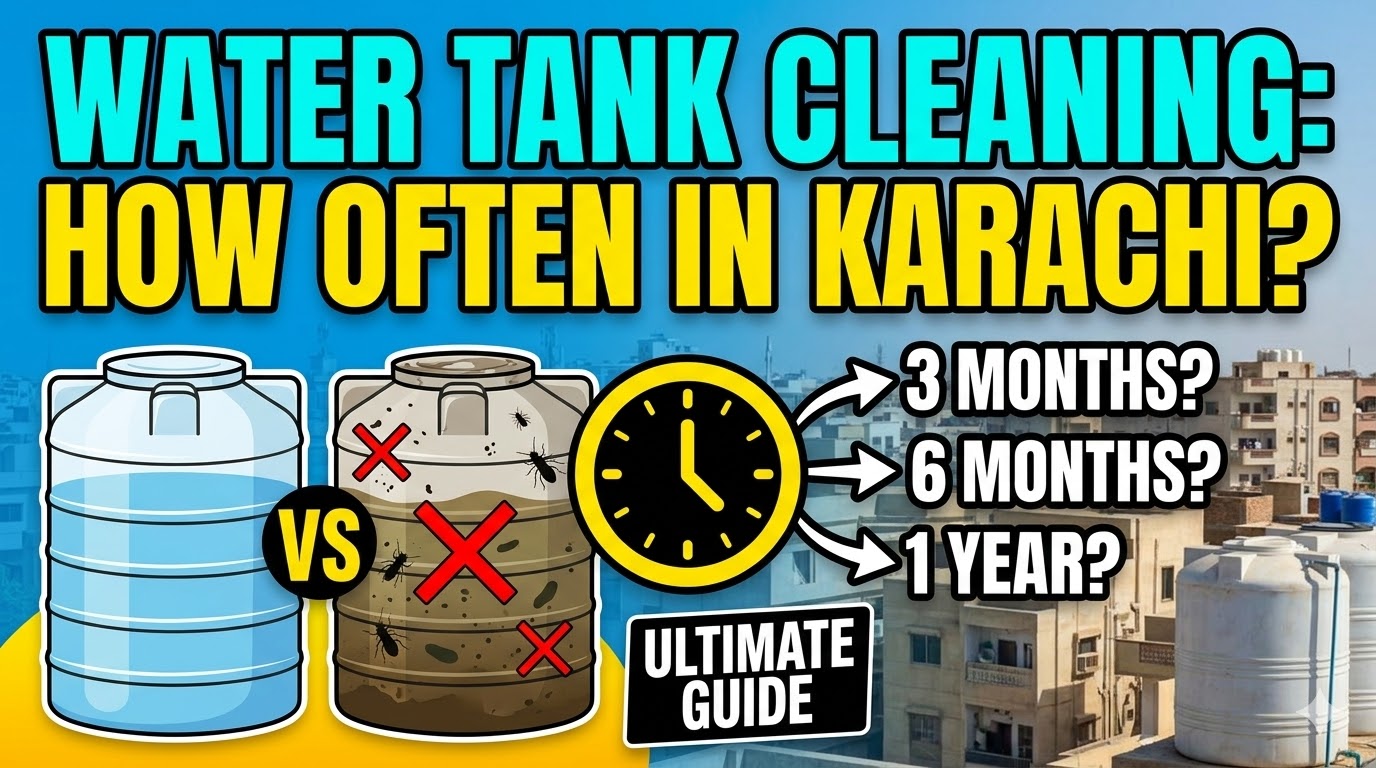
    How Often Should You Get Your Water Tank Cleaned in Karachi?

    If you live in Karachi and haven’t thought about your water tank recently, this article is for you. Every day, millions of Karachi households rely on stored water for drinking, cooking, bathing, and washing. But here’s the uncomfortable truth: if that water tank hasn’t been professionally cleaned in the last six months, the water flowing from your taps may be doing more harm than good.

    Waterborne diseases — including typhoid, gastroenteritis, cholera, and dysentery — remain among the most common health threats in Pakistan’s largest city. Contaminated water tanks are one of the leading, yet most preventable, causes. This guide explains exactly how often you should clean your water tank in Karachi, what factors affect the frequency, and why professional cleaning is the only approach that truly protects your family.

    Why Karachi Homeowners Face a Unique Water Quality Challenge

    Karachi is not a typical city when it comes to water supply. The combination of irregular municipal supply, dense urban infrastructure, extreme heat, and aging pipeline networks creates a uniquely challenging environment for clean water storage. Understanding these local factors helps explain why tank cleaning here demands more urgency than it would in other cities.

    1. Intermittent Water Supply From KWSB

    Karachi Water and Sewerage Board (KWSB) supplies water to most households only once or twice per week. This means residents must store large quantities of water in overhead or underground tanks to last through the entire week. The longer water sits in a tank, the higher the risk of bacterial growth, sludge accumulation, and contamination — making the tank itself a potential health hazard.

    2. High Ambient Temperatures

    Karachi’s temperatures regularly soar above 40°C during summer months. Warm, stagnant water is the perfect breeding ground for bacteria, algae, and biofilm. Overhead rooftop tanks are especially vulnerable — exposed to direct sunlight all day, these tanks can become biologically dangerous within weeks of the last cleaning.

    3. Aging and Contaminated Supply Lines

    Much of Karachi’s underground pipeline network is decades old. Cross-contamination between water supply lines and sewage lines is a well-documented problem in many parts of the city, including areas like Orangi Town, Korangi, and parts of Landhi. Even if your tank started with clean water, what flows through those pipes before reaching your tank may already carry sediment, rust, and microbial loads.

    4. Dust, Smog, and Airborne Contaminants

    Karachi’s air quality — affected by industrial activity, vehicle emissions, sea winds, and periodic dust storms — means that overhead tank lids and vents are constantly exposed to fine particulate matter. Over time, these particles settle into the tank, adding to the layer of sludge at the bottom and creating additional contamination risks.

    These combined factors mean that a Karachi water tank accumulates contaminants significantly faster than a tank in a cooler, less polluted city with consistent water supply. This is not a hypothetical risk — it is a daily reality for millions of families.

    The Short Answer: How Often Should You Clean Your Tank?

    🗓  Recommended Cleaning Schedule for Karachi

    Standard households: Every 3 to 6 months High-risk zones / summer months: Every 2 to 3 months Commercial/industrial properties: Every 1 to 2 months Absolute minimum (any property): Once every 6 months

    While international health guidelines suggest cleaning water tanks at least once every six months, Karachi’s specific conditions mean that the lower end of that range — every three months — is a far safer target for most households. If your tank has gone a year without a professional clean, do not wait any longer.

    Factors That Determine Your Cleaning Frequency

    Not every home or water tank is the same. Several factors should influence how often you schedule a professional tank cleaning service in Karachi.

    Tank Type: Overhead vs. Underground

    Overhead plastic tanks (like those from Bestank or Aqua Plus) sit on rooftops and are directly exposed to sunlight and ambient air. They tend to develop algae and biofilm faster than underground tanks. Underground concrete tanks, on the other hand, accumulate sludge and sediment more heavily due to their size and the nature of water flow into them, and they also carry higher risks of confined-space contamination — making professional cleaning not just important, but essential for safety reasons.

    Neighbourhood and Water Source Quality

    Residents of areas like Gulshan-e-Iqbal, Gulistan-e-Johar, and Jauhar — where water supply is managed through KWSB as well as private tankers — often deal with more variable water quality. Tanker water in Karachi is not uniformly clean; some suppliers draw from sources with higher turbidity and bacterial content. If your home or apartment relies partially on tanker water, your tank needs cleaning more frequently — at least every three months.

    Our Gulshan-Jauhar water tank cleaning service is specifically designed for residents across these densely populated neighbourhoods, where irregular supply schedules and tanker dependency make routine tank hygiene a genuine health priority.

    Number of Residents and Daily Water Usage

    A family of two using a standard 500-gallon tank will cycle through water more quickly than a single-person household. Higher water turnover means less stagnation — but it also means more frequent refilling, which increases the frequency of new contaminants being introduced. For large families or shared properties like apartment buildings, quarterly cleaning is strongly recommended.

    Tank Material and Condition

    Concrete underground tanks in older properties can develop cracks and porous surfaces that harbour bacteria far more readily than smooth plastic or stainless steel tanks. If your underground tank was built more than 10–15 years ago, it likely has surface degradation that makes thorough professional cleaning — including proper disinfection — even more important.

    Commercial and Industrial Properties

    Businesses, restaurants, offices, hostels, factories, and housing societies that use water at scale have a professional and legal responsibility to maintain their water storage at safe standards. In Karachi’s commercial hubs — from the business districts of DHA and Clifton to the industrial estates of SITE and Korangi — tank cleaning frequency should ideally be monthly or bi-monthly, particularly where water is used in food preparation or healthcare environments.

    Our dedicated DHA and Clifton water tank cleaning service is built for exactly this kind of high-standard commercial and residential demand — serving premium properties across Defence, Clifton, Phase-wise DHA colonies, and surrounding areas with 24/7 availability and industrial-grade equipment.

    Warning Signs: Your Tank Needs Cleaning Right Now

    Sometimes, you don’t need to calculate frequencies — the signs are right in front of you. If you notice any of the following, schedule a professional cleaning immediately:

    • Water has an unusual smell — musty, earthy, or chemical odour
    • Water appears discoloured, cloudy, or has floating particles
    • Family members have experienced recurring stomach upsets, diarrhoea, or unexplained nausea
    • You can see visible algae, slime, or dark staining inside the tank
    • More than 6 months have passed since the last professional clean
    • You have recently used tanker water to fill the tank
    • The tank lid has been damaged, loose, or missing, allowing direct air or contaminant entry
    • A water pest or rodent infestation has occurred near the tank area

    Do not dismiss these warning signs. Contaminated water does not always look or smell different — but when it does, it is already beyond safe levels. Act immediately.

    What Does Professional Tank Cleaning Actually Involve?

    Many homeowners assume tank cleaning simply means draining and rinsing. Professional tank cleaning is a multi-step process that no DIY effort can fully replicate. Here is what a proper professional service includes:

    • Complete drainage: All water is fully removed from the tank.
    • High-pressure jet washing: Industrial-grade pressure washing removes deep-rooted algae, biofilm, and hardened deposits that manual scrubbing cannot reach.
    • Industrial vacuuming: Specialized vacuum systems extract sludge, sediment, and debris without leaving residue behind — unlike bucket-and-brush methods used by informal cleaners.
    • Scrubbing and surface cleaning: Trained technicians manually clean all interior surfaces, including edges, corners, and inlet/outlet areas.
    • Safe chemical disinfection: Potable-water-safe disinfectants — such as Silver Hydrogen Peroxide — are applied to eliminate bacteria, viruses, and biofilm. These chemicals are safe for human consumption and approved for water storage use.
    • Final inspection and reporting: The tank is inspected before being certified clean, and any structural issues or cracks are noted for your attention.

    This is the standard of service you should expect from any professional you hire. If a cleaner shows up with only a bucket, a brush, and chlorine tablets — that is not professional tank cleaning. That is a surface rinse that leaves bacterial biofilm, sludge deposits, and potential contamination intact.

    Why Karachi-Specific Expertise Matters

    Not all tank cleaning services in Pakistan understand Karachi’s specific urban water challenges. Khan Tank Cleaning was founded in Karachi and has built its entire operation around the city’s unique conditions — from the sludge profiles common in old KDA-built underground tanks in Gulshan, to the biofilm buildup patterns in rooftop plastic tanks in the high-rise apartments of Clifton.

    Residents of Gulshan-e-Iqbal, Gulistan-e-Johar, North Nazimabad, Liaquatabad, Shah Faisal Town, Malir, and surrounding areas benefit from Khan Tank Cleaning’s dedicated Gulshan and Jauhar service branch — a team that understands the water supply patterns and infrastructure specific to Karachi East and Central.

    For homeowners and businesses in DHA, Clifton, PECHS, Bahadurabad, Zamzama, Khayaban-e-Seher, and the broader Defence corridor, our DHA and Clifton branch provides the same high standard of industrial-grade cleaning — now with 24/7 emergency availability for times when clean water simply cannot wait.

    The Cost of NOT Cleaning Your Tank

    Homeowners sometimes delay tank cleaning to save money. But the cost of inaction is almost always higher than the cost of a professional clean. Consider the real financial and human impact of a contaminated tank:

    • Medical expenses for waterborne illnesses (hospital visits, medication, lab tests) easily exceed the cost of a professional clean several times over
    • Water purifier filters clog faster and need replacing more frequently when water quality from the tank is poor
    • Washing machines, geysers, and dishwashers suffer scale buildup and reduced lifespan when water carries high sediment and mineral loads
    • Lost productivity from sick days — for working adults and school-going children — carries its own economic and emotional cost
    • In cases of severe neglect, tank walls can crack or corrode, requiring expensive structural repair or full tank replacement

    A professional tank cleaning service in Karachi is not an expense — it is an investment in your family’s health, your home’s infrastructure, and your peace of mind.

    A Quick Cleaning Schedule to Bookmark

    Use the following as a practical guide for scheduling your next cleaning:

    • Overhead plastic tank, family of 4+, summer months: Every 3 months
    • Overhead plastic tank, small household, moderate season: Every 4–5 months
    • Underground concrete tank, any household: Every 4–6 months
    • Tanker-fed tank (partial or full): Every 2–3 months
    • Commercial property / housing society / restaurant: Monthly to bi-monthly
    • Post-flooding or monsoon season: Immediately — do not wait

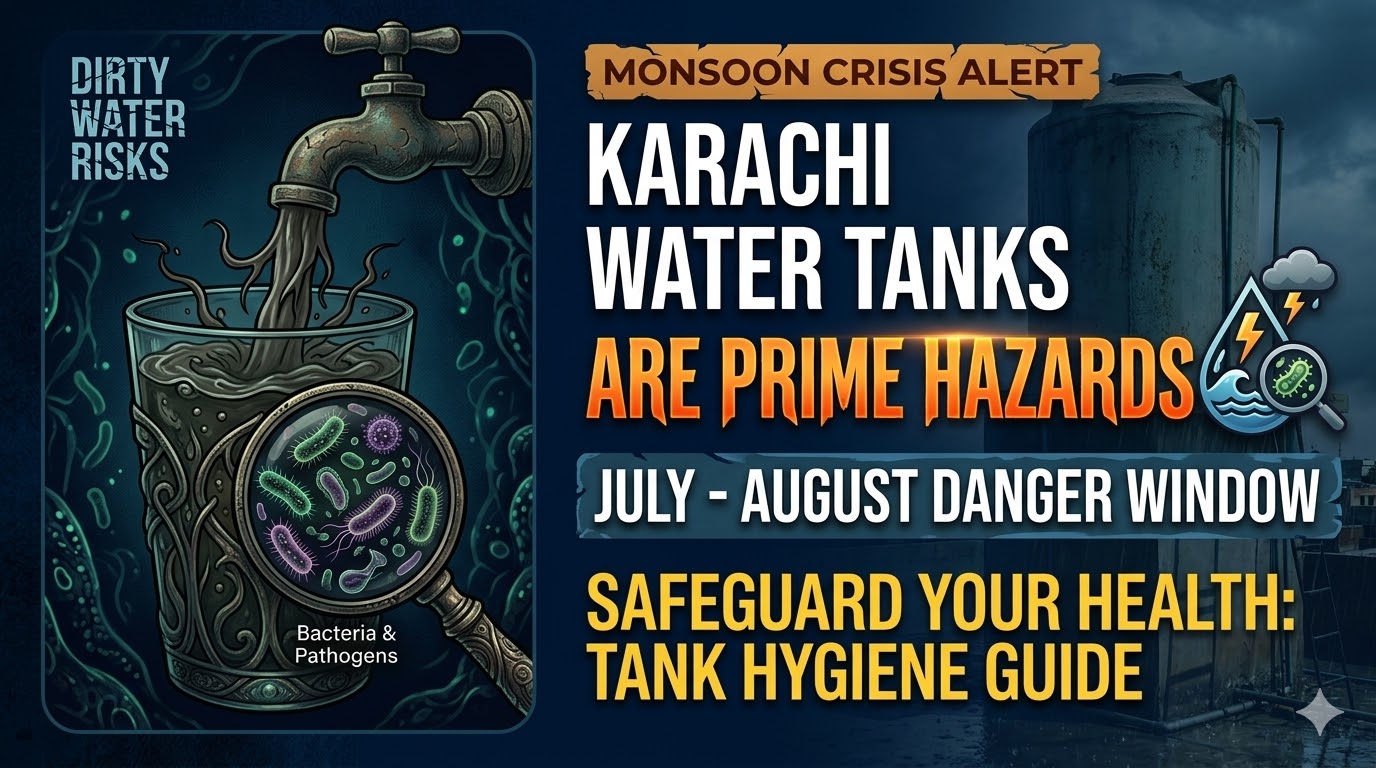
    Karachi’s monsoon season (July–September) is a particularly high-risk period. Floodwater contamination, mosquito breeding grounds, and disrupted supply lines all increase the risk that your tank has been compromised. A post-monsoon tank cleaning should be considered non-negotiable for every Karachi household.

    🚿  Don’t Risk Your Family’s Health Another Day

    Book Your Professional Tank Cleaning Service Today

    Your water tank is the foundation of your household’s water supply. Every glass of water you drink, every meal you cook, every time your children wash their hands — it all starts with what’s inside that tank. If it’s dirty, your water is dirty. It really is that simple.

    Khan Tank Cleaning is Karachi’s most experienced dedicated tank cleaning service. We use industrial-grade high-pressure jet washing, professional vacuuming systems, and potable-water-safe disinfectants — not buckets and brushes. Our teams are trained, equipped, and available around the clock to serve every part of the city, from residential flats to large commercial complexes.

    📍 Based in Gulshan or Jauhar? Book our Gulshan-Jauhar service here →

    📍 In DHA, Clifton, or nearby? Book our DHA-Clifton service here →

    📞 Call 24/7: 0340-2717530  |  03330293174

    🌐 www.khantankcleaning.com

    Khan Tank Cleaning — Karachi’s Dedicated Professional Water Tank Cleaning Service

  • Why Filtered Water Is Not Enough — The Truth About Tank Contamination

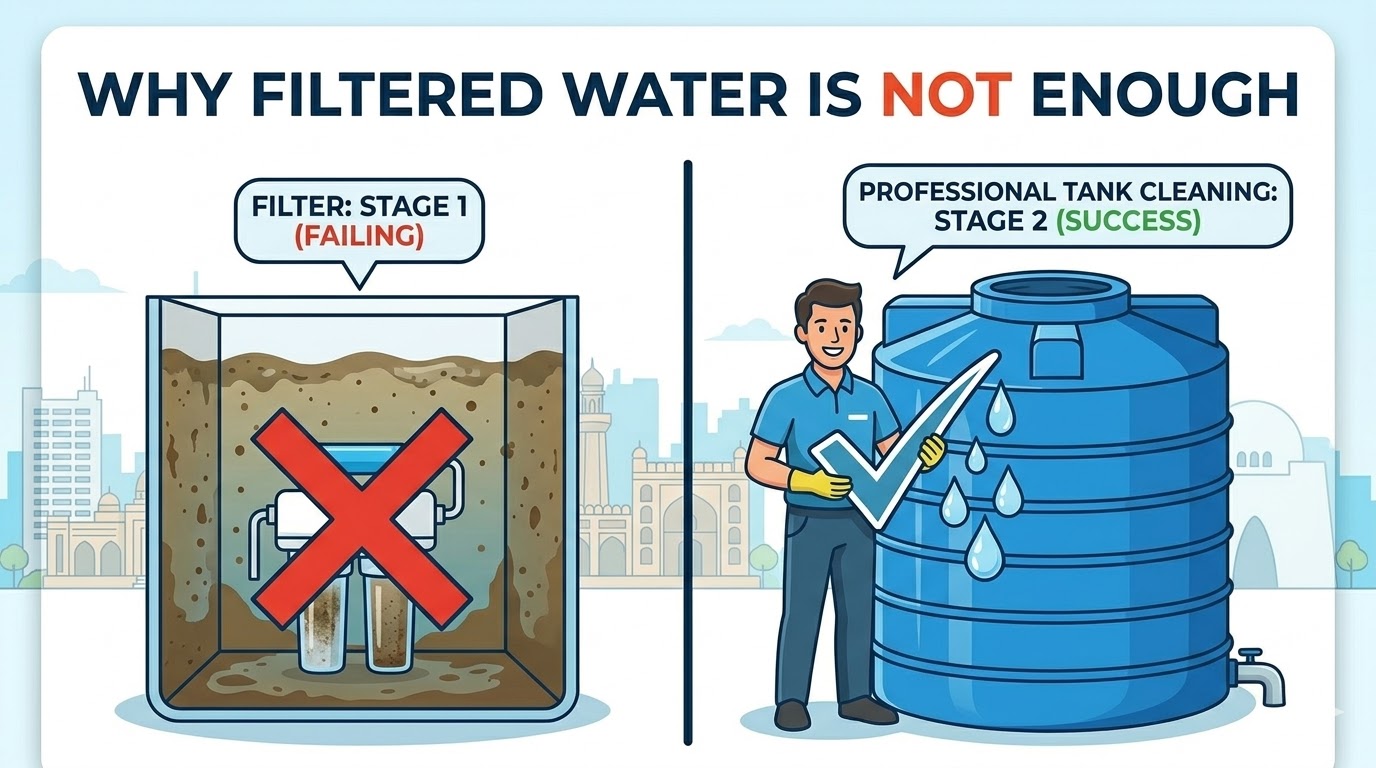
    Why Filtered Water Is Not Enough — The Truth About Tank Contamination

    There is a quiet assumption in millions of Karachi homes: if the water has passed through a filter, it is safe. Families spend thousands of rupees on water purifiers, UV filters, and reverse osmosis systems — and feel confident that the health risk has been handled. But here is the problem that almost no one talks about:

    Your filter is only as good as what goes into it — and if your water tank hasn’t been professionally cleaned recently, your filter is fighting a battle it was never designed to win.

    This article breaks down the science and reality of tank contamination in Karachi, explains exactly why filtration alone is insufficient, and tells you what you actually need to do to protect your household’s water supply.

    The Filter Myth: What Your Water Purifier Actually Does

    Water purifiers and filters are genuinely useful devices. A good reverse osmosis (RO) system can remove dissolved salts, heavy metals, and many chemical contaminants. A UV filter can neutralise bacteria and viruses in the water that passes through it. A sediment filter catches visible particles and rust.

    But all of these systems share one critical design limitation:

    They treat the water as it flows through them — not the source it comes from.

    If your tank contains a thick layer of sludge at the bottom, biofilm coating the interior walls, algae colonies growing in the corners, and bacterial contamination throughout the stored water — your purifier is receiving a heavily compromised input. Here is what your filter cannot do:

    • It cannot remove biofilm — the sticky, protective layer that bacteria build on tank surfaces, which continuously sheds microorganisms and toxins into the water
    • It cannot clean your tank walls — where algae, mould, and fungi establish long-term colonies that recontaminate water every time the tank is refilled
    • It cannot neutralise sludge — the accumulated sediment, rust, dead organic matter, and microbial waste at the bottom of your tank that dissolves back into the water column over time
    • It cannot handle bacterial overload — if bacterial counts in the stored water are extremely high, UV systems may not provide adequate contact time to neutralise all organisms
    • It cannot address cross-contamination — if a crack in the tank wall or a poorly sealed inlet is allowing external material to enter, no filter addresses the source

    In short: your filter is a treatment device, not a cleaning system. If the tank itself is dirty, filtration is managing — not solving — the problem.

    What Is Actually Growing in Your Unclean Water Tank?

    Most homeowners imagine a dirty tank simply has some visible grime or discolouration. The biological reality is considerably more alarming.

    Biofilm: The Hidden Contamination Layer

    Biofilm is a structured community of microorganisms — predominantly bacteria — that attach to surfaces and produce a protective matrix of polysaccharides. Once biofilm establishes itself on your tank’s interior walls, it is extremely resistant to simple rinsing or low-concentration disinfectants. It requires mechanical scrubbing combined with appropriate chemical treatment to fully remove.

    Biofilm communities found in water tanks commonly include species capable of causing typhoid fever, urinary tract infections, respiratory infections, and severe gastroenteritis. Standard domestic water filters do not remove biofilm. They are designed to treat water in transit — not to address a biofilm colony growing on a fixed surface upstream.

    Sludge Deposits

    Every time your tank is filled — whether from KWSB supply or a water tanker — fine particles of sediment, rust, clay, and organic matter are introduced. Over months and years, these particles settle at the bottom and form a thick sludge layer. This sludge contains:

    • Dead and living bacterial colonies at very high concentrations
    • Rust and heavy metal particles from aging pipeline networks
    • Organic matter — including decomposed insects, bird droppings, and plant debris that enter through imperfectly sealed lids
    • Chemical residues from disinfection by-products

    When water is drawn from the tank — especially when levels are low — this sludge becomes disturbed and particles re-enter the water column. Even a high-quality RO system will struggle when sediment concentrations are high enough to rapidly clog its pre-filters.

    Algae and Fungi

    In Karachi’s climate, overhead tanks that receive any indirect light or heat are vulnerable to algae growth. Algae produce toxins — including cyanotoxins in certain species — that some water purifiers are not specifically designed to remove. Fungal contamination from airborne spores is also common in tanks with loose or damaged lids, and fungal metabolites can persist in water even after the organisms themselves are filtered out.

    Insect and Rodent Contamination

    It is more common than most homeowners want to accept: open or poorly sealed tanks in Karachi regularly contain evidence of insect activity (mosquito larvae being the most prevalent concern), small animals, and bird droppings. Mosquito larvae in water tanks are a significant contributor to dengue fever transmission — a public health crisis that Karachi faces each monsoon season.

    Why Karachi’s Water Tanks Are Especially Vulnerable

    Tank contamination is a concern everywhere — but Karachi’s combination of environmental, infrastructural, and climatic factors makes it especially acute.

    Tanker Water Quality Is Not Regulated

    A large proportion of Karachi households — particularly in areas like Gulshan-e-Iqbal, Gulistan-e-Johar, North Nazimabad, and Orangi — supplement or replace municipal supply with water tankers. These tankers vary enormously in quality. Many draw from sources with no treatment, some carry residual contamination from previous loads, and their tanks are rarely cleaned to any professional standard.

    When tanker water enters your home tank, it introduces whatever biological and chemical load it was carrying. Your purifier may reduce some of this — but the tank wall contamination it deposits begins to compound with every refill.

    Residents of these areas have a higher-than-average contamination risk, which is why routine professional tank cleaning is not optional — it is essential. Our water tank cleaning service for Gulshan and Jauhar covers the entire central and eastern zone of Karachi, including Gulshan-e-Iqbal, Johar, North Nazimabad, Federal B Area, Liaquatabad, and surrounding neighbourhoods.

    Extreme Heat Accelerates Bacterial Growth

    Karachi’s summer temperatures — regularly exceeding 40°C on rooftops — turn overhead tanks into incubators. Most pathogenic bacteria double their population every 20–30 minutes under optimal warm conditions. A tank that tested safe in January can have clinically significant bacterial levels by June, even if no new contamination source was introduced. Heat combined with stagnation is one of the most consistent drivers of rapid tank contamination in the city.

    Irregular Supply Means Longer Storage Times

    KWSB water supply in many Karachi neighbourhoods is available only one or two days per week. Households store water for extended periods — sometimes 5–7 days at a stretch. The longer water sits in a warm, potentially contaminated tank, the higher the bacterial load grows. This is in direct contrast to how most domestic water filters are designed and tested — against water that has been stored for hours, not days.

    DHA, Clifton, and PECHS: Not Immune

    It would be a mistake to assume that the tank contamination problem is limited to areas with older infrastructure. Premium residential areas including Defence Housing Authority, Clifton, PECHS, Bahadurabad, and Zamzama face the same fundamental risks — high-rise buildings with rooftop tanks exposed to direct sun, underground tanks in older bungalows that have not been cleaned in years, and private housing societies that do not maintain a regular professional cleaning schedule for shared water tanks.

    Khan Tank Cleaning’s DHA and Clifton tank cleaning service brings the same industrial-grade cleaning and disinfection standards to premium properties that we apply across the city — including high-rise apartment tanks, shared society overhead tanks, and large underground cisterns in bungalow-style properties.

    The Filter vs. Clean Tank: A Side-by-Side Reality Check

      Filter Only vs. Filter + Clean Tank

    Filter only:  Treats water in transit. Does not remove biofilm, sludge, or tank wall contamination. Requires frequent cartridge/membrane replacement. Provides false sense of complete protection.  Filter + professionally cleaned tank:  Filter receives clean input water. Cartridges last longer. Bacteria counts at source are low. Biofilm and sludge removed at root. Full-spectrum protection for your household.

    The two approaches are not alternatives — they are complementary. A professionally cleaned tank and a good water filter together provide a genuinely safe water supply. A filter alone, sitting downstream of a contaminated tank, provides the appearance of safety without the reality.

    The Health Consequences Karachi Families Are Already Experiencing

    Waterborne illness is not an abstract risk in Karachi — it is a measurable, ongoing public health burden. Pakistan’s largest city consistently records high rates of the following conditions, many of which are directly or indirectly linked to contaminated water storage:

    • Typhoid fever — caused by Salmonella typhi, which survives in stagnant, biofilm-rich water. Karachi sees endemic typhoid year-round, with spikes in summer
    • Gastroenteritis and diarrhoeal disease — the leading cause of childhood hospitalisation and mortality in Pakistan, with unsafe water being the primary vehicle
    • Hepatitis A and E — both transmitted via faecally contaminated water; Karachi’s cross-contamination between supply and sewage lines makes this a persistent threat
    • Dengue fever — the Aedes mosquito breeds in clean, stagnant water, making improperly covered tanks a breeding site even when the water quality itself seems acceptable
    • Skin and eye infections — from bathing in water containing elevated levels of bacteria, fungi, and chemical residues from untreated tank water

    Every one of these conditions is preventable. And the most impactful single step a Karachi household can take — beyond installing a water filter — is to ensure that the tank feeding that filter is professionally cleaned on a regular schedule.

    Why DIY Cleaning Is Not the Answer

    When the problem is explained clearly, many homeowners consider cleaning the tank themselves. This is understandable — but there are serious limitations to DIY approaches that must be considered.

    1. You cannot remove biofilm with household cleaning agents. Biofilm requires mechanical disruption (high-pressure washing) combined with appropriate biocidal agents. Household bleach at domestic concentrations, chlorine tablets, and manual scrubbing with brushes leave significant biofilm intact and may create disinfection by-products that introduce new chemical risks.
    2. You cannot safely access underground tanks. Underground concrete tanks present confined-space entry hazards. Without proper oxygen monitoring, safety harnesses, and trained personnel, entering an underground tank is genuinely dangerous. Multiple deaths occur each year in Pakistan from this exact scenario.
    3. You cannot properly vacuum sludge. Industrial wet vacuums designed for tank use extract sludge with a completely different mechanism from manual scooping or rinsing. Manual methods redistribute sludge back into the water; proper vacuuming removes it entirely.
    4. You cannot verify disinfection. A professional cleaning service uses appropriate biocides and leaves the tank with a measurable, safe disinfectant residual. DIY cleaning has no verification mechanism — there is no way to confirm that the surfaces are genuinely free of bacterial contamination.

    These are not reasons to feel helpless — they are reasons to use the professionals who have the right equipment and training.

    What a Professional Tank Clean Includes — and Why Each Step Matters

    A genuine professional tank cleaning is a methodical, multi-stage process. Here is what it looks like when done properly:

    • Complete drainage: All stored water is removed. Cleaning a tank that still contains water is not cleaning — it is dilution.
    • High-pressure jet washing: Industrial-grade pressure washers dislodge biofilm, algae, and hard mineral deposits from all interior surfaces — including corners, inlets, and outlet pipe areas — that manual scrubbing cannot fully reach.
    • Industrial wet vacuuming: Specialised vacuum systems extract all sludge and debris. This is the critical step that bucket-and-rinse methods fail to replicate. No sludge left behind means no ongoing bacterial reservoir.
    • Manual inspection and scrubbing: Trained technicians visually inspect every surface and manually clean areas requiring additional attention, including visible staining, algae patches, and inlet areas.
    • Potable-water-safe disinfection: Professional-grade disinfectants approved for water storage use — such as Silver Hydrogen Peroxide — are applied to kill residual bacteria, fungi, and viruses. These are specifically chosen to be safe for human consumption and to leave no harmful residue.
    • Final inspection and documentation: The cleaned tank is inspected before being declared ready for use. Any structural issues — cracks, damaged inlet seals, loose lids — are flagged for the homeowner’s attention.

    This is the standard that Khan Tank Cleaning applies on every job — whether it is a 200-gallon overhead plastic tank in a Gulshan flat or a 5,000-gallon underground cistern at a DHA bungalow.

    How Often Should You Clean, and When Should You Start?

    The answer for most Karachi households: every three to six months — and if you have not cleaned your tank in the last six months, you should book a cleaning now, regardless of how good your filter seems to be performing.

    Specific situations that require immediate action:

    • Any household using tanker water as a primary or supplementary source
    • Overhead tanks that have been exposed to direct sunlight through summer months without cleaning
    • Any home where a family member has experienced repeated gastrointestinal illness without a clear alternative explanation
    • Properties where the tank lid has been loose, damaged, or missing for any period
    • Tanks that have never been professionally cleaned since installation
    • Post-monsoon season — floodwater contamination risk is real and tank cleaning should be part of every household’s monsoon recovery process

    Our Gulshan and Jauhar cleaning team covers all of Karachi’s central and eastern residential zones and can typically schedule same-day or next-day visits. Our DHA and Clifton service operates 24/7 for both residential and commercial clients across the Defence and Clifton corridor and the wider south-western zones of Karachi.

    Your Filter Cannot Fix a Dirty Tank.

    Only a Professional Clean Can.

    Book Khan Tank Cleaning Today — Serving All of Karachi

    You have invested in a good water filter. That is a smart decision. Now protect that investment — and your family’s health — by ensuring that the tank feeding your filter is genuinely, professionally clean. Khan Tank Cleaning uses industrial jet washing, professional vacuum systems, and potable-water-safe disinfectants on every job. We are a Karachi-based, Karachi-focused company, and we understand the specific contamination challenges of every neighbourhood in this city.

    📍 Gulshan, Jauhar, Gulistan-e-Johar, North Nazimabad & surrounding areas: Book your Gulshan-Jauhar tank clean →

    📍 DHA, Clifton, PECHS, Zamzama & surrounding areas: Book your DHA-Clifton tank clean →

    📞 24/7 Helpline: 0340-2717530  |  03330293174

    🌐 www.khantankcleaning.com  — Clean Tank. Safe Water. Healthy Family.

    Khan Tank Cleaning — Karachi’s Dedicated Professional Water Tank Cleaning Service

  • Monsoon Season Warning: Why Karachi Tanks Are Most Dangerous in July–August

    Monsoon Season Warning: Why Karachi Tanks Are Most Dangerous in July–August

    The rains arrive. The humidity soars. And deep inside your water tank, conditions become ideal for the bacterial explosion that causes cholera, typhoid, and severe gastroenteritis. Here is what Karachi homeowners need to know — and do — before July arrives.

    Karachi’s Monsoon Is Not Just a Weather Event — It Is a Health Event

    For most Karachi families, the monsoon season brings a mix of relief and disruption: cooler evenings, flooded streets, erratic power supply, and — almost invariably — a spike in stomach infections, diarrhoea, and fever cases that fills clinics across the city every July and August.

    Doctors attribute this surge to the usual seasonal suspects: contaminated street food, stagnant floodwater, and poor sanitation. These are real factors. But there is a less visible, more consistent culprit sitting on the roof of your house or buried beneath your courtyard — your water storage tank.

    The monsoon season fundamentally changes the conditions inside Karachi’s household water tanks. Humidity, temperature fluctuations, infrastructure stress, and flooding combine to create what water safety experts describe as a “contamination peak” — the period of highest bacterial activity in stored water. For families who have not had their tanks professionally cleaned before July, this peak can directly translate into preventable illness.

    This article explains exactly why July and August are the most dangerous months for Karachi’s water tanks, what is happening inside them during the monsoon, and what you need to do to protect your household.

    Why July–August Are the Most Dangerous Months for Your Tank

    To understand what makes the monsoon uniquely dangerous for tank water, you need to understand the four factors that drive bacterial growth in stored water — and how the monsoon pushes each one to its worst extreme.

    Factor 1: The Humidity–Condensation Cycle

    During Karachi’s monsoon, relative humidity regularly exceeds 80–90%. This creates a condensation cycle on the interior walls of water tanks — particularly overhead plastic and fiber tanks — where moisture accumulates and then drips back into the stored water. This condensation is unfiltered and can carry airborne fungal spores, dust particles, and bacteria directly into your water supply.

    In underground RCC tanks, the humidity problem manifests differently. High ambient humidity causes moisture infiltration through hairline cracks and porous concrete walls that were previously dry. Any bacteria present in the surrounding soil — including E. coli from nearby sewage seepage — can enter the tank through these pathways during heavy rain.

    Factor 2: Temperature Volatility — The Danger Is Not Heat, It Is the Swing

    Most people assume that because July and August bring cooler temperatures than May and June, the bacterial risk in tanks decreases. This is incorrect. The danger is not peak heat — it is temperature cycling.

    During the monsoon, Karachi experiences repeated cycles of intense solar heating (when clouds part) followed by rapid cooling during rain. Overhead tanks can swing between 28°C and 42°C within a single day. These temperature cycles accelerate the metabolic rate of bacteria already present in biofilm and sediment, causing rapid population bursts followed by die-offs that release bacterial toxins into the water. Even dead bacteria release endotoxins (lipopolysaccharides) that can cause fever and inflammatory responses in humans.

    Why this matters: A tank that might take three weeks to reach dangerous bacterial levels in cooler conditions can reach the same contamination level within five to seven days during active monsoon temperature cycling. If your tank was cleaned in January or February, it may be critically overdue by July.

    Factor 3: Infrastructure Failure and Cross-Contamination Surges

    Karachi’s water distribution infrastructure is under its greatest annual stress during the monsoon. Heavy rainfall causes:

    • Sewage system overflow: Karachi’s combined stormwater and sewage drainage system is overwhelmed during heavy rain events. Sewage overflow contaminates groundwater and low-lying water mains, dramatically increasing the bacterial load entering tanks from the supply side.
    • Pressure drops in supply lines: When KWSB supply pressure drops — which happens frequently during load-shedding spikes that accompany monsoon weather — negative pressure can cause back-siphonage, pulling contaminated groundwater or sewage directly into supply pipes and from there into your tank.
    • Flooded underground tanks: Underground RCC tanks in low-lying areas of Karachi — parts of Orangi, Korangi, Landhi, and sections of Gulshan-e-Iqbal — can experience direct surface water infiltration during severe flooding, introducing raw floodwater contaminated with sewage, chemicals, and debris directly into the household water supply.

    Factor 4: Extended Load-Shedding and Stagnation

    Karachi’s load-shedding schedule intensifies during the monsoon as demand for power spikes while grid supply is disrupted by storm damage. Extended power outages mean water pumps are inactive for longer periods — 12 to 18 hours in some residential areas. During these outages, water sits stagnant in tanks at warm temperatures with no circulation. Stagnation time is one of the most reliable predictors of bacterial concentration: the longer water sits still in a warm, dark, contaminated tank, the more dangerous it becomes.

    The Pathogens That Peak in Karachi During Monsoon

    The following pathogens are specifically associated with elevated incidence during Karachi’s monsoon season and are directly linked to contaminated household water tank storage:

    Vibrio cholerae (Cholera)

    Cholera cases in Karachi spike predictably every monsoon season. Vibrio cholerae is transmitted almost exclusively through contaminated water and survives well in warm, stagnant tank environments. The bacterium can reach infectious doses rapidly in conditions created by monsoon-affected tanks. Symptoms — profuse watery diarrhoea and severe dehydration — can become life-threatening within hours, particularly in children and the elderly.

    Salmonella typhi (Typhoid)

    Typhoid case reports increase across Karachi every July and August. Salmonella typhi can persist for weeks in tank sediment and is resistant to low concentrations of chlorine. It enters tanks through contaminated supply water, particularly during the pressure drops and pipe failures that characterise monsoon season. Families in Karachi’s densely populated neighbourhoods — where sewage and water infrastructure are in close proximity — are at greatest risk.

    E. coli and Coliform Bacteria

    Faecal coliform contamination — a direct indicator of sewage cross-contamination — increases in urban water systems during and after heavy rainfall. E. coli strains in monsoon-affected tanks can cause gastroenteritis that mimics simple food poisoning: stomach cramps, vomiting, and diarrhoea that many families dismiss as a seasonal stomach bug. In children and immunocompromised individuals, pathogenic E. coli strains can cause haemolytic uraemic syndrome, a serious condition affecting the kidneys.

    Leptospira (Leptospirosis)

    Leptospirosis is a monsoon-specific waterborne disease that is significantly underdiagnosed in Karachi. It is caused by bacteria carried in the urine of rodents — particularly rats, which thrive in Karachi’s flood-affected areas — and enters water supplies through floodwater contamination. Underground tanks are particularly vulnerable. The disease presents with sudden fever, headache, and muscle aches, and can progress to liver and kidney failure in severe cases.

    Karachi Health Alert: According to Sindh health records and academic studies on urban Pakistan, waterborne disease cases in Karachi increase by 40–60% during the July–August monsoon period compared to the preceding months. The most commonly cited household risk factor is contaminated water storage, not contaminated supply.

    Monsoon Risk by Neighbourhood: How Your Area Affects Your Tank

    Not all of Karachi faces identical monsoon water risk. Infrastructure age, drainage quality, elevation, and housing density all influence how severely the monsoon affects your tank. Here is a breakdown by the areas our two branches serve:

    DHA, Clifton, Saddar, Korangi and South Karachi

    DHA’s newer phases have comparatively modern water infrastructure, but older phases (Phase 1–4) rely on aging mains that are particularly susceptible to pressure-loss contamination during heavy rain. Clifton’s high-rise buildings often have rooftop tanks and shared underground cisterns that serve multiple floors simultaneously — making a single contamination event a building-wide health risk. Korangi and Landhi are in low-lying industrial zones that experience significant flooding, with underground tanks especially vulnerable to direct floodwater infiltration.

    Households in these areas should prioritise a pre-monsoon clean from our DHA and Clifton water tank cleaning team. Our DHA branch covers DHA Phase 1–8, Clifton, Gizri, Punjab Colony, Saddar, Korangi, Malir, and surrounding areas — call 03330293174 for immediate same-day service.

    Gulshan-e-Iqbal, Gulistan-e-Johar, Nazimabad, North Karachi and East Karachi

    Gulshan-e-Iqbal and Gulistan-e-Johar experience some of the most severe annual monsoon flooding in Karachi, particularly in low-lying blocks adjacent to the Lyari River drainage corridor. Underground RCC tanks in these areas are at direct risk of floodwater infiltration during extreme rainfall events. The density of housing in North Nazimabad, Liaquatabad, and North Karachi Township means that sewage and water mains are in very close proximity — creating high cross-contamination risk during any pipe pressure fluctuation.

    East Karachi residents have dedicated access to our Gulshan and Jauhar branch water tank cleaning service, which covers all blocks of Gulshan-e-Iqbal and Gulistan-e-Johar, Nazimabad, Federal B Area, SITE, PECHS, New Karachi, North Karachi, Bahria Town, and surrounding areas. Call 03402717530 — same-day emergency service is available 24/7.

    Wherever you are in Karachi, professional water tank cleaning services from Khan Tank Cleaning are accessible within the day. Both branches operate around the clock.

    Warning Signs Your Monsoon Tank Contamination Has Already Begun

    By the time contamination becomes visible or smellable, bacterial concentrations in your tank are already at dangerous levels. However, these warning signs should be treated as emergency indicators requiring immediate professional attention:

    • Musty, earthy, or sulphurous odour from taps: Indicates anaerobic bacterial activity, algae decomposition, or hydrogen sulphide production in tank sediment.
    • Slightly cloudy or discoloured water: A sign of elevated sediment, algae growth, or high bacterial turbidity — particularly common in post-rain supply water entering a dirty tank.
    • Yellow or brownish tinge: Rust from corroded pipes or tank fittings, often made worse by pressure fluctuations during monsoon supply disruptions.
    • Slippery or slimy feel on tank walls (if accessible): Classic biofilm indicator. Biofilm is the primary bacterial reservoir in any water storage tank.
    • Recurring stomach issues in household: If two or more family members experience diarrhoea, nausea, or fever within the same week, waterborne contamination from the household tank is a primary suspect.
    • More than six months since last professional clean: In Karachi’s monsoon conditions, a tank that was cleaned in January or earlier is at significant risk of reaching dangerous contamination levels by July.

    Critical reminder: You cannot rely on appearance or smell alone to assess tank safety. Most dangerous bacterial contamination — including typhoid and cholera — is odourless and colourless at the concentrations needed to cause infection. Professional cleaning is required on schedule, not just when the water looks or smells bad.

    Why Pre-Monsoon Cleaning in June Is the Most Important Clean of the Year

    If you can only have your tank professionally cleaned once a year — which is, itself, less than the recommended twice-yearly schedule — the single most important time to do it is during June, before the monsoon arrives. Here is why:

    1. You start the high-risk period with a clean baseline. A professionally cleaned and disinfected tank eliminates the existing biofilm reservoir, sediment, and bacterial population. When contaminated supply water or humidity-driven infiltration begins during July, the tank has no pre-existing bacterial colony to amplify the incoming contamination.
    2. Silver Hydrogen Peroxide residual effect. Our food-grade disinfectant provides a residual antibacterial effect on tank surfaces after the clean, offering an additional defensive layer during the first weeks of the monsoon — the period of greatest contamination risk from supply-side events.
    3. You can monitor effectively. A family that knows their tank was professionally cleaned in June can assess any illness or water quality change against a known baseline. A family with an unknown cleaning history cannot.
    4. Bookings are concentrated — act early. Demand for professional tank cleaning in Karachi surges in late June and early July as families respond to news of the first monsoon-related cholera or typhoid cases. Booking your clean in June avoids the rush and ensures same-day availability.

    Why DIY Tank Cleaning Is Especially Inadequate During Monsoon Season

    Many Karachi homeowners rely on informal cleaning — a manual scrub with bleach by a local laborer — and consider this adequate. During ordinary conditions, this provides minimal protection. During and after the monsoon, it is dangerously insufficient for the following specific reasons:

    • Monsoon-driven contamination is deeper: Floodwater infiltration and high-humidity condensation introduce bacteria deep into the porous surface of RCC concrete tanks, into inlet pipe residue, and into any crack or joint. Manual scrubbing with brushes cannot reach or dislodge contamination at this depth.
    • Household bleach is neutralised by organic matter: Post-monsoon tank water contains elevated levels of organic matter — soil particles, algae, and debris introduced by supply-side events. Organic matter chemically neutralises chlorine-based bleach before it reaches the bacteria it is meant to kill.
    • No vacuum extraction means recontamination: Any manual clean that does not include industrial vacuum extraction leaves loosened sludge in the tank. During the monsoon, when water agitation from supply refills is frequent and pump cycling is irregular, this residue constantly stirs back into the water column.
    • No safety equipment for confined space entry: Underground RCC tanks accumulate methane and hydrogen sulphide gas — both more concentrated in warm, wet monsoon conditions. Entry without oxygen monitoring and ventilation equipment is genuinely life-threatening. Informal cleaners who enter these tanks without proper safety gear put their lives — and yours — at risk.

    Khan Tank Cleaning’s ISO-certified 8-step tank cleaning procedure — involving industrial jet washing at 3,000+ PSI, vacuum sludge extraction, and Silver Hydrogen Peroxide disinfection — is specifically designed to address the depth and type of contamination that monsoon conditions produce. It is the professional standard your family’s health requires.

    What Khan Tank Cleaning’s Monsoon Service Involves

    Every tank cleaning service we perform follows this ISO 9001-audited eight-step process, with specific attention to the contamination types associated with monsoon conditions:

    • Site Assessment: We evaluate tank type, size, access, and any visible signs of monsoon-related damage or infiltration before work begins. You receive an exact scope and price upfront.
    • Controlled Complete Drainage: All water is drained and safely discharged — no contaminated water is recycled back.
    • High-Pressure Jet Washing (3,000+ PSI): Industrial washers blast all walls, floor, ceiling, and fittings — removing biofilm, algae colonies, mineral scale, and the organic matter that accumulates during monsoon supply disruptions.
    • Industrial Vacuum Extraction: All loosened sediment, sludge, and debris are completely removed. Nothing is left to resettle in fresh water.
    • Silver Hydrogen Peroxide Disinfection: EPA and FDA approved for potable water. Penetrates and destroys residual biofilm. More effective against monsoon-specific contamination than chlorine-based products. Breaks down into water and oxygen — zero toxic residue.
    • Thorough Rinse: Complete rinse cycle ensures no chemical residue before refilling.
    • Senior Technician Quality Inspection: Every surface is inspected against our ISO 9001 standards before the tank is cleared for refilling.
    • Official Documentation: You receive a full service report and a tax-compliant invoice (SRB/FBR registered). This is a certified, documented service — not a cash transaction.

    Our teams carry full safety equipment — oxygen monitoring devices, forced ventilation, harnesses, and protective gear — for all underground RCC tank work. This is non-negotiable under our ISO 45001 Occupational Health & Safety certification.

    Recommended Cleaning Schedule Around Monsoon Season

    Based on water safety best practices for Karachi’s climate and infrastructure conditions, Khan Tank Cleaning recommends the following annual schedule:

    • Twice-yearly residential clean: Ideally in June (pre-monsoon) and December (post-winter). This ensures your tank enters the two highest-risk periods — monsoon and the first cold months — in a clean, disinfected state.
    • Quarterly commercial and institutional clean: Hotels, hospitals, schools, and office buildings should clean every three months, with a mandatory clean before July regardless of when the last service occurred.
    • Immediate clean if: any household member is diagnosed with typhoid, cholera, or a waterborne gastrointestinal illness; if the tank has been visibly affected by flooding; if water taste, odour, or appearance changes; or if the tank has not been professionally cleaned for more than six months.

    Frequently Asked Questions About Monsoon Tank Safety in Karachi

    If it rains heavily, should I empty and reclean my tank immediately after?

    If your underground tank may have been exposed to floodwater — indicated by water entering from around the access hatch, unusual floating debris, or a sudden change in water colour — then yes, an immediate professional clean is warranted. Contact us for a same-day emergency service. For overhead tanks that were professionally cleaned before monsoon, heavy rainfall alone does not typically require an emergency reclean unless visible contamination is observed.

    Can I use water purification tablets instead of cleaning the tank?

    Purification tablets and chlorine drops treat water in the tank but do not clean the tank itself. Biofilm on tank walls and sediment at the bottom are physical structures — not free-floating bacteria — and are not eliminated by chemical dosing of the water column. The bacteria within biofilm are shielded from contact with purification chemicals. Tablets are a short-term interim measure only, not a substitute for professional cleaning.

    How quickly can Khan Tank Cleaning attend after I call?

    Both our branches offer same-day service, 24 hours a day, seven days a week. During the monsoon peak in July and August, we recommend calling as early in the day as possible to secure a same-day slot. You can also book in advance through our online estimate form to guarantee your preferred date.

    Is it safe for children and pregnant women to use the water after the clean?

    Yes. Our Silver Hydrogen Peroxide disinfectant is EPA and FDA approved for potable water systems and breaks down completely into water and oxygen with no chemical residue. A thorough post-disinfection rinse is a mandatory step in our ISO-certified process before the tank is cleared for refilling. The water is safe for all household members, including infants, pregnant women, and the elderly.

    Act Now — Before the Monsoon Turns Your Tank Into a Health Risk

    Every monsoon season, Karachi’s hospitals and clinics see the same pattern: a sharp rise in cholera, typhoid, and gastrointestinal illness cases in July and August, followed by weeks of treatment, recovery, and expense that could have been prevented by a single professional tank clean in June.

    Do not wait for your family to become part of that statistic. Khan Tank Cleaning has been protecting Karachi households since 2005 with ISO-certified processes, food-grade disinfection, and industrial equipment that delivers genuine results — not just a visual impression of cleanliness.

    Book your pre-monsoon clean today. Both our branches are open 24/7 with same-day availability. Tell us your tank type and size — we quote immediately, transparently, and without obligation.

    DHA, Clifton, Saddar, Korangi, Malir & South Karachi Call: 03330293174  |  Book online: Tank Cleaning — DHA & Clifton Branch Available 24/7 | Same-day pre-monsoon slots filling fast

    Gulshan-e-Iqbal, Jauhar, Nazimabad, North Karachi, SITE & East Karachi Call: 03402717530  |  Book online: Tank Cleaning — Gulshan & Jauhar Branch Available 24/7 | Same-day pre-monsoon slots filling fast

    Get your free, no-obligation quote at khantankcleaning.com/estimate. Protect your family from Karachi’s most preventable seasonal health risk — book your tank clean before July arrives.

    Khan Tank Cleaning | ISO 9001 & ISO 45001 Certified | SRB & FBR Registered | Serving Karachi Since 2005

    DHA Branch: 03330293174  |  Gulshan Branch: 03402717530  |  khantankcleaning.com

  • Children & Water Safety in Karachi: What Every Parent Should Know

    Children & Water Safety in Karachi: What Every Parent Should Know

    The Water Your Child Drinks Today Tells the Story of Their Health Tomorrow

    In a city of over 16 million people, water is life — but clean water is a privilege that too many Karachi families unknowingly compromise on. Every day, children across Gulshan-e-Iqbal, Gulistan-e-Jauhar, DHA, Clifton, North Nazimabad, PECHS, and dozens of other neighbourhoods drink, cook with, and bathe in water that has passed through a storage tank that may not have been professionally cleaned in months — or even years.

    As parents, we invest in school fees, nutritious food, vitamins, and healthcare. Yet one of the most overlooked threats to our children’s health sits quietly on the rooftop or underground beneath our homes: the water tank.

    This article is your complete guide to understanding the link between water tank hygiene and child health in Karachi — and what you must do to protect your family.

    ⚠️  Did You Know? Waterborne diseases are among the leading causes of child illness and hospitalisation across Karachi, particularly during and after the monsoon season. In many cases, the source is not the water supply itself — it is the contaminated storage tank inside the home.

    Why Karachi’s Water Storage System Makes Children Especially Vulnerable

    Karachi’s water supply infrastructure is under constant pressure. Most residential areas receive water from the Karachi Water and Sewerage Board (KWSB) only once or twice a week, or sometimes less. This forces households to store large quantities of water in overhead and underground tanks — often for several days at a time.

    This storage gap creates a dangerous window:

    • Bacteria such as E. coli, Salmonella, and Legionella thrive in stagnant, warm water — exactly the conditions found in improperly maintained rooftop tanks during Karachi’s hot summers.
    • Algae and biofilm develop on tank walls over time, creating a protective layer for bacteria that basic rinsing cannot remove.
    • Sludge and sediment settle at the bottom of tanks, becoming a reservoir for harmful microorganisms.
    • The intermittent pressure in Karachi’s supply lines allows back-contamination — contaminated water or air can enter the tank when pressure drops.

    Children under 5 are particularly at risk because their immune systems are still developing. A dose of contaminated water that a healthy adult might handle without noticeable symptoms can cause severe diarrhoea, vomiting, dehydration, and in extreme cases, life-threatening complications in a young child.

    In high-density residential areas like Gulshan-e-Iqbal and Gulistan-e-Jauhar, where families live in flats and apartments with shared water systems, the risk multiplies across entire buildings.

    The Hidden Threat: What’s Actually Growing in Your Water Tank

    Most water tanks in Karachi are made of plastic, fibreglass, or concrete. Over time, without regular professional cleaning, the interior surfaces become contaminated in ways that are invisible to the naked eye.

    1. Bacterial Biofilm

    A thin but deadly layer of bacteria that forms on tank walls and is highly resistant to ordinary rinsing. High-pressure jet washing is required to break this biofilm loose.

    2. Algae Growth

    In tanks exposed to even minimal sunlight — particularly plastic overhead tanks in Karachi’s year-round sunshine — algae can grow rapidly. Algae not only smells unpleasant but also provides food for bacteria.

    3. Sludge and Sediment

    Over months of use, sand, dust, rust particles, and biological matter settle at the bottom of the tank. Karachi’s dusty environment, especially in summer, accelerates this process. When water is drawn, this sludge becomes suspended and enters the household supply.

    4. Chemical Contamination

    Pipeline leaks in many parts of Karachi can allow traces of sewage or industrial waste to enter the water system. A clean tank with properly disinfected walls provides a last line of defence.

    🔬  What Professional Cleaning Removes High-pressure jet washing, industrial vacuuming, and proper disinfection with safe chemicals like Silver Hydrogen Peroxide removes bacterial biofilm, algae, sludge, and sediment that ordinary household cleaning simply cannot reach or eliminate.

    Signs That Your Water Tank Needs Immediate Cleaning

    As a parent, watch for these warning signs:

    • Your child or family members have recurring episodes of stomach upset, diarrhoea, or vomiting with no clear food-related cause.
    • The water from your taps has a faint smell — earthy, musty, or chemical-like.
    • Water appears slightly cloudy or has a yellowish or greenish tint.
    • You haven’t had your tank professionally cleaned in the last 3–6 months.
    • Your tank is underground — underground tanks in Karachi are particularly vulnerable to sludge accumulation and require specialised cleaning with confined space safety equipment.
    • Your building or housing society recently had a water supply disruption, as this increases the likelihood of contamination during refill.

    Any one of these signs should be treated as urgent. Don’t wait for a visible problem — by the time water looks or smells bad, contamination is already advanced.

    Karachi-Specific Risks Parents Must Take Seriously

    Karachi’s environment presents a set of unique challenges that make regular tank cleaning more critical here than in many other cities:

    Monsoon Season (July–September)

    The monsoon brings flooding in many areas including Gulshan, Jauhar, PECHS, and coastal areas. Floodwater can enter tanks — both underground and overhead — bringing bacteria, sewage, and debris. Every monsoon, parents should immediately arrange a professional cleaning of all water storage.

    Peak Summer Heat (April–June)

    Temperatures in Karachi regularly reach 38–42°C during summer. Warm water accelerates bacterial growth dramatically. Tanks that might be borderline safe in winter become genuinely dangerous during these months.

    Dust and Air Pollution

    Karachi consistently ranks among the most polluted cities in the world. Airborne dust particles, heavy metals, and pollutants find their way into improperly sealed tanks and contribute to contamination.

    Intermittent Water Supply

    Water supply interruptions followed by sudden pressure surges — a common occurrence across Karachi — can dislodge sediment and biofilm from tank walls, sending contamination directly into your household pipes.

    How Often Should Karachi Families Clean Their Water Tank?

    Health experts and professional water tank cleaning services recommend the following schedule for Karachi households:

    • Minimum: Every 6 months (twice a year).
    • Ideal: Every 3–4 months, particularly for households with young children, elderly members, or anyone with a compromised immune system.
    • After every monsoon season: Without exception. Even if you cleaned the tank in July, clean it again after monsoon rains end in September.
    • After any water supply disruption lasting more than 24 hours.
    • After moving into a new home — regardless of how recently the previous owner claims it was cleaned.

    This is not a luxury expense — it is a health investment. The cost of one hospital visit for a child with a waterborne illness far exceeds the cost of regular professional tank cleaning.

    Professional Tank Cleaning Services Closest to You in Karachi

    Khan Tank Cleaning operates two dedicated branches serving the entirety of Karachi, ensuring fast response times and local expertise wherever you are located.

    Branch 1: Serving Gulshan, Jauhar, and East/Central Karachi

    Families living in Gulshan-e-Iqbal, Gulistan-e-Jauhar, Nazimabad, North Nazimabad, FB Area, Liaquatabad, Korangi, Shah Faisal Town, Malir, Landhi, and surrounding areas are served by our dedicated water tank cleaning service in Gulshan & Jauhar Karachi. This branch is positioned to reach your home faster, with trained technicians who understand the high-density residential and apartment layouts typical of these areas.

    Whether you live in a multi-storey flat in Block 13 of Gulshan-e-Iqbal or a house in Gulistan-e-Jauhar near the expressway, our professional overhead and underground tank cleaning in Gulshan-Jauhar team is equipped to handle every type of residential and commercial tank cleaning job.

    Branch 2: Serving DHA, Clifton, and South/West Karachi

    For families in DHA, Clifton, PECHS, Bahadurabad, Tariq Road, Saddar, Garden, Zamzama, Bahria Town Karachi, Keamari, and surrounding neighbourhoods, our water tank cleaning service in DHA & Clifton Karachi delivers the same high-standard, equipment-grade cleaning with added expertise in the larger bungalow and villa tank configurations common in DHA phases and Clifton blocks.

    DHA and Clifton properties often feature large-capacity underground concrete tanks as well as rooftop tanks — requiring specialised confined space entry protocols and industrial vacuum systems. Our DHA and Clifton professional tank cleaning team uses oxygen safety systems, full-body protective equipment, and industrial-grade disinfectants including Silver Hydrogen Peroxide to ensure thorough, safe cleaning.

    🏙️  Serving All of Karachi Both branches collectively cover the entire city of Karachi — from North Karachi and New Karachi in the north, to Baldia Town and Orangi Town in the west, to Korangi and Landhi in the east, and DHA and Clifton in the south. No matter where you live, Khan Tank Cleaning can reach you.

    What to Expect from a Professional Water Tank Cleaning — Step by Step

    A professional tank cleaning from Khan Tank Cleaning follows a structured, certified process:

    • Step 1 — Inspection: Technicians assess the tank type (overhead/underground/fibre/plastic/concrete/stainless steel), size, and condition before starting.
    • Step 2 — Draining: The tank is fully emptied using high-pressure systems.
    • Step 3 — High-Pressure Jet Washing: Industrial-grade equipment blasts tank walls, floors, and ceilings to dislodge biofilm, algae, and deposits that manual scrubbing cannot reach.
    • Step 4 — Industrial Vacuuming: All loosened sludge, debris, and residue is extracted completely — leaving no sediment behind.
    • Step 5 — Disinfection: Safe, food-grade disinfectants including Silver Hydrogen Peroxide are applied to kill remaining bacteria, viruses, and fungi.
    • Step 6 — Inspection and Drying: The cleaned interior is inspected and left to dry before refilling, ensuring no chemical residue enters your water supply.

    The entire process is designed around the safety of your family — particularly children — and uses only disinfectants approved for potable (drinking) water systems.

    6 Things Every Karachi Parent Should Do Right Now

    • Check when your tank was last cleaned. If you can’t remember, that’s your answer — book a cleaning immediately.
    • Ask your building management. In apartments and housing societies, find out if there is a regular tank cleaning schedule and when it was last done.
    • Install a tank cover. Ensure your overhead tank has a properly fitting, sealed lid to prevent airborne contamination.
    • Observe the first water of the day. If the first water from the tap each morning has any discolouration, smell, or visible particles, stop using it for drinking and cooking until your tank is cleaned.
    • Educate your children. Teach older children not to drink directly from taps without asking and to always use filtered water for drinking.
    • Schedule recurring cleanings. Don’t treat this as a one-time task — set a calendar reminder every 3–6 months for professional tank cleaning.

    “But We Have a Water Filter” — Why That’s Not Enough

    This is one of the most common misconceptions among Karachi homeowners. A water filter at the point of use — whether an RO system, ultraviolet purifier, or ceramic filter — is an important layer of protection. But it is not a substitute for a clean tank.

    Here’s why:

    • Filters treat water at the tap, but your children also use tank water for brushing teeth, washing hands, and bathing — none of which goes through the filter.
    • A heavily contaminated tank can overwhelm a filter’s capacity, allowing some contaminants to pass through.
    • Filters do not eliminate all microorganisms. Biofilm and certain bacterial spores can pass through standard domestic filters.
    • Filters require regular maintenance — a poorly maintained filter is itself a contamination source.

    Clean tank + quality filter = genuine protection for your family. One without the other leaves a dangerous gap.

    Protect Your Children — Book Your Professional Tank Cleaning Today

    Your child’s health is not something to leave to chance. Every day that passes with an unclean water tank is a day your family is exposed to unnecessary risk. The solution is straightforward, affordable, and available right now.

    Khan Tank Cleaning is Karachi’s dedicated, professional water tank cleaning service — available 24/7, serving every corner of the city, and trusted by homeowners, apartment buildings, schools, offices, and industrial facilities across Karachi.

    If you are in Gulshan, Jauhar, Gulshan-e-Iqbal, Nazimabad, FB Area, Korangi, Landhi, Malir, or surrounding areas, visit our dedicated water tank cleaning service page for Gulshan & Jauhar to book your cleaning.

    If you are in DHA, Clifton, PECHS, Saddar, Bahadurabad, Zamzama, Bahria Town, Keamari, or surrounding areas, visit our dedicated water tank cleaning service page for DHA & Clifton to book your cleaning.

    🛡️  BOOK YOUR PROFESSIONAL TANK CLEANING TODAY   Available 24/7 — Emergency & Scheduled Services High-Pressure Jet Washing | Industrial Vacuuming | Safe Disinfection   📍  Branch 1 — Gulshan, Jauhar & East Karachi khantankcleaning.com/water-tank-cleaning-gulshan-jauhar-karachi   📍  Branch 2 — DHA, Clifton & South Karachi khantankcleaning.com/water-tank-cleaning-dha-clifton-karachi   Clean water is not a luxury. It is your child’s right. Act today.

    Khan Tank Cleaning | khantankcleaning.com | Available 24/7 across all of Karachi