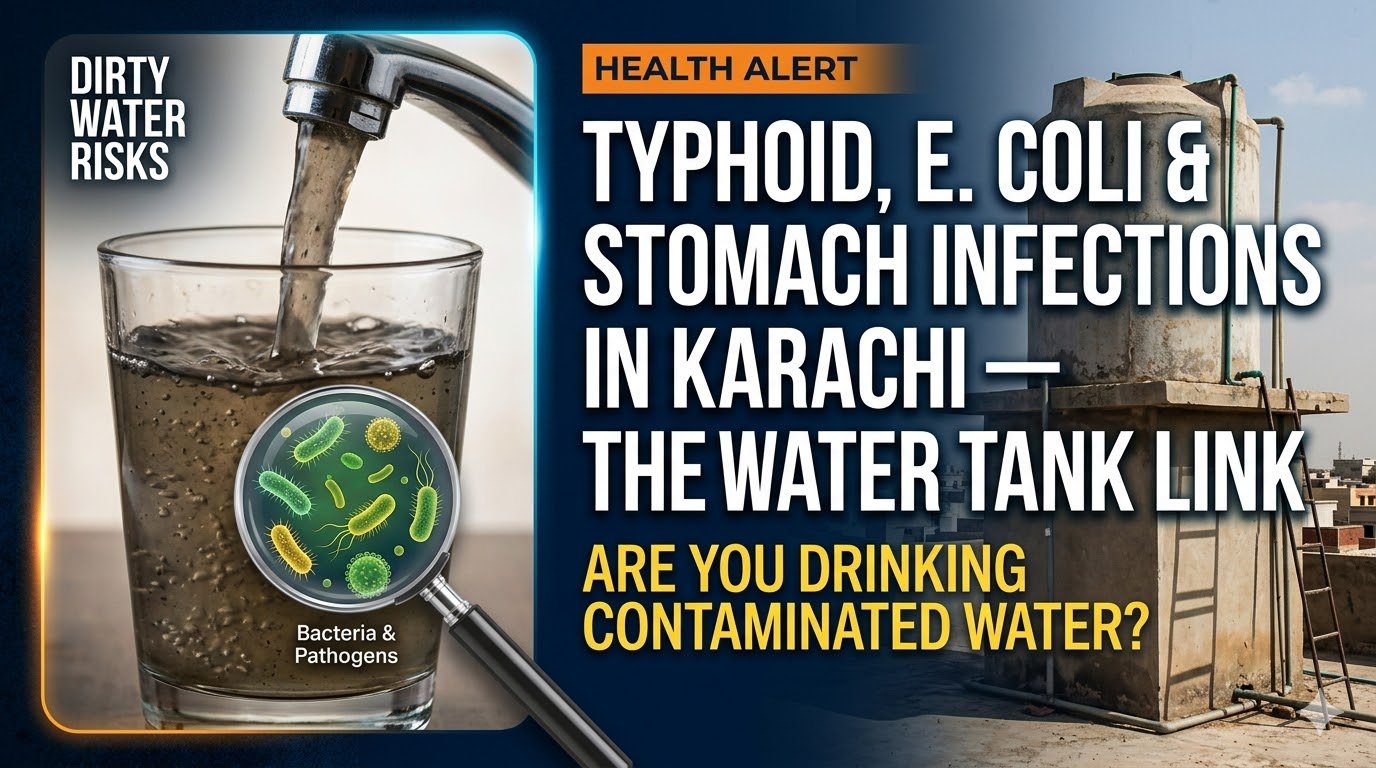
Waterborne disease in Karachi is not a seasonal scare. It is a documented, year-round burden, and the city’s intermittent supply means most of the water people use has spent days in a household tank before it reaches a tap. This article looks at what has actually been measured, how the main infections travel, and where the tank fits in.
One caution first. A dirty tank is rarely the only source of infection in a home. Food, hands, school and outside meals all play a part. The case for cleaning the tank is that it is one of the few sources you fully control.
In brief
- Most Karachi water samples tested in 2017 and again in 2020 to 2021 were unsafe to drink.
- Typhoid, cholera, hepatitis A and E and most diarrhoea come from sewage reaching drinking water.
- A household tank does not create these germs. It stores them, along with sludge and biofilm, for months.
- Boiling protects what you drink. A clean tank protects every other use of water in the house.
- Illness needs a doctor. Cleaning the tank is prevention, not treatment.
What the evidence shows
- Unsafe samples. When the Pakistan Council of Research in Water Resources tested 118 Karachi samples for a Supreme Court commission in 2017, 107 were unsafe to drink: 104 contained coliform bacteria and 40 contained E. coli.
- No improvement since. PCRWR’s 2020 to 2021 monitoring, reported in August 2021, put Karachi’s unsafe share at 93 percent.
- Typhoid. In the XDR typhoid outbreak that began in Sindh in November 2016, WHO counted 5,274 XDR cases by December 2018, 69 percent of them in Karachi.
- Cholera. In 2022 WHO reported 234 laboratory-confirmed cases in Sindh in under five months and found coliform bacteria in most Karachi water samples tested during the response.
- Children. UNICEF attributes 53,000 deaths of children under five each year in Pakistan to diarrhoea linked to poor water and sanitation.
The international standard is strict: under the WHO Guidelines for Drinking-water Quality, E. coli must not be detectable in any 100 ml sample of drinking water.
The main infections and how they spread
| Infection | Cause | Typical route | Why it matters in Karachi |
|---|---|---|---|
| Typhoid | Salmonella Typhi | Water or food contaminated with human faeces | Drug-resistant (XDR) strain established since 2016 |
| Diarrhoea and gastroenteritis | E. coli, Shigella, viruses and others | Faecal contamination of water, food and hands | Leading cause of illness in young children |
| Cholera | Vibrio cholerae | Contaminated water | Outbreaks recorded in Sindh in 2022 |
| Hepatitis A and E | Viruses | Faecal-oral, mainly contaminated water | Hepatitis E is especially dangerous in late pregnancy |
| Giardiasis and cryptosporidiosis | Protozoan parasites | Contaminated water; cysts resist chlorine | Cause persistent diarrhoea; removed by cleaning and filtration, not by chlorine alone |
| Naegleria infection (PAM) | Naegleria fowleri | Warm, unchlorinated water entering the nose | Rare, nearly always fatal; deaths in Karachi most years |
| Legionnaires’ disease | Legionella | Breathing in droplets from contaminated water systems | Favoured by warm, stagnant stored water |
On hepatitis E, the WHO states that the virus is transmitted principally via contaminated water and that up to 20 to 25 percent of women infected in the third trimester can die. On Naegleria, the US CDC is clear that infection happens through the nose and not by swallowing, which is why bathing and ablution water matter as well as drinking water.
How germs get from the supply into your home
- Contamination enters the network. Leaking pipes, low pressure between supply turns and line repairs let dirty groundwater and sewage into treated water. We trace this in our guide to KWSB water supply.
- It arrives in the underground tank with the sediment that came down the line, or by tanker.
- It settles and attaches. Particles sink to form sludge. Bacteria attach to the walls and build biofilm, a slippery layer that shields them from what little chlorine remains.
- Warmth and time do the rest. Water sits for days at temperatures that favour growth, a process described in heat and bacteria in water tanks.
- The motor lifts it to the roof tank, where the same thing happens again.
- Every tap delivers it, including the ones that bypass your filter.
Notice that the tank does not create typhoid or cholera. Those organisms come from sewage contamination upstream. What a neglected tank does is hold contaminated water, sediment and biofilm in the house for months after the original event has passed.
Typical symptoms, in brief
| Illness | Common symptoms | Usual onset after exposure |
|---|---|---|
| Gastroenteritis | Loose motions, vomiting, cramps, mild fever | Hours to a few days |
| Typhoid | Fever that climbs over several days, headache, tiredness, abdominal pain, constipation or diarrhoea | One to three weeks |
| Cholera | Sudden, profuse watery diarrhoea and rapid dehydration | Hours to five days |
| Hepatitis A and E | Tiredness, nausea, dark urine, yellow eyes and skin | Two to six weeks |
| Giardiasis | Greasy, foul-smelling loose stools, bloating, weight loss | One to three weeks |
This table is for orientation only. Many illnesses share these symptoms and only a doctor, usually with a laboratory test, can tell them apart. The long gap between exposure and illness in typhoid and hepatitis is why families often fail to connect the infection with a water problem that happened weeks earlier.
Who is most at risk
- Children under five, covered in our water safety guide for parents
- Pregnant women, particularly for hepatitis E
- Elderly people and anyone with a weakened immune system
- Households on tanker water or with shared building tanks
- Patients in hospitals and clinics, discussed in water tank contamination in hospitals
- Families in the weeks after flooding, as explained in our monsoon water guide
Why a brush and bleach do not solve it
Most households that clean their tank use a labourer with a brush and some bleach. It looks clean afterwards, but three things are usually missed. Loosened sludge is rinsed around, not removed. Biofilm in corners, on the ceiling and around pipe entries is untouched. And bleach poured into dirty water is used up by the dirt before it disinfects anything, which is why the WHO’s technical note on cleaning storage tanks puts physical cleaning first and disinfection second. We compare the two approaches in tank wallah versus professional cleaning.
Reducing the risk of waterborne disease in Karachi
- Treat drinking water. Boil it, or use a properly maintained filter. A filter protects one tap only, as discussed in water filter versus tank cleaning.
- Keep storage clean. Clean both tanks every four to six months, more often for shared and tanker-fed tanks. See how often to clean a tank in Karachi.
- Seal the tank. Tight lids, mesh on vents, a raised hatch on the underground tank.
- Vaccinate. The typhoid conjugate vaccine has been part of routine childhood immunisation in Pakistan since 2019.
- Wash hands with soap before eating and after the toilet. It is the cheapest protection there is.
- Act on warning signs. The list is in signs your drinking water is making you sick.
Does where you live in Karachi change the risk?
Every district draws on the same bulk supply, so no area is exempt, but exposure differs. Dense neighbourhoods with shared building tanks spread a single contamination event across many families. Areas at the end of long supply lines, or hit by the 2024 and 2026 main failures, receive more dirty first flow. Districts that depend on tankers add an unknown source. We look at two areas in detail in water tank problems in Gulshan and Jauhar and water quality in DHA.
What a laboratory test can and cannot tell you
If illness keeps recurring, a water test is worth the modest cost. Use an accredited laboratory and follow its instructions on sterile bottles, sampling point and delivery time, because a badly taken sample gives a meaningless result.
- What it can show: whether coliform bacteria and E. coli are present, which indicates faecal contamination; turbidity; total dissolved solids; and, if requested, specific chemicals.
- What it cannot show: the condition of the tank walls and floor, or whether the result will be the same next week. A sample is a snapshot of one tap on one day.
- Where to sample: the incoming line or tanker, the underground tank, and a tap fed from the roof. Comparing the three tells you where contamination enters.
- When to test: before cleaning, to find the source, and a week or two after, to confirm the improvement.
A clean result from the tap is reassuring. A clean result from the incoming line and a dirty one from the tap points squarely at storage.
When to see a doctor
We clean tanks; we do not diagnose illness. See a doctor promptly for fever lasting more than three days, blood in the stool, yellowing of the eyes or skin, signs of dehydration in a child, or any illness in pregnancy. If the doctor confirms typhoid or hepatitis in the household, have the tank cleaned and disinfected as part of the response, and boil all drinking water in the meantime.
What a professional cleaning does
Our eight-step procedure removes the reservoir: jet washing at 3,000+ PSI detaches biofilm, vacuum extraction takes the sludge out of the tank, and the surfaces are disinfected with silver-stabilised hydrogen peroxide, or food-grade chlorine where contamination is heavy, before a clear-water rinse. Each job ends with a dated report and photographs. How the disinfectant works is explained in our article on silver hydrogen peroxide.
Our branches cover DHA, Clifton and South Karachi and Gulshan, Jauhar and East Karachi, and you can get a fixed price online for a standard home.
Frequently asked questions
Can a dirty water tank cause typhoid?
Typhoid comes from water or food contaminated with human faeces. A tank becomes part of the chain when contaminated supply or tanker water enters it and is then stored and used. Cleaning removes that stored contamination.
How would I know if my tank water has E. coli?
Only a laboratory test can confirm it. Contaminated water often looks and smells normal, which is why cleaning should follow a schedule and not wait for visible signs.
Does boiling make tank water safe?
Boiling makes drinking water safe from germs. It does not help with water used for bathing, brushing teeth or washing food unless that is boiled as well.
Someone at home has typhoid. What should we do about the water?
Follow the doctor’s treatment, boil all drinking water, wash hands carefully, and have both tanks cleaned and disinfected.
Is hepatitis spread through tank water?
Hepatitis A and E are spread by the faecal-oral route, mainly through contaminated water, so stored water can carry them if the supply was contaminated. Hepatitis B and C are blood-borne and are not spread through water.
Do chlorine tablets in the tank prevent these diseases?
Chlorine kills most bacteria and viruses in clear water when dosed correctly, and the health department recommends it. It is far less effective in a tank with sludge and biofilm, and it does not kill Cryptosporidium.
Sources
Figures in this article were checked in October 2026 against the following:
- Dialogue Earth, 28 July 2017: 91% of Karachi’s water unfit to drink (PCRWR results)
- Geo News, 24 August 2021: PCRWR monitoring of drinking water in 29 cities
- WHO Disease Outbreak News, 27 December 2018: Typhoid fever, Pakistan
- WHO Disease Outbreak News, 17 June 2022: Cholera, Pakistan
- UNICEF Pakistan: Water, sanitation and hygiene
- WHO: Guidelines for Drinking-water Quality
- WHO: Hepatitis E fact sheet
- US Centers for Disease Control and Prevention: About Naegleria fowleri infection
- WHO Technical Note No. 3: Cleaning and disinfecting water storage tanks and tankers
- WHO EMRO: Pakistan first country to introduce new typhoid vaccine into routine immunization
About Khan Tank Cleaning
This guide is published by Khan Tank Cleaning, a Karachi water tank cleaning company founded in 2005 by Mateen Khan. We work from two branches, DHA Phase 2 and Gulshan-e-Iqbal, and you can read more about the company or contact either branch at any hour. Call or WhatsApp 0333 0293174 (DHA) or 0340 2717530 (Gulshan).

Mateen Khan is the Founder & Owner of Khan Tank Cleaning, Karachi’s first dedicated professional water tank cleaning company (est. 2005). With 20+ years of industry experience, he leads an ISO 9001 & ISO 45001 certified team that follows a strict 8-step process using industrial equipment and food-grade disinfectants. Mateen is committed to making clean, safe water accessible to every household and business in Karachi.