Category: Why Professional Cleaning Matters

Proper cleaning is essential for maintaining a safe, hygienic, and pest-free environment. In this section, we discuss why professional cleaning and pest control services are often more effective than DIY methods. These articles explain how trained technicians, proper equipment, and industry-grade treatments help eliminate hidden contamination, stubborn pests, and health risks that ordinary cleaning may miss. For homes and businesses in Karachi, professional services play a crucial role in ensuring long-lasting cleanliness, safety, and peace of mind.

  • Why ISO-Certified Tank Cleaning Matters— Especially for Karachi Businesses & Homeowners

    Why ISO-Certified Tank Cleaning Matters— Especially for Karachi Businesses & Homeowners

    In a city of over 15 million people where water arrives once or twice a week and is stored in rooftop or underground tanks for days at a time, the quality of that stored water is quite literally a matter of life and death. Karachi’s water supply challenges are well-documented: aging pipelines, intermittent supply schedules, and high microbial loads in source water all conspire to make tank contamination not an occasional risk, but a near-certainty without proper, professional cleaning.

    Yet, despite this reality, most households in Karachi still rely on either DIY cleaning or informal services that operate with no documented process, no verifiable chemical safety, and no accountability. This is where ISO certification becomes not just a quality badge — but a critical safeguard for your family’s health and your business’s reputation.

    In this article, we break down exactly what ISO certification means for water tank cleaning, why it matters specifically in Karachi’s unique conditions, and how Khan Tank Cleaning — through both our Gulshan-Jauhar branch and our DHA-Clifton branch — delivers certified, professional results that protect every drop of water your home or business relies on.

    1. What Does “ISO-Certified” Actually Mean for Tank Cleaning?

    ISO, the International Organization for Standardization, sets globally recognized benchmarks for quality management, safety procedures, and environmental responsibility. For a water tank cleaning company, ISO certification means the service provider has been independently audited and verified to follow consistent, documented processes every single time they perform a job.

    In practical terms, ISO certification for tank cleaning covers:

    • Documented, repeatable cleaning procedures — not guesswork
    • Use of approved chemicals tested safe for potable (drinking) water systems
    • Trained technicians who follow confined-space entry safety protocols
    • Proper equipment maintenance and calibration standards
    • Environmental compliance for wastewater and sludge disposal
    • Client documentation, including before/after reports and chemical usage records

    The difference between an ISO-compliant service and an informal one is not just paperwork. It is the difference between a technician who checks oxygen levels before entering an underground tank and one who simply climbs in — risking asphyxiation and leaving your tank inadequately cleaned.

    Key Takeaway ISO certification transforms water tank cleaning from a casual chore into a scientifically verified health intervention — documented, safe, and accountable.

    2. Karachi’s Unique Water Challenges — Why the Bar Is Higher Here

    Every major city faces water storage challenges. But Karachi’s situation is among the most demanding in the region, and understanding this context explains why standard cleaning simply is not good enough.

    Intermittent Supply Creates Extended Storage Periods

    In most Karachi neighbourhoods — from Gulshan-e-Iqbal and Gulistan-e-Jauhar to PECHS and Bahadurabad — water from KWSB (Karachi Water & Sewerage Board) arrives on irregular schedules, often once or twice per week. Families and businesses must store enough water in overhead and underground tanks to last through the dry periods. The longer water sits in a tank, the greater the opportunity for bacterial biofilm to form, algae to grow, and sediment to settle.

    Poor Source Water Quality

    Independent water tests in Karachi have consistently shown elevated coliform bacteria counts and heavy metal traces in municipal supply. When this water enters your tank and sits for days, any pre-existing contamination multiplies. Without certified, chemical-grade disinfection, your tank simply becomes an incubation chamber.

    Karachi’s Climate Accelerates Microbial Growth

    With average temperatures exceeding 35°C in summer, Karachi’s warm climate creates ideal conditions for bacterial growth inside tanks — particularly overhead tanks on rooftops that absorb direct heat. Bacteria such as E. coli, Salmonella, and Legionella thrive in warm, stagnant water. Waterborne diseases including diarrhoea, typhoid, and hepatitis A remain among the leading causes of hospital admissions in the city’s paediatric wards every year.

    Construction Dust, Smog, and Airborne Contamination

    Karachi’s year-round construction activity, sea breeze carrying salt particulates, and chronic air quality issues mean that open or loosely sealed tanks are perpetually exposed to airborne contamination. In dense areas like Korangi Industrial Zone, SITE Area, and even residential pockets near major roads, this risk is compounded further.

    The Bottom Line In a city with Karachi’s water infrastructure and climate conditions, tank cleaning is not a luxury service — it is a health emergency prevention tool. And only certified, process-driven cleaning can be trusted to do the job right.

    3. What Happens When You Skip Certified Tank Cleaning?

    Let’s be blunt: cutting corners on tank cleaning in Karachi has real, measurable consequences.

    For Homeowners

    • Persistent gastrointestinal illnesses — particularly in children under 12 — often trace back directly to contaminated tank water.
    • Foul-smelling or discoloured water, scaling in plumbing fixtures, and reduced effectiveness of water purifiers are all downstream effects of an uncleaned tank.
    • Biofilm (a slimy bacterial layer) that forms on tank walls is invisible to the naked eye but can cause serious long-term health issues. It cannot be removed by manual scrubbing alone.

    For Businesses — The Stakes Are Even Higher

    For Karachi’s restaurants, hotels, schools, hospitals, factories, and commercial offices, contaminated water is not just a health risk — it is a legal and reputational liability.

    • Food businesses can face PSQCA (Pakistan Standards and Quality Control Authority) violations if served water fails health standards.
    • Schools and educational institutions have an ethical duty of care to students; a waterborne illness outbreak can trigger immediate inspection and closure.
    • Hospitals and clinics — where vulnerable patients already have compromised immune systems — face catastrophic risk from Legionella and other waterborne pathogens.
    • Corporate offices, restaurants, and hotels risk severe reputational damage if water quality complaints surface publicly.

    An ISO-certified cleaning service provides documented proof that your water storage meets professional health standards — protection for your family and legal cover for your business.

    4. What Sets ISO-Certified Tank Cleaning Apart: The Process Difference

    When Khan Tank Cleaning arrives at your property, our technicians follow a structured, documented process that informal services simply do not and cannot replicate. Here is what certified, professional tank cleaning looks like:

    Step 1 — Pre-Inspection & Safety Setup

    Every job begins with a full assessment of tank type (overhead, underground, concrete, fibre, plastic, stainless steel), size, accessibility, and contamination level. For underground tanks, we deploy oxygen meters, forced ventilation systems, and full confined-space entry safety gear before anyone descends.

    Step 2 — Controlled Drainage

    All water is drained using industrial-grade submersible pumps, directed to appropriate drainage systems to prevent property flooding and environmental contamination.

    Step 3 — Sludge & Debris Removal

    Accumulated sediment, dead insects, rust flakes, and organic matter are physically removed before mechanical cleaning begins. This step is critical and is routinely skipped by informal operators.

    Step 4 — High-Pressure Jet Washing (2,000–3,000 PSI)

    Industrial jet washers blast away algae, biofilm, mineral scale, and stubborn deposits from all surfaces — walls, floor, ceiling, and every corner. Many small Karachi services only use buckets and brushes, which leave biofilm intact. High-pressure washing removes 99.9% more contaminants.

    Step 5 — Industrial Vacuuming

    Specialized vacuum systems extract all loosened sludge and residual water from the tank, leaving surfaces dry and ready for disinfection. This step ensures no sludge residue remains to re-contaminate your water.

    Step 6 — Certified Chemical Disinfection

    This is where certification truly matters. We use Silver Stabilized Hydrogen Peroxide as our primary disinfectant — a food-grade, WHO/EPA-approved compound that is highly effective against bacteria, viruses, and biofilm, while being completely safe for human consumption. We never use harsh industrial acids that can damage tank materials and leave toxic residues.

    Step 7 — Final Inspection & Documentation

    Before we refill your tank, we conduct a thorough final inspection. Every job is documented with before/after records, chemical usage logs, and a service report that you retain — your verifiable proof of certified cleaning.

    No Shortcuts. No Guesswork. Just Results. This is the process Khan Tank Cleaning follows on every single job — whether it is a 200-litre residential overhead tank in Gulistan-e-Jauhar or a 50,000-litre industrial storage system in DHA. Certification means the same standard, every time.

    5. Khan Tank Cleaning’s Two Branches — Certified Service Across All of Karachi

    Khan Tank Cleaning operates two dedicated service branches, allowing us to cover all corners of Karachi with local depth and faster response times. Both branches follow the same ISO-aligned procedures, use the same certified chemicals, and are staffed by the same professionally trained technicians.

    Branch 1 — Serving Gulshan, Gulistan-e-Jauhar & Karachi East

    Our water tank cleaning service for Gulshan and Jauhar is specifically positioned to serve the high-density residential and commercial zones of East Karachi. This branch prioritizes areas including:

    • Gulistan-e-Jauhar (Blocks 1–19, all sectors)
    • Gulshan-e-Iqbal (all blocks) & Gulshan-e-Maymar
    • North Nazimabad, Buffer Zone & F.B. Area
    • Korangi, Landhi & Shah Faisal Town
    • Malir, Model Colony & Gulzar-e-Hijri
    • And all surrounding areas across Central and East Karachi

    Gulistan-e-Jauhar and Gulshan-e-Iqbal are among Karachi’s most densely populated residential corridors — areas where apartment blocks, multi-family housing, and commercial plazas all share intermittent water supply and heavily used storage tanks. The need for certified tank cleaning in these neighbourhoods is especially acute. Our Gulshan-Jauhar team offers professional tank cleaning near Jauhar and Gulshan with short response times and deep local knowledge.

    Branch 2 — Serving DHA, Clifton & Karachi South-West

    Our professional water tank cleaning service for DHA and Clifton caters to Karachi’s premium residential and commercial districts where property values are high, corporate offices are concentrated, and water quality expectations are rightly elevated. This branch serves:

    • DHA (Defence Housing Authority) — all phases
    • Clifton (all blocks) & Bath Island
    • PECHS (all blocks) & Tariq Road
    • Saddar, Cantt & Garden East
    • Zamzama, Bahadurabad & Shadman Town
    • Keamari, Kemari Port & Karachi Cantt areas
    • Bahria Town Karachi and surrounding new development zones

    For businesses and homeowners in DHA and Clifton, ISO-certified cleaning is particularly relevant: the commercial real estate density, the presence of high-end restaurants, private schools, and corporate offices, and the reputational stakes involved all demand documentation and accountability that only a certified service can provide. Our DHA and Clifton tank cleaning team is equipped and experienced for both residential and large-capacity commercial jobs.

    Full Karachi Coverage No matter which side of the city you are on — whether it is the congested residential lanes of Jauhar and Gulshan or the premium districts of DHA and Clifton — Khan Tank Cleaning brings the same certified, professional standard to your doorstep.

    6. How Often Should Karachi Homes and Businesses Clean Their Tanks?

    Given Karachi’s water quality and storage conditions, the internationally recommended minimum of once every six months is a starting baseline — not a ceiling. Here is a more practical guide for Karachi residents:

    Property TypeRecommended FrequencySpecial Considerations
    Residential (apartment/house)Every 6 monthsIncrease frequency if waterborne illness detected
    Large housing society/flat complexEvery 3–4 monthsMultiple tanks, higher contamination risk
    Restaurant / food businessEvery 3 monthsRegulatory compliance; staff & customer health
    School / collegeEvery 3 monthsStudent health duty of care
    Hospital / clinicEvery 1–2 monthsVulnerable patients; Legionella risk is critical
    Hotel / serviced apartmentsEvery 3 monthsGuest-facing water quality standard
    Factory / industrial facilityEvery 6 monthsDepends on water usage volume; document all cleanings

    In addition to scheduled cleaning, immediate professional cleaning is recommended if you notice any discolouration, odour, or taste changes in your water, or if a household member or employee experiences unexplained gastrointestinal illness.

    7. The Hidden Cost of Cheap, Uncertified Cleaning

    It is tempting to book the cheapest option you find on OLX or through a WhatsApp forward. But when it comes to your water supply, the cheapest service almost always costs more in the long run. Consider the real costs of substandard tank cleaning:

    • Medical bills — Treating a case of typhoid or hepatitis A in a Karachi private hospital can easily run PKR 50,000–200,000 or more, far exceeding the cost of even the most thorough professional cleaning.
    • Recurrent illness — Biofilm left behind by bucket-and-brush cleaners means contamination returns within weeks. You end up cleaning more often, spending more, and staying sick.
    • Plumbing damage — Scale, sediment, and chemical residue from improper cleaning corrodes pipes, clogs filters, and shortens the life of water purifiers and geysers.
    • Business disruption — A contamination incident at your restaurant, school, or office can mean days of operational shutdown, regulatory scrutiny, and long-term reputational loss.
    • No accountability — Informal cleaners carry no insurance, provide no documentation, and disappear if something goes wrong. Certified services are accountable.

    Whether you are in Gulistan-e-Jauhar needing reliable residential tank cleaning in Jauhar and Gulshan, or a business owner in DHA requiring documented commercial tank cleaning in DHA and Clifton — the value of ISO-aligned certified cleaning is not just health protection. It is financial protection.

    8. What to Look For When Choosing a Tank Cleaning Service in Karachi

    Not all services that claim to be “certified” or “professional” actually are. Here is a quick checklist to separate genuine certified services from marketing claims:

    • ✔  Can they show you their cleaning procedure in writing? A certified company has documented steps — not just verbal assurances.
    • ✔  Do they use certified, food-grade disinfectants? Ask for the product name and its safety classification. Avoid any service that uses industrial acids or unknown chemicals.
    • ✔  Do they have proper safety equipment for underground tanks? Confined space entry without oxygen monitoring is not just unprofessional — it is potentially fatal for the technician and a liability for you.
    • ✔  Will they provide a service report? Documentation is the mark of a professional, accountable service.
    • ✔  Are they available 24/7 for emergencies? Water problems don’t keep office hours. A service that is only reachable 9-to-5 is not equipped for Karachi’s needs.
    • ✔  Do they have experience with your tank type? Underground RCC tanks, overhead plastic tanks, fibre tanks, and stainless steel tanks each require different approaches. Generalist cleaning is not the same as specialist cleaning.

    Khan Tank Cleaning checks every box on this list. We are the only dedicated, specialist water tank cleaning company in Karachi — meaning tank cleaning is not a side job we do between other contracts. It is our entire business, and we have built our processes, equipment, and team around doing it right.

    Conclusion: Your Water Is Only as Clean as Your Tank

    Karachi’s water challenges are real, persistent, and — for most homeowners and businesses — largely invisible. You cannot see the biofilm growing on your tank walls. You cannot taste the early stages of bacterial contamination. By the time the problem becomes obvious, it has already affected your family’s health or your business’s operations.

    ISO-certified tank cleaning is the only reliable answer to these invisible risks. It provides the process consistency, chemical safety, technical expertise, and documented accountability that Karachi’s conditions demand. It is not an upgrade. In this city, it is the baseline standard every family and every business should insist on.

    Whether you are in the busy residential streets of Gulshan and Jauhar — where our Gulshan-Jauhar branch provides fast, certified service — or in the premium districts of DHA and Clifton, where our DHA-Clifton branch delivers professional, documented cleaning for homes and businesses alike — Khan Tank Cleaning stands ready to protect your water supply.

    🚨  Is Your Tank Due for a Professional Clean?

    Book Your ISO-Certified Tank Cleaning Today Don’t wait for illness to tell you it’s time. Whether it’s been 6 months or 6 years, our certified team is ready to restore your tank to a safe, clean standard — fast.   📍 Gulshan-e-Jauhar / Gulshan / East Karachi:  khantankcleaning.com/water-tank-cleaning-gulshan-jauhar-karachi 📍 DHA / Clifton / South & West Karachi:  khantankcleaning.com/water-tank-cleaning-dha-clifton-karachi   📞 Branch 1 (Gulshan/Jauhar):  0340-2717530      📞 Branch 2 (DHA/Clifton):  03330293174   ✔  Available 24/7      ✔  All Tank Types      ✔  Residential & Commercial ✔  Certified Chemicals      ✔  Full Documentation      ✔  Satisfaction Guaranteed

    Serving all areas of Karachi with dedicated branches in Gulshan-Jauhar and DHA-Clifton.

    Visit us at  khantankcleaning.com
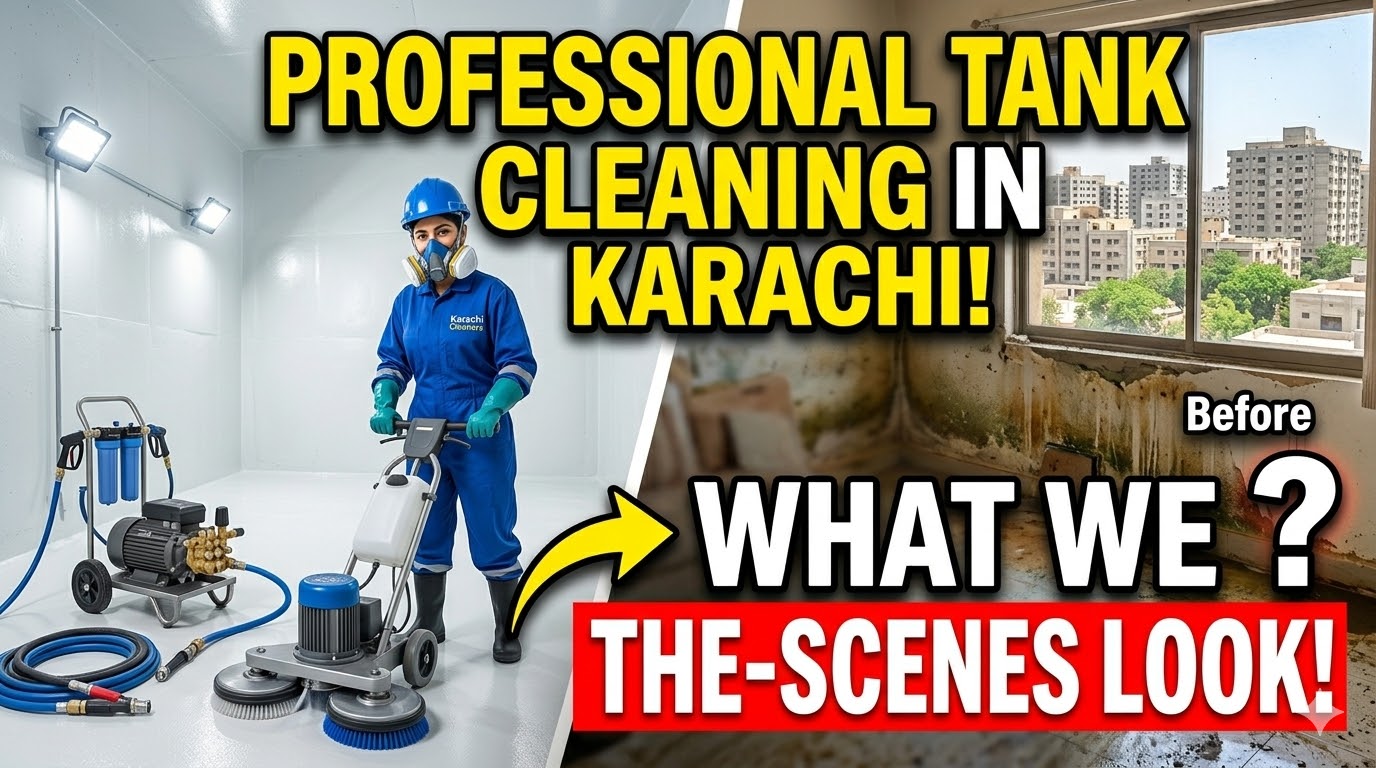
  • What Happens During a Professional Tank Cleaning in Karachi? A Behind-the-Scenes Look

    What Happens During a Professional Tank Cleaning in Karachi? A Behind-the-Scenes Look

    If you live in Karachi, you already know how precious water is. Whether it arrives once or twice a week via the KWSB tanker, or flows through municipal lines, virtually every drop that enters your home passes through a storage tank first — either an overhead rooftop tank or an underground sump. Most Karachi homeowners never think twice about what’s sitting inside that tank. The reality, however, might surprise you.

    Sludge, algae, bacterial biofilm, rust particles, and even insect matter can accumulate inside an uncleaned water tank within as little as a few months. The city’s intermittent water supply and hot climate accelerate this process considerably. The water you use to cook, bathe, brush your teeth, and give your children is filtered through that tank — and no filter in the world can fully compensate for a contaminated storage source.

    So what actually happens when a professional team shows up at your door? What do they do, what equipment do they use, and why does it matter so much for your family’s health? In this article, we take you through the entire process — step by step, behind the scenes — so you know exactly what you’re paying for and why it’s worth every rupee.

    Why Karachi’s Water Tanks Get Dirty Faster Than You Think

    Before we dive into the cleaning process, it’s important to understand why Karachi homes face a higher-than-average risk of water tank contamination. Several local factors combine to create a perfect breeding ground for bacteria and sludge:

    • Irregular supply: When water arrives in bursts, it stirs up sediment that has settled at the bottom of the tank, spreading it throughout the stored water.
    • Hard water: Karachi’s water supply is notoriously high in minerals, leading to rapid scale and sediment buildup on tank walls and floors.
    • Extreme heat: Temperatures regularly exceeding 40°C in summer create ideal conditions for algae growth and bacterial multiplication.
    • Dust and pollution: Tank lids that are not fully sealed — common in older buildings across Gulshan-e-Iqbal, Orangi Town, and Lyari — allow dust, insects, and environmental pollutants to enter.
    • Ageing infrastructure: Many residential buildings in older parts of the city have underground concrete tanks that are decades old and prone to seepage and biofilm buildup in porous walls.

    Given these conditions, experts recommend cleaning your water tank at least every six months in Karachi — and more frequently for families with children, elderly members, or anyone with a compromised immune system.

    Step 1: Pre-Cleaning Inspection — The Foundation of a Good Job

    The first thing a properly trained professional team does is not start spraying water around. They begin with a thorough inspection.

    Our teams at Khan Tank Cleaning arrive with the equipment and training to assess your tank before a single drop is drained. This includes checking the tank type (overhead plastic, underground concrete, fiber, or stainless steel), evaluating the inlet and outlet valves, looking for cracks or leaks, and assessing the level and nature of contamination inside. This step determines the cleaning approach, the chemicals required, and the safety precautions necessary — particularly for underground tanks, which are classified as confined spaces.

    For homeowners in areas like Gulshan-e-Iqbal, Gulistan-e-Johar, and FB Area, the majority of residential setups involve a combination of an underground sump (where the main supply is stored) and an overhead plastic tank. Both require different techniques and both are covered in a single visit when you book our dedicated water tank cleaning service in Gulshan and Jauhar Karachi.

    Step 2: Draining — Getting Rid of Contaminated Water Properly

    Once the inspection is complete, the next step is fully draining the tank. This sounds simple, but it’s a critical stage where amateur services often cut corners.

    The contaminated water at the bottom of your tank — laden with sludge, sediment, bacteria, and debris — must be completely removed. Our teams use high-powered submersible pumps to drain the tank entirely, including the sludge layer that settles at the floor. This thick layer is where the highest concentration of harmful microorganisms lives. Leaving even a thin film of it behind before re-filling is one of the most common mistakes made by untrained workers.

    For underground tanks in Karachi — which can hold anywhere from 1,000 to over 10,000 litres — this process requires the right equipment and, critically, the right safety protocols. Underground confined spaces can develop dangerous oxygen-deficient atmospheres or accumulate toxic gases. Our teams working in areas such as DHA, Clifton, PECHS, and Zamzama are equipped with oxygen safety systems and forced ventilation to ensure worker safety. If you live in those areas, our professional tank cleaning services in DHA and Clifton Karachi are specifically designed to handle the mix of large residential bungalows, apartments, and commercial buildings common to those localities.

    Step 3: Industrial Vacuuming — Removing What Draining Cannot

    After draining, a residue of sludge, sand, algae, and sediment remains stuck to the walls, corners, and floor of the tank. This is where professional services diverge sharply from what a local handyman or maid might attempt with a bucket and mop.

    Khan Tank Cleaning uses industrial-grade vacuum systems specifically designed for water tank interiors. These machines suck out every trace of residual sludge and particulate matter from corners, floor seams, and wall surfaces. Manual scrubbing alone simply cannot access all areas and inevitably leaves behind contaminated residue — which then begins re-contaminating your fresh water from day one.

    This step is one of the most visually striking for homeowners who choose to observe the process. The amount of black or brown sludge extracted from a tank that appears ‘fairly clean’ from the outside is often shocking — and an immediate reminder of what has been passing through household taps.

    Step 4: High-Pressure Jet Washing — Deep-Cleaning the Tank Interior

    With the bulk of sludge vacuumed out, our teams move to high-pressure jet washing — arguably the most important mechanical cleaning stage. Industrial-grade pressure washers blast water at high velocity across all interior surfaces: walls, floor, ceiling (for overhead tanks), and any structural features like columns or reinforcement bars in concrete underground tanks.

    The high-pressure jet physically dislodges biofilm, algae colonies, mineral scale, and embedded contaminants that no amount of manual scrubbing could reach. This is especially important for:

    • Older underground concrete tanks found in properties in North Nazimabad, Nazimabad, Liaquatabad, and similar established neighbourhoods, where porous concrete walls harbour deep-rooted bacterial communities.
    • Plastic overhead tanks (such as Bestank, Aqua Plus, and similar brands) common in apartment buildings across Gulistan-e-Johar, Block 14, and Scheme 33, where algae tends to develop in the roof-heat-exposed walls.
    • Fiber and fibreglass tanks used in newer constructions across DHA Phases and Clifton, which require careful non-abrasive jet washing to avoid surface damage.

    Many small operators in Karachi skip this step entirely or use domestic garden hoses that lack the pressure to actually clean. This is one of the key differences in the service quality that separates a genuinely professional company from a side-hustle operation.

    Step 5: Disinfection — The Stage That Protects Your Family’s Health

    This is the most technically important step in the entire process — and the one that most directly affects your family’s health outcomes.

    After the tank has been physically cleaned, it still contains microorganisms that cannot be removed by vacuuming or jet washing alone. Bacterial biofilm, in particular, forms a protective matrix on surfaces that survives physical cleaning unless specifically targeted with the right chemical agents.

    At Khan Tank Cleaning, our primary disinfectant is Silver Hydrogen Peroxide — a professional-grade, potable-water-safe disinfectant that is highly effective against bacteria, viruses, and biofilm while being completely safe for human consumption. Unlike harsh industrial acids or chlorine bleach used by some operators in Karachi, Silver Hydrogen Peroxide does not damage your tank’s structure, does not leave harmful residues, and does not affect the taste of your water.

    The disinfectant is applied to all internal surfaces and left to act for a specific dwell time — then the tank is rinsed thoroughly before being closed and prepared for refilling. For cases requiring stronger sanitization (such as tanks where waterborne illness has already occurred in the household), a secondary disinfection protocol is also available.

    Whether you are booking our tank cleaning service in the Gulshan and Jauhar belt or our specialist cleaning for homes and businesses in DHA and Clifton, the same rigorous disinfection protocol applies — no shortcuts, no compromises.

    Step 6: Post-Cleaning Inspection and Water-Safety Confirmation

    A professional job does not end when the disinfectant is applied. Before the tank is sealed and refilling begins, our technicians carry out a final inspection of the interior to confirm:

    1. All sludge and sediment has been fully removed
    2. No visible biofilm, algae, or scale remains on walls and floor
    3. The disinfectant has been properly applied and rinsed
    4. Inlet and outlet valves are functioning correctly
    5. Tank lid/cover is properly sealed to prevent re-contamination

    This final check is something the homeowner is always welcome to observe — and we encourage it. Transparency is part of what makes a professional service genuinely professional.

    What Types of Tanks Does Khan Tank Cleaning Service?

    Karachi’s housing stock is remarkably diverse, and so are its water storage systems. Khan Tank Cleaning’s teams are trained and equipped to handle all major types:

    • Underground concrete tanks — Common in older homes, bungalows, and large apartment buildings in areas like PECHS, Saddar, North Nazimabad, and Lyari. Require confined-space safety systems.
    • Overhead plastic tanks (Bestank, Aqua Plus, Master, etc.) — Widely used across mid-rise apartments and houses throughout Gulshan-e-Iqbal, Gulistan-e-Johar, Malir, and Shah Faisal Town.
    • Fiber/fibreglass tanks — Increasingly popular in newer constructions in DHA phases and Bahria Town Karachi. Require non-abrasive cleaning techniques.
    • Stainless steel tanks — Found in commercial properties, high-end residential buildings, and hospitals across Clifton and Zamzama. Require specialised non-abrasive cleaning.
    • Boring/borehole water tanks — Common where families supplement KWSB supply with underground bore water. These tanks often have higher sediment loads and require more intensive cleaning cycles.

    How Often Should You Schedule a Professional Tank Clean in Karachi?

    The general international recommendation is every six months. For Karachi specifically, given the water quality challenges outlined above, we recommend:

    • Every 3 months for households with infants, young children, elderly members, or anyone with weakened immunity
    • Every 4–6 months for the average urban Karachi household
    • Every 6 months minimum for commercial properties, offices, and small businesses
    • Immediately if household members have experienced unexplained gastrointestinal illness, if you notice discoloration or odour in tap water, or if your tank has not been cleaned in over a year

    If your tank has not been professionally cleaned in the last twelve months, it is almost certainly overdue — regardless of how the water looks or smells. Many of the most dangerous waterborne pathogens are colourless and odourless.

    Karachi’s Water Reality: Numbers That Should Concern Every Homeowner

    The urgency is not theoretical. Waterborne diseases — including typhoid, cholera, hepatitis A, and gastroenteritis — remain among the leading causes of hospitalisation in Karachi. The city’s water distribution infrastructure, while gradually improving, still delivers water that carries bacteria and contamination risk. The storage tank in your home is both the last line of defense and, if poorly maintained, the source of illness itself.

    A clean tank does not just protect against disease. It also:

    • Extends the lifespan of your water filters, purifiers, and household appliances by reducing sediment load
    • Reduces bad taste and odour that Karachi homeowners often attribute to the supply rather than the storage
    • Lowers the bacterial load on your water purifier, making it more effective at the point of use
    • Protects structural integrity of older underground tanks where biofilm accelerates concrete corrosion

    Why Choose Khan Tank Cleaning? What Sets Us Apart

    Not all tank cleaning services in Karachi are equal. Many operate as side businesses, sending general workers without specialized training or proper equipment. Here is what differentiates Khan Tank Cleaning:

    • Dedicated, specialized company: We are focused exclusively on water tank cleaning — it is not a side offering. This specialization means our teams have years of hands-on experience that general cleaning or fumigation companies cannot match.
    • Industrial equipment: High-pressure jet washers, industrial vacuum systems, oxygen safety equipment for confined spaces, and full PPE for our workers.
    • Safe, certified disinfectants: Silver Hydrogen Peroxide as the primary disinfectant — potable-water-safe, effective, and non-corrosive. We do not use harsh industrial acids that damage tanks.
    • 24/7 availability: Available for both scheduled and emergency bookings, seven days a week.
    • Two dedicated service branches: Serving all of Karachi with priority response in their respective zones — so you get faster service from a team that knows your neighbourhood.

    Our Gulshan-Jauhar branch prioritizes rapid response for residents and businesses across Gulshan-e-Iqbal, Gulistan-e-Johar, FB Area, North Nazimabad, Scheme 33, and surrounding areas. Our DHA-Clifton branch provides specialized services for the diverse residential and commercial tank types found across DHA Phases 1–8, Clifton, PECHS, Saddar, Zamzama, Bahadurabad, and neighbouring localities.

    Book Your Professional Tank Clean Today — Your Family’s Health Depends on It

    When did you last have your water tank professionally cleaned? If you’re not sure — or if the answer is ‘more than six months ago’ — then the answer is: it’s overdue.

    Every day your tank goes uncleaned is another day of potential contamination flowing through your taps. In a city with Karachi’s water challenges, that is a risk no family should take. The good news is that a professional clean takes just a few hours, causes minimal disruption to your daily routine, and delivers results that last months.

    Khan Tank Cleaning is available 24 hours a day, 7 days a week. Our teams are ready to visit your home or business, assess your tank, and deliver a complete clean using industrial equipment and certified disinfectants.

    📍 Live in Gulshan, Jauhar, FB Area, or surrounding areas? Book with our dedicated Gulshan-Jauhar water tank cleaning team for priority service near you.

    📍 Based in DHA, Clifton, PECHS, Saddar, or nearby? Our DHA and Clifton professional tank cleaning specialists are equipped for every tank type in your area.

    📞 Call Us Now: 0340-2717 530 | 03330293174

    Available 24/7 · Serving All Areas of Karachi · Residential & Commercial

    Clean water starts with a clean tank. Don’t wait for a health crisis to remind you — take action today.

    — Khan Tank Cleaning | Karachi’s Dedicated Water Tank Cleaning Specialists

  • We Cleaned 7,000+ Homes in Karachi — Here’s What We Always Find

    We Cleaned 7,000+ Homes in Karachi — Here’s What We Always Find

    Over the years, our teams at Khan Tank Cleaning have entered thousands of homes across Karachi — from high-rise apartments in Gulshan-e-Iqbal and Gulistan-e-Jauhar to bungalows and commercial plazas in DHA and Clifton. We have cleaned over 7,000 tanks — overhead, underground, plastic, concrete, and fiberglass — and in every single job, there is a pattern to what we find inside.

    What we discover inside those tanks is shocking, even to us. And if you have not had your tank professionally cleaned in the last six months, the chances are very high that what we describe below is sitting in your water supply right now.

    1. A Black or Dark Brown Sludge Layer at the Bottom

    This is the single most common finding in Karachi’s water tanks. No matter the neighbourhood — Gulberg, PECHS, North Nazimabad, or Malir — there is almost always a thick layer of sludge at the bottom of the tank.

    Karachi’s water supply is intermittent. Water arrives once or twice a week through KW&SB tankers or municipal lines, and during the journey, it picks up sediment, rust, and suspended particles. Over weeks and months, all of that settles at the bottom of your tank and hardens into a dark, foul-smelling sludge.

    This sludge is a breeding ground for bacteria. When you draw water from the tank for cooking or drinking, you are mixing that sludge back into your supply. Boiling helps, but it does not remove the heavy metal sediment or neutralise all the biofilm already present.

    Why This Matters for Karachi Homes The KWSB water supply passes through aging infrastructure. By the time water reaches your tank, it has already collected significant particulate matter. Without regular professional cleaning, your tank is essentially a settling basin for Karachi’s water quality problems.

    2. Algae and Green or Black Biofilm on Tank Walls

    If your tank receives any indirect light — even a small crack in the lid or a semi-transparent plastic body — algae will grow. We regularly find tanks coated in green or black biofilm, especially overhead plastic tanks that sit under direct sun on Karachi rooftops for years on end.

    The heat is relentless in Karachi — rooftop temperatures in summer often exceed 50°C. This does not kill algae; it actually accelerates its growth. Certain algae species thrive in warm, still water. The biofilm they form coats the interior walls and is nearly impossible to remove with a bucket and mop, which is how many informal cleaners still approach the job.

    At Khan Tank Cleaning, we use industrial-grade high-pressure jet washing systems specifically because regular manual scrubbing cannot eliminate deep-rooted algae and biofilm. We have seen tanks where the growth was several millimetres thick — invisible when you look in from the top, but present all the same.

    3. Rusty Water and Corroded Inlet Pipes

    For homes with older concrete underground tanks or steel overhead tanks, corrosion is a near-certainty. We regularly find rusted inlet and outlet pipe fittings, crumbling cement interior surfaces, and iron-rich red-brown residue coating the base of the tank.

    This is a particularly common issue we encounter when serving older residential areas — parts of Nazimabad, Liaquatabad, and Saddar, where tanks have been in place for decades without replacement. But it also affects newer builds where cheap iron fittings have been used without corrosion protection.

    Rust contamination in drinking water is associated with gastrointestinal irritation and long-term health effects from heavy metal ingestion. If your water ever has a slight metallic taste or a reddish tinge, this is almost certainly the cause.

    4. Insect and Rodent Entry Points

    You would be surprised — or perhaps horrified — at how many tanks we open to find evidence of insects, lizards, or even small rodents that have entered through improperly sealed lids or cracked covers.

    Karachi’s heat and water scarcity mean insects actively seek water sources. Cockroaches, mosquito larvae, and small invertebrates are common findings, particularly in tanks with damaged or missing lids. This is not a hygiene issue that filters or purifiers can fully compensate for — the contamination happens at the source, inside the tank itself.

    This is a finding we frequently encounter in apartment buildings across Gulshan-e-Iqbal, Gulistan-e-Jauhar, and surrounding localities where multi-storey buildings share overhead tanks with rooftop access points that are rarely inspected.

    5. Incomplete or No Disinfection After Previous Cleaning

    When customers tell us their tank was “cleaned recently,” we often find that it was merely rinsed and scrubbed — with no chemical disinfection applied afterwards. This is one of the most dangerous situations we encounter.

    Scrubbing without disinfection stirs up bacteria and biofilm without killing them. In some cases, the tank is actually in a worse state than if nothing had been done, because the disturbance causes bacterial cells to disperse into the water column.

    At Khan Tank Cleaning, we use Silver Hydrogen Peroxide as our primary disinfectant — a hospital-grade solution specifically approved for potable water systems. It is highly effective against bacteria, viruses, and biofilm while being completely safe for human consumption. This is especially important in Karachi, where water carries heavy microbial loads due to the state of the distribution infrastructure.

    Our Standard Disinfection Protocol Every tank we clean undergoes: (1) Full draining and sludge removal using industrial vacuum systems, (2) High-pressure jet washing of all surfaces, (3) Manual scrubbing of corners and joints, (4) Silver Hydrogen Peroxide disinfection, and (5) A final inspection before the tank is refilled. Shortcuts are never taken.

    6. Tanks That Have Not Been Cleaned in Years — Or Ever

    We have walked into homes in every corner of Karachi where the family has lived for 5, 10, even 15 years and has never once had their tank professionally cleaned. In some cases, the tank has not been cleaned since the building was constructed.

    This is not negligence — it is a lack of awareness. Many Karachi homeowners simply do not know that tank cleaning is necessary, or they assume that because they use a water filter, the tank does not matter. Water filtration systems treat the water at the point of use, but they do not clean the contamination source. A dirty tank will continuously re-contaminate even filtered water if the supply line passes through it.

    The World Health Organisation recommends that household water storage tanks be cleaned and disinfected at least once every six months. For Karachi, where water quality from supply lines is especially variable, we recommend cleaning every three to four months for families with children, elderly members, or anyone with compromised immunity.

    Why Karachi Is a Unique Case

    Most guides to water tank hygiene are written for cities with reliable, clean municipal water supplies. Karachi is different. Our city faces a combination of factors that make tank contamination faster and more severe than average:

    • Intermittent water supply — tanks sit stagnant for days, allowing bacteria to multiply
    • Extreme heat — Karachi summers accelerate algae growth and chemical changes in stored water
    • Aging infrastructure — pipes and distribution lines introduce additional contamination before water reaches your tank
    • High-density urban living — apartments with shared tanks mean one contaminated tank affects many families
    • Frequent use of tanker water — private tankers are often unregulated and can carry significantly higher bacterial loads than municipal supply

    These factors make professional, regular tank cleaning not a luxury service — it is a genuine public health necessity for Karachi households.

    We Serve All of Karachi — With Two Dedicated Branches

    Khan Tank Cleaning operates two fully equipped service branches to ensure fast, responsive service across the city:

    Branch 1 — Gulshan, Jauhar & East Karachi

    Our water tank cleaning service for Gulshan-e-Iqbal, Gulistan-e-Jauhar, and surrounding areas covers Gulshan-e-Iqbal, Gulistan-e-Jauhar, FB Area, North Nazimabad, Nazimabad, Liaquatabad, Korangi, Malir, Shah Faisal Town, Landhi, Gulshan-e-Maymar, and all neighbouring localities. If you live in East or Central Karachi, this is your closest point of contact.

    Branch 2 — DHA, Clifton & South Karachi

    Our professional tank cleaning team for DHA and Clifton serves Defence Housing Authority (DHA), Clifton, PECHS, Saddar, Bahadurabad, Zamzama, Tariq Road, Karachi Cantonment, Bahria Town Karachi, and all areas in South and South-West Karachi. We are available 24/7 for both scheduled appointments and emergency call-outs.

    Both branches are equipped with industrial-grade high-pressure jet systems, vacuum sludge extractors, Silver Hydrogen Peroxide disinfectant, and full confined-space safety equipment for underground tanks.

    We Clean Every Type of Water Tank

    Whether your building has a rooftop plastic tank, an underground concrete chamber, a fiberglass Syntex tank, or a stainless-steel commercial unit, our teams have the training and equipment for it:

    • Overhead plastic tanks (Bestank, Aqua Plus, and all imported brands)
    • Underground concrete tanks (with full confined-space oxygen safety systems)
    • Fiberglass tanks (Syntex, Bestank Fiber, and all fiberglass varieties)
    • Stainless steel commercial tanks
    • Large industrial and housing society bulk storage tanks

    From a single 500-litre residential tank to a 100,000-litre industrial storage system, we scale our team and equipment to the job.

    Do Not Wait Until Someone Falls Ill. Book Your Tank Cleaning Today.

    After cleaning over 7,000 tanks across Karachi, we can tell you this with complete confidence: the vast majority of water tanks in this city are overdue for a professional clean. The problems — sludge, biofilm, insects, corrosion, incomplete disinfection — are not visible from the outside. They build up silently. And the consequences show up not in the tank, but in the health of your family.

    Waterborne illnesses — diarrhoea, typhoid, cholera, skin infections, gastrointestinal disease — are among the most common health complaints in Karachi. Many of these cases trace back to contaminated household water storage. You cannot control the quality of water arriving through the pipeline, but you can control what happens inside your tank.

    If you live in Gulshan, Jauhar, FB Area, North Nazimabad, Korangi, or anywhere in East Karachi, book your professional water tank cleaning service here. If you are in DHA, Clifton, PECHS, Saddar, or anywhere in South Karachi, our DHA & Clifton branch is ready to serve you.

    We are available 24 hours a day, 7 days a week. Our teams are on the ground across Karachi. Call us now at 0340-2717 530 or 0333-0293174 — and let us show you what we find in your tank, and what a truly clean tank looks and smells like.

    Khan Tank Cleaning — Karachi’s Most Experienced Professional Tank Cleaning Service Serving 7,000+ homes & businesses across Karachi  |  Available 24/7  |  Industrial equipment  |  Safe disinfection chemicals  |  All tank types  |  Both overhead & underground  |  Residential, commercial & industrial
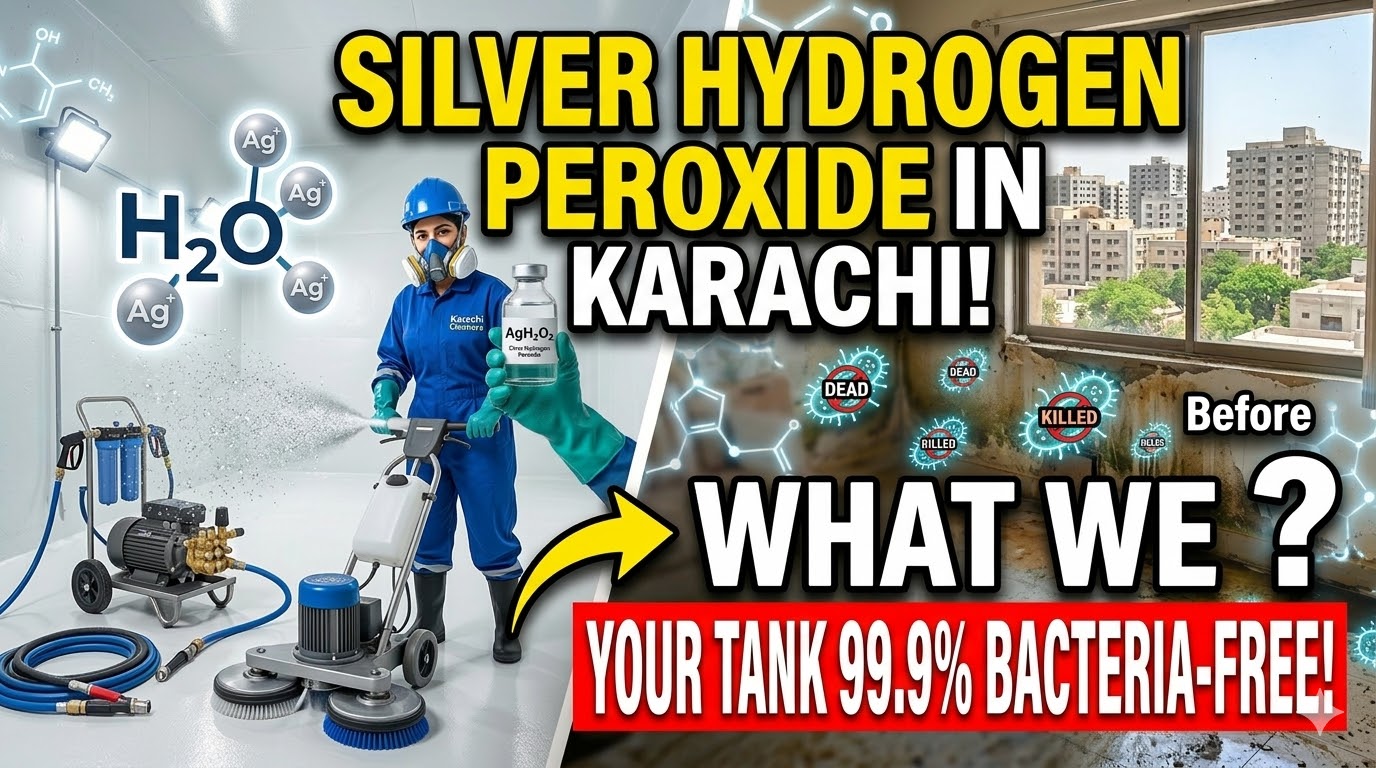
  • Silver Hydrogen Peroxide: The Chemical That Makes Your Tank 99.9% Bacteria-Free

    Silver Hydrogen Peroxide: The Chemical That Makes Your Tank 99.9% Bacteria-Free

    If you live in Karachi, you already know that water supply is never guaranteed. Whether you are in Gulshan-e-Iqbal, Gulistan-e-Jauhar, DHA, Clifton, or anywhere across the city, your household depends on a stored water tank — sometimes for days at a stretch. But here is the uncomfortable truth that most homeowners never consider: your water tank could be the single biggest health hazard in your home.

    Bacteria, algae, sludge, and biofilm do not need much of an invitation. A dark, damp tank that goes uncleaned for months is the perfect breeding ground. And once they are in your water supply, they go directly into your drinking water, cooking water, and bathing water.

    So what is the solution? Professionals worldwide — and right here in Karachi — are turning to one powerful chemical: Silver Hydrogen Peroxide (AgH₂O₂). In this article, we break down exactly what this compound is, how it works, why Karachi households specifically need it, and what to look for when booking a professional tank cleaning service.

    What Is Silver Hydrogen Peroxide?

    Silver Hydrogen Peroxide is a stabilised disinfectant that combines two powerful antimicrobial agents: hydrogen peroxide (H₂O₂) and colloidal silver (Ag). On its own, hydrogen peroxide is a strong oxidising agent capable of destroying bacterial cell walls. Colloidal silver, on the other hand, is a well-documented antimicrobial that interferes with bacterial enzymes and DNA replication.

    When these two are combined into a single compound, the result is a synergistic disinfectant far more potent than either element alone. The silver acts as a stabiliser that extends the active life of the hydrogen peroxide, while simultaneously adding its own continuous antimicrobial action.

    Key Properties at a Glance:

    • Broad-spectrum efficacy: Destroys bacteria, viruses, fungi, and biofilm.
    • Safe for potable water: Approved for use in drinking water systems at correct concentrations.
    • No harmful residue: Breaks down into water and oxygen — zero toxic byproducts.
    • Biofilm penetration: Penetrates deep into microbial communities that chlorine often misses.
    • Long-lasting action: Silver ions continue working even after the initial application.

    Why Karachi Homes Face a Higher Bacterial Risk Than Most Cities

    Karachi’s water supply situation is unique — and uniquely challenging. The city receives water through the Karachi Water and Sewerage Board (KWSB), with supply often available only once or twice a week in many neighbourhoods. This means every household must store large quantities of water in overhead or underground tanks, sometimes for five to seven days at a time.

    This extended storage creates the ideal conditions for microbial growth. Consider what researchers and health officials consistently highlight about Karachi’s water chain:

    • Intermittent supply lines create negative pressure in pipes, which can suck in contaminants from surrounding soil.
    • Aging infrastructure in older neighbourhoods means that cross-contamination between water and sewage lines is not uncommon.
    • High ambient temperatures in Karachi — particularly between April and October — accelerate bacterial multiplication in stagnant stored water.
    • Frequent power cuts mean water often sits in tanks without circulation for extended periods.
    • Saltwater intrusion in coastal areas like Clifton, DHA, and Keamari can introduce additional mineral deposits and microbial load into underground tanks.

    Areas like Gulshan-e-Iqbal, Gulistan-e-Jauhar, Federal B Area, and North Nazimabad — which have high population density and older pipe networks — face particularly acute risks. Meanwhile, upscale areas like DHA and Clifton are not immune either: larger tanks, rooftop installations, and long storage durations mean bacteria have plenty of time and space to colonise.

    This is precisely why families in East Karachi rely on our dedicated water tank cleaning service in Gulshan and Jauhar, while residents of Defence and Clifton trust our specialised water tank cleaning service in DHA and Clifton — both branches operating with the same professional standard, same equipment, and same Silver Hydrogen Peroxide disinfection protocol.

    How Silver Hydrogen Peroxide Eliminates Bacteria: The Science

    Understanding the mechanism helps you appreciate why not every cleaning job is equal. When Silver Hydrogen Peroxide is applied inside a cleaned tank, it works through multiple simultaneous pathways:

    1. Oxidative Cell Destruction

    The hydrogen peroxide component releases reactive oxygen species (free radicals) on contact with biological matter. These free radicals aggressively attack the lipid membranes and proteins that form bacterial cell walls. The structural integrity of the bacteria collapses within seconds of exposure, causing immediate cell death.

    2. Silver Ion Disruption

    Silver ions (Ag⁺) are released into the water and attach themselves to bacterial enzymes. This disrupts the metabolic processes the bacteria rely on to survive and reproduce. Critically, silver ions remain active in the water even after the hydrogen peroxide has dissipated — providing a continuing antimicrobial shield.

    3. Biofilm Destruction

    Biofilm is arguably the most dangerous element in a neglected water tank. It is a structured community of bacteria encased in a self-produced polymer matrix — essentially a bacterial fortress. Regular cleaning agents and even chlorine frequently fail to penetrate this matrix. Silver Hydrogen Peroxide is one of the few disinfectants documented to effectively break down biofilm structures, exposing the bacteria within to direct oxidative attack.

    4. Virus and Fungal Elimination

    While bacteria get most of the attention, tanks in Karachi can also harbour waterborne viruses and fungi. Silver Hydrogen Peroxide has demonstrated efficacy against a broad range of pathogens including E. coli, Salmonella, Staphylococcus, Pseudomonas, Legionella, Aspergillus, and various enteric viruses — all of which have been linked to waterborne disease outbreaks in urban Pakistan.

    The 99.9% Result

    When applied correctly — at the right concentration, after proper physical cleaning of the tank interior — Silver Hydrogen Peroxide achieves microbial reduction rates of 99.9% or greater. This is the standard that professionally trained technicians aim for. It is worth noting that the chemical alone is not enough: the physical removal of sludge, algae, and sediment must come first. A disinfectant applied to a dirty surface cannot work effectively — which is exactly why Khan Tank Cleaning combines high-pressure jet washing and industrial vacuuming before any chemical treatment.

    Silver Hydrogen Peroxide vs. Chlorine: Why the Comparison Matters

    Many tank cleaning services in Karachi still use chlorine-based disinfectants as their primary sanitisation method. While chlorine has a long history in water treatment, it has significant limitations when used in household tank cleaning:

    • Chlorine struggles with biofilm: It does not penetrate the protective polymer layer that biofilm bacteria produce.
    • Chlorine degrades rapidly: Its disinfecting action stops quickly, leaving no residual protection.
    • Chlorine byproducts: When chlorine reacts with organic matter in tanks, it can produce trihalomethanes (THMs) — compounds classified as potentially carcinogenic at prolonged exposure.
    • Odour and taste: High chlorine doses can leave unpleasant smells and flavours in stored water.

    Silver Hydrogen Peroxide avoids all of these issues. It leaves no carcinogenic byproducts, has no lasting taste or odour impact when properly diluted, and its residual silver action provides ongoing protection between cleanings.

    For Karachi families storing water for extended periods between supply cycles, this residual action is especially valuable. It means that water stored in a properly disinfected tank remains safer for longer.

    Is Silver Hydrogen Peroxide Safe for My Family?

    This is the most common question we hear from homeowners — and it is completely understandable. You want a chemical that is tough on bacteria but harmless to your family.

    The answer is yes — at professionally applied concentrations, Silver Hydrogen Peroxide is safe for potable water systems. Here is why:

    • WHO-approved chemistry: Both hydrogen peroxide and silver ions are recognised in international guidelines for water treatment when used within approved concentration limits.
    • Clean breakdown: Hydrogen peroxide breaks down entirely into water (H₂O) and oxygen (O₂). There are no toxic residues.
    • Silver at safe trace levels: The silver ions present after proper disinfection are at levels far below any health concern thresholds — comparable to natural trace silver levels found in some drinking water sources.
    • No re-contamination risk: Unlike some industrial acids used by untrained cleaners, Silver Hydrogen Peroxide does not damage tank materials or introduce new contaminants into your water supply.

    What matters critically is correct application by trained professionals. This is not a product to be purchased and self-applied by homeowners. The concentration, contact time, and post-treatment rinse protocols must be followed precisely to ensure safety and effectiveness. At Khan Tank Cleaning, every technician is trained in Silver Hydrogen Peroxide application protocols for both overhead and underground tank systems.

    The Complete Tank Cleaning Process: What Should Actually Happen

    Silver Hydrogen Peroxide is the final and most critical step — but a professional tank clean is a multi-stage process. If any cleaning service skips the earlier steps and just sprays a disinfectant, your tank is not properly cleaned. Here is the full process that Khan Tank Cleaning follows:

    1. Complete Drainage: All stored water is fully drained from the tank.
    2. High-Pressure Jet Washing: Industrial-grade jet systems blast loose deposits, algae, rust stains, and accumulated sludge from all surfaces. This step is critical — many small local services in Karachi skip this and rely only on manual scrubbing, which misses corners, joints, and wall surfaces.
    3. Industrial Vacuum Extraction: Loosened debris and sludge is removed entirely from the tank using industrial vacuum systems. Traditional methods leave sludge residue on the floor of the tank, which immediately begins re-contaminating the water when refilling starts.
    4. Surface Inspection: Technicians inspect for cracks, algae re-growth points, rust, and any structural issues that could affect water quality.
    5. Silver Hydrogen Peroxide Application: The disinfectant is applied at the correct concentration across all interior tank surfaces. Contact time is observed strictly to ensure maximum microbial kill.
    6. Final Rinse and Inspection: The tank is rinsed, inspected, and cleared for refilling.

    For underground tanks in areas like Gulshan, Jauhar, FB Area, and North Nazimabad, additional safety protocols apply — including confined space entry procedures, oxygen monitoring equipment, and forced ventilation systems. Our dedicated Gulshan-Jauhar water tank cleaning team is fully equipped for underground tank work in East Karachi’s densely built neighbourhoods.

    How Often Should Karachi Households Clean Their Tanks?

    The general recommendation from water safety professionals is a minimum of every six months. However, for Karachi specifically, we recommend every three to four months for households that experience the following conditions:

    • Water supply arrives heavily turbid or discoloured
    • Tank is located outdoors and exposed to direct sunlight (accelerates algae growth)
    • Water is stored for more than four days at a stretch between supply cycles
    • Family members have experienced repeated stomach ailments, diarrhoea, or skin rashes with no other identified cause
    • Tank has not been cleaned in over six months
    • Property is near construction, industrial activity, or areas with known groundwater contamination

    For commercial properties — offices, apartment buildings, schools, hostels, factories — more frequent cleaning is often necessary given the higher volume of users and the greater daily throughput of water. Our professional tank cleaning service covering DHA, Clifton, and surrounding areas handles commercial accounts across the southern and coastal zones of Karachi, with flexible scheduling to minimise disruption to your operations.

    Red Flags: Signs Your Tank Urgently Needs Professional Cleaning

    Do not wait for a scheduled cleaning if your household is experiencing any of the following warning signs:

    • Unusual smell or taste: Musty, earthy, or sulphuric odours are classic signs of bacterial activity or algae growth.
    • Visible discolouration: Green, brown, or black deposits on tank walls or lid edges indicate algae or mould.
    • Slippery or slimy tank walls: This is almost certainly biofilm — a structured bacterial colony that requires professional chemical treatment to eliminate.
    • Repeated waterborne illness: If multiple family members experience stomach problems after drinking tap water, the tank is a primary suspect.
    • Insects or sediment in tap water: Visible foreign matter in water coming from household taps is an urgent sign of tank contamination.
    • More than six months since last professional cleaning: Even if there are no visible signs, bacterial colonies can exist in concentrations that pose health risks before they are detectable by smell or sight.

    If you are based in the eastern districts — Gulshan-e-Iqbal, Gulistan-e-Jauhar, Korangi, Landhi, Malir, Shah Faisal Town, or Federal B Area — reach out to our Gulshan and Jauhar branch for urgent tank cleaning service. For residents and businesses in DHA Phase 1-8, Clifton, PECHS, Zamzama, Saddar, Keamari, or Bahria Town Karachi, our DHA and Clifton branch is available 24/7 including emergency same-day service.

    What to Look for When Hiring a Tank Cleaning Service in Karachi

    Unfortunately, the tank cleaning market in Karachi has a significant number of informal operators who offer cheap prices but deliver poor results. Here is what distinguishes a professional service from a casual one:

    • Industrial equipment: High-pressure jet washers and industrial vacuums — not buckets and brushes.
    • Verified disinfectants: Specifically Silver Hydrogen Peroxide or verifiable potable-water-grade disinfectants — not unbranded ‘chemicals’ of unknown origin.
    • Trained technicians: Staff who understand confined space safety for underground tanks, and who can explain the products they are using.
    • No harsh industrial acids: Some operators use industrial-grade acids that damage tank structure, corrode fittings, and leave chemical residues. This is an immediate disqualifier.
    • Transparent pricing: A trustworthy company will give you a clear quote based on tank size and type — not a vague ‘cheap’ price that inflates on arrival.
    • Availability: A dedicated tank cleaning company with 24/7 availability and clear contact points — not a side-job operation with unreliable response times.

    Book Your Professional Tank Cleaning Today — Don’t Wait Until Someone Falls Ill

    Karachi’s water challenges are real and they are not going away. But while you cannot control what happens to the water in the municipal supply lines, you absolutely can control what lives in your water tank. Silver Hydrogen Peroxide, applied by trained professionals using the right equipment and the right technique, is the single most effective tool available to Karachi homeowners for protecting their family’s water supply.

    Khan Tank Cleaning is Karachi’s dedicated, professional water tank cleaning company — not a side business, not an informal operator. We are specialists, with trained staff, industrial equipment, and verified Silver Hydrogen Peroxide disinfection as our standard protocol for every single job.

    Residents of Gulshan-e-Iqbal, Gulistan-e-Jauhar, FB Area, North Nazimabad, Korangi, Landhi, Malir, and surrounding East and Central Karachi:

    Book through our water tank cleaning service in Gulshan and Jauhar — your dedicated local team is ready.

    Residents of DHA (Phase 1–8), Clifton, PECHS, Zamzama, Saddar, Keamari, Bahria Town Karachi, and surrounding areas:

    Book through our water tank cleaning service in DHA and Clifton — available 24/7 for both scheduled and emergency service.

    📞 Call Now: 0340-2717 530 | 03330293174

    Available 24 Hours, 7 Days a Week

    Serving all of Karachi — Residential, Commercial & Industrial

    Your family deserves water they can trust. Let Khan Tank Cleaning — and the power of Silver Hydrogen Peroxide — make that a reality.

  • Why Amateur ‘Tank Wallahs’ in Karachi Are Making Your Water Worse

    Why Amateur ‘Tank Wallahs’ in Karachi Are Making Your Water Worse

    Every week, thousands of Karachi families unknowingly drink, cook with, and bathe in water contaminated not by the municipal supply alone — but by the very people they paid to clean their tanks. The amateur ‘tank wallah’ — the informal labourer who shows up with a bucket, a rag, and little else — has become one of the biggest hidden health threats in Pakistani urban homes.

    Karachi’s water infrastructure presents unique challenges. Water is typically stored in rooftop plastic tanks or underground concrete chambers for days at a time before use. In a city where summer temperatures soar past 40°C, standing water becomes a breeding ground for bacteria, algae, and sediment at an alarming rate. Cleaning this storage is not optional — it is essential. But how it is cleaned matters enormously.

    This article explains exactly why amateur tank cleaning in Karachi is not just ineffective — it is actively dangerous — and what a genuine professional service looks like.

    1. The Amateur ‘Tank Wallah’: Who Are They?

    You’ve seen them. They circulate in neighbourhoods like Gulshan-e-Iqbal, Gulistan-e-Johar, North Nazimabad, DHA, and Clifton, often advertising verbally or via a handwritten flyer. They offer cheap rates, same-day availability, and a confident smile. In most cases, their ‘equipment’ consists of:

    • A bucket and rope
    • A worn scrubbing brush or old cloth
    • No protective gear
    • No professional disinfectant
    • No training in confined space safety

    They are not licensed, not trained, and not equipped to handle the biological and chemical realities of a contaminated water tank. Yet their low prices make them attractive, particularly to budget-conscious homeowners who assume that ‘any cleaning is better than none.’ This assumption, as we will show, is dangerously wrong.

    2. Six Ways Amateur Cleaners Are Making Your Water Worse

    2.1 They Cannot Remove Biofilm — They Spread It

    Biofilm is an invisible slime layer produced by colonies of bacteria that attach to tank surfaces. In Karachi’s warm climate, biofilm establishes itself quickly on plastic and concrete surfaces alike. Manual scrubbing with a brush does not remove biofilm — it breaks it up and spreads it across the tank walls. Within 48 hours, the bacterial colonies reassemble and multiply. Only industrial-grade high-pressure jet washing can physically blast biofilm off tank surfaces.

    2.2 Sludge Is Moved, Not Removed

    Sludge — the dark, heavy sediment that settles at the bottom of your tank — contains heavy metals, dead organic matter, and concentrated bacterial colonies. An amateur will scoop out visible debris, but the remaining sludge suspension is stirred through the water. Professional services use industrial vacuum extraction to physically remove all sediment. Without this step, you are bathing in what was left behind.

    2.3 Wrong Chemicals or No Chemicals at All

    Many amateur cleaners use household chlorine bleach at incorrect concentrations — either too weak to disinfect or so strong that it contaminates your drinking water with harmful chlorine residue. Reputable professional services use food-grade disinfectants such as Silver Hydrogen Peroxide, which is specifically designed for potable water systems, is effective against bacteria, viruses, and biofilm, and is safe for human consumption at proper concentrations. The amateur simply doesn’t know the difference.

    2.4 Underground Tanks Are a Serious Safety Risk

    Karachi has tens of thousands of underground storage tanks, common in older residential areas like Nazimabad, PECHS, Saddar, and Liaquatabad. These confined spaces accumulate hydrogen sulphide and carbon dioxide, creating an immediate asphyxiation risk. Amateur cleaners enter without oxygen monitoring equipment, gas detectors, or rescue harnesses. In recent years, multiple incidents of workers collapsing inside confined water tanks have been reported across Pakistan. A professional service deploys oxygen safety systems, forced ventilation, and full body protective equipment before any person enters the space.

    2.5 No Before-and-After Verification

    An amateur cleaner has no way to verify whether their cleaning was effective. There is no water quality check, no inspection of tank integrity, no documentation. You are trusting your family’s health entirely to a visual inspection performed by an unqualified individual. Professional services conduct systematic inspections and can identify cracks, leakages, and structural issues that could allow ground contamination to enter your tank — a particularly critical issue for underground tanks in older Karachi neighbourhoods.

    2.6 They Make Your Water Purifier Work Harder — and Fail Faster

    If you have a Reverse Osmosis (RO) or gravity filter installed, you may believe your water is protected regardless of tank cleanliness. This is a costly misunderstanding. A heavily contaminated tank sends turbid, bacteria-laden water to your filter, clogging membranes, exhausting filter media prematurely, and in severe cases, overwhelming the filter entirely. Regular professional tank cleaning actively extends the life of your water purification system.

    3. Karachi’s Water Challenge: Why the Stakes Are Higher Here

    Karachi faces water quality challenges that make professional tank maintenance more critical than in many other cities:

    • Municipal water supply arrives once or twice per week in most areas, meaning stored water sits in tanks for 5–7 days before use
    • Average summer temperatures exceed 40°C, dramatically accelerating bacterial growth in stored water
    • Water supply lines pass through aging infrastructure prone to cross-contamination and sediment ingress
    • Many areas rely on tanker water of uncertain quality, introducing additional microbial loads into tanks
    • A significant portion of Karachi’s housing stock uses concrete underground tanks that are particularly prone to algae colonisation and structural seepage

    The most common waterborne illnesses reported in Karachi — including gastroenteritis, typhoid, hepatitis A, and skin infections — are directly linked to contaminated stored water. According to public health research, contaminated household water storage is among the leading contributing factors to preventable disease burden in urban Pakistan. Your tank is not a passive container; it is an active part of your family’s daily health.

    4. What a Genuine Professional Water Tank Cleaning Looks Like

    When you book a professional service, there are clear non-negotiable standards that should be met. At Khan Tank Cleaning, every job follows a structured, multi-step process:

    • Full drainage of the tank using appropriate pumping equipment
    • Industrial high-pressure jet washing to remove biofilm and hardened deposits from all surfaces
    • Industrial vacuum extraction of all sludge and debris — nothing is left behind
    • Application of food-grade Silver Hydrogen Peroxide disinfectant as the primary agent, safe for potable water
    • Structural inspection of tank walls, base, lid seal, and inlet/outlet connections
    • For underground tanks: deployment of oxygen safety systems, gas monitoring, and fall protection before entry
    • Post-service refill and final inspection before sign-off

    If you are located in the Gulshan-e-Iqbal or Gulistan-e-Johar belt, our dedicated water tank cleaning service in Gulshan and Johar team covers your entire area with priority response times and deep familiarity with the local housing stock, from multi-storey apartment buildings in Johar to older bungalows in Gulshan Block 7 and beyond.

    For residents and businesses in DHA, Clifton, and surrounding premium localities, our specialist water tank cleaning service in DHA and Clifton operates with the same rigorous standards — handling everything from single-unit rooftop tanks in Phase 4 and 6 bungalows to large-capacity tanks serving DHA commercial plazas, housing society water supply systems, and farmhouses along the Karachi outskirts.

    5. The Real Cost Comparison: Cheap vs. Professional

    Amateur Cleaner (per visit):  Rs. 500 – 1,500
    Professional Tank Cleaning (per visit):  Contact for quote based on tank size
    Cost of treating one child for typhoid fever (hospitalization):  Rs. 20,000 – 80,000+
    Cost of replacing a failed RO filter prematurely:  Rs. 5,000 – 15,000
    Cost of one hospitalisation due to waterborne illness:  Rs. 25,000 – 100,000+

    The maths are not complicated. The question is not whether you can afford a professional service — it is whether you can afford the consequences of skipping one.

    6. How Often Should Your Tank Be Cleaned Professionally?

    The general guidance from water quality experts is:

    • Overhead (rooftop) tanks: Every 3–6 months, more frequently during summer or if the water supply source changes
    • Underground tanks: Every 6 months minimum, with structural inspection annually
    • Commercial, office, or housing society tanks: Every 3 months, given higher daily throughput and usage patterns
    • After any incident of water discolouration, unusual odour, or reported illness in the household: Immediately

    Khan Tank Cleaning covers all residential and commercial properties across Karachi. Whether you are in a single-family home in Defence, a multi-storey apartment in Gulistan-e-Johar, a shop in Saddar, or a factory in Korangi, the same professional standards apply.

    7. Questions to Ask Before Hiring Any Tank Cleaning Service

    Do not hire anyone — including a professional company — without asking these questions:

    • Do you use industrial high-pressure equipment or manual scrubbing?
    • What specific disinfectant do you use, and is it safe for potable water?
    • Do you use vacuum extraction to remove sludge?
    • For underground tanks, do you carry oxygen safety and gas monitoring equipment?
    • Do you conduct a post-cleaning inspection?
    • Are your staff trained and do they use proper protective equipment?

    Any hesitation or vague answer to these questions is a red flag. Your family’s water deserves the same scrutiny you would apply to any other health service.

    💧  Protect Your Family’s Water Today
    Book a Professional Tank Cleaning Service with Khan Tank Cleaning
    Khan Tank Cleaning is Karachi’s dedicated professional water tank cleaning company — the only firm in the city exclusively focused on this service. Our trained, equipment-equipped teams operate across all Karachi areas.
     
    ✅  Gulshan-e-Iqbal & Gulistan-e-Johar area?
    Book our Gulshan-Johar branch → khantankcleaning.com/water-tank-cleaning-gulshan-jauhar-karachi
    ✅  DHA, Clifton & nearby areas?
    Book our DHA-Clifton branch → khantankcleaning.com/water-tank-cleaning-dha-clifton-karachi
     
    ✅  Rest of Karachi?
    Call us on: 0340-2717530  |  Available 24/7
     
    Don’t wait for illness to remind you. Schedule your tank cleaning today.

    Khan Tank Cleaning  —  Karachi’s First & Only Dedicated Professional Tank Cleaning Company

    khantankcleaning.com

  • What to Ask Before Hiring a Tank Cleaning Company in Karachi (Red Flags Included)

    What to Ask Before Hiring a Tank Cleaning Company in Karachi (Red Flags Included)

    In a city like Karachi — where KWSB water supply arrives once or twice a week, where underground tanks sit in the heat for days, and where boring water carries sediment and bacteria — the cleanliness of your water tank is not a luxury. It is a matter of public health.

    Yet every year, thousands of Karachi households suffer from waterborne illnesses — typhoid, diarrhea, gastroenteritis — that trace directly back to uncleaned or poorly cleaned water tanks. The tragedy is that most of these cases are entirely preventable.

    Unfortunately, not all tank cleaning companies in Karachi are equal. Many are side businesses run by untrained workers with a bucket and a brush. Some use industrial chemicals that damage your tank lining and leave residue in your drinking water. Others quote a suspiciously low price — and deliver suspiciously low quality.

    So before you hand over access to your water tank to any service provider, ask the right questions. This guide will walk you through exactly what to ask — and the red flags to watch out for.

    1. Are They a Dedicated Tank Cleaning Company — Or Is It a Side Job?

    The first and most important question you should ask is: Is water tank cleaning your primary business?

    Many workers in Karachi offer tank cleaning as an add-on to pest control, plumbing, or general cleaning. While they may seem convenient, their lack of specialisation shows in the results.

    A dedicated, professional tank cleaning company will have trained staff, specialised equipment, and a defined cleaning process. They will be able to tell you exactly how they clean, what chemicals they use, and how long the job will take.

    🚩 Red Flag: “We do it on the side”

    If the company primarily offers fumigation, painting, or general labour and also offers tank cleaning, walk away. Their staff likely has no formal training in water tank hygiene or confined space safety.

    Khan Tank Cleaning, for instance, describes itself as a dedicated water tank cleaning company in Karachi — not a general cleaning service. Their teams cover all of Karachi, with a branch focused on water tank cleaning in Gulshan and Jauhar and another serving water tank cleaning in DHA and Clifton.

    2. What Equipment Do They Use? (Bucket vs. Industrial-Grade)

    This is where you can quickly separate professional services from amateur ones. Ask them directly:

    In Karachi’s climate — with high temperatures and infrequent water supply — tanks accumulate algae, biofilm, sludge, and dangerous bacteria at an accelerated rate. Scrubbing with a brush simply cannot reach biofilm colonies embedded in corners or crevices.

    🚩 Red Flag: “We use brushes and detergent”

    Manual scrubbing with basic chemicals does not eliminate bacteria at a microbial level. It removes visible dirt but leaves behind the invisible contamination that causes illness. This is particularly dangerous for families using unfiltered tank water for bathing, brushing teeth, or cooking.

    Professional companies use industrial-grade high-pressure jet washers and vacuum extraction systems. For disinfection, look for the use of Silver Hydrogen Peroxide or other WHO-approved potable water disinfectants — not harsh industrial acids, which can corrode your tank and leave toxic residues.

    3. Do They Have Experience With Your Specific Tank Type?

    Karachi homes have a wide variety of water tanks — and each requires a different cleaning approach:

    • Overhead plastic tanks (Sintex, Aqua Plus, Bestank, Fiber)
    • Underground concrete tanks (common in older Gulshan, North Nazimabad, Saddar homes)
    • Rooftop concrete tanks in older housing societies
    • Boring water tanks and large commercial storage systems

    Underground tanks present unique dangers: confined space entry, risk of suffocation from accumulated gases, and the need for oxygen safety systems. Ask the company whether they have certified confined space entry equipment before permitting anyone to enter your underground tank.

    🚩 Red Flag: No Confined Space Safety Protocol

    If a team arrives to clean your underground tank without oxygen safety systems, rescue equipment, and proper ventilation, this is a serious safety hazard — not just for the workers but a liability for you as the property owner. Refuse the service.

    4. What Disinfectants Do They Use — And Can They Prove It?

    This is a question many homeowners skip — and one of the costliest omissions.

    Ask the company: “Can you show me the disinfectant you will use, and confirm it is safe for drinking water tanks?”

    There are two major concerns in Karachi specifically:

    • Industrial acids — Some cheap services use strong hydrochloric or muriatic acid. While these kill bacteria, they also corrode plastic and cement tanks, shorten tank lifespan, and can leave residues that are harmful if consumed.
    • Unverified chlorine concentrations — Over-chlorination can cause its own health risks and leave your water tasting and smelling terrible for days.

    🚩 Red Flag: Cannot Name Their Disinfectant

    A professional company will immediately and confidently name the disinfectant they use, explain why they chose it, and confirm it is approved for potable water systems. If they are evasive or say “don’t worry, it’s safe,” that is not an acceptable answer for water your family will drink.

    For residents of DHA, Clifton, and surrounding areas — where high-density residential buildings share large communal tanks — disinfectant quality matters even more. Khan Tank Cleaning’s DHA and Clifton branch specifically uses Silver Hydrogen Peroxide as its primary disinfectant, chosen for its effectiveness against bacteria, viruses, and biofilm, while remaining fully safe for human consumption.

    5. Do They Provide a Written Service Record or Certificate?

    A professional tank cleaning company should offer you written documentation of the service performed. This should include:

    • Date and time of cleaning
    • Name of technician(s)
    • Tank type and approximate volume
    • Cleaning process followed
    • Disinfectants used
    • Next recommended cleaning date

    This documentation is important for several reasons:

    • Health accountability: If someone in your household falls ill after a cleaning, you need a paper trail.
    • Maintenance scheduling: Karachi’s environment means tanks should ideally be cleaned every 3 to 6 months. Documentation helps you track this.
    • Property management: For landlords managing flats, apartments, or commercial properties in areas like Gulshan-e-Iqbal, Gulistan-e-Johar, or Korangi, a service record protects you legally.

    🚩 Red Flag: No Written Record Offered

    If a company cannot or will not provide any written proof of the service they performed, that is a sign they lack both professionalism and accountability. You have no way to verify what was done — or to hold them responsible if problems arise.

    6. Are They Available 24/7 and How Quickly Can They Respond?

    Karachi households rarely have water available on demand. When water does come — often at odd hours — and if you notice signs of tank contamination such as a foul smell, visible discolouration, or illness in your household, you need a tank cleaning service that can respond quickly.

    Ask:

    For homeowners in areas like Gulshan-e-Iqbal, Gulistan-e-Johar, Federal B Area, and Malir — areas served by Khan Tank Cleaning’s Gulshan and Jauhar branch — proximity matters. A team that is based nearby can respond faster and knows the local water conditions, pipeline age, and common contaminants in your zone.

    🚩 Red Flag: “We’ll Come Whenever” With No Specific Commitment

    Vague availability with no defined response times is a red flag. It may mean the company is understaffed, poorly organised, or operates on an informal basis. When your household is without clean water, vague commitments are unacceptable.

    7. What Areas Do They Serve — And Do They Know Your Locality?

    This may seem like a minor point, but it matters more than you think.

    Karachi is a vast city with dramatically different water infrastructure across its neighbourhoods. The water arriving in a DHA villa tank is different from what enters an underground tank in Orangi Town or a rooftop tank in Saddar. Local knowledge — of water quality, pressure patterns, common contamination types — helps a technician do a more thorough job.

    Ask:

    Khan Tank Cleaning maintains two dedicated branches to serve Karachi better: one for East Karachi areas including Gulshan, Jauhar, FB Area, and surroundings, and one for South Karachi areas including DHA, Clifton, Zamzama, and Bahadurabad. Both branches cover all of Karachi, while prioritising rapid response in their respective zones.

    8. Is the Pricing Transparent — Or Suspiciously Cheap?

    Price is often the deciding factor for Karachi homeowners — and it is exactly what many unscrupulous companies exploit.

    Here is a practical rule:

    “If a price sounds too good to be true in Karachi, it almost certainly is.”

    When comparing prices, ask for a complete breakdown:

    • What does the price include — draining, scrubbing, vacuuming, and disinfection?
    • Is the disinfectant included or extra?
    • Are there additional charges for large tanks, underground tanks, or multi-story access?

    🚩 Red Flag: “Flat Price, No Questions Asked”

    A company that quotes you a single flat rate without asking about your tank size, type, location (ground floor vs. rooftop), or last cleaning date is either cutting corners or will add hidden charges later. A legitimate company needs this information to quote accurately.

    9. Quick Checklist: Before You Book Any Tank Cleaning in Karachi

    Use this checklist before hiring:

    1. Is tank cleaning their primary, dedicated business?
    2. Do they use industrial high-pressure jet washers and vacuum systems?
    3. Can they handle your specific tank type (underground, overhead, fiber, concrete)?
    4. Can they name the disinfectant and confirm it is safe for drinking water?
    5. Do they provide a written service record upon completion?
    6. Are they available 24/7 with a defined response commitment?
    7. Do they have experience in your specific area of Karachi?
    8. Is their pricing transparent with a full breakdown?
    9. Do they have verifiable customer reviews or references?
    10. Do their underground tank teams carry confined space safety equipment?

    Don’t Risk Your Family’s Health.

    Book a Professional Tank Cleaning Service Today.

    You now know exactly what to look for — and what to avoid. The question is: does the tank cleaning company you are considering actually meet these standards?

    Khan Tank Cleaning does. As Karachi’s only fully dedicated water tank cleaning company, we serve every corner of this city with properly trained technicians, industrial-grade equipment, and WHO-compliant disinfectants. Whether you live in a flat in Gulshan-e-Iqbal or Gulistan-e-Johar, or a villa or apartment in DHA or Clifton, we have a branch nearby ready to serve you — quickly, professionally, and transparently.

    We serve: Residential homes, apartments, commercial offices, factories, hostels, schools, and more — across all of Karachi.

    Available: 24 hours, 7 days a week.

    Call us now: 0340-2717530 | 03330293174

    → Book Your Tank Cleaning Service at khantankcleaning.com

    Your water should be clean. Your family deserves nothing less.