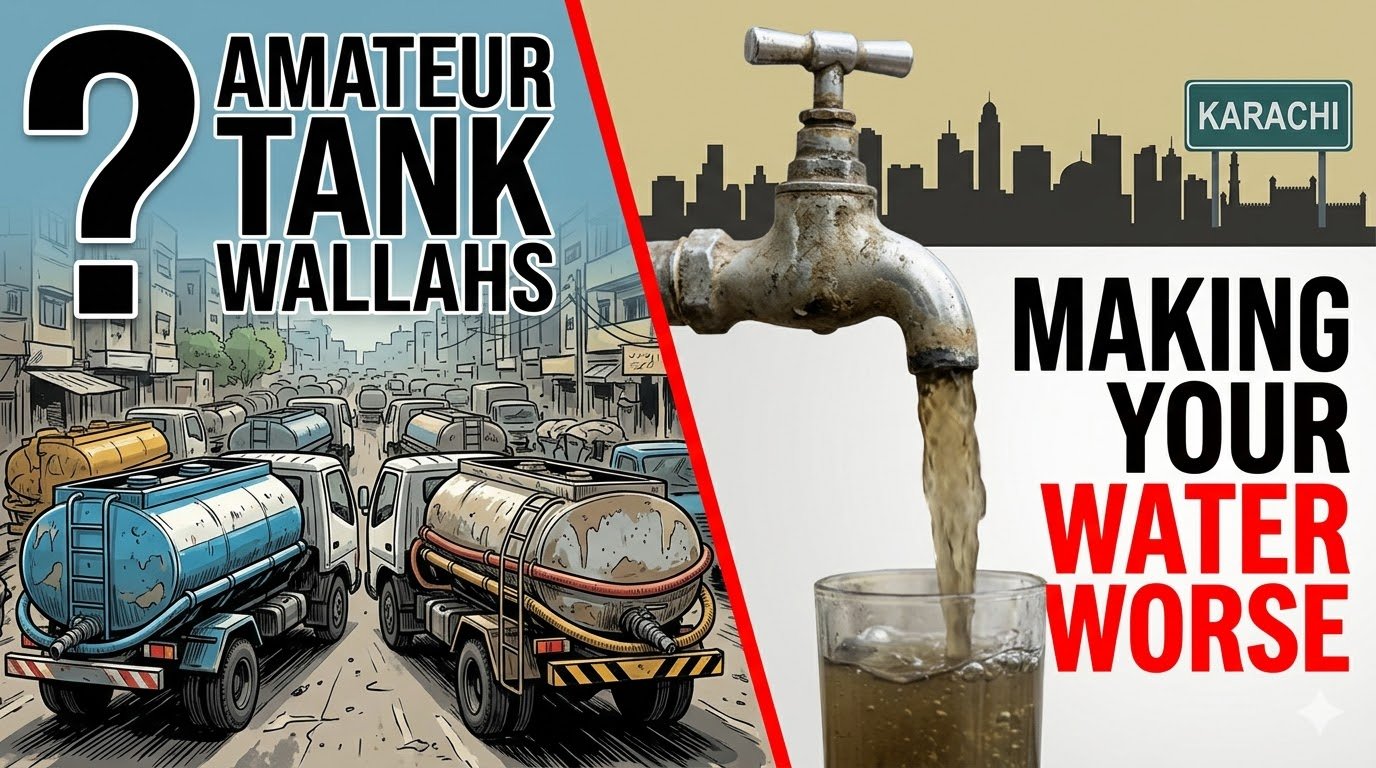
Most water tanks in Karachi that are cleaned at all are cleaned by a tank wallah: a man who goes door to door, or whom the chowkidar knows, with a rope, a bucket and a brush. He is cheap, he comes the same day, and when he leaves the tank looks better than it did.
This article compares tank wallah vs professional in Karachi as fairly as we can. The men who do this work are not the problem. They are doing a hard and dangerous job without the tools it needs. The problem is what the method cannot do, and what it risks.
In brief
- A brush and bucket remove loose dirt. They leave most of the sludge and the bacterial film on the walls.
- Entering an underground tank without ventilation and a person outside has killed people in Karachi, including five in one incident in 2025.
- Cleaning and disinfection are separate steps. Bleach poured into a dirty tank does little.
- Manual rinsing has a place for small rooftop tanks between proper cleanings, and nowhere else.
- Not every company that calls itself professional is. Ask what equipment and safety steps they use.
Tank wallah vs professional in Karachi: side by side
| Tank wallah | Professional service | |
|---|---|---|
| Tools | Rope, bucket, brush, cloth | Pressure washer, wet vacuum, pump, lighting |
| Sludge | Stirred and bailed; much is left or flushed into the pipes | Vacuumed out of the tank |
| Biofilm on walls | Scrubbed where the arm can reach | Cut off all surfaces with a water jet at 3,000+ PSI |
| Disinfection | None, or bleach or acid poured by eye | Measured dose of a product suited to drinking water tanks, then a rinse |
| Underground entry | No ventilation, no gas check, usually alone | Forced ventilation, gas check, harness, attendant at the hatch |
| Proof | None | Dated report with photographs |
| Invoice | Cash | Numbered tax invoice |
| Typical time | Under an hour | Two to four hours for a rooftop tank, four to eight for underground RCC |
What a brush and bucket leave behind
Biofilm
The slippery layer on a tank wall is a living film of bacteria held in a protective slime. A brush removes the loose top and smears the rest. Corners, the ceiling, the back wall of an underground tank and the area around pipe entries are rarely reached at all. Within days the film has regrown from what remains.
Sludge
With no vacuum, the only way to remove sludge is to stir it into the last few inches of water and bail it out. A good part stays on the floor, and some is pushed into the outlet pipe, from where it reaches your taps and filters. People often notice dirtier water for a few days after a manual cleaning, and this is why.
Disinfection
Cleaning and disinfecting are separate steps, in that order. The WHO’s technical note on cleaning and disinfecting storage tanks sets out the sequence: empty and scrub, flush, then disinfect with a measured chlorine dose and leave it for the contact time. A splash of bleach in a tank that still holds sludge is used up by the dirt before it kills anything. Acid, which some cleaners use because it makes concrete look bright, is not a disinfectant and attacks the tank surface.
The safety problem nobody mentions
An underground tank is a confined space. Gases collect in it and oxygen can be low, and a person who climbs down can lose consciousness within seconds. The people who go in after him usually suffer the same fate.
- June 2025, Ibrahim Hyderi: five men died in a house’s underground water tank. A sanitation worker and the owner’s son were overcome first; the owner’s second son and two neighbours died attempting a rescue.
- January 2022, Landhi: four workers died in a factory’s underground water tank, three of them while trying to save the first.
These are not freak events. They are what happens when a tank is entered without ventilation, without testing the air and without a trained person outside. Sindh’s factory law recognises the danger: section 48 of the Sindh Factories Act, 2015 bars entry into any tank or confined space where dangerous fumes are likely unless it has been made safe or the person has breathing apparatus and a rope held from outside. No such rule protects a labourer in a private home. As the householder, you are the one who let him in.
If you take one thing from this article, let it be this: never allow anyone to enter your underground tank alone, without air being blown in first, and without someone standing at the opening.
Why it matters more in Karachi
A quick rinse would matter less in a city with clean, continuous supply. Karachi’s water arrives intermittently, carries sediment and bacteria from a leaking network, and is stored for days in the heat. The background is in our guides to KWSB water supply and heat and bacteria in tanks. In those conditions the layer left behind after a manual cleaning becomes the starting culture for the next few months.
The real cost comparison
A tank wallah charges a fraction of a professional fee, and we will not pretend otherwise. The fair comparison is between what each fee buys.
| Cost item | Tank wallah | Professional service |
|---|---|---|
| Fee per visit | Low | Higher; fixed by tank type and size |
| How long the result lasts | Weeks, because biofilm and sludge remain | Months, to the next scheduled cleaning |
| Effect on filters | Cartridges often clog after the visit | Cartridges last longer |
| Risk carried by you | Injury or death on your property; no record of work | Trained crew with safety equipment; written report |
| Damage risk | Acid on concrete; cracked fibreglass from rough handling | Pressure matched to tank material |
We have deliberately left out figures for hospital bills. They vary too widely to quote honestly. The link between stored water and illness is covered, with sources, in waterborne disease in Karachi.
Why the trade stays informal
It is worth understanding why the tank wallah exists. There is no licence, training requirement or inspection for tank cleaning in Karachi. Entry costs nothing: a rope and a brush. Customers mostly judge by price and by whether the tank looks clean from the hatch, and both of those favour the quick rinse. The men doing the work earn little, carry all the physical risk and have no employer responsible for their safety.
Nothing in that is the worker’s fault, and nothing in it will change through regulation soon. It changes one household at a time, when customers start asking what was removed, how the tank was entered and what was used to disinfect it.
When is a tank wallah good enough?
There is a limited case. A small rooftop plastic tank that was professionally cleaned a few months ago, has a sound lid and shows only light dust can be rinsed out by a careful person standing outside it, with no need to climb in. That is maintenance between proper cleanings. It is not a substitute for them, and it never applies to an underground tank.
If you still plan to use a manual cleaner
- Do not let anyone enter the underground tank. Limit the job to what can be done from outside.
- Open the tank and air it for as long as possible before any work, and keep the lid off.
- Have a second adult present for the whole job.
- Forbid acid. Check what is in the bottle.
- Make sure sludge is taken out of the tank, not flushed through the outlet. Close the outlet valve during the work.
- Rinse thoroughly and run the first refill to waste.
- Book a proper cleaning within the season.
What professional cleaning involves
Our eight-step procedure runs in this order: survey and written quote, controlled drainage, ventilation and gas check, jet washing, vacuum extraction, disinfection, rinse and inspection, report and invoice. A full description of a visit is in what happens during a professional tank cleaning, and the disinfectant is explained in our silver hydrogen peroxide article.
Not every company that calls itself professional works this way. Use the checklist in what to ask before hiring a tank cleaning company to tell them apart, and see what we typically find in Karachi tanks for the condition most tanks are in after years of manual cleaning.
To book, contact the branch for Gulshan, Jauhar and East Karachi or DHA, Clifton and South Karachi, or get a price online.
Frequently asked questions
My tank wallah has cleaned our tank for years and nobody has been ill. Why change?
Illness from stored water is often mild, delayed and blamed on food, so the link is easy to miss. The stronger argument is safety: an unventilated underground tank is a risk every single time someone enters it.
Can I clean my own rooftop tank?
A small plastic tank, from the outside, yes, as maintenance between professional cleanings. Drain it, wipe and rinse the inside without climbing in, and check the lid and mesh.
Is bleach safe to use in a water tank?
Chlorine is the standard disinfectant for drinking water worldwide, but the dose and contact time matter and the tank must be cleaned first and rinsed afterwards. Pouring household bleach by eye into a dirty tank achieves little.
How often should a tank be cleaned properly?
Every four to six months for most houses and every three months for shared tanks. See how often to clean a water tank in Karachi.
Can I pay my usual cleaner more to do it properly?
More money does not supply a pressure washer, a vacuum, a gas detector or training. If he has those, he is no longer a tank wallah. If he does not, the result will be the same.
What is the biggest danger with informal tank cleaning?
A person entering an unventilated underground tank. Everything else is a matter of water quality; that is a matter of life and death.
Sources
External references used in this article, checked in October 2026:
- WHO Technical Note No. 3: Cleaning and disinfecting water storage tanks and tankers
- Dawn, 11 June 2025: Five dead after inhaling toxic gases in water tank in Karachi
- Dawn, 4 January 2022: Four workers die after inhaling toxic fumes in factory’s water tank
- The Sindh Factories Act, 2015
About Khan Tank Cleaning
Written by the team at Khan Tank Cleaning, which has worked on Karachi’s water tanks since 2005 under founder Mateen Khan. Some of the organisations we clean for are listed on our clients page. To talk to a branch, use the contact page or call 0333 0293174 (DHA Phase 2) or 0340 2717530 (Gulshan-e-Iqbal).

Mateen Khan is the Founder & Owner of Khan Tank Cleaning, Karachi’s first dedicated professional water tank cleaning company (est. 2005). With 20+ years of industry experience, he leads an ISO 9001 & ISO 45001 certified team that follows a strict 8-step process using industrial equipment and food-grade disinfectants. Mateen is committed to making clean, safe water accessible to every household and business in Karachi.