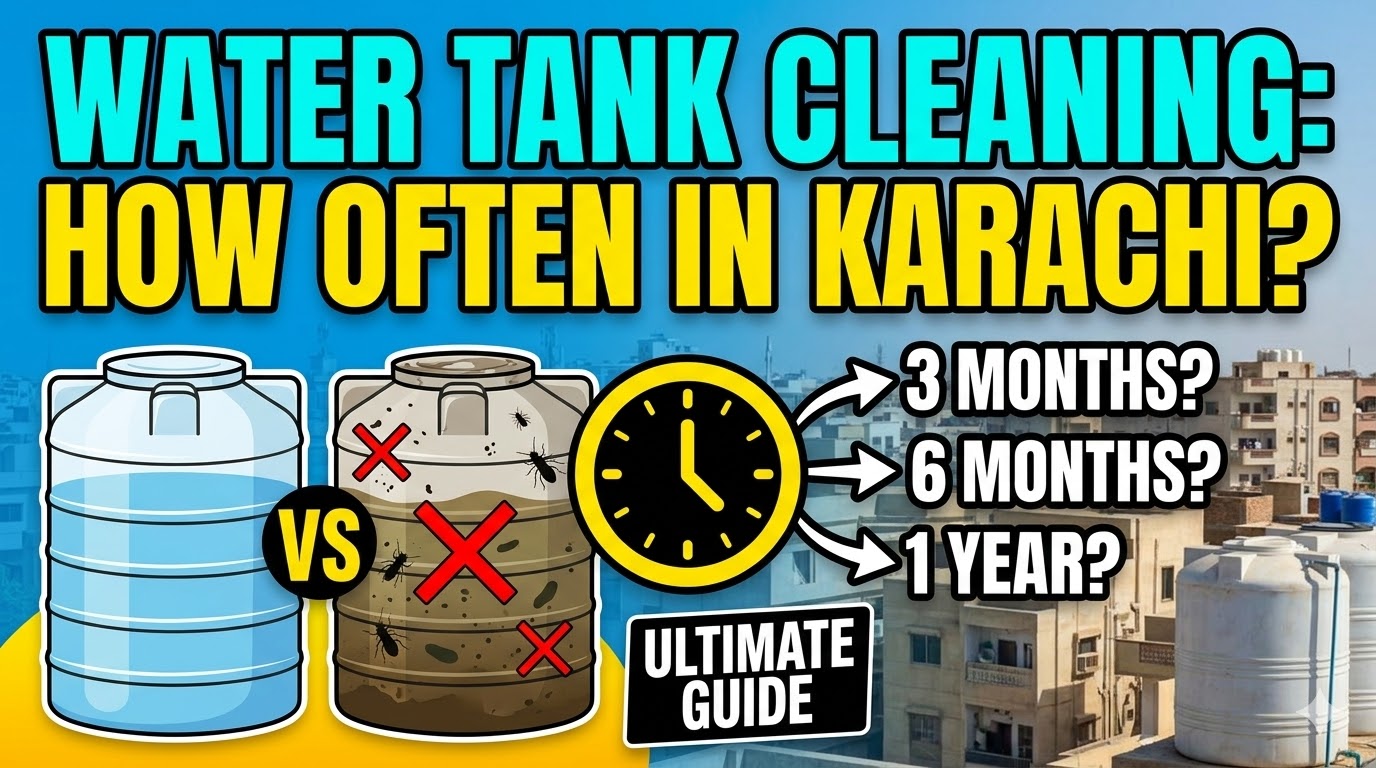
If you live in Karachi and haven’t thought about your water tank recently, this article is for you. Every day, millions of Karachi households rely on stored water for drinking, cooking, bathing, and washing. But here’s the uncomfortable truth: if that water tank hasn’t been professionally cleaned in the last six months, the water flowing from your taps may be doing more harm than good.
Waterborne diseases — including typhoid, gastroenteritis, cholera, and dysentery — remain among the most common health threats in Pakistan’s largest city. Contaminated water tanks are one of the leading, yet most preventable, causes. This guide explains exactly how often you should clean your water tank in Karachi, what factors affect the frequency, and why professional cleaning is the only approach that truly protects your family.
Why Karachi Homeowners Face a Unique Water Quality Challenge
Karachi is not a typical city when it comes to water supply. The combination of irregular municipal supply, dense urban infrastructure, extreme heat, and aging pipeline networks creates a uniquely challenging environment for clean water storage. Understanding these local factors helps explain why tank cleaning here demands more urgency than it would in other cities.
1. Intermittent Water Supply From KWSB
Karachi Water and Sewerage Board (KWSB) supplies water to most households only once or twice per week. This means residents must store large quantities of water in overhead or underground tanks to last through the entire week. The longer water sits in a tank, the higher the risk of bacterial growth, sludge accumulation, and contamination — making the tank itself a potential health hazard.
2. High Ambient Temperatures
Karachi’s temperatures regularly soar above 40°C during summer months. Warm, stagnant water is the perfect breeding ground for bacteria, algae, and biofilm. Overhead rooftop tanks are especially vulnerable — exposed to direct sunlight all day, these tanks can become biologically dangerous within weeks of the last cleaning.
3. Aging and Contaminated Supply Lines
Much of Karachi’s underground pipeline network is decades old. Cross-contamination between water supply lines and sewage lines is a well-documented problem in many parts of the city, including areas like Orangi Town, Korangi, and parts of Landhi. Even if your tank started with clean water, what flows through those pipes before reaching your tank may already carry sediment, rust, and microbial loads.
4. Dust, Smog, and Airborne Contaminants
Karachi’s air quality — affected by industrial activity, vehicle emissions, sea winds, and periodic dust storms — means that overhead tank lids and vents are constantly exposed to fine particulate matter. Over time, these particles settle into the tank, adding to the layer of sludge at the bottom and creating additional contamination risks.
These combined factors mean that a Karachi water tank accumulates contaminants significantly faster than a tank in a cooler, less polluted city with consistent water supply. This is not a hypothetical risk — it is a daily reality for millions of families.
The Short Answer: How Often Should You Clean Your Tank?
🗓 Recommended Cleaning Schedule for Karachi
Standard households: Every 3 to 6 months High-risk zones / summer months: Every 2 to 3 months Commercial/industrial properties: Every 1 to 2 months Absolute minimum (any property): Once every 6 months
While international health guidelines suggest cleaning water tanks at least once every six months, Karachi’s specific conditions mean that the lower end of that range — every three months — is a far safer target for most households. If your tank has gone a year without a professional clean, do not wait any longer.
Factors That Determine Your Cleaning Frequency
Not every home or water tank is the same. Several factors should influence how often you schedule a professional tank cleaning service in Karachi.
Tank Type: Overhead vs. Underground
Overhead plastic tanks (like those from Bestank or Aqua Plus) sit on rooftops and are directly exposed to sunlight and ambient air. They tend to develop algae and biofilm faster than underground tanks. Underground concrete tanks, on the other hand, accumulate sludge and sediment more heavily due to their size and the nature of water flow into them, and they also carry higher risks of confined-space contamination — making professional cleaning not just important, but essential for safety reasons.
Neighbourhood and Water Source Quality
Residents of areas like Gulshan-e-Iqbal, Gulistan-e-Johar, and Jauhar — where water supply is managed through KWSB as well as private tankers — often deal with more variable water quality. Tanker water in Karachi is not uniformly clean; some suppliers draw from sources with higher turbidity and bacterial content. If your home or apartment relies partially on tanker water, your tank needs cleaning more frequently — at least every three months.
Our Gulshan-Jauhar water tank cleaning service is specifically designed for residents across these densely populated neighbourhoods, where irregular supply schedules and tanker dependency make routine tank hygiene a genuine health priority.
Number of Residents and Daily Water Usage
A family of two using a standard 500-gallon tank will cycle through water more quickly than a single-person household. Higher water turnover means less stagnation — but it also means more frequent refilling, which increases the frequency of new contaminants being introduced. For large families or shared properties like apartment buildings, quarterly cleaning is strongly recommended.
Tank Material and Condition
Concrete underground tanks in older properties can develop cracks and porous surfaces that harbour bacteria far more readily than smooth plastic or stainless steel tanks. If your underground tank was built more than 10–15 years ago, it likely has surface degradation that makes thorough professional cleaning — including proper disinfection — even more important.
Commercial and Industrial Properties
Businesses, restaurants, offices, hostels, factories, and housing societies that use water at scale have a professional and legal responsibility to maintain their water storage at safe standards. In Karachi’s commercial hubs — from the business districts of DHA and Clifton to the industrial estates of SITE and Korangi — tank cleaning frequency should ideally be monthly or bi-monthly, particularly where water is used in food preparation or healthcare environments.
Our dedicated DHA and Clifton water tank cleaning service is built for exactly this kind of high-standard commercial and residential demand — serving premium properties across Defence, Clifton, Phase-wise DHA colonies, and surrounding areas with 24/7 availability and industrial-grade equipment.
Warning Signs: Your Tank Needs Cleaning Right Now
Sometimes, you don’t need to calculate frequencies — the signs are right in front of you. If you notice any of the following, schedule a professional cleaning immediately:
- Water has an unusual smell — musty, earthy, or chemical odour
- Water appears discoloured, cloudy, or has floating particles
- Family members have experienced recurring stomach upsets, diarrhoea, or unexplained nausea
- You can see visible algae, slime, or dark staining inside the tank
- More than 6 months have passed since the last professional clean
- You have recently used tanker water to fill the tank
- The tank lid has been damaged, loose, or missing, allowing direct air or contaminant entry
- A water pest or rodent infestation has occurred near the tank area
Do not dismiss these warning signs. Contaminated water does not always look or smell different — but when it does, it is already beyond safe levels. Act immediately.
What Does Professional Tank Cleaning Actually Involve?
Many homeowners assume tank cleaning simply means draining and rinsing. Professional tank cleaning is a multi-step process that no DIY effort can fully replicate. Here is what a proper professional service includes:
- Complete drainage: All water is fully removed from the tank.
- High-pressure jet washing: Industrial-grade pressure washing removes deep-rooted algae, biofilm, and hardened deposits that manual scrubbing cannot reach.
- Industrial vacuuming: Specialized vacuum systems extract sludge, sediment, and debris without leaving residue behind — unlike bucket-and-brush methods used by informal cleaners.
- Scrubbing and surface cleaning: Trained technicians manually clean all interior surfaces, including edges, corners, and inlet/outlet areas.
- Safe chemical disinfection: Potable-water-safe disinfectants — such as Silver Hydrogen Peroxide — are applied to eliminate bacteria, viruses, and biofilm. These chemicals are safe for human consumption and approved for water storage use.
- Final inspection and reporting: The tank is inspected before being certified clean, and any structural issues or cracks are noted for your attention.
This is the standard of service you should expect from any professional you hire. If a cleaner shows up with only a bucket, a brush, and chlorine tablets — that is not professional tank cleaning. That is a surface rinse that leaves bacterial biofilm, sludge deposits, and potential contamination intact.
Why Karachi-Specific Expertise Matters
Not all tank cleaning services in Pakistan understand Karachi’s specific urban water challenges. Khan Tank Cleaning was founded in Karachi and has built its entire operation around the city’s unique conditions — from the sludge profiles common in old KDA-built underground tanks in Gulshan, to the biofilm buildup patterns in rooftop plastic tanks in the high-rise apartments of Clifton.
Residents of Gulshan-e-Iqbal, Gulistan-e-Johar, North Nazimabad, Liaquatabad, Shah Faisal Town, Malir, and surrounding areas benefit from Khan Tank Cleaning’s dedicated Gulshan and Jauhar service branch — a team that understands the water supply patterns and infrastructure specific to Karachi East and Central.
For homeowners and businesses in DHA, Clifton, PECHS, Bahadurabad, Zamzama, Khayaban-e-Seher, and the broader Defence corridor, our DHA and Clifton branch provides the same high standard of industrial-grade cleaning — now with 24/7 emergency availability for times when clean water simply cannot wait.
The Cost of NOT Cleaning Your Tank
Homeowners sometimes delay tank cleaning to save money. But the cost of inaction is almost always higher than the cost of a professional clean. Consider the real financial and human impact of a contaminated tank:
- Medical expenses for waterborne illnesses (hospital visits, medication, lab tests) easily exceed the cost of a professional clean several times over
- Water purifier filters clog faster and need replacing more frequently when water quality from the tank is poor
- Washing machines, geysers, and dishwashers suffer scale buildup and reduced lifespan when water carries high sediment and mineral loads
- Lost productivity from sick days — for working adults and school-going children — carries its own economic and emotional cost
- In cases of severe neglect, tank walls can crack or corrode, requiring expensive structural repair or full tank replacement
A professional tank cleaning service in Karachi is not an expense — it is an investment in your family’s health, your home’s infrastructure, and your peace of mind.
A Quick Cleaning Schedule to Bookmark
Use the following as a practical guide for scheduling your next cleaning:
- Overhead plastic tank, family of 4+, summer months: Every 3 months
- Overhead plastic tank, small household, moderate season: Every 4–5 months
- Underground concrete tank, any household: Every 4–6 months
- Tanker-fed tank (partial or full): Every 2–3 months
- Commercial property / housing society / restaurant: Monthly to bi-monthly
- Post-flooding or monsoon season: Immediately — do not wait
Karachi’s monsoon season (July–September) is a particularly high-risk period. Floodwater contamination, mosquito breeding grounds, and disrupted supply lines all increase the risk that your tank has been compromised. A post-monsoon tank cleaning should be considered non-negotiable for every Karachi household.
🚿 Don’t Risk Your Family’s Health Another Day
Book Your Professional Tank Cleaning Service Today
Your water tank is the foundation of your household’s water supply. Every glass of water you drink, every meal you cook, every time your children wash their hands — it all starts with what’s inside that tank. If it’s dirty, your water is dirty. It really is that simple.
Khan Tank Cleaning is Karachi’s most experienced dedicated tank cleaning service. We use industrial-grade high-pressure jet washing, professional vacuuming systems, and potable-water-safe disinfectants — not buckets and brushes. Our teams are trained, equipped, and available around the clock to serve every part of the city, from residential flats to large commercial complexes.
📍 Based in Gulshan or Jauhar? Book our Gulshan-Jauhar service here →
📍 In DHA, Clifton, or nearby? Book our DHA-Clifton service here →
📞 Call 24/7: 0340-2717530 | 03330293174
Khan Tank Cleaning — Karachi’s Dedicated Professional Water Tank Cleaning Service
Leave a Reply