Author: admin

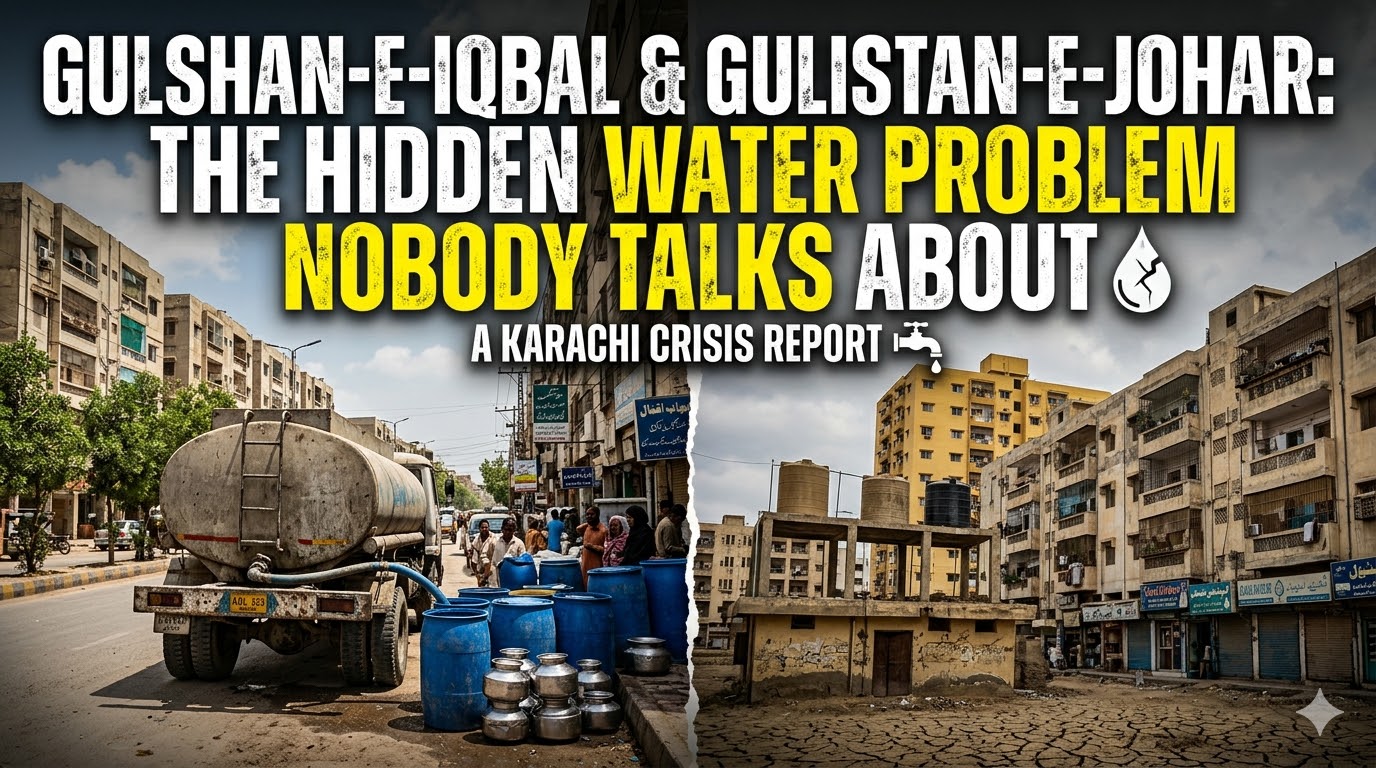
  • Gulshan-e-Iqbal & Gulistan-e-Johar: The Hidden Water Problem Nobody Talks About

    Gulshan-e-Iqbal & Gulistan-e-Johar: The Hidden Water Problem Nobody Talks About

    Every morning, millions of residents across Gulshan-e-Iqbal and Gulistan-e-Johar wake up, turn on the tap, and use that water to brush their teeth, boil their chai, cook their meals, and bathe their children. Most never stop to ask a simple but deeply important question: Where exactly has that water been sitting — and what is growing inside the tank that holds it?

    The answer is uncomfortable. And it is one that too few families in these densely populated neighbourhoods are having.

    This is the hidden water problem that nobody talks about — and in a city like Karachi, where municipal water supply is irregular, infrastructure is aging, and summer temperatures regularly push past 40°C, the consequences of ignoring a dirty water tank can range from stomach infections and diarrhoea to typhoid and hepatitis.

    Why Gulshan-e-Iqbal and Gulistan-e-Johar Are Especially Vulnerable

    Both Gulshan-e-Iqbal and Gulistan-e-Johar are among Karachi’s most densely populated residential zones. They are home to thousands of apartment blocks, housing societies, individual bungalows, and commercial buildings — each with at least one overhead or underground water storage tank.

    These neighbourhoods face a unique combination of challenges that makes water contamination more likely than almost anywhere else in the city:

    • Irregular KWSB supply — Water is delivered once or twice a week in most blocks, meaning tanks sit full and stagnant for days at a time.
    • Aging underground pipelines — Many of the water supply lines running beneath the streets of Gulshan and Johar are decades old, prone to micro-leakages that introduce soil bacteria and contaminants into the supply.
    • High ambient temperatures — Karachi summers create the perfect breeding environment for algae, biofilm, and bacteria inside tanks that are not regularly cleaned.
    • High-rise density — Multi-storey apartment buildings often have large shared underground sumps or rooftop tanks that serve dozens of families, yet rarely receive professional cleaning.
    • Rapid urban growth — New construction, borehole water mixing with mains supply, and illegal connections are common in the area, all of which affect water quality.
     
    The World Health Organization estimates that contaminated drinking water causes over 485,000 deaths globally each year. In Pakistan, waterborne diseases are among the leading causes of preventable illness — and a dirty water tank inside your own home is often where the contamination begins.

    What Is Actually Growing in Your Tank Right Now?

    Most homeowners assume that because they cannot see anything floating in their water, the tank must be clean. This assumption is dangerously wrong.

    Water tanks that have not been professionally cleaned develop multiple layers of contamination over time:

    1. Sludge and Sediment at the Base

    Every time water enters your tank, it carries fine particles of sand, rust, clay, and organic matter. Over months, these particles settle at the bottom, forming a thick layer of sludge. This sludge is a rich breeding ground for anaerobic bacteria — bacteria that thrive in low-oxygen environments and produce harmful byproducts.

    2. Algae Growth on Tank Walls

    In tanks that receive any light exposure — even indirect light through a poorly sealed lid — algae begins to grow along the walls. Green or black algae colonies alter the taste and smell of water and create an environment where harmful organisms can flourish.

    3. Biofilm — The Invisible Threat

    Biofilm is a thin, slippery layer of bacteria that adheres to the inner surfaces of your tank. It is completely invisible to the naked eye, and it cannot be removed by simply draining and refilling the tank. Biofilm is resistant to standard chlorination and requires high-pressure mechanical cleaning to eliminate. It is one of the primary sources of E. coli, Legionella, and other harmful pathogens in home water supplies.

    4. Rust and Chemical Leaching

    Steel and older fiber tanks corrode over time. Rust particles contaminate the water and can cause long-term health effects with regular consumption. In older buildings across Gulshan-e-Iqbal, steel tanks that have never been inspected are silently shedding rust into the water supply.

    The Symptoms You Are Probably Ignoring

    Contaminated tank water does not always announce itself with an obvious smell or colour change. In many cases, the water looks and smells perfectly normal — yet it is making your family ill in ways that are easy to misattribute. Watch for these warning signs:

    • Recurring stomach upsets or loose motions — especially in children — with no clear dietary cause
    • Unexplained fatigue or nausea that comes and goes
    • A faint musty, earthy, or metallic taste in tap water
    • Skin irritation, rashes, or dryness that flares up after showering
    • Hair fall that has worsened over recent months
    • Water that looks slightly discoloured when collected in a white container
    • A slight odour from the tap, particularly when water has sat overnight in pipes

    If any of these sound familiar, there is a very good chance your water tank is overdue for a professional clean. Our water tank cleaning service in Gulshan-e-Iqbal and Gulistan-e-Johar is specifically designed to address every one of these contamination sources.

    How Long Has It Been Since Your Tank Was Last Cleaned?

    Ask yourself honestly: when was the last time your water tank received a thorough professional cleaning? Not a manual wash-and-rinse by a helper — but a real, high-pressure jet wash with industrial vacuuming and chemical disinfection?

    For most households in Gulshan-e-Iqbal and Gulistan-e-Johar, the honest answer is: never. Or many years ago.

    Health authorities recommend cleaning domestic water tanks at least every six months. In Karachi, given the quality of incoming supply water and the heat, every three to four months is even better for families with young children, elderly residents, or anyone with a compromised immune system.

     
    If you cannot remember when your tank was last properly cleaned — it has been too long. Every additional month is another month of sediment building up, biofilm expanding, and algae taking hold.

    Why a Water Filter Is Not Enough

    One of the most common misconceptions among Karachi homeowners is this: “We have an RO or filter at home, so our water is fine.”

    Filters treat water at the point of use. They do not clean the tank that stores the water before it reaches the filter. If your tank contains sludge, biofilm, and algae, your filter is working overtime to compensate — and in many cases, it simply cannot keep up. The result is that heavily contaminated water still reaches your taps.

    Furthermore, most households only filter their drinking water — the water used for cooking, bathing, brushing teeth, and washing vegetables comes directly from the uncleaned tank. All of these are exposure pathways for waterborne illness.

    A clean tank and a good filter work together. One without the other leaves your family exposed.

    The Karachi Factor: Why Standard Cleaning Methods Fall Short

    Karachi is not an ordinary city, and its water supply challenges are not ordinary either. The combination of KWSB water — which arrives through aging mains carrying sediment and bacteria — mixed with borehole water (common across many parts of Gulshan and Johar) means that the incoming water itself often carries a higher-than-average contamination load.

    On top of this, Karachi’s extreme summer temperatures mean that tanks heat up significantly, dramatically accelerating bacterial growth. A tank that might stay relatively clean for six months in a cooler city may require cleaning every three months in Karachi’s climate.

    Many residents rely on informal workers who clean tanks by manually scrubbing with a brush and rinsing with a bucket. While this removes visible dirt, it leaves behind:

    • Biofilm firmly adhered to tank walls
    • Sludge residue in corners and at the base
    • No chemical disinfection to kill pathogens
    • No verification that the tank is genuinely safe after cleaning

    Professional tank cleaning services — like those provided by our Gulshan-e-Iqbal and Gulistan-e-Johar branch — use industrial-grade high-pressure jet washing, mechanical vacuuming, and safe chemical disinfection (including Silver Hydrogen Peroxide) to achieve a genuinely clean tank. This is not something a bucket and brush can replicate.

    Not in Gulshan or Johar? We Cover All of Karachi

    While our Gulshan-Johar branch is specifically equipped to serve the eastern zones of the city with rapid response times, we also operate a dedicated branch serving DHA, Clifton, and surrounding areas. Residents and businesses in Defence, Clifton, Zamzama, Bahadurabad, PECHS, Saddar, and Tariq Road can book our professional water tank cleaning service in DHA and Clifton, which brings the same high-pressure jet washing and disinfection technology to the southern and central parts of the city.

    Whether you are a homeowner in a Gulshan apartment block or a business owner managing a commercial building in Clifton, Khan Tank Cleaning has a dedicated team near you, ready to respond quickly to your booking. Our two-branch structure across Karachi means no long travel times, no delays, and faster service for customers across the city.

    What Does a Professional Tank Clean Actually Involve?

    If you have never had a professional tank cleaning done, it is worth understanding exactly what the process looks like — and why it is so different from what a helper does with a broom and a bucket.

    Our full professional cleaning process includes:

    • Complete drainage of the tank using high-capacity pumping equipment
    • High-pressure jet washing of all interior surfaces — walls, floor, and corners — to break down biofilm, sludge, and algae deposits
    • Industrial-grade vacuuming to extract all loosened debris and residue without leaving anything behind
    • Manual inspection and scrubbing of any remaining deposits, particularly around inlet and outlet pipes
    • Chemical disinfection using Silver Hydrogen Peroxide or food-safe chlorine compounds — safe for human consumption and effective against bacteria, viruses, and fungi
    • A final rinse and inspection before the tank is returned to service

    For underground tanks — common in many older Gulshan-e-Iqbal properties — our team also employs confined space entry protocols including oxygen safety systems and proper ventilation, ensuring worker safety and a thoroughly cleaned enclosed space.

    We service all tank types: overhead plastic tanks (Bestank, Aqua Plus, Syntex, and all fibre variants), underground concrete sumps, steel tanks, and large commercial storage systems. For more about our full-service approach, visit our Gulshan-e-Iqbal & Gulistan-e-Johar service page.

    How Often Should You Clean Your Tank in Karachi?

    A simple guide for Karachi households:

    Household type / situation               Recommended frequency
    Standard family home (overhead tank)                            Every 6 months
    Home with young children or elderly residents                  Every 3-4 months
    Home using borehole / boring water (mixed supply)              Every 3 months
    Apartment building / shared underground sump                   Every 3-4 months
    Commercial property (office, restaurant, school)               Every 2-3 months
    After any sewage leak, flood, or contamination event           Immediately

    The Cost of Not Cleaning: Medical Bills vs. Service Fees

    Many homeowners delay tank cleaning because they see it as an unnecessary expense. The real calculation, however, works the other way.

    A single episode of typhoid in a family requires doctor visits, laboratory tests, prescription medication, and days of lost work and school. A single hospitalisation for severe gastroenteritis can cost many times more than a full year’s worth of professional tank cleaning.

    Beyond the direct medical costs, there is the ongoing toll of subclinical illness — the persistent fatigue, the recurring stomach problems, the diminished immunity — that slowly erodes quality of life without ever producing a single clear diagnosis, because nobody connects the symptoms to the tank sitting on the roof.

    Professional tank cleaning is not an expense. It is an investment in your family’s health — and one of the most cost-effective health decisions you can make as a homeowner in Karachi.

    💧  Book Your Professional Tank Clean Today

    Your family deserves clean water — not water that has been sitting in a tank full of sludge, biofilm, and bacteria for months. If you live in Gulshan-e-Iqbal, Gulistan-e-Johar, or the surrounding areas of eastern Karachi, Khan Tank Cleaning’s dedicated branch is ready to serve you quickly, professionally, and at rates that suit your budget.

    Our team is available 24 hours a day, 7 days a week. We service residential homes, apartment complexes, commercial buildings, offices, factories, schools, and hostels across Karachi. There is no tank too big or too small.

    📞  Gulshan-e-Iqbal & Gulistan-e-Johar Branch:  0340-2717 530
    📞  DHA & Clifton Branch:  0333-0293174
    🌐  www.khantankcleaning.com

    Book your clean via our Gulshan & Johar service page or our DHA & Clifton service page. Clean water starts with a clean tank — and a clean tank starts with one phone call.

    Khan Tank Cleaning — Karachi’s Most Trusted Professional Water Tank Cleaning Company

    Head Office: Suite-203, Mumtaz Manzil, Block-16, Gulshan-e-Iqbal, Karachi

  • DHA Karachi Water Quality: What Residents Are Really Drinking

    DHA Karachi Water Quality: What Residents Are Really Drinking

    If you live in DHA Karachi — Phase 1, 2, 5, 6, or anywhere in between — there is a good chance you assume your water is cleaner than the rest of the city. After all, DHA is one of Karachi’s most developed and well-maintained residential zones. Wide roads, planned infrastructure, disciplined housing societies. Surely the water must be fine, right?

    The uncomfortable truth is: the water that arrives at your tap or flows into your rooftop/underground tank may be far less safe than you think. And the problem rarely starts with the supply line. It starts — and multiplies — inside your storage tank.

    In this article, we break down exactly what DHA Karachi residents are drinking, the hidden dangers lurking in their tanks, and what you can do about it right now.

    How Water Actually Reaches Your Home in DHA Karachi

    Karachi’s water supply is managed primarily through the Karachi Water and Sewerage Board (KWSB), supplemented by private water tankers and, in some areas, boring water (groundwater pumped from underground). Most of DHA’s residential units receive KWSB supply once or twice a week — sometimes less.

    Because supply is intermittent, virtually every home, apartment, and commercial building in DHA relies on storage tanks — both overhead (rooftop) and underground (sump tanks). The water sits in these tanks for days at a time before being consumed.

    This storage phase is where the real problem begins.

    The Real State of DHA Karachi’s Water Quality

    DHA’s proximity to the Arabian Sea and Clifton Belt means groundwater in the area often carries higher salinity levels. Meanwhile, KWSB supply lines — many of which are ageing — are susceptible to cross-contamination from sewage lines that run parallel to them. Pressure fluctuations during distribution can suck in contaminants, meaning bacteria can enter the supply before it even reaches your property.

    What Builds Up in Your Tank Over Time

    • Sediment and sludge: Dust, dirt, and particulate matter that enter via the inlet pipe or through an improperly sealed tank lid settle at the bottom over weeks and months.
    • Algae: Plastic overhead tanks exposed to sunlight become breeding grounds for algae, especially in Karachi’s intense heat. Green or black discolouration inside your tank is a classic sign.
    • Bacterial biofilm: A slimy layer of bacteria (biofilm) coats the interior walls of tanks that are not regularly cleaned. This is invisible to the naked eye but poses serious health risks.
    • Heavy microbial loads: Karachi’s water is known to carry high microbial loads. In a tank that hasn’t been cleaned in 6 months or more, bacterial colonies multiply rapidly.
    • Chemical residues: Bore water used to top up tanks in DHA often contains elevated levels of chlorides, nitrates, and other dissolved minerals that accumulate with each refill.

    Health Consequences Karachi Residents Overlook

    Contaminated water is not just an abstract health risk. It is one of the leading causes of disease in Pakistan. Waterborne illnesses like typhoid, gastroenteritis, cholera, and hepatitis A are closely linked to unclean water storage. In Karachi, hundreds of cases are reported every year — and the numbers are likely far higher given underreporting.

    Beyond acute illness, prolonged exposure to even mildly contaminated water causes chronic issues: recurring stomach upsets, skin rashes, weakened immunity — problems that many DHA households attribute to diet or stress, not realising the culprit is in their tank.

    Children, the elderly, and anyone with a compromised immune system are especially vulnerable. If you have young children at home, the state of your water tank is not a matter to defer.

    And here is the part most people miss: your home water filter does not solve this. Filters placed on kitchen taps remove impurities at the point of use — but they do not sanitise the hundreds of litres sitting in your tank. You are brushing teeth, washing produce, bathing, and making tea with that tank water every single day.

    DHA-Specific Risk Factors You Should Know

    DHA and Clifton present a unique combination of risk factors:

    • High ambient temperatures year-round accelerate bacterial growth inside tanks. Karachi’s heat is relentless — and so is microbial multiplication in stagnant water.
    • Many DHA properties use both KWSB supply and private water tankers. Tanker water quality varies enormously and is largely unregulated. Mixing sources in the same tank compounds contamination risk.
    • Older properties in DHA Phases 1–4 often have ageing concrete underground tanks that develop cracks, allowing soil bacteria and root matter to seep in.
    • High-rise apartments and multi-unit buildings in DHA Phase 8 and DHA City have large communal storage tanks that require industrial-grade cleaning — yet many housing societies only arrange cleaning once every year or two.
    • DHA’s proximity to the sea means some bore water sources have brackish contamination, which interacts with bacteria in tank sediment in particularly harmful ways.

    Khan Tank Cleaning’s professional water tank cleaning service in DHA and Clifton Karachi is specifically designed for this zone — with teams that understand the area’s unique water profile, the types of tanks commonly installed, and the cleaning protocols best suited to them.

    How Long Has It Been Since Your Tank Was Last Cleaned?

    Health authorities recommend cleaning domestic water tanks at least every six months. In Karachi’s climate and with Karachi’s water quality, every three to four months is a more realistic and responsible standard.

    Ask yourself honestly: when was the last time your overhead tank or underground sump was properly cleaned and disinfected by a professional? Not rinsed out. Not swept with a broom. Properly cleaned — with high-pressure jet washing, industrial vacuuming of sludge, and food-safe disinfection chemicals.

    If the answer is “I can’t remember” — or if you moved into your property and have no idea when it was last done — the contamination inside your tank could be significant.

    Warning Signs Your Tank Needs Immediate Cleaning: Water has an unusual smell or taste | Visible slime or discolouration on tank walls | Recurring stomach issues among household members | Tank lid is cracked, missing, or poorly sealed | More than 4 months since last professional cleaning

    Why DIY Cleaning Simply Is Not Enough

    It is tempting to think that draining the tank and hosing it down is sufficient. It is not — and here is why:

    • Bacterial biofilm is invisible and adhesive. Standard scrubbing tools cannot remove it. It requires high-pressure water jets — at pressures most household equipment cannot achieve — to dislodge biofilm from tank walls and corners.
    • Manual methods miss corners, seams, and inlet areas. These are precisely where sludge and contamination accumulate most heavily.
    • Disinfection requires the right chemicals at the right concentration. Household bleach used in incorrect quantities either fails to disinfect adequately or leaves harmful residues. Professionals use food-safe disinfectants like Silver Hydrogen Peroxide calibrated for potable water tanks.
    • Underground tank entry carries safety risks. Confined space entry into underground sump tanks requires oxygen safety systems and proper ventilation equipment. Attempting this without professional gear is genuinely dangerous.

    What a Professional Tank Cleaning Actually Looks Like

    At Khan Tank Cleaning, our process is methodical and leaves nothing behind:

    • Step 1: Full drainage of the tank to remove all stored water.
    • Step 2: Industrial high-pressure jet washing to blast off algae, biofilm, and scale from all internal surfaces.
    • Step 3: Industrial vacuum extraction to remove all dislodged sludge, sediment, and debris — ensuring nothing is left to re-contaminate.
    • Step 4: Manual inspection and scrubbing of corners, seams, and inlet/outlet areas where contamination clusters.
    • Step 5: Food-safe disinfection using Silver Hydrogen Peroxide — highly effective against bacteria, viruses, and biofilm, and completely safe for human consumption after the rinse cycle.
    • Step 6: Final rinse and inspection before the tank is refilled.

    The result is not just a cleaner tank — it is water that is genuinely safer to store, use, and drink.

    Serving All of Karachi — From DHA and Clifton to Gulshan and Jauhar

    Water quality is not a DHA-exclusive problem. The same tank contamination issues affect residents across the city. Whether you are in the coastal, upscale neighbourhoods of DHA and Clifton or in the densely populated localities further east, the risks are real and the solution is the same: regular professional cleaning.

    Our DHA and Clifton branch handles the entire southern and central belt of the city — DHA Phases 1 through 8, DHA City, Clifton, Zamzama, Bahadurabad, PECHS, and beyond.

    Meanwhile, our Gulshan and Jauhar branch serves the eastern and central corridors — Gulshan-e-Iqbal, Gulistan-e-Jauhar, FB Area, Nazimabad, North Nazimabad, Malir, Korangi, and surrounding neighbourhoods. Families in these areas deal with the same combination of intermittent KWSB supply, hot weather, and tank sediment build-up.

    No matter which part of Karachi you call home, Khan Tank Cleaning has a branch near you and the expertise to clean every type of tank: plastic overhead, fibre, stainless steel, and deep concrete underground tanks.

    How Often Should DHA Residents Clean Their Tanks?

    Given Karachi’s climate and water conditions, we recommend the following schedule:

    SituationRecommended Frequency
    Standard residential propertyEvery 3–4 months
    Property using both KWSB + tanker waterEvery 2–3 months
    Houses with young children or elderly residentsEvery 2 months
    Commercial buildings / housing societiesEvery 2–3 months or as per building size
    Underground concrete tanks (older DHA properties)Every 3 months, with structural inspection

    What to Look for When Choosing a Tank Cleaning Service in Karachi

    Not all tank cleaning services in Karachi are created equal. Many operate informally, relying on manual scrubbing with buckets and brushes — a method that gives the appearance of cleanliness while leaving behind the bacterial biofilm and sludge residue that actually pose health risks.

    Before booking any service, ensure they use:

    • Industrial high-pressure jet washing equipment (not just manual scrubbing)
    • Industrial vacuum extraction for sludge removal
    • Food-safe, verifiable disinfectants — ask the provider to name the chemical and confirm it is safe for potable water
    • Proper confined-space safety equipment for underground tank cleaning
    • Trained, uniformed staff — not day-labourers with no tank cleaning background

    Khan Tank Cleaning ticks every box. We are Karachi’s most dedicated, specialised tank cleaning company — this is all we do, which means our team’s expertise and equipment are purpose-built for the job, not borrowed from a general cleaning business.

    The Bottom Line: DHA Residents Deserve Cleaner Water

    DHA is one of Karachi’s finest residential addresses — but that premium address does not automatically mean premium water quality. The water arriving at your tap has travelled through ageing city infrastructure, sat in a storage tank for days, and potentially accumulated bacteria, algae, and sludge that no household filter will remove.

    Clean water is not a luxury. It is the foundation of your family’s health. And ensuring that the tank storing your water is genuinely clean is one of the most important — and most overlooked — home maintenance tasks in Karachi.

    Whether you are in DHA’s seaside lanes or the bustling neighbourhoods of Gulshan and Jauhar, Khan Tank Cleaning has the expertise, the equipment, and the presence to deliver the standard of service your water deserves. Explore our water tank cleaning services in Gulshan and Jauhar or our water tank cleaning services in DHA and Clifton to learn more.

    🚿  Your Tank. Your Family. Don’t Wait.

    Book Khan Tank Cleaning’s Professional Service Today

    If you cannot remember when your tank was last cleaned — it has been too long. Our teams operate across Karachi seven days a week, covering both residential and commercial properties of every size.

    📍 DHA, Clifton & South Karachi:  Book Your DHA/Clifton Cleaning  |  Call: 03330293174

    📍 Gulshan, Jauhar & East Karachi:  Book Your Gulshan/Jauhar Cleaning  |  Call: 0340-2717530

    ✅ 24/7 Availability  ✅ Residential & Commercial  ✅ All Tank Types  ✅ Budget-Friendly Rates

    Visit us at khantankcleaning.com to learn more and schedule your service.

    © Khan Tank Cleaning | khantankcleaning.com | Karachi’s Professional Water Tank Cleaning Specialists

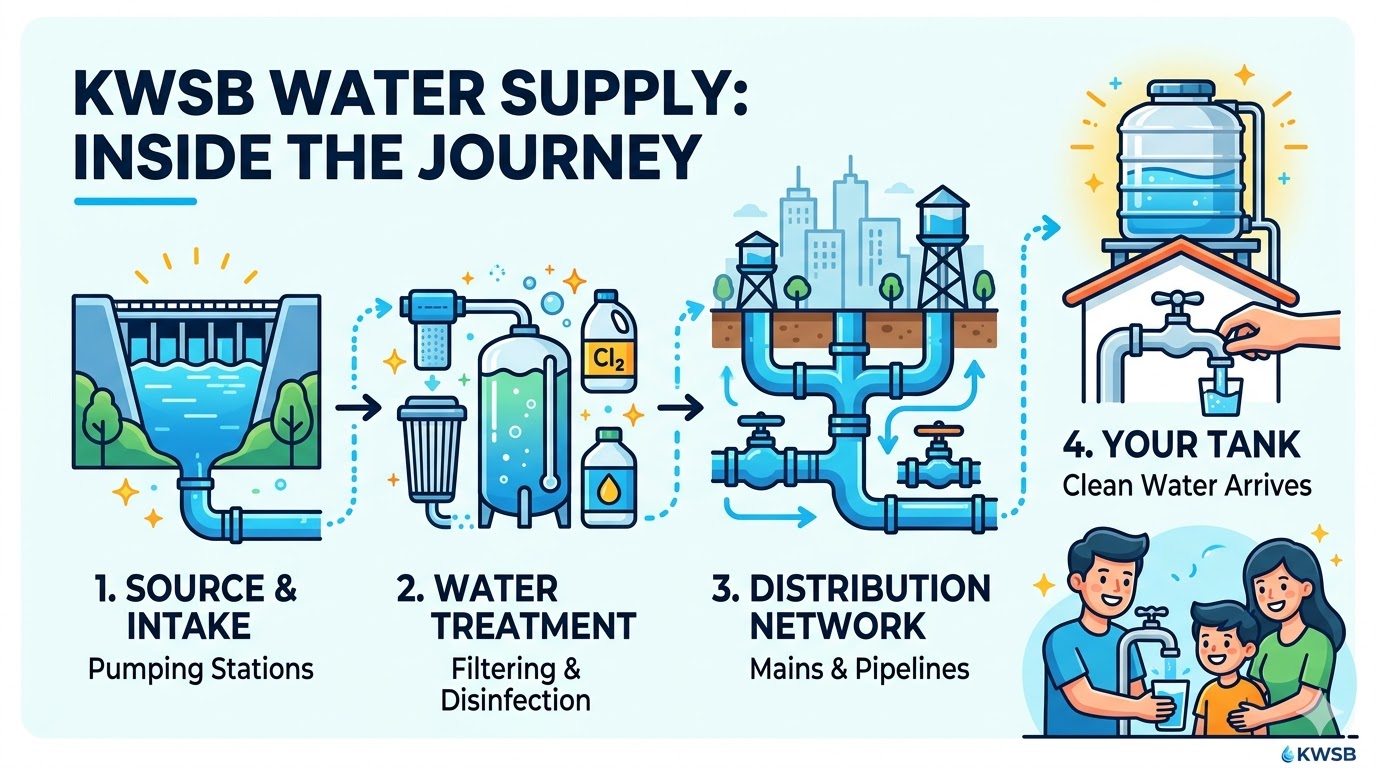
  • KWSB Water Supply: What Actually Happens Before It Reaches Your Tank — The Invisible Journey That Determines What Your Family Drinks Every Day

    KWSB Water Supply: What Actually Happens Before It Reaches Your Tank — The Invisible Journey That Determines What Your Family Drinks Every Day

    Turn on your tap and water flows. It is easy to take that moment for granted. What very few Karachi homeowners realise is that the water filling your glass has survived one of the longest, most demanding, and most risk-laden journeys of any public utility service in Pakistan — and that the final, most critical leg of that journey ends not in some treatment plant run by professionals, but in your own storage tank, which may not have been cleaned in years.

    This article traces exactly what happens to Karachi’s water — from its source over 120 kilometres away, through canals, pumping stations, filtration plants, miles of aging pipes, and a gauntlet of leakages, illegal connections, and pressure failures — before it finally lands in your tank. Understanding this journey will change the way you think about your water, your tank, and your family’s health.

    1. Where Does Karachi’s Water Actually Come From?

    Most Karachi residents know, vaguely, that water comes from somewhere far away. The reality is more specific — and more sobering — than most people appreciate.

    Primary Source: Keenjhar Lake and the Indus River

    Keenjhar Lake, also known as Kalri Lake, sits approximately 122 kilometres from Karachi in District Thatta. It is a man-made reservoir created by earthen embankments in the 1950s, fed by the Indus River via the Kalri-Baghar Feeder canal that runs from the Kotri Barrage. According to the Sindh Irrigation Department, Keenjhar serves as Karachi’s primary water source, accounting for roughly 80% of the city’s total requirement.

    Here is a figure that immediately puts the system’s fragility into perspective: the first drop of water that enters Keenjhar Lake from the Indus River takes 17 days to reach Karachi. That single fact — cited by KWSB’s own Deputy Managing Director — tells you everything about the complexity and vulnerability of this supply chain.

    Secondary Source: Hub Dam

    Hub Dam, located on the Hub River to the northwest of Karachi, contributes approximately 70–100 million gallons per day (MGD) when it holds water. The critical qualifier is when it holds water. The Hub Dam has gone dry in multiple recent years due to insufficient rainfall, leaving Hub District West — and many homes in Orangi Town, SITE, and Baldia — entirely dependent on the Keenjhar supply. When Hub Dam is dry, that 70–100 MGD shortfall is simply not replaced.

    The Supply Gap No One Talks About

    Karachi’s total daily water demand from a population now exceeding 20 million is estimated at 1,080–1,200 MGD. Total supply from all sources — Keenjhar, Hub Dam, and minor contributions from Haleji Lake and Dumlottee wells — amounts to approximately 650 MGD. That means Karachi receives, at best, roughly 55% of its daily water requirement. Many areas receive nothing for days or weeks at a stretch.

    The Scale in Numbers: Keenjhar Lake delivers 450 MGD. Hub Dam adds up to 100 MGD when full. Total supply: ~650 MGD. Total demand: 1,100–1,200 MGD. The gap — nearly 550 MGD — is filled by expensive water tankers, illegal hydrants, and, in many areas, simply going without.

    2. Stage One: The Canal Journey From Keenjhar to Dhabeji

    Water leaves Keenjhar Lake through the Keenjhar-Gujjo (KG) Canal and travels via the Roller Compacted Concrete (RCC) Canal and the K-II/K-III Canal system to the Dhabeji Pumping Station — the heart of Karachi’s water supply. The total conveyance capacity between Gujjo and Dhabeji is currently rated at 515 MGD.

    This canal journey is the first point of contamination risk. Open canals are exposed to:

    • Agricultural runoff containing fertilisers, pesticides, and animal waste from farmland along the canal banks
    • Industrial discharge where canal routes pass near manufacturing areas
    • Direct human dumping — waste, plastics, and debris entering open water channels
    • Wildlife and bird contamination in unenclosed stretches of the canal
    • Sedimentation — silt and particulate matter that the canal carries from its source

    By the time raw water reaches Dhabeji, it is already carrying turbidity, organic matter, bacteria, and chemical residues that require treatment before it is safe for human consumption. The canal journey, in other words, is not neutral — it actively adds contamination to water that started out considerably cleaner at its source.

    3. Stage Two: Dhabeji Pumping Station — The City’s Water Heart

    The Dhabeji Pumping Station, located roughly 50 kilometres from central Karachi, is the single most critical piece of infrastructure in the city’s water supply. It is the main intake point where canal water is received, and from where it is pumped onward to filtration plants across the city. According to KWSC, the station serves over 15 million residents.

    From Dhabeji, water is gravity-fed and pumped to several key destinations:

    • Pipri Filter Farm — one of the city’s main treatment facilities
    • NEK (North East Karachi) Filter Plant — serving northern and eastern Karachi including Surjani, North Nazimabad, North Karachi, and surrounding areas
    • COD Filter Plant — serving central districts
    • Old NEK Filter Plant — an aging facility still in active use

    Dhabeji itself has faced repeated crises in recent years. A January 2025 explosion at the station disrupted water supply to vast sections of the city. In December 2024, the 84-inch pipeline along University Road suffered three consecutive leakages during BRT Red Line construction, cutting supply to areas including Gulshan Town, Liaquatabad, Chanesar Town, Keamari, Clifton, and Saddar for an extended period. These are not rare events — they are recurring features of a system under extreme stress.

    Infrastructure Alert: In December 2024 alone, three consecutive leaks in the University Road main pipeline reportedly caused a loss of 2.5 billion gallons of water and cut supply to dozens of Karachi neighbourhoods. Repair work required shutting down 12 pumps at Dhabeji. This is the infrastructure your family’s water depends on.

    4. Stage Three: Filtration — What It Does and What It Cannot Do

    Water arriving at Karachi’s filtration plants undergoes several treatment steps before entering the distribution network. A standard treatment process includes coagulation (adding chemicals to bind fine particles), sedimentation (letting those clumps settle), filtration through sand and gravel beds, and chlorination to kill pathogens.

    When the system works as designed, this process produces water that meets basic safety standards. But there are several important limitations that Karachi homeowners must understand:

    • Karachi’s filtration plants are operating well below their combined potential capacity due to aging equipment, power failures, and maintenance backlogs. KWSC has been working to rehabilitate filter plants at Gharo, Pipri, COD, and NEK, and new filtration facilities are under construction — but the gap between what is needed and what currently functions is significant.
    • Filtration treats what enters the plant. It cannot compensate for water that was contaminated in the canals, nor for contamination that occurs after the water leaves the plant and enters the distribution network.
    • Chlorine dosing — the primary bactericidal treatment — is effective at the point of application but dissipates over time and distance. By the time water travels from the filtration plant to a neighbourhood in Gulshan, Jauhar, DHA, or North Karachi, the chlorine residual may have dropped significantly below effective levels.

    A 2020 study that tested 118 water samples across Karachi found that a staggering 90.7% of samples were unsafe for drinking. Of these, 88.1% showed coliform bacteria beyond WHO limits, and 33.4% had faecal contamination (E. coli). These figures were from treated and distributed water — not raw canal water. The distribution system was recontaminating water that had already been treated.

    5. Stage Four: The Distribution Network — 10,000 Kilometres of Risk

    From the filtration plants, treated water enters Karachi’s distribution network — a system of approximately 10,000 kilometres of pipes that snake beneath the city’s streets, many of which are 30, 40, or even 50 years old. This is the most dangerous leg of the journey, and the one most directly responsible for the condition of the water that eventually reaches your tank.

    5.1 Leakages and Non-Revenue Water Loss

    According to KWSB data, an estimated 42% of water — approximately 235 MGD — is either lost through leakages in the distribution network or stolen before it reaches consumers. Some estimates place leakage losses alone at 35% of total supply, compared to Tokyo’s benchmark loss rate of under 5%. This means that for every litre of water that leaves the Dhabeji filtration system, almost half never reaches a household tap.

    Every leakage point is a two-way vulnerability: water leaks out, but when pressure drops, soil and groundwater can enter the pipe through the same breach. This is the mechanism through which agricultural chemicals, industrial pollutants, and in densely built areas, sewage contaminants enter Karachi’s treated water supply.

    5.2 Illegal Connections and Water Theft

    Illegal connections — pipes tapped directly into the main distribution lines without authorisation — are widespread across all areas of Karachi. As KWSB’s own senior officials have acknowledged, detecting these underground punctures is far more difficult than identifying illegal electricity connections. Each illegal connection further reduces system pressure, multiplies contamination entry points, and degrades water quality for everyone else on the same line.

    5.3 Intermittent Supply and Biofilm

    Because Karachi’s water is not supplied continuously — many areas receive water once a week, some less frequently — the pipes between supply cycles are not filled with flowing water. They are empty. Or worse, they hold stagnant puddles of residual water in their lower sections. Research cited in environmental reporting on Karachi’s water crisis shows that a single E. coli bacterium entering a dry pipeline can multiply into trillions within a week if conditions are favourable. Inside aging iron pipes, biofilm — a structured colony of bacteria embedded in a protective film on pipe walls — provides an ideal breeding environment that survives normal chlorination.

    The Pipeline Reality: Karachi has 10,000 kilometres of pipeline. Many are old iron pipes. The water in them is intermittent, meaning they spend much of the week empty or stagnant. Biofilm grows on their walls. Pressure fluctuations cause soil and sewage to enter through cracks. This is the pipe that delivers water to your building’s storage tank.

    6. Stage Five: The Final Destination — Your Storage Tank

    After this entire journey — 122 kilometres of canals exposed to agriculture and industrial runoff, pumping stations under constant stress, filtration plants working below capacity, and 10,000 kilometres of aging distribution pipes plagued by leakages and illegal connections — the water finally reaches your building. And it enters your storage tank.

    If you live in a house in Gulshan-e-Iqbal, Gulistan-e-Johar, Federal B Area, or North Nazimabad, that tank is almost certainly an overhead tank. If you are in DHA, Clifton, or Defence, you likely have both an underground tank and a rooftop tank. In housing societies, you share a central tank with dozens or hundreds of other families.

    Whatever the configuration, the tank is where the journey ends — and where your responsibility begins. Everything the water has accumulated during its journey — sediment, bacterial contamination, reduced chlorine residual, traces of agricultural and industrial chemicals — is now sitting in your tank. And if that tank has not been professionally cleaned recently, it is also accumulating:

    • A layer of sludge at the base — sediment, rust particles, and organic matter that settles with every cycle of water supply
    • Biofilm on the interior walls — invisible colonies of bacteria that adhere to tank surfaces and are impossible to remove with manual scrubbing
    • Algae growth — particularly in tanks that are not fully sealed, which describes the majority of tanks in Karachi
    • Scale and mineral deposits — calcium and magnesium buildups from Karachi’s hard water supply that degrade water taste and provide surfaces for bacterial adhesion

    7. Why Your Neighbourhood Matters: Area-by-Area Risk Factors

    The journey described above affects every part of Karachi — but not equally. Infrastructure age, distance from filtration plants, supply frequency, and local density all affect how much contamination accumulates by the time water reaches your tank.

    Gulshan-e-Iqbal, Gulistan-e-Johar, Federal B Area, North Nazimabad

    These densely populated central-eastern areas are served by the NEK and COD filter plants. Many supply lines here are older, running beneath high-traffic roads where construction and road work frequently damage and create pressure fluctuations in pipelines. The 84-inch University Road pipeline — which runs directly through this corridor — has suffered repeated critical failures in recent years. Apartment complexes with shared overhead tanks in these areas carry compounded risk: one contamination event can affect every family in the building simultaneously.

    Khan Tank Cleaning’s water tank cleaning service in Gulshan and Jauhar Karachi is the dedicated branch for this zone, with teams that understand the specific water supply challenges of this part of the city.

    DHA, Clifton, Bath Island, Defence

    While these areas generally receive more consistent supply, they present different challenges. Large underground tanks common in DHA and Clifton hold substantial volumes of water for extended periods, creating ideal conditions for bacterial growth and sedimentation. The longer the water sits in a large tank between cleaning cycles, the more pronounced the biofilm and sludge accumulation. Elevated rooftop tanks in Clifton’s older buildings are particularly prone to algae growth due to sun exposure and inadequate sealing.

    Khan Tank Cleaning’s professional water tank cleaning service in DHA and Clifton Karachi is specifically equipped for the larger-capacity underground and elevated tanks common in this corridor, with the industrial-grade equipment needed to clean tanks of all sizes effectively.

    Korangi, Landhi, Malir, Shah Faisal Town

    These areas are among the most infrastructure-stressed in the city. Supply is irregular, pipelines are older, and the proximity of water and sewage infrastructure creates heightened back-siphonage risk during pressure fluctuations. Residents here may go days or weeks without supply, and when water does arrive, its quality has often degraded significantly during transmission.

    Orangi Town, Baldia, SITE, Liaquatabad

    Areas previously supplied by Hub Dam — now often dry — are particularly vulnerable to supply shortfalls and the quality degradation that comes with irregular, low-pressure delivery through aging pipes. These areas also have higher rates of illegal connections to the main supply lines, which increases contamination risk for all households in the zone.

    8. The Health Consequences of a Contaminated Tank

    A KWSB official speaking about Karachi’s water infrastructure noted that the city’s water supply challenge is not just quantity — it is fundamentally a quality problem at every stage of the supply chain. The health consequences for families consuming tank water that has accumulated contamination across this entire journey are well-documented:

    • Typhoid fever — Salmonella typhi, one of the most common water-borne illnesses in Karachi, transmitted through faecally contaminated water
    • Hepatitis A and E — viral infections causing liver inflammation, both spread through contaminated drinking water
    • Cholera — bacterial infection associated with contaminated water sources; health risks linked to contaminated tanker water are connected to approximately 30% of hospital admissions for cholera in parts of Karachi
    • Gastroenteritis — severe vomiting and diarrhea, most dangerous for children and the elderly
    • Chronic digestive conditions — long-term low-level consumption of bacterially contaminated water
    • Skin conditions and eye infections — from bathing and washing in contaminated water

    9. What a Professional Tank Cleaning Actually Resolves

    You cannot change Karachi’s canal infrastructure or fix the distribution network’s aging pipes. But you can completely control what happens at the end of the journey — in your own tank. Professional cleaning addresses every layer of contamination that has accumulated:

    • High-pressure jet washing removes biofilm from all interior surfaces — corners, seams, and walls that manual scrubbing cannot reach
    • Industrial vacuum extraction removes all sludge and sediment from the tank base without dispersing it back into the water
    • Silver Hydrogen Peroxide disinfection — a hospital-grade treatment — kills residual bacteria and viruses and prevents rapid recontamination
    • Full inspection of tank integrity, seals, and covers to prevent external contamination entry

    For households and businesses across Gulshan, Jauhar, Federal B Area, North Nazimabad, Gulshan-e-Maymar, and surrounding areas, the Gulshan and Jauhar branch of Khan Tank Cleaning provides rapid-response professional service with full familiarity of local water supply conditions.

    For properties in DHA, Clifton, Zamzama, Bath Island, Defence, and adjacent areas, the DHA and Clifton branch of Khan Tank Cleaning brings specialised equipment sized for the large-volume tanks typical of that zone.

    10. How Often Should You Clean? A Karachi-Specific Guide

    Given the contamination accumulating at every stage of Karachi’s supply chain, standard cleaning intervals are not sufficient. The recommended schedule for Karachi conditions:

    • Every 3 months: Households in areas with very irregular supply, older infrastructure, or shared building tanks (apartments, housing societies)
    • Every 4–6 months: Standard residential properties in areas with moderate supply consistency
    • Immediately: After any period of discoloured or unusual-smelling water, after any major pipeline failure in your area, after monsoon season, or after extended supply disruption

    It is also worth noting that if you cannot recall when your tank was last professionally cleaned, it is overdue. In our experience serving Karachi homeowners, the majority of households requesting their first professional cleaning have tanks with years of accumulated contamination — sludge layers, mature biofilm colonies, and scale deposits that have been building silently since the tank was installed.

    Your Tank Is the Last Line of Defence.

    Make Sure It Is Doing Its Job.

    Karachi’s water has already survived a 122-kilometre journey through open canals, under-capacity filtration plants, and 10,000 kilometres of aging leaking pipes before it reaches your neighbourhood. By the time it enters your storage tank, it is carrying everything it has picked up along the way.   You cannot fix the canals. You cannot repair the city’s pipes. But you can ensure that your family’s water tank is clean, disinfected, and safe — and that everything your water has collected during its long journey is removed before it reaches your family’s taps.   Khan Tank Cleaning is Karachi’s dedicated professional water tank cleaning company. Water tank cleaning is all we do. We use industrial high-pressure jet washing, professional vacuum extraction, and Silver Hydrogen Peroxide disinfection to clean tanks that bucket-and-brush methods simply cannot. Our trained technicians serve all areas of Karachi from two dedicated branches:

    📍 Gulshan | Jauhar | Federal B Area | North Nazimabad | Gulshan-e-Maymar & surrounding areas:

    Book Your Professional Tank Cleaning — Gulshan & Jauhar Branch

    📍 DHA | Clifton | Defence | Zamzama | Bath Island | Korangi & surrounding areas:

    Book Your Professional Tank Cleaning — DHA & Clifton Branch

    📞 Call / WhatsApp: 0340-2717530  |  03330293174 Available 24/7 for residential, commercial, and industrial clients across all of Karachi.

    Your water’s journey was 122 kilometres. Your tank cleaning call takes 30 seconds.

    Khan Tank Cleaning  |  khantankcleaning.com  |  Professional Water Tank Cleaning — Serving All Karachi

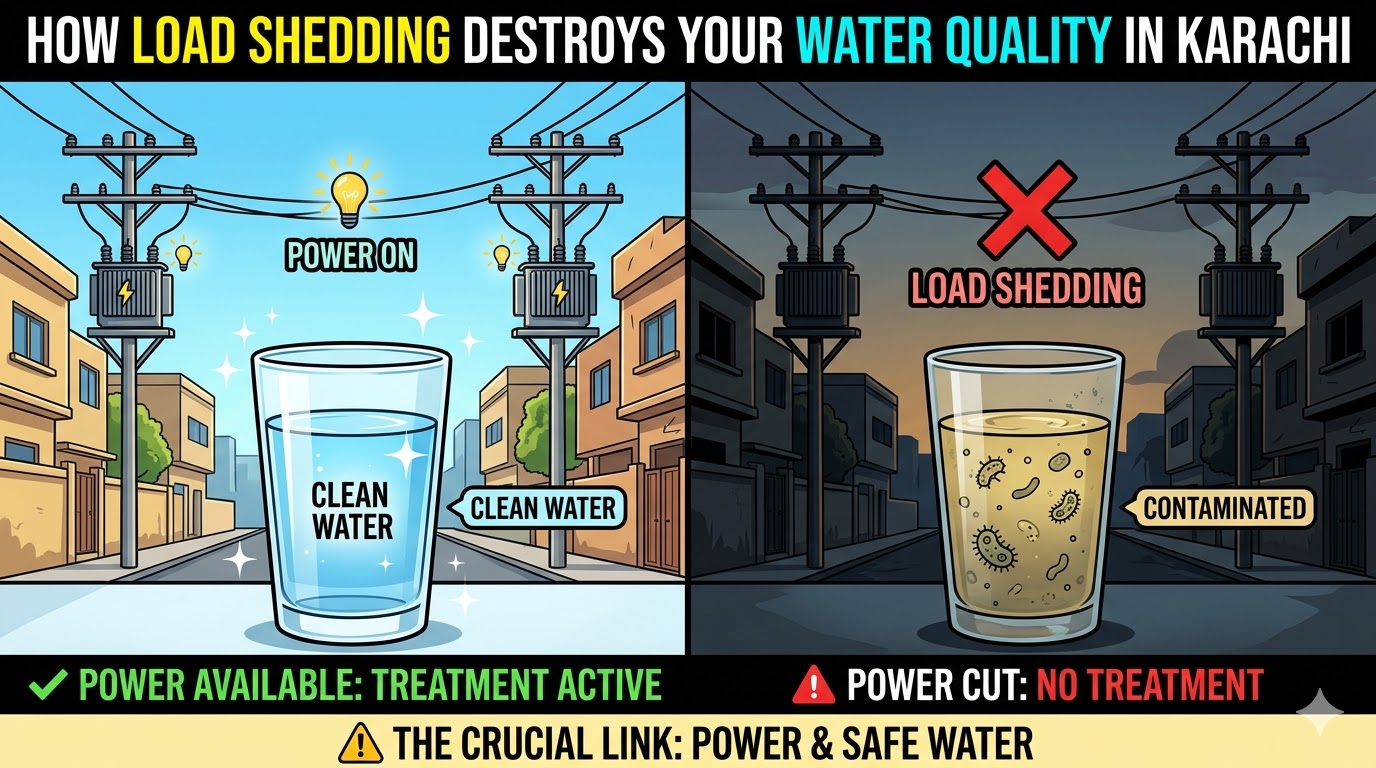
  • How Load Shedding Destroys Your Water Quality in Karachi — And What Every Karachi Homeowner Must Do Right Now

    How Load Shedding Destroys Your Water Quality in Karachi — And What Every Karachi Homeowner Must Do Right Now

    Every Karachi resident knows the drill. The electricity cuts out — sometimes for two hours, sometimes for eight — and life grinds to a halt. While most of us focus on the obvious inconveniences (no fans, no air conditioning in the brutal heat, stalled homework), there is a silent, invisible crisis quietly unfolding in your water storage tank. One that could be making your family sick right now.

    Load shedding in Karachi is not just an inconvenience. It is a water contamination event that occurs every single time the power goes off. In this article, we explain exactly how unscheduled power outages damage your water quality, why Karachi’s specific conditions make the problem worse, and what you need to do to protect your household.

    1. Understanding Karachi’s Water Supply Chain — and Where It Breaks

    Before we discuss load shedding’s impact, it is important to understand how water reaches your home in the first place. Karachi’s water supply chain involves multiple pumping stations, storage reservoirs, and distribution lines managed by the Karachi Water and Sewerage Corporation (KWSC). Water travels from the Indus River, Hub Dam, and Keenjhar Lake through filtration plants before reaching neighbourhood distribution lines — and ultimately, your overhead or underground storage tank.

    This entire chain depends on electricity. When load shedding hits, the chain breaks at multiple points simultaneously:

    • Municipal pumping stations shut down, reducing or stopping water flow to your area.
    • Your building’s motor or submersible pump cannot operate, so water cannot be transferred from the underground tank to the overhead tank.
    • Pressure in the supply line drops to zero or near-zero, creating a vacuum effect in the pipes.
    • When power finally returns, the sudden pressure surge can dislodge sediment, rust, and biofilm built up inside aging pipelines — pushing it directly into your storage tank.
    Key Fact: In many areas of Karachi — from Gulshan-e-Iqbal to Gulistan-e-Johar to DHA — residents experience 6–12 hours of load shedding daily during peak summer months. That is 6–12 hours of pump failure, pressure fluctuations, and stagnation — every single day.

    2. The Five Ways Load Shedding Contaminates Your Tank Water

    2.1 Stagnant Water Becomes a Bacterial Breeding Ground

    When pumps stop working, water in your tank simply sits still. Stagnant water is warm (especially in Karachi’s climate, where summer temperatures regularly exceed 40°C), dark, and nutrient-rich from dust and organic particles that settle in any tank over time. This is the perfect environment for bacteria like E. coli, Salmonella, Legionella, and various coliform bacteria to multiply exponentially. Studies show that bacterial counts can double in stagnant water every 20 minutes under warm conditions.

    2.2 Vacuum Effect Draws Sewage and Groundwater Into Supply Pipes

    This is the most alarming and least-discussed effect. When electricity is cut and pump pressure drops to zero, the supply pipes experience negative pressure — a vacuum. In Karachi, where many underground water supply lines run in close proximity to sewage lines (many of which are aging and cracked), this vacuum can literally suck sewage water backwards into your drinking water supply. By the time power returns and water flows again, the contamination is already in your pipes — and heading into your tank.

    This phenomenon, known as back-siphonage, is well-documented and particularly severe in densely built areas like Orangi Town, Korangi, Landhi, and parts of North Karachi where infrastructure is older and more vulnerable.

    2.3 Algae Blooms Accelerate Without Circulation

    Water in motion resists algae growth. Water that sits still, especially in tanks that are not perfectly sealed (which describes the vast majority of tanks in Karachi), quickly develops algae colonies. These colonies not only make water smell and taste foul, they release toxins and provide the substrate on which dangerous bacteria thrive. A single load shedding period in summer can trigger visible algae growth within 24–48 hours in an uncleaned tank.

    2.4 Sludge Layers Are Disturbed and Resuspended

    Every water tank accumulates a layer of sediment, rust particles, mineral deposits, and organic sludge at its base. When your motor suddenly turns on after a power cut, the surge of water agitates this sludge layer, mixing it back into the water column. Your household then consumes this sediment-rich water — potentially for hours before it settles again. Over time, this repeated cycle means your household is regularly drinking water with elevated levels of heavy metals, rust, and organic matter.

    2.5 Disinfectant Residuals Break Down During Outages

    Municipal water from KWSC is treated with chlorine to kill pathogens. However, chlorine is a volatile compound — it dissipates quickly in warm, stagnant water. During a 6–8 hour load shedding period in Karachi’s summer heat, the chlorine residual in stored water can drop to near zero. This means the water in your tank loses its protection against pathogens precisely when bacterial growth is at its fastest.

    3. Karachi-Specific Factors That Make the Problem Much Worse

    Load shedding affects cities across Pakistan, but Karachi has a set of local conditions that dramatically amplify the water quality damage:

    • Extreme Heat: Karachi’s coastal humidity and temperatures of 38–45°C in summer create ideal conditions for bacterial and algal growth in tanks. A contamination event that takes days elsewhere takes hours here.
    • Aging Infrastructure: Many residential areas — including parts of North Nazimabad, Liaquatabad, Malir, and Orangi Town — are served by water supply pipes that are 30–50 years old. These pipes are far more vulnerable to back-siphonage and sediment dislodging during pressure fluctuations.
    • High-Density Living: Apartment buildings, shared housing societies, and multi-storey buildings common in areas like Gulshan-e-Iqbal, Gulistan-e-Johar, PECHS, and DHA Phase 1-6 all share central tanks, meaning one contamination event affects dozens of families simultaneously.
    • Irregular Water Supply: Even without load shedding, many Karachi areas only receive water once or twice a week. This means tanks are often at maximum capacity and sitting for longer periods — greatly increasing the risk of contamination.
    • Poor Tank Maintenance Culture: Most Karachi homeowners have never had their water tank professionally cleaned. Without proper cleaning, the buildup of sludge, biofilm, and scale that load shedding agitates is far thicker and more dangerous.
    Did You Know? Waterborne diseases including typhoid, hepatitis A, gastroenteritis, and cholera are among the most common causes of emergency hospital visits in Karachi. A significant proportion of these cases are linked to contaminated household water storage — the very tanks sitting in your building right now.

    4. The Health Consequences Your Family Faces

    Contaminated tank water does not announce itself. It often looks clear. It may smell faintly off or it may smell fine. Yet the pathogens it carries can cause:

    • Typhoid Fever — caused by Salmonella typhi, extremely common in Karachi, can be life-threatening without treatment
    • Hepatitis A — a viral infection spread through contaminated water, causing liver inflammation
    • Severe Gastroenteritis — vomiting, diarrhea, and dehydration, particularly dangerous for children and the elderly
    • Cholera — bacterial infection causing acute watery diarrhea, historically associated with contaminated water sources
    • Skin Rashes and Eye Infections — from bathing or washing in bacterially contaminated water
    • Chronic Digestive Issues — long-term consumption of low-level contaminated water can cause persistent gut problems

    Children under 12 and elderly adults are the most vulnerable. Even if healthy adults in your home seem fine, your children or elderly parents may be silently suffering the effects of poor water quality.

    5. Why Your Water Filter Is Not Enough

    Many Karachi homeowners feel reassured by their Reverse Osmosis (RO) or UV water filter. We understand the logic — but it is dangerously incomplete. Here is why:

    • Filters only treat the water you drink — not the water you cook with, wash dishes with, brush your teeth with, or bathe in.
    • Heavily contaminated water entering the filter can overwhelm its capacity and reduce its effectiveness against pathogens.
    • Sludge and sediment from uncleaned tanks clog and damage filters, shortening their lifespan and increasing maintenance costs.
    • Biofilm growing inside a dirty tank can eventually spread to your filter’s housing and tubing, contaminating even filtered water.

    The filter is the last line of defence. A clean water tank is the first line of defence — and the most important one.

    6. How Often Should You Clean Your Tank in Karachi?

    Given Karachi’s specific conditions — extreme heat, irregular water supply, frequent load shedding, and aging infrastructure — the recommended professional cleaning schedule is more aggressive than international guidelines:

    • Minimum: Every 6 months for households in areas with relatively stable water supply and newer infrastructure.
    • Recommended: Every 3–4 months for households in areas with frequent load shedding, older infrastructure, or shared central tanks (housing societies, apartment buildings).
    • After any flooding or unusual water colour/smell: Immediately, regardless of the last cleaning date.

    7. Professional Tank Cleaning: What It Actually Involves

    Many Karachi residents assume that tank cleaning means someone climbs in and scrubs the walls. Professional cleaning is far more comprehensive and significantly more effective than any DIY approach.

    A proper professional cleaning service — like the one offered by Khan Tank Cleaning’s water tank cleaning service in Gulshan and Jauhar Karachi — includes:

    • Complete draining of the tank using high-powered vacuum systems
    • High-pressure jet washing to remove biofilm, algae, and sludge from all interior surfaces — including corners and seams that manual scrubbing cannot reach
    • Industrial vacuuming to extract all loosened debris without leaving residue behind
    • Disinfection with Silver Hydrogen Peroxide — a hospital-grade disinfectant that is highly effective against bacteria, viruses, and biofilm, and is completely safe for potable water systems
    • Secondary disinfection where required for tanks with severe contamination
    • Final inspection and safety check before the tank is refilled

    For households in DHA, Clifton, and the Defence area, Khan Tank Cleaning’s professional water tank cleaning in DHA and Clifton Karachi applies the same industrial-grade process with equipment specifically suited to the underground tanks, elevated rooftop tanks, and large-capacity storage systems common in that part of the city.

    The difference between professional cleaning and bucket-and-brush methods is not minor. Industrial high-pressure jet systems reach areas no person can access. Industrial vacuums remove sludge without spreading it through the tank. And crucially, bacterial biofilm — the thin, invisible film of bacteria that adheres to tank walls and is the primary source of ongoing contamination — can only be effectively destroyed by high-pressure washing combined with proper disinfection. Manual scrubbing leaves biofilm behind. Every single time.

    8. Specific Areas of Karachi Most at Risk

    While load shedding affects all of Karachi, certain areas face compounded risk due to infrastructure age, water supply irregularity, or building density:

    • Gulshan-e-Iqbal, Gulistan-e-Johar, Federal B Area, North Nazimabad — high-density residential areas with older water supply networks and long load shedding schedules. Shared tanks in apartment complexes amplify contamination risk.
    • DHA Phases 1–8, Clifton, Bath Island — large underground tanks, extended supply lines, and high-value properties where the consequences of contaminated water (on both health and property) deserve serious attention.
    • Korangi, Landhi, Malir, Shah Faisal Town — areas with aging infrastructure, proximity of water and sewage lines, and frequent irregular water supply episodes.
    • PECHS, Bahadurabad, Tariq Road, Saddar — older commercial and residential buildings where tank maintenance has historically been neglected.

    If your home or business is in Gulshan, Jauhar, or surrounding areas, Khan Tank Cleaning’s dedicated branch ensures fast response times and deep familiarity with the specific infrastructure conditions of your neighbourhood.

    If you are in DHA, Clifton, or the Defence/Clifton corridor, our DHA and Clifton branch serves your area with the specialised equipment needed for the larger-scale underground and elevated tank configurations prevalent there.

    9. What You Can Do Between Professional Cleanings

    Professional cleaning is essential and irreplaceable. Between scheduled cleanings, the following steps will help reduce contamination risk during load shedding events:

    • Inspect your tank lid and cover regularly. Any gap, crack, or missing seal allows insects, dust, and bird droppings to enter — especially critical after power fluctuations cause water level changes.
    • Check your tank’s water colour and smell after every major load shedding event. Discolouration, cloudiness, or unusual odour are immediate warning signs.
    • Install a high-quality float valve to prevent overflow, which can introduce external contamination.
    • Consider a small UV disinfection unit as a supplementary measure for particularly high-risk periods such as monsoon season or prolonged load shedding.
    • Keep records of your last professional cleaning date and schedule the next one before the 6-month mark — not after you notice a problem.

    10. The True Cost of Not Cleaning Your Tank

    Some homeowners delay professional tank cleaning because of the perceived cost. Consider what contaminated water actually costs:

    • Medical bills for typhoid treatment in Karachi average Rs. 15,000–50,000 per case, not including hospitalisation.
    • Hepatitis A treatment can run significantly higher, with serious cases requiring months of care.
    • Lost workdays and school days multiply the economic impact across your household.
    • Damage to water filters, geysers, and washing machines from sediment and scale accelerates servicing costs and shortens appliance lifespan.

    Professional tank cleaning is not an expense. It is one of the most cost-effective health investments a Karachi homeowner can make — and one of the most frequently overlooked.

    Do Not Wait for Someone in Your Family to Fall Ill   Your water tank has been silently affected by every load shedding event this year. Bacteria, biofilm, sludge, and sediment are building up right now — and your family is consuming this water daily.   Khan Tank Cleaning is Karachi’s dedicated, professional water tank cleaning company. We are not a side business or a part-time operation — water tank cleaning is all we do, and we have been doing it longer and better than anyone else in the city.   We use industrial high-pressure jet washing, professional vacuum systems, and Silver Hydrogen Peroxide disinfection to deliver results that bucket-and-brush approaches simply cannot match. Our trained technicians serve all areas of Karachi, with two dedicated branches:

    📍 Gulshan | Jauhar | Federal B Area | North Nazimabad | Gulshan-e-Maymar & surrounding areas:

    Book Your Tank Cleaning — Gulshan & Jauhar Branch

    📍 DHA | Clifton | Defence | Zamzama | Bath Island | Korangi & surrounding areas:

    Book Your Tank Cleaning — DHA & Clifton Branch

    📞 Call / WhatsApp: 0340-2717530  |  03330293174 Available 24 hours, 7 days a week. Serving all residential, commercial, and industrial clients across Karachi.

    Clean tank. Pure water. Healthy family. Book today.

    Khan Tank Cleaning  |  khantankcleaning.com  |  Professional Water Tank Cleaning Karachi

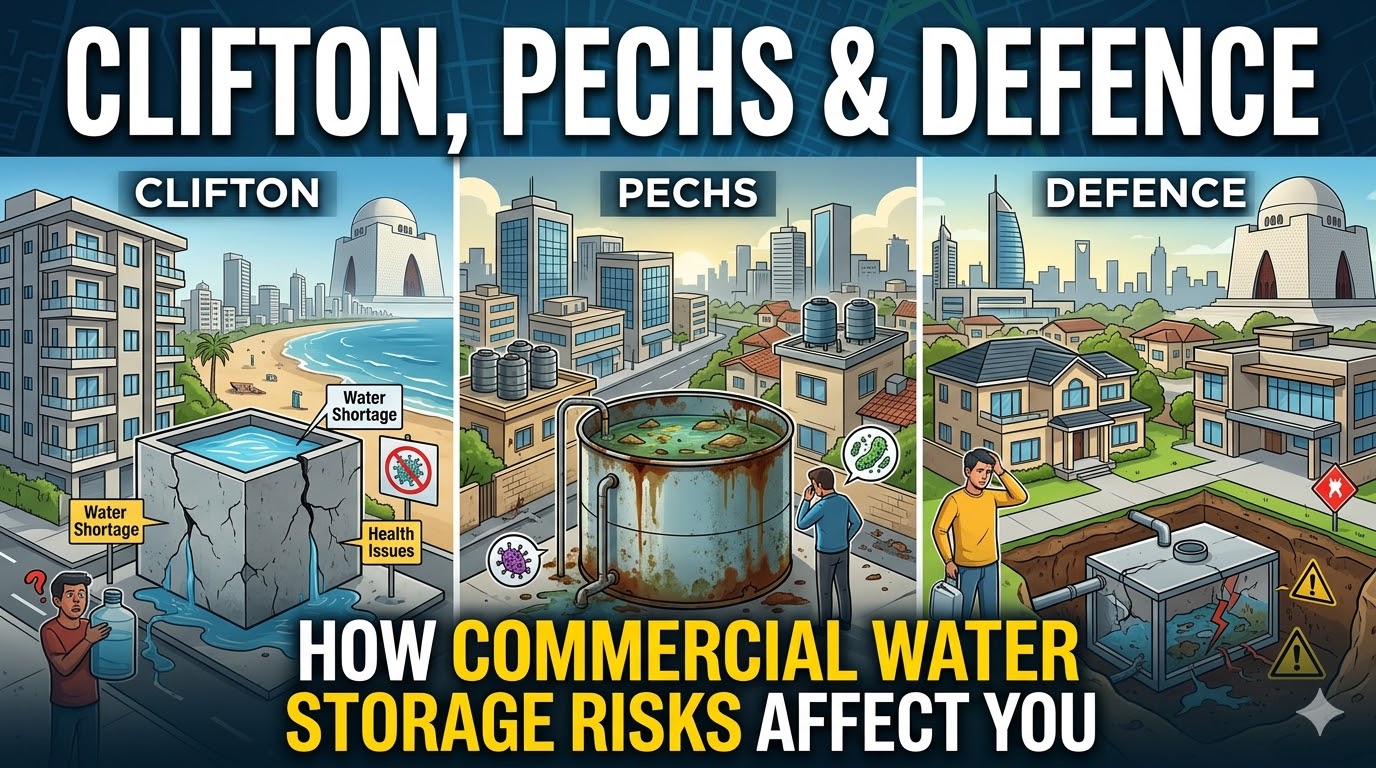
  • Clifton, PECHS & Defence: How Commercial Water Storage Risks Affect You

    Clifton, PECHS & Defence: How Commercial Water Storage Risks Affect You

    If you live or run a business in Clifton, PECHS, or Defence Housing Authority (DHA), you are likely surrounded by high-rise apartments, large housing societies, and multi-tenant commercial buildings. What you may not think about, however, is what is sitting inside your water storage tank — and how it is quietly affecting your health, your appliances, and your daily life.

    Karachi’s water supply carries some of the highest levels of sediment, bacterial contamination, and biological growth in Pakistan. When that water sits in a storage tank for days — as it routinely does in most Karachi homes and commercial buildings — it does not stay the same. It changes. And not for the better.

    This guide explains the specific water storage risks facing residents and property owners in Clifton, PECHS, and Defence, and what you should be doing right now to protect your family or your business.

    Why Karachi’s Water Is a Unique Challenge

    Unlike cities with reliable, pressurised municipal water supply, Karachi depends on intermittent bulk water delivery. Water is supplied once or twice a week in most areas — sometimes less frequently in peak summer months — which means storage is not a choice. It is a necessity.

    Every home, apartment block, commercial building, and factory in Karachi has at least one storage tank: typically an underground RCC (reinforced concrete) cistern, an overhead plastic or fiber tank, or both. The water sits in these tanks for extended periods, often in conditions that accelerate contamination:

    • Karachi’s heat — temperatures regularly exceeding 38°C in summer — accelerates bacterial growth
    • High humidity creates ideal conditions for algae and biofilm formation inside tanks
    • Sediment-heavy water supply from the Karachi Water and Sewerage Board (KWSB) introduces particulate matter that settles at the bottom of storage tanks
    • Old or poorly sealed RCC tanks in older DHA and Clifton properties allow ground contamination to enter
    • Shared water systems in apartment blocks mean contamination in one unit’s supply can affect the entire building

    In Karachi’s climate, a water tank that has not been professionally cleaned within the last six months is likely harbouring bacterial colonies, biofilm, and accumulated sludge — even if the water looks and smells normal to you.

    The Specific Risks in Clifton, PECHS & Defence

    These three areas are among Karachi’s most developed and densely occupied residential and commercial zones. That density, combined with the nature of the water infrastructure in these neighbourhoods, creates some distinct risk factors.

    Clifton: Older Buildings, Large Underground Tanks

    Clifton’s residential stock includes many older properties built in the 1970s, 80s, and 90s — often with large underground RCC cisterns that were constructed before modern waterproofing standards were in place. These tanks are prone to:

    • Hairline cracks that allow soil bacteria and ground seepage to enter
    • Interior surface deterioration that creates rough surfaces where biofilm adheres
    • No natural light or ventilation — ideal conditions for anaerobic bacterial growth

    Clifton’s beachside location also means higher ambient humidity year-round, which accelerates biological growth inside tanks. Newer high-rise towers along the Clifton seafront have large shared overhead tanks that, when not regularly cleaned, distribute contaminated water across dozens of units simultaneously.

    PECHS: High-Density Residential & Commercial Mix

    PECHS (Pakistan Employees Cooperative Housing Society) is one of Karachi’s most densely populated areas, with a mix of older bungalows converted to multi-floor apartments, commercial buildings, clinics, restaurants, and schools. The water risks here are compounded by:

    • Higher water demand from commercial premises putting pressure on shared storage systems
    • Restaurants and food businesses using tank water in food preparation — a serious public health risk if tanks are unclean
    • Frequent construction in the area causing sediment and dust contamination of exposed tanks
    • Many aging buildings with no record of when their tanks were last professionally cleaned

    DHA (Defence): Large Properties, High Expectations

    DHA is home to some of Karachi’s largest residential properties and most premium commercial real estate. Despite the upmarket perception, DHA properties face water storage challenges that are equally serious — and often more complex:

    • Large bungalows often have multiple tanks — underground cisterns, rooftop tanks, and garden storage — each requiring separate cleaning
    • DHA Phase 1 through 4 properties are decades old; concrete tanks in these phases often have significant deterioration
    • Many DHA residents use water filtration systems or water purifiers — but these do not compensate for a contaminated storage tank upstream of the filter
    • High water usage from larger households means faster contamination cycling

    Our professional water tank cleaning service in DHA & Clifton is specifically equipped for the tank types, property sizes, and contamination profiles typical of this area — from confined underground RCC tanks in Phase 4 bungalows to rooftop overhead tanks in Clifton high-rises.

    What Happens Inside an Uncleaned Water Tank

    The contamination process in a neglected water tank is gradual but serious. Here is what typically builds up inside:

    Sludge & Sediment

    Every time KWSB water enters your tank, it carries dissolved and suspended particles. Over months and years, this settles as a thick layer at the bottom of the tank. This sludge is a breeding ground for bacteria and provides nutrients for biological growth.

    Biofilm

    Biofilm is a layer of microorganisms — including dangerous bacteria like E. coli and Legionella — that attaches itself to the walls and floor of a tank. It cannot be removed by simply draining the tank or using household bleach. Industrial-grade high-pressure jet washing is required to physically dislodge and remove it.

    Algae

    In tanks exposed to any natural or artificial light — including overhead plastic tanks — algae can flourish. Algae changes the taste and smell of water and provides a food source for bacteria.

    Chemical Contamination

    Deteriorating concrete in older tanks can leach minerals into stored water. Rust from steel fittings adds iron contamination. In some older DHA and Clifton properties, paint or sealant used on tank interiors decades ago may not have been food-safe — and those surfaces are now degrading into the water supply.

    You may be drinking filtered water — but if your storage tank is contaminated, your filter is working against a much higher pathogen load than it was designed for. Many common household filters are not effective against the bacterial concentrations found in a neglected Karachi water tank.

    Health & Business Consequences You Cannot Afford to Ignore

    The consequences of contaminated water storage go well beyond a bad taste or occasional stomach upset.

    • Waterborne diseases — typhoid, hepatitis A, gastroenteritis, dysentery — are directly linked to contaminated water storage and remain a significant public health issue in Karachi
    • Skin infections and eye irritation from bathing in bacterially contaminated water
    • For commercial properties: restaurant fines, reputational damage, and liability if customers or tenants become ill due to unsafe water
    • Reduced lifespan of water heaters, washing machines, and plumbing fittings due to sediment and biological contamination
    • Blocked water filters that fail prematurely because they are handling an excessive contamination load

    For property owners in PECHS and DHA managing rental properties, multi-tenant buildings, or commercial premises, the liability implications of providing contaminated water to tenants or customers are considerable — and increasingly, tenants are aware of their rights.

    How Often Should Your Tank Be Cleaned in These Areas?

    The standard recommendation from water quality experts is every six months. In Karachi’s specific conditions — particularly in Clifton, PECHS, and DHA — there is a strong case for quarterly cleaning for:

    • Commercial properties: restaurants, cafes, clinics, schools, hospitals, and offices with high water usage
    • Large residential buildings and housing societies with shared water systems
    • Properties with old RCC underground tanks that have not been inspected recently
    • Any property where water filtration or purification systems are installed — clean tanks extend filter life and effectiveness significantly

    For most residential homes in these areas, a minimum six-month professional cleaning cycle is essential. Annual cleaning, which many Karachi residents currently practice (if at all), is simply not sufficient given local water quality and climate conditions.

    Our water tank cleaning team serving Gulshan, PECHS & central Karachi can advise on the right cleaning schedule based on your specific tank type, property, and water usage profile.

    What Professional Tank Cleaning Actually Involves

    Many Karachi residents have experienced the informal ‘tank cleaner’ — typically an individual who arrives with a brush, drains the tank manually, gives the interior a scrub with household bleach, and declares the job done. This approach has significant limitations.

    A properly executed professional tank clean involves:

    • Full drainage and removal of all stored water
    • Industrial vacuum extraction of sludge and sediment from the tank floor
    • High-pressure jet washing of all interior surfaces to physically remove biofilm — something manual scrubbing cannot achieve
    • Application of a food-grade disinfectant: Silver Hydrogen Peroxide or food-grade chlorine at controlled concentrations
    • Full rinse and inspection before sign-off
    • Documented procedure — a formal record you can produce to demonstrate compliance if required

    For underground tanks, which are common in Clifton and DHA properties, proper confined-space entry protocols are also required: oxygen level testing, safety harnesses, and emergency rescue equipment. An informal operator without this equipment is putting your property and their worker at risk.

    Khan Tank Cleaning has been providing professional, certified tank cleaning in Karachi since 2005. We hold ISO 9001 and ISO 45001 certifications, and we are fully registered with the Sindh Revenue Board (SRB) and Federal Board of Revenue (FBR). Whether your property is in Clifton, PECHS, DHA, or anywhere across Karachi, we bring industrial-grade equipment and certified processes — not brushes and buckets.

    Serving Clifton, PECHS & Defence — Two Branches, All of Karachi

    Khan Tank Cleaning operates two strategically located branches to serve residents and businesses across Karachi. Both branches provide the same certified service, equipment, and standards — with the same-day availability you need in an emergency.

    DHA Phase 2 Branch — Serving Clifton, DHA, Korangi & South Karachi

    Our DHA & Clifton water tank cleaning branch is the primary service point for all properties in DHA Phase 1 through 8, all blocks of Clifton, Gizri, Saddar, Kiamari, Korangi Industrial Area, Landhi, Malir, and the surrounding areas. Call: 0333-0293174 — available 24/7, same-day service.

    Gulshan-e-Iqbal Branch — Serving PECHS, Gulshan, Jauhar & East Karachi

    Our Gulshan & PECHS water tank cleaning branch covers all blocks of Gulshan-e-Iqbal and Gulistan-e-Johar, PECHS, Nazimabad, North Karachi, Federal B Area, Liaquatabad, North Nazimabad, Shahrah-e-Faisal, and all of East and Central Karachi. Call: 0340-2717530 — available 24/7, same-day service.

    ⚠️ Book Your Professional Tank Clean Today — Don’t Wait Until Someone Gets Sick

    If you live in Clifton, PECHS, DHA, or anywhere in Karachi, ask yourself honestly: when did you last have your water tank professionally cleaned? Not wiped out by a handyman — professionally cleaned with industrial equipment, food-grade disinfectants, and a documented procedure?

    If the answer is more than six months ago — or if you cannot remember — your family or your business is at risk right now. Contaminated water storage is not a visible problem. Your water can look, smell, and taste perfectly normal while containing bacterial colonies that cause typhoid, hepatitis, and gastroenteritis.

    The good news: this is one of the easiest health risks to eliminate. A professional tank clean from Khan Tank Cleaning takes a few hours, causes minimal disruption to your water supply, and gives you six months of confidence that the water your family is using is genuinely safe.

    📞 DHA & Clifton: Call 0333-0293174  |  📞 PECHS, Gulshan & East Karachi: Call 0340-2717530

    Available 24/7. Same-day service across all of Karachi. ISO 9001 & ISO 45001 certified. SRB & FBR registered. Official invoicing provided.

    🛡️ Trusted by thousands of Karachi homes and businesses since 2005.

    Published by Khan Tank Cleaning | khantankcleaning.com | ISO 9001 & ISO 45001 Certified | SRB & FBR Registered

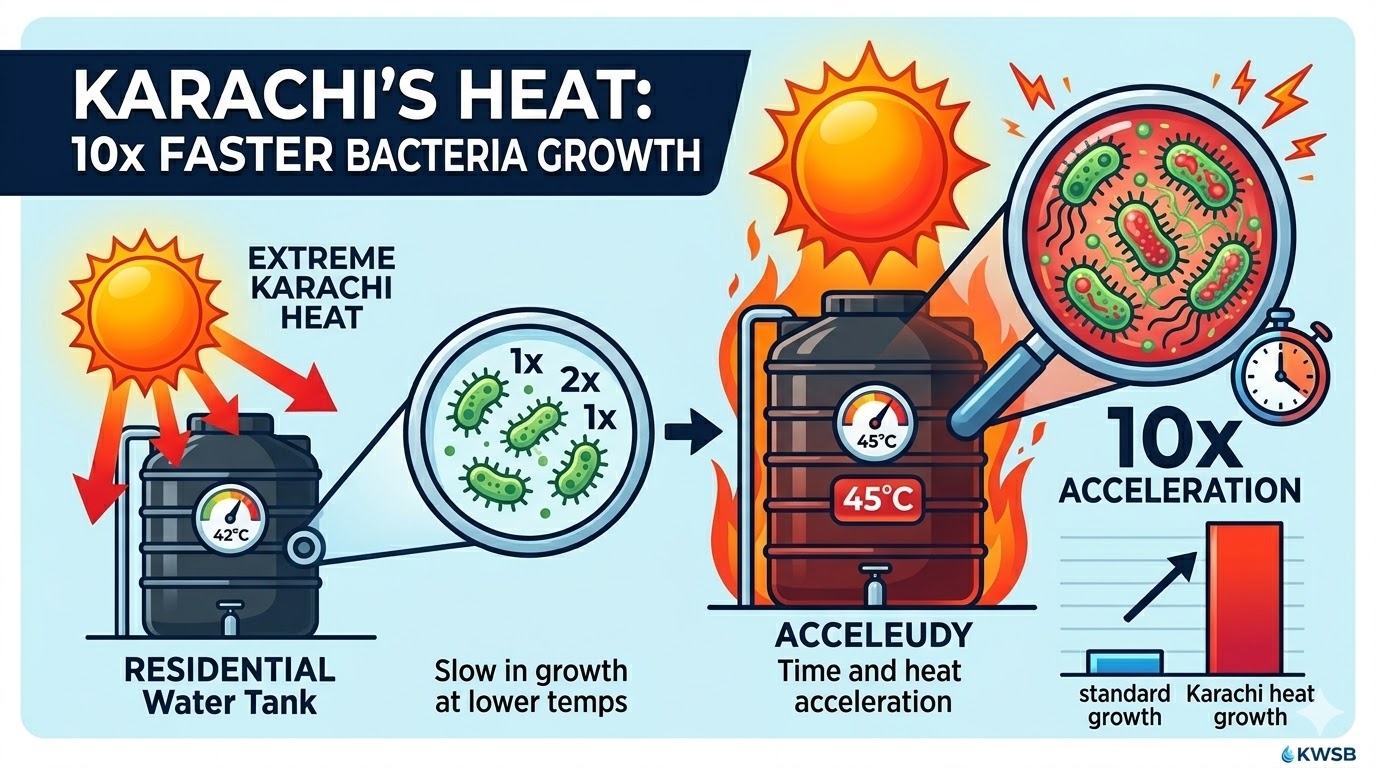
  • Why Karachi’s Heat Makes Bacterial Growth 10x Faster Inside Your Tank And Why Every Karachi Family Needs to Act Before It’s Too Late

    Why Karachi’s Heat Makes Bacterial Growth 10x Faster Inside Your Tank And Why Every Karachi Family Needs to Act Before It’s Too Late

    Picture this: You wake up on a sweltering Karachi morning in May. The temperature outside is already pushing 42°C. You brush your teeth, make chai, and use water for your family — all from your overhead or underground tank. What you cannot see is what is quietly multiplying inside that tank while you sleep.

    Bacteria. Biofilm. Algae. And in Karachi’s specific climate, they are growing at a rate that would alarm even a microbiologist.

    This is not a scare tactic — it is microbiology combined with local geography. Karachi’s unique combination of extreme heat, high humidity during the monsoon, inconsistent municipal water supply, and ageing infrastructure creates what experts describe as a perfect breeding environment for waterborne pathogens.

    In this article, we explain exactly why heat accelerates bacterial growth in water tanks, what makes Karachi uniquely dangerous, and what you must do right now to protect your family.

    The Science: How Heat Supercharges Bacterial Growth

    To understand the threat, you need to understand one basic principle of microbiology: bacteria reproduce faster when the temperature is higher. This is not a subtle difference — it is dramatic and exponential.

    The Doubling Time Effect

    Common waterborne bacteria such as E. coli, Salmonella, Legionella, and Pseudomonas have a phenomenon called “doubling time” — the time it takes for a colony to double in size. Here is how temperature changes everything:

    Bacterial Doubling Time vs. Temperature   20°C (moderate climate):  Doubling time ~60 minutes 30°C (warm climate):       Doubling time ~20 minutes 37°C–42°C (Karachi summer): Doubling time ~10–12 minutes   At 42°C — a temperature Karachi commonly reaches from April through June — a single bacterium can become over 16 million organisms within 4 hours.

    That is the “10x faster” effect in real numbers. When the temperature in your rooftop tank climbs during Karachi’s peak summer, bacterial colonies that might take two days to reach dangerous levels in a cooler climate reach them in a matter of hours.

    The Danger Zone: 25°C to 50°C

    Microbiologists refer to the temperature band between 25°C and 50°C as the “danger zone” for water storage. This is the range in which the most dangerous waterborne pathogens thrive, replicate fastest, and produce the most harmful toxins.

    In Karachi, your rooftop overhead tank sits in direct sunlight for 10–14 hours a day during summer. Water temperature inside these tanks routinely reaches 35°C to 45°C — sitting squarely in the middle of this danger zone.

    Why Karachi Is Uniquely Dangerous: 6 Local Factors

    While bacterial growth in water tanks is a problem across Pakistan, Karachi’s specific conditions make this issue significantly worse than most other cities. Here is what makes our city uniquely vulnerable:

    1. Extreme Temperatures and Direct Sun Exposure

    Karachi is one of the hottest major cities in South Asia. From April to August, temperatures regularly exceed 38°C, with peak days crossing 45°C. Rooftop tanks — the most common water storage solution in Karachi homes and apartment buildings — are exposed to direct sunlight for most of the day.

    A black or dark-coloured plastic tank absorbs heat rapidly. Internal water temperatures can exceed ambient air temperature by 5°C to 10°C. This means when it is 40°C outside in areas like Gulshan-e-Iqbal or Gulistan-e-Johar, your tank water may be sitting at 45°C to 50°C — optimal conditions for pathogen multiplication.

    2. Infrequent Water Supply and Long Stagnation Periods

    Karachi’s municipal water supply from KWSB (Karachi Water and Sewerage Board) is notoriously irregular. Most households receive water once every two to four days. This means water sits stagnant in your tank for 48 to 96 hours at a time — in extreme heat — before being replaced.

    Stagnant, warm water is a breeding ground. The longer water sits without circulation, the faster bacteria proliferate. Unlike running water, stagnant water allows sediment to settle and biofilm to form on tank walls, creating permanent colonies that survive even when fresh water is added.

    3. High Humidity During Monsoon Season

    Karachi’s monsoon season (July to September) brings a secondary threat. High humidity combined with warm temperatures creates ideal conditions for mould, algae, and certain bacteria that thrive in humid environments. Tank lids and inlet pipes are especially vulnerable to contamination during this period, allowing external pathogens to enter the tank.

    Coastal areas such as DHA and Clifton experience higher baseline humidity year-round due to their proximity to the Arabian Sea, making this a persistent challenge rather than a seasonal one.

    4. Aging Infrastructure and Sediment Accumulation

    Many water tanks in Karachi — particularly in older neighbourhoods like PECHS, Nazimabad, Liaquatabad, and Saddar — have not been professionally cleaned in years, or ever. Over time, sediment, rust particles, algae, and organic matter accumulate at the bottom. This sludge layer acts as a nutrient-rich substrate for bacterial colonies, insulating them even when the water above is treated or replaced.

    Heat accelerates the decomposition of this organic matter, producing further nutrients that feed bacterial growth and cause the unpleasant taste and smell many Karachi residents have come to mistakenly accept as “normal.”

    5. Biofilm: The Hidden Enemy

    One of the most dangerous threats in Karachi’s water tanks is biofilm — a thin, slimy layer of bacterial communities that adhere to tank walls, inlets, and outlets. Biofilm is not removed by simply replacing the water or adding chlorine tablets.

    In warm climates like Karachi’s, biofilm develops faster and becomes significantly thicker than in cooler regions. Studies on biofilm formation show that at temperatures above 35°C, biofilm communities can establish themselves on surfaces within 24 to 48 hours. Once established, they release planktonic bacteria back into the water and can resist standard disinfection methods.

    This is why industrial-grade high-pressure jet washing is essential — not optional. Standard bucket-and-brush cleaning, which many informal services in Karachi offer, cannot penetrate or remove biofilm effectively.

    6. Contaminated Municipal Supply as a Starting Point

    The water entering your tank is often already carrying a bacterial load. Karachi’s distribution network has thousands of kilometres of ageing pipes, many of which have leaks and cross-contamination points. By the time water reaches your tank, it may contain bacteria, heavy metals, and other contaminants.

    When contaminated water enters a hot tank, bacterial populations that were already present in small numbers explode into dangerous concentrations within hours. Your tank, in effect, amplifies the contamination it receives.

    The Diseases You Are Risking Right Now

    The bacteria thriving in Karachi’s hot, stagnant water tanks are directly linked to serious, sometimes fatal illnesses. These are not theoretical risks — they are documented public health problems in our city every year:

    • Typhoid Fever: Caused by Salmonella Typhi, typhoid is endemic in Karachi. The bacteria are transmitted primarily through contaminated drinking water and can survive in warm stagnant tanks.
    • Gastroenteritis and Diarrhoea: E. coli and Salmonella strains cause severe diarrhoeal illness, particularly dangerous for children under five and elderly family members. Karachi hospitals report thousands of such cases every summer.
    • Cholera: Vibrio cholerae spreads through faecally contaminated water. Cholera outbreaks in Karachi — particularly in densely populated areas — have been linked to contaminated tank water.
    • Skin and Eye Infections: Pseudomonas and Staphylococcus bacteria in contaminated tank water cause skin rashes, folliculitis, and eye infections — symptoms many Karachi residents experience without connecting them to their water source.
    • Legionnaires’ Disease: Legionella bacteria — which thrive between 25°C and 45°C — can cause a severe form of pneumonia. This pathogen is particularly associated with warm water storage systems and is more common than most people realise.
    A Note on Water Filters    

    Neighbourhood Spotlight: Which Areas of Karachi Are Most at Risk?

    While no part of Karachi is immune, certain neighbourhoods face higher risk due to a combination of tank type, sun exposure, water supply frequency, and building density:

    Gulshan-e-Iqbal and Gulistan-e-Johar

    These densely populated neighbourhoods in Karachi East are home to hundreds of thousands of families living in multi-storey apartments, flats, and townhouses. Rooftop tanks in this area experience prolonged sun exposure, and the irregular KWSB water supply means water routinely sits stagnant for 2–4 days at a time. The combination of heat and stagnation creates severe bacterial accumulation. If you live in this part of the city, our water tank cleaning service in Gulshan and Johar is available throughout the area — from Gulshan blocks to Johar Chowrangi and beyond.

    DHA and Clifton

    The upscale coastal belt of Defence Housing Authority and Clifton presents a different but equally serious challenge. While many properties here are newer, their proximity to the Arabian Sea means persistent humidity — which accelerates tank corrosion, mould growth, and algae formation. Larger residential properties and commercial buildings often have high-capacity storage tanks that have not been cleaned in years despite their premium setting. Our dedicated tank cleaning service in DHA and Clifton uses industrial-grade equipment suited for both large underground reserves and elevated rooftop tanks common in this area.

    PECHS, Nazimabad, North Karachi, and Beyond

    Older residential areas across Karachi Central, West, and South face the additional risk of ageing tank infrastructure. Many concrete underground tanks in these areas have cracks and uneven surfaces that harbour bacteria even after surface cleaning. Sludge accumulation in these tanks can be years old, creating a persistent source of contamination regardless of how frequently fresh municipal water is added.

    How Often Should You Clean Your Tank in Karachi?

    Given Karachi’s heat and water quality challenges, the recommended cleaning frequency is significantly higher than the national average:

    Recommended Cleaning Frequency for Karachi   Residential overhead tanks:  Every 3 months (more often in summer) Underground tanks:           Every 4–6 months Commercial & industrial:     Monthly or quarterly depending on usage Post-monsoon inspection:     Mandatory after every rainy season

    Many Karachi homeowners clean their tanks once a year — or less. In Karachi’s climate, this is far from sufficient. A tank left for 12 months in Karachi’s heat without cleaning can accumulate the same level of contamination as one left for several years in a temperate climate.

    What Professional Cleaning Actually Does (and Why DIY Falls Short)

    This is where the difference between professional and DIY or informal cleaning becomes critical. Many homeowners pour some bleach in the tank, let it sit, and drain it — believing the tank is now clean. It is not.

    Why Standard DIY Methods Fail in Karachi’s Conditions

    • Bleach tablets and chlorine solutions do not penetrate biofilm. They kill bacteria in the water column but leave the biofilm layer on tank walls completely intact, ready to repopulate the water within days.
    • Manual scrubbing with brushes cannot reach corners, inlet pipes, and outlet channels — the exact locations where bacteria concentrate most.
    • Without industrial vacuuming, sludge at the bottom of the tank remains. This sludge is a dense bacterial colony. Adding clean water on top of undisturbed sludge simply re-contaminates the water.
    • Informal services in Karachi often lack the equipment and training to address confined-space underground tank cleaning safely — creating risk for both the workers and the tank structure.

    What Khan Tank Cleaning’s Professional Service Provides

    Khan Tank Cleaning uses a multi-step industrial process specifically designed for Karachi’s challenging conditions:

    • High-Pressure Jet Washing: Industrial-grade pressure washing that reaches every corner, surface, and crevice — removing biofilm, algae, and calcified deposits that manual methods leave behind.
    • Industrial Vacuuming: Complete sludge extraction from the tank floor, leaving no residue that can re-contaminate fresh water.
    • Silver Hydrogen Peroxide Disinfection: A hospital-grade disinfectant that is highly effective against bacteria, viruses, and biofilm — and safe for human consumption. Far more effective than household bleach in Karachi’s heat conditions.
    • Confined Space Safety Systems: For underground tanks, oxygen safety equipment and forced ventilation systems are used — protecting workers while ensuring a thorough deep-clean.
    • All Tank Types: Overhead, underground, plastic, fiber, concrete, stainless steel — all brands including Bestank, Aqua Plus, and Syntex — cleaned to the same professional standard.

    Serving All of Karachi — With Priority Coverage in Key Areas

    Khan Tank Cleaning operates across the entire city from two strategically located branches. Our Gulshan and Johar branch provides priority coverage to Karachi East — including Gulshan-e-Iqbal, Gulistan-e-Johar, FB Area, Malir, Korangi, Shah Faisal Town, and surrounding neighbourhoods. Our DHA and Clifton branch serves the coastal and southern belt — including Defence Housing Authority, Clifton, Saddar, PECHS, Bahadurabad, Zamzama, and adjacent areas.

    Wherever you are in Karachi — from Orangi Town to Bahria Town, from North Karachi to Kemari — our teams are available for both scheduled and emergency service, 24 hours a day, 7 days a week.

    Your Family’s Health Cannot Wait for a Convenient Reminder The heat in Karachi is not going anywhere. And right now, at this very moment, bacteria in your uncleaned tank are doubling every 10–12 minutes. By the time you finish reading this article, the colony count in a neglected tank may have increased by millions. Khan Tank Cleaning is Karachi’s most experienced professional tank cleaning company — the first and only firm dedicated exclusively to this service. We have the equipment, the trained staff, and the local knowledge to protect your family’s water. Book Your Professional Tank Cleaning Today Gulshan & Johar area: Water Tank Cleaning — Gulshan & Johar DHA, Clifton & South Karachi: Water Tank Cleaning — DHA & Clifton Available 24/7  |  All Tank Types  |  Residential & Commercial  |  All Areas of Karachi Khan Tank Cleaning — 0340-2717 530  |  03330293174

    Khan Tank Cleaning is Karachi’s first and most trusted professional water tank cleaning company. Head Office: Suite-203, Mumtaz Manzil, Block-16, Gulshan-e-Iqbal, Karachi. Service available across all areas of Karachi for residential, commercial, and industrial tanks.

  • What Happens During a Professional Tank Cleaning in Karachi? A Behind-the-Scenes Look

    What Happens During a Professional Tank Cleaning in Karachi? A Behind-the-Scenes Look

    If you live in Karachi, you already know how precious water is. Whether it arrives once or twice a week via the KWSB tanker, or flows through municipal lines, virtually every drop that enters your home passes through a storage tank first — either an overhead rooftop tank or an underground sump. Most Karachi homeowners never think twice about what’s sitting inside that tank. The reality, however, might surprise you.

    Sludge, algae, bacterial biofilm, rust particles, and even insect matter can accumulate inside an uncleaned water tank within as little as a few months. The city’s intermittent water supply and hot climate accelerate this process considerably. The water you use to cook, bathe, brush your teeth, and give your children is filtered through that tank — and no filter in the world can fully compensate for a contaminated storage source.

    So what actually happens when a professional team shows up at your door? What do they do, what equipment do they use, and why does it matter so much for your family’s health? In this article, we take you through the entire process — step by step, behind the scenes — so you know exactly what you’re paying for and why it’s worth every rupee.

    Why Karachi’s Water Tanks Get Dirty Faster Than You Think

    Before we dive into the cleaning process, it’s important to understand why Karachi homes face a higher-than-average risk of water tank contamination. Several local factors combine to create a perfect breeding ground for bacteria and sludge:

    • Irregular supply: When water arrives in bursts, it stirs up sediment that has settled at the bottom of the tank, spreading it throughout the stored water.
    • Hard water: Karachi’s water supply is notoriously high in minerals, leading to rapid scale and sediment buildup on tank walls and floors.
    • Extreme heat: Temperatures regularly exceeding 40°C in summer create ideal conditions for algae growth and bacterial multiplication.
    • Dust and pollution: Tank lids that are not fully sealed — common in older buildings across Gulshan-e-Iqbal, Orangi Town, and Lyari — allow dust, insects, and environmental pollutants to enter.
    • Ageing infrastructure: Many residential buildings in older parts of the city have underground concrete tanks that are decades old and prone to seepage and biofilm buildup in porous walls.

    Given these conditions, experts recommend cleaning your water tank at least every six months in Karachi — and more frequently for families with children, elderly members, or anyone with a compromised immune system.

    Step 1: Pre-Cleaning Inspection — The Foundation of a Good Job

    The first thing a properly trained professional team does is not start spraying water around. They begin with a thorough inspection.

    Our teams at Khan Tank Cleaning arrive with the equipment and training to assess your tank before a single drop is drained. This includes checking the tank type (overhead plastic, underground concrete, fiber, or stainless steel), evaluating the inlet and outlet valves, looking for cracks or leaks, and assessing the level and nature of contamination inside. This step determines the cleaning approach, the chemicals required, and the safety precautions necessary — particularly for underground tanks, which are classified as confined spaces.

    For homeowners in areas like Gulshan-e-Iqbal, Gulistan-e-Johar, and FB Area, the majority of residential setups involve a combination of an underground sump (where the main supply is stored) and an overhead plastic tank. Both require different techniques and both are covered in a single visit when you book our dedicated water tank cleaning service in Gulshan and Jauhar Karachi.

    Step 2: Draining — Getting Rid of Contaminated Water Properly

    Once the inspection is complete, the next step is fully draining the tank. This sounds simple, but it’s a critical stage where amateur services often cut corners.

    The contaminated water at the bottom of your tank — laden with sludge, sediment, bacteria, and debris — must be completely removed. Our teams use high-powered submersible pumps to drain the tank entirely, including the sludge layer that settles at the floor. This thick layer is where the highest concentration of harmful microorganisms lives. Leaving even a thin film of it behind before re-filling is one of the most common mistakes made by untrained workers.

    For underground tanks in Karachi — which can hold anywhere from 1,000 to over 10,000 litres — this process requires the right equipment and, critically, the right safety protocols. Underground confined spaces can develop dangerous oxygen-deficient atmospheres or accumulate toxic gases. Our teams working in areas such as DHA, Clifton, PECHS, and Zamzama are equipped with oxygen safety systems and forced ventilation to ensure worker safety. If you live in those areas, our professional tank cleaning services in DHA and Clifton Karachi are specifically designed to handle the mix of large residential bungalows, apartments, and commercial buildings common to those localities.

    Step 3: Industrial Vacuuming — Removing What Draining Cannot

    After draining, a residue of sludge, sand, algae, and sediment remains stuck to the walls, corners, and floor of the tank. This is where professional services diverge sharply from what a local handyman or maid might attempt with a bucket and mop.

    Khan Tank Cleaning uses industrial-grade vacuum systems specifically designed for water tank interiors. These machines suck out every trace of residual sludge and particulate matter from corners, floor seams, and wall surfaces. Manual scrubbing alone simply cannot access all areas and inevitably leaves behind contaminated residue — which then begins re-contaminating your fresh water from day one.

    This step is one of the most visually striking for homeowners who choose to observe the process. The amount of black or brown sludge extracted from a tank that appears ‘fairly clean’ from the outside is often shocking — and an immediate reminder of what has been passing through household taps.

    Step 4: High-Pressure Jet Washing — Deep-Cleaning the Tank Interior

    With the bulk of sludge vacuumed out, our teams move to high-pressure jet washing — arguably the most important mechanical cleaning stage. Industrial-grade pressure washers blast water at high velocity across all interior surfaces: walls, floor, ceiling (for overhead tanks), and any structural features like columns or reinforcement bars in concrete underground tanks.

    The high-pressure jet physically dislodges biofilm, algae colonies, mineral scale, and embedded contaminants that no amount of manual scrubbing could reach. This is especially important for:

    • Older underground concrete tanks found in properties in North Nazimabad, Nazimabad, Liaquatabad, and similar established neighbourhoods, where porous concrete walls harbour deep-rooted bacterial communities.
    • Plastic overhead tanks (such as Bestank, Aqua Plus, and similar brands) common in apartment buildings across Gulistan-e-Johar, Block 14, and Scheme 33, where algae tends to develop in the roof-heat-exposed walls.
    • Fiber and fibreglass tanks used in newer constructions across DHA Phases and Clifton, which require careful non-abrasive jet washing to avoid surface damage.

    Many small operators in Karachi skip this step entirely or use domestic garden hoses that lack the pressure to actually clean. This is one of the key differences in the service quality that separates a genuinely professional company from a side-hustle operation.

    Step 5: Disinfection — The Stage That Protects Your Family’s Health

    This is the most technically important step in the entire process — and the one that most directly affects your family’s health outcomes.

    After the tank has been physically cleaned, it still contains microorganisms that cannot be removed by vacuuming or jet washing alone. Bacterial biofilm, in particular, forms a protective matrix on surfaces that survives physical cleaning unless specifically targeted with the right chemical agents.

    At Khan Tank Cleaning, our primary disinfectant is Silver Hydrogen Peroxide — a professional-grade, potable-water-safe disinfectant that is highly effective against bacteria, viruses, and biofilm while being completely safe for human consumption. Unlike harsh industrial acids or chlorine bleach used by some operators in Karachi, Silver Hydrogen Peroxide does not damage your tank’s structure, does not leave harmful residues, and does not affect the taste of your water.

    The disinfectant is applied to all internal surfaces and left to act for a specific dwell time — then the tank is rinsed thoroughly before being closed and prepared for refilling. For cases requiring stronger sanitization (such as tanks where waterborne illness has already occurred in the household), a secondary disinfection protocol is also available.

    Whether you are booking our tank cleaning service in the Gulshan and Jauhar belt or our specialist cleaning for homes and businesses in DHA and Clifton, the same rigorous disinfection protocol applies — no shortcuts, no compromises.

    Step 6: Post-Cleaning Inspection and Water-Safety Confirmation

    A professional job does not end when the disinfectant is applied. Before the tank is sealed and refilling begins, our technicians carry out a final inspection of the interior to confirm:

    1. All sludge and sediment has been fully removed
    2. No visible biofilm, algae, or scale remains on walls and floor
    3. The disinfectant has been properly applied and rinsed
    4. Inlet and outlet valves are functioning correctly
    5. Tank lid/cover is properly sealed to prevent re-contamination

    This final check is something the homeowner is always welcome to observe — and we encourage it. Transparency is part of what makes a professional service genuinely professional.

    What Types of Tanks Does Khan Tank Cleaning Service?

    Karachi’s housing stock is remarkably diverse, and so are its water storage systems. Khan Tank Cleaning’s teams are trained and equipped to handle all major types:

    • Underground concrete tanks — Common in older homes, bungalows, and large apartment buildings in areas like PECHS, Saddar, North Nazimabad, and Lyari. Require confined-space safety systems.
    • Overhead plastic tanks (Bestank, Aqua Plus, Master, etc.) — Widely used across mid-rise apartments and houses throughout Gulshan-e-Iqbal, Gulistan-e-Johar, Malir, and Shah Faisal Town.
    • Fiber/fibreglass tanks — Increasingly popular in newer constructions in DHA phases and Bahria Town Karachi. Require non-abrasive cleaning techniques.
    • Stainless steel tanks — Found in commercial properties, high-end residential buildings, and hospitals across Clifton and Zamzama. Require specialised non-abrasive cleaning.
    • Boring/borehole water tanks — Common where families supplement KWSB supply with underground bore water. These tanks often have higher sediment loads and require more intensive cleaning cycles.

    How Often Should You Schedule a Professional Tank Clean in Karachi?

    The general international recommendation is every six months. For Karachi specifically, given the water quality challenges outlined above, we recommend:

    • Every 3 months for households with infants, young children, elderly members, or anyone with weakened immunity
    • Every 4–6 months for the average urban Karachi household
    • Every 6 months minimum for commercial properties, offices, and small businesses
    • Immediately if household members have experienced unexplained gastrointestinal illness, if you notice discoloration or odour in tap water, or if your tank has not been cleaned in over a year

    If your tank has not been professionally cleaned in the last twelve months, it is almost certainly overdue — regardless of how the water looks or smells. Many of the most dangerous waterborne pathogens are colourless and odourless.

    Karachi’s Water Reality: Numbers That Should Concern Every Homeowner

    The urgency is not theoretical. Waterborne diseases — including typhoid, cholera, hepatitis A, and gastroenteritis — remain among the leading causes of hospitalisation in Karachi. The city’s water distribution infrastructure, while gradually improving, still delivers water that carries bacteria and contamination risk. The storage tank in your home is both the last line of defense and, if poorly maintained, the source of illness itself.

    A clean tank does not just protect against disease. It also:

    • Extends the lifespan of your water filters, purifiers, and household appliances by reducing sediment load
    • Reduces bad taste and odour that Karachi homeowners often attribute to the supply rather than the storage
    • Lowers the bacterial load on your water purifier, making it more effective at the point of use
    • Protects structural integrity of older underground tanks where biofilm accelerates concrete corrosion

    Why Choose Khan Tank Cleaning? What Sets Us Apart

    Not all tank cleaning services in Karachi are equal. Many operate as side businesses, sending general workers without specialized training or proper equipment. Here is what differentiates Khan Tank Cleaning:

    • Dedicated, specialized company: We are focused exclusively on water tank cleaning — it is not a side offering. This specialization means our teams have years of hands-on experience that general cleaning or fumigation companies cannot match.
    • Industrial equipment: High-pressure jet washers, industrial vacuum systems, oxygen safety equipment for confined spaces, and full PPE for our workers.
    • Safe, certified disinfectants: Silver Hydrogen Peroxide as the primary disinfectant — potable-water-safe, effective, and non-corrosive. We do not use harsh industrial acids that damage tanks.
    • 24/7 availability: Available for both scheduled and emergency bookings, seven days a week.
    • Two dedicated service branches: Serving all of Karachi with priority response in their respective zones — so you get faster service from a team that knows your neighbourhood.

    Our Gulshan-Jauhar branch prioritizes rapid response for residents and businesses across Gulshan-e-Iqbal, Gulistan-e-Johar, FB Area, North Nazimabad, Scheme 33, and surrounding areas. Our DHA-Clifton branch provides specialized services for the diverse residential and commercial tank types found across DHA Phases 1–8, Clifton, PECHS, Saddar, Zamzama, Bahadurabad, and neighbouring localities.

    Book Your Professional Tank Clean Today — Your Family’s Health Depends on It

    When did you last have your water tank professionally cleaned? If you’re not sure — or if the answer is ‘more than six months ago’ — then the answer is: it’s overdue.

    Every day your tank goes uncleaned is another day of potential contamination flowing through your taps. In a city with Karachi’s water challenges, that is a risk no family should take. The good news is that a professional clean takes just a few hours, causes minimal disruption to your daily routine, and delivers results that last months.

    Khan Tank Cleaning is available 24 hours a day, 7 days a week. Our teams are ready to visit your home or business, assess your tank, and deliver a complete clean using industrial equipment and certified disinfectants.

    📍 Live in Gulshan, Jauhar, FB Area, or surrounding areas? Book with our dedicated Gulshan-Jauhar water tank cleaning team for priority service near you.

    📍 Based in DHA, Clifton, PECHS, Saddar, or nearby? Our DHA and Clifton professional tank cleaning specialists are equipped for every tank type in your area.

    📞 Call Us Now: 0340-2717 530 | 03330293174

    Available 24/7 · Serving All Areas of Karachi · Residential & Commercial

    Clean water starts with a clean tank. Don’t wait for a health crisis to remind you — take action today.

    — Khan Tank Cleaning | Karachi’s Dedicated Water Tank Cleaning Specialists

  • We Cleaned 7,000+ Homes in Karachi — Here’s What We Always Find

    We Cleaned 7,000+ Homes in Karachi — Here’s What We Always Find

    Over the years, our teams at Khan Tank Cleaning have entered thousands of homes across Karachi — from high-rise apartments in Gulshan-e-Iqbal and Gulistan-e-Jauhar to bungalows and commercial plazas in DHA and Clifton. We have cleaned over 7,000 tanks — overhead, underground, plastic, concrete, and fiberglass — and in every single job, there is a pattern to what we find inside.

    What we discover inside those tanks is shocking, even to us. And if you have not had your tank professionally cleaned in the last six months, the chances are very high that what we describe below is sitting in your water supply right now.

    1. A Black or Dark Brown Sludge Layer at the Bottom

    This is the single most common finding in Karachi’s water tanks. No matter the neighbourhood — Gulberg, PECHS, North Nazimabad, or Malir — there is almost always a thick layer of sludge at the bottom of the tank.

    Karachi’s water supply is intermittent. Water arrives once or twice a week through KW&SB tankers or municipal lines, and during the journey, it picks up sediment, rust, and suspended particles. Over weeks and months, all of that settles at the bottom of your tank and hardens into a dark, foul-smelling sludge.

    This sludge is a breeding ground for bacteria. When you draw water from the tank for cooking or drinking, you are mixing that sludge back into your supply. Boiling helps, but it does not remove the heavy metal sediment or neutralise all the biofilm already present.

    Why This Matters for Karachi Homes The KWSB water supply passes through aging infrastructure. By the time water reaches your tank, it has already collected significant particulate matter. Without regular professional cleaning, your tank is essentially a settling basin for Karachi’s water quality problems.

    2. Algae and Green or Black Biofilm on Tank Walls

    If your tank receives any indirect light — even a small crack in the lid or a semi-transparent plastic body — algae will grow. We regularly find tanks coated in green or black biofilm, especially overhead plastic tanks that sit under direct sun on Karachi rooftops for years on end.

    The heat is relentless in Karachi — rooftop temperatures in summer often exceed 50°C. This does not kill algae; it actually accelerates its growth. Certain algae species thrive in warm, still water. The biofilm they form coats the interior walls and is nearly impossible to remove with a bucket and mop, which is how many informal cleaners still approach the job.

    At Khan Tank Cleaning, we use industrial-grade high-pressure jet washing systems specifically because regular manual scrubbing cannot eliminate deep-rooted algae and biofilm. We have seen tanks where the growth was several millimetres thick — invisible when you look in from the top, but present all the same.

    3. Rusty Water and Corroded Inlet Pipes

    For homes with older concrete underground tanks or steel overhead tanks, corrosion is a near-certainty. We regularly find rusted inlet and outlet pipe fittings, crumbling cement interior surfaces, and iron-rich red-brown residue coating the base of the tank.

    This is a particularly common issue we encounter when serving older residential areas — parts of Nazimabad, Liaquatabad, and Saddar, where tanks have been in place for decades without replacement. But it also affects newer builds where cheap iron fittings have been used without corrosion protection.

    Rust contamination in drinking water is associated with gastrointestinal irritation and long-term health effects from heavy metal ingestion. If your water ever has a slight metallic taste or a reddish tinge, this is almost certainly the cause.

    4. Insect and Rodent Entry Points

    You would be surprised — or perhaps horrified — at how many tanks we open to find evidence of insects, lizards, or even small rodents that have entered through improperly sealed lids or cracked covers.

    Karachi’s heat and water scarcity mean insects actively seek water sources. Cockroaches, mosquito larvae, and small invertebrates are common findings, particularly in tanks with damaged or missing lids. This is not a hygiene issue that filters or purifiers can fully compensate for — the contamination happens at the source, inside the tank itself.

    This is a finding we frequently encounter in apartment buildings across Gulshan-e-Iqbal, Gulistan-e-Jauhar, and surrounding localities where multi-storey buildings share overhead tanks with rooftop access points that are rarely inspected.

    5. Incomplete or No Disinfection After Previous Cleaning

    When customers tell us their tank was “cleaned recently,” we often find that it was merely rinsed and scrubbed — with no chemical disinfection applied afterwards. This is one of the most dangerous situations we encounter.

    Scrubbing without disinfection stirs up bacteria and biofilm without killing them. In some cases, the tank is actually in a worse state than if nothing had been done, because the disturbance causes bacterial cells to disperse into the water column.

    At Khan Tank Cleaning, we use Silver Hydrogen Peroxide as our primary disinfectant — a hospital-grade solution specifically approved for potable water systems. It is highly effective against bacteria, viruses, and biofilm while being completely safe for human consumption. This is especially important in Karachi, where water carries heavy microbial loads due to the state of the distribution infrastructure.

    Our Standard Disinfection Protocol Every tank we clean undergoes: (1) Full draining and sludge removal using industrial vacuum systems, (2) High-pressure jet washing of all surfaces, (3) Manual scrubbing of corners and joints, (4) Silver Hydrogen Peroxide disinfection, and (5) A final inspection before the tank is refilled. Shortcuts are never taken.

    6. Tanks That Have Not Been Cleaned in Years — Or Ever

    We have walked into homes in every corner of Karachi where the family has lived for 5, 10, even 15 years and has never once had their tank professionally cleaned. In some cases, the tank has not been cleaned since the building was constructed.

    This is not negligence — it is a lack of awareness. Many Karachi homeowners simply do not know that tank cleaning is necessary, or they assume that because they use a water filter, the tank does not matter. Water filtration systems treat the water at the point of use, but they do not clean the contamination source. A dirty tank will continuously re-contaminate even filtered water if the supply line passes through it.

    The World Health Organisation recommends that household water storage tanks be cleaned and disinfected at least once every six months. For Karachi, where water quality from supply lines is especially variable, we recommend cleaning every three to four months for families with children, elderly members, or anyone with compromised immunity.

    Why Karachi Is a Unique Case

    Most guides to water tank hygiene are written for cities with reliable, clean municipal water supplies. Karachi is different. Our city faces a combination of factors that make tank contamination faster and more severe than average:

    • Intermittent water supply — tanks sit stagnant for days, allowing bacteria to multiply
    • Extreme heat — Karachi summers accelerate algae growth and chemical changes in stored water
    • Aging infrastructure — pipes and distribution lines introduce additional contamination before water reaches your tank
    • High-density urban living — apartments with shared tanks mean one contaminated tank affects many families
    • Frequent use of tanker water — private tankers are often unregulated and can carry significantly higher bacterial loads than municipal supply

    These factors make professional, regular tank cleaning not a luxury service — it is a genuine public health necessity for Karachi households.

    We Serve All of Karachi — With Two Dedicated Branches

    Khan Tank Cleaning operates two fully equipped service branches to ensure fast, responsive service across the city:

    Branch 1 — Gulshan, Jauhar & East Karachi

    Our water tank cleaning service for Gulshan-e-Iqbal, Gulistan-e-Jauhar, and surrounding areas covers Gulshan-e-Iqbal, Gulistan-e-Jauhar, FB Area, North Nazimabad, Nazimabad, Liaquatabad, Korangi, Malir, Shah Faisal Town, Landhi, Gulshan-e-Maymar, and all neighbouring localities. If you live in East or Central Karachi, this is your closest point of contact.

    Branch 2 — DHA, Clifton & South Karachi

    Our professional tank cleaning team for DHA and Clifton serves Defence Housing Authority (DHA), Clifton, PECHS, Saddar, Bahadurabad, Zamzama, Tariq Road, Karachi Cantonment, Bahria Town Karachi, and all areas in South and South-West Karachi. We are available 24/7 for both scheduled appointments and emergency call-outs.

    Both branches are equipped with industrial-grade high-pressure jet systems, vacuum sludge extractors, Silver Hydrogen Peroxide disinfectant, and full confined-space safety equipment for underground tanks.

    We Clean Every Type of Water Tank

    Whether your building has a rooftop plastic tank, an underground concrete chamber, a fiberglass Syntex tank, or a stainless-steel commercial unit, our teams have the training and equipment for it:

    • Overhead plastic tanks (Bestank, Aqua Plus, and all imported brands)
    • Underground concrete tanks (with full confined-space oxygen safety systems)
    • Fiberglass tanks (Syntex, Bestank Fiber, and all fiberglass varieties)
    • Stainless steel commercial tanks
    • Large industrial and housing society bulk storage tanks

    From a single 500-litre residential tank to a 100,000-litre industrial storage system, we scale our team and equipment to the job.

    Do Not Wait Until Someone Falls Ill. Book Your Tank Cleaning Today.

    After cleaning over 7,000 tanks across Karachi, we can tell you this with complete confidence: the vast majority of water tanks in this city are overdue for a professional clean. The problems — sludge, biofilm, insects, corrosion, incomplete disinfection — are not visible from the outside. They build up silently. And the consequences show up not in the tank, but in the health of your family.

    Waterborne illnesses — diarrhoea, typhoid, cholera, skin infections, gastrointestinal disease — are among the most common health complaints in Karachi. Many of these cases trace back to contaminated household water storage. You cannot control the quality of water arriving through the pipeline, but you can control what happens inside your tank.

    If you live in Gulshan, Jauhar, FB Area, North Nazimabad, Korangi, or anywhere in East Karachi, book your professional water tank cleaning service here. If you are in DHA, Clifton, PECHS, Saddar, or anywhere in South Karachi, our DHA & Clifton branch is ready to serve you.

    We are available 24 hours a day, 7 days a week. Our teams are on the ground across Karachi. Call us now at 0340-2717 530 or 0333-0293174 — and let us show you what we find in your tank, and what a truly clean tank looks and smells like.

    Khan Tank Cleaning — Karachi’s Most Experienced Professional Tank Cleaning Service Serving 7,000+ homes & businesses across Karachi  |  Available 24/7  |  Industrial equipment  |  Safe disinfection chemicals  |  All tank types  |  Both overhead & underground  |  Residential, commercial & industrial
  • Silver Hydrogen Peroxide: The Chemical That Makes Your Tank 99.9% Bacteria-Free

    Silver Hydrogen Peroxide: The Chemical That Makes Your Tank 99.9% Bacteria-Free

    If you live in Karachi, you already know that water supply is never guaranteed. Whether you are in Gulshan-e-Iqbal, Gulistan-e-Jauhar, DHA, Clifton, or anywhere across the city, your household depends on a stored water tank — sometimes for days at a stretch. But here is the uncomfortable truth that most homeowners never consider: your water tank could be the single biggest health hazard in your home.

    Bacteria, algae, sludge, and biofilm do not need much of an invitation. A dark, damp tank that goes uncleaned for months is the perfect breeding ground. And once they are in your water supply, they go directly into your drinking water, cooking water, and bathing water.

    So what is the solution? Professionals worldwide — and right here in Karachi — are turning to one powerful chemical: Silver Hydrogen Peroxide (AgH₂O₂). In this article, we break down exactly what this compound is, how it works, why Karachi households specifically need it, and what to look for when booking a professional tank cleaning service.

    What Is Silver Hydrogen Peroxide?

    Silver Hydrogen Peroxide is a stabilised disinfectant that combines two powerful antimicrobial agents: hydrogen peroxide (H₂O₂) and colloidal silver (Ag). On its own, hydrogen peroxide is a strong oxidising agent capable of destroying bacterial cell walls. Colloidal silver, on the other hand, is a well-documented antimicrobial that interferes with bacterial enzymes and DNA replication.

    When these two are combined into a single compound, the result is a synergistic disinfectant far more potent than either element alone. The silver acts as a stabiliser that extends the active life of the hydrogen peroxide, while simultaneously adding its own continuous antimicrobial action.

    Key Properties at a Glance:

    • Broad-spectrum efficacy: Destroys bacteria, viruses, fungi, and biofilm.
    • Safe for potable water: Approved for use in drinking water systems at correct concentrations.
    • No harmful residue: Breaks down into water and oxygen — zero toxic byproducts.
    • Biofilm penetration: Penetrates deep into microbial communities that chlorine often misses.
    • Long-lasting action: Silver ions continue working even after the initial application.

    Why Karachi Homes Face a Higher Bacterial Risk Than Most Cities

    Karachi’s water supply situation is unique — and uniquely challenging. The city receives water through the Karachi Water and Sewerage Board (KWSB), with supply often available only once or twice a week in many neighbourhoods. This means every household must store large quantities of water in overhead or underground tanks, sometimes for five to seven days at a time.

    This extended storage creates the ideal conditions for microbial growth. Consider what researchers and health officials consistently highlight about Karachi’s water chain:

    • Intermittent supply lines create negative pressure in pipes, which can suck in contaminants from surrounding soil.
    • Aging infrastructure in older neighbourhoods means that cross-contamination between water and sewage lines is not uncommon.
    • High ambient temperatures in Karachi — particularly between April and October — accelerate bacterial multiplication in stagnant stored water.
    • Frequent power cuts mean water often sits in tanks without circulation for extended periods.
    • Saltwater intrusion in coastal areas like Clifton, DHA, and Keamari can introduce additional mineral deposits and microbial load into underground tanks.

    Areas like Gulshan-e-Iqbal, Gulistan-e-Jauhar, Federal B Area, and North Nazimabad — which have high population density and older pipe networks — face particularly acute risks. Meanwhile, upscale areas like DHA and Clifton are not immune either: larger tanks, rooftop installations, and long storage durations mean bacteria have plenty of time and space to colonise.

    This is precisely why families in East Karachi rely on our dedicated water tank cleaning service in Gulshan and Jauhar, while residents of Defence and Clifton trust our specialised water tank cleaning service in DHA and Clifton — both branches operating with the same professional standard, same equipment, and same Silver Hydrogen Peroxide disinfection protocol.

    How Silver Hydrogen Peroxide Eliminates Bacteria: The Science

    Understanding the mechanism helps you appreciate why not every cleaning job is equal. When Silver Hydrogen Peroxide is applied inside a cleaned tank, it works through multiple simultaneous pathways:

    1. Oxidative Cell Destruction

    The hydrogen peroxide component releases reactive oxygen species (free radicals) on contact with biological matter. These free radicals aggressively attack the lipid membranes and proteins that form bacterial cell walls. The structural integrity of the bacteria collapses within seconds of exposure, causing immediate cell death.

    2. Silver Ion Disruption

    Silver ions (Ag⁺) are released into the water and attach themselves to bacterial enzymes. This disrupts the metabolic processes the bacteria rely on to survive and reproduce. Critically, silver ions remain active in the water even after the hydrogen peroxide has dissipated — providing a continuing antimicrobial shield.

    3. Biofilm Destruction

    Biofilm is arguably the most dangerous element in a neglected water tank. It is a structured community of bacteria encased in a self-produced polymer matrix — essentially a bacterial fortress. Regular cleaning agents and even chlorine frequently fail to penetrate this matrix. Silver Hydrogen Peroxide is one of the few disinfectants documented to effectively break down biofilm structures, exposing the bacteria within to direct oxidative attack.

    4. Virus and Fungal Elimination

    While bacteria get most of the attention, tanks in Karachi can also harbour waterborne viruses and fungi. Silver Hydrogen Peroxide has demonstrated efficacy against a broad range of pathogens including E. coli, Salmonella, Staphylococcus, Pseudomonas, Legionella, Aspergillus, and various enteric viruses — all of which have been linked to waterborne disease outbreaks in urban Pakistan.

    The 99.9% Result

    When applied correctly — at the right concentration, after proper physical cleaning of the tank interior — Silver Hydrogen Peroxide achieves microbial reduction rates of 99.9% or greater. This is the standard that professionally trained technicians aim for. It is worth noting that the chemical alone is not enough: the physical removal of sludge, algae, and sediment must come first. A disinfectant applied to a dirty surface cannot work effectively — which is exactly why Khan Tank Cleaning combines high-pressure jet washing and industrial vacuuming before any chemical treatment.

    Silver Hydrogen Peroxide vs. Chlorine: Why the Comparison Matters

    Many tank cleaning services in Karachi still use chlorine-based disinfectants as their primary sanitisation method. While chlorine has a long history in water treatment, it has significant limitations when used in household tank cleaning:

    • Chlorine struggles with biofilm: It does not penetrate the protective polymer layer that biofilm bacteria produce.
    • Chlorine degrades rapidly: Its disinfecting action stops quickly, leaving no residual protection.
    • Chlorine byproducts: When chlorine reacts with organic matter in tanks, it can produce trihalomethanes (THMs) — compounds classified as potentially carcinogenic at prolonged exposure.
    • Odour and taste: High chlorine doses can leave unpleasant smells and flavours in stored water.

    Silver Hydrogen Peroxide avoids all of these issues. It leaves no carcinogenic byproducts, has no lasting taste or odour impact when properly diluted, and its residual silver action provides ongoing protection between cleanings.

    For Karachi families storing water for extended periods between supply cycles, this residual action is especially valuable. It means that water stored in a properly disinfected tank remains safer for longer.

    Is Silver Hydrogen Peroxide Safe for My Family?

    This is the most common question we hear from homeowners — and it is completely understandable. You want a chemical that is tough on bacteria but harmless to your family.

    The answer is yes — at professionally applied concentrations, Silver Hydrogen Peroxide is safe for potable water systems. Here is why:

    • WHO-approved chemistry: Both hydrogen peroxide and silver ions are recognised in international guidelines for water treatment when used within approved concentration limits.
    • Clean breakdown: Hydrogen peroxide breaks down entirely into water (H₂O) and oxygen (O₂). There are no toxic residues.
    • Silver at safe trace levels: The silver ions present after proper disinfection are at levels far below any health concern thresholds — comparable to natural trace silver levels found in some drinking water sources.
    • No re-contamination risk: Unlike some industrial acids used by untrained cleaners, Silver Hydrogen Peroxide does not damage tank materials or introduce new contaminants into your water supply.

    What matters critically is correct application by trained professionals. This is not a product to be purchased and self-applied by homeowners. The concentration, contact time, and post-treatment rinse protocols must be followed precisely to ensure safety and effectiveness. At Khan Tank Cleaning, every technician is trained in Silver Hydrogen Peroxide application protocols for both overhead and underground tank systems.

    The Complete Tank Cleaning Process: What Should Actually Happen

    Silver Hydrogen Peroxide is the final and most critical step — but a professional tank clean is a multi-stage process. If any cleaning service skips the earlier steps and just sprays a disinfectant, your tank is not properly cleaned. Here is the full process that Khan Tank Cleaning follows:

    1. Complete Drainage: All stored water is fully drained from the tank.
    2. High-Pressure Jet Washing: Industrial-grade jet systems blast loose deposits, algae, rust stains, and accumulated sludge from all surfaces. This step is critical — many small local services in Karachi skip this and rely only on manual scrubbing, which misses corners, joints, and wall surfaces.
    3. Industrial Vacuum Extraction: Loosened debris and sludge is removed entirely from the tank using industrial vacuum systems. Traditional methods leave sludge residue on the floor of the tank, which immediately begins re-contaminating the water when refilling starts.
    4. Surface Inspection: Technicians inspect for cracks, algae re-growth points, rust, and any structural issues that could affect water quality.
    5. Silver Hydrogen Peroxide Application: The disinfectant is applied at the correct concentration across all interior tank surfaces. Contact time is observed strictly to ensure maximum microbial kill.
    6. Final Rinse and Inspection: The tank is rinsed, inspected, and cleared for refilling.

    For underground tanks in areas like Gulshan, Jauhar, FB Area, and North Nazimabad, additional safety protocols apply — including confined space entry procedures, oxygen monitoring equipment, and forced ventilation systems. Our dedicated Gulshan-Jauhar water tank cleaning team is fully equipped for underground tank work in East Karachi’s densely built neighbourhoods.

    How Often Should Karachi Households Clean Their Tanks?

    The general recommendation from water safety professionals is a minimum of every six months. However, for Karachi specifically, we recommend every three to four months for households that experience the following conditions:

    • Water supply arrives heavily turbid or discoloured
    • Tank is located outdoors and exposed to direct sunlight (accelerates algae growth)
    • Water is stored for more than four days at a stretch between supply cycles
    • Family members have experienced repeated stomach ailments, diarrhoea, or skin rashes with no other identified cause
    • Tank has not been cleaned in over six months
    • Property is near construction, industrial activity, or areas with known groundwater contamination

    For commercial properties — offices, apartment buildings, schools, hostels, factories — more frequent cleaning is often necessary given the higher volume of users and the greater daily throughput of water. Our professional tank cleaning service covering DHA, Clifton, and surrounding areas handles commercial accounts across the southern and coastal zones of Karachi, with flexible scheduling to minimise disruption to your operations.

    Red Flags: Signs Your Tank Urgently Needs Professional Cleaning

    Do not wait for a scheduled cleaning if your household is experiencing any of the following warning signs:

    • Unusual smell or taste: Musty, earthy, or sulphuric odours are classic signs of bacterial activity or algae growth.
    • Visible discolouration: Green, brown, or black deposits on tank walls or lid edges indicate algae or mould.
    • Slippery or slimy tank walls: This is almost certainly biofilm — a structured bacterial colony that requires professional chemical treatment to eliminate.
    • Repeated waterborne illness: If multiple family members experience stomach problems after drinking tap water, the tank is a primary suspect.
    • Insects or sediment in tap water: Visible foreign matter in water coming from household taps is an urgent sign of tank contamination.
    • More than six months since last professional cleaning: Even if there are no visible signs, bacterial colonies can exist in concentrations that pose health risks before they are detectable by smell or sight.

    If you are based in the eastern districts — Gulshan-e-Iqbal, Gulistan-e-Jauhar, Korangi, Landhi, Malir, Shah Faisal Town, or Federal B Area — reach out to our Gulshan and Jauhar branch for urgent tank cleaning service. For residents and businesses in DHA Phase 1-8, Clifton, PECHS, Zamzama, Saddar, Keamari, or Bahria Town Karachi, our DHA and Clifton branch is available 24/7 including emergency same-day service.

    What to Look for When Hiring a Tank Cleaning Service in Karachi

    Unfortunately, the tank cleaning market in Karachi has a significant number of informal operators who offer cheap prices but deliver poor results. Here is what distinguishes a professional service from a casual one:

    • Industrial equipment: High-pressure jet washers and industrial vacuums — not buckets and brushes.
    • Verified disinfectants: Specifically Silver Hydrogen Peroxide or verifiable potable-water-grade disinfectants — not unbranded ‘chemicals’ of unknown origin.
    • Trained technicians: Staff who understand confined space safety for underground tanks, and who can explain the products they are using.
    • No harsh industrial acids: Some operators use industrial-grade acids that damage tank structure, corrode fittings, and leave chemical residues. This is an immediate disqualifier.
    • Transparent pricing: A trustworthy company will give you a clear quote based on tank size and type — not a vague ‘cheap’ price that inflates on arrival.
    • Availability: A dedicated tank cleaning company with 24/7 availability and clear contact points — not a side-job operation with unreliable response times.

    Book Your Professional Tank Cleaning Today — Don’t Wait Until Someone Falls Ill

    Karachi’s water challenges are real and they are not going away. But while you cannot control what happens to the water in the municipal supply lines, you absolutely can control what lives in your water tank. Silver Hydrogen Peroxide, applied by trained professionals using the right equipment and the right technique, is the single most effective tool available to Karachi homeowners for protecting their family’s water supply.

    Khan Tank Cleaning is Karachi’s dedicated, professional water tank cleaning company — not a side business, not an informal operator. We are specialists, with trained staff, industrial equipment, and verified Silver Hydrogen Peroxide disinfection as our standard protocol for every single job.

    Residents of Gulshan-e-Iqbal, Gulistan-e-Jauhar, FB Area, North Nazimabad, Korangi, Landhi, Malir, and surrounding East and Central Karachi:

    Book through our water tank cleaning service in Gulshan and Jauhar — your dedicated local team is ready.

    Residents of DHA (Phase 1–8), Clifton, PECHS, Zamzama, Saddar, Keamari, Bahria Town Karachi, and surrounding areas:

    Book through our water tank cleaning service in DHA and Clifton — available 24/7 for both scheduled and emergency service.

    📞 Call Now: 0340-2717 530 | 03330293174

    Available 24 Hours, 7 Days a Week

    Serving all of Karachi — Residential, Commercial & Industrial

    Your family deserves water they can trust. Let Khan Tank Cleaning — and the power of Silver Hydrogen Peroxide — make that a reality.

  • Why Amateur ‘Tank Wallahs’ in Karachi Are Making Your Water Worse

    Why Amateur ‘Tank Wallahs’ in Karachi Are Making Your Water Worse

    Every week, thousands of Karachi families unknowingly drink, cook with, and bathe in water contaminated not by the municipal supply alone — but by the very people they paid to clean their tanks. The amateur ‘tank wallah’ — the informal labourer who shows up with a bucket, a rag, and little else — has become one of the biggest hidden health threats in Pakistani urban homes.

    Karachi’s water infrastructure presents unique challenges. Water is typically stored in rooftop plastic tanks or underground concrete chambers for days at a time before use. In a city where summer temperatures soar past 40°C, standing water becomes a breeding ground for bacteria, algae, and sediment at an alarming rate. Cleaning this storage is not optional — it is essential. But how it is cleaned matters enormously.

    This article explains exactly why amateur tank cleaning in Karachi is not just ineffective — it is actively dangerous — and what a genuine professional service looks like.

    1. The Amateur ‘Tank Wallah’: Who Are They?

    You’ve seen them. They circulate in neighbourhoods like Gulshan-e-Iqbal, Gulistan-e-Johar, North Nazimabad, DHA, and Clifton, often advertising verbally or via a handwritten flyer. They offer cheap rates, same-day availability, and a confident smile. In most cases, their ‘equipment’ consists of:

    • A bucket and rope
    • A worn scrubbing brush or old cloth
    • No protective gear
    • No professional disinfectant
    • No training in confined space safety

    They are not licensed, not trained, and not equipped to handle the biological and chemical realities of a contaminated water tank. Yet their low prices make them attractive, particularly to budget-conscious homeowners who assume that ‘any cleaning is better than none.’ This assumption, as we will show, is dangerously wrong.

    2. Six Ways Amateur Cleaners Are Making Your Water Worse

    2.1 They Cannot Remove Biofilm — They Spread It

    Biofilm is an invisible slime layer produced by colonies of bacteria that attach to tank surfaces. In Karachi’s warm climate, biofilm establishes itself quickly on plastic and concrete surfaces alike. Manual scrubbing with a brush does not remove biofilm — it breaks it up and spreads it across the tank walls. Within 48 hours, the bacterial colonies reassemble and multiply. Only industrial-grade high-pressure jet washing can physically blast biofilm off tank surfaces.

    2.2 Sludge Is Moved, Not Removed

    Sludge — the dark, heavy sediment that settles at the bottom of your tank — contains heavy metals, dead organic matter, and concentrated bacterial colonies. An amateur will scoop out visible debris, but the remaining sludge suspension is stirred through the water. Professional services use industrial vacuum extraction to physically remove all sediment. Without this step, you are bathing in what was left behind.

    2.3 Wrong Chemicals or No Chemicals at All

    Many amateur cleaners use household chlorine bleach at incorrect concentrations — either too weak to disinfect or so strong that it contaminates your drinking water with harmful chlorine residue. Reputable professional services use food-grade disinfectants such as Silver Hydrogen Peroxide, which is specifically designed for potable water systems, is effective against bacteria, viruses, and biofilm, and is safe for human consumption at proper concentrations. The amateur simply doesn’t know the difference.

    2.4 Underground Tanks Are a Serious Safety Risk

    Karachi has tens of thousands of underground storage tanks, common in older residential areas like Nazimabad, PECHS, Saddar, and Liaquatabad. These confined spaces accumulate hydrogen sulphide and carbon dioxide, creating an immediate asphyxiation risk. Amateur cleaners enter without oxygen monitoring equipment, gas detectors, or rescue harnesses. In recent years, multiple incidents of workers collapsing inside confined water tanks have been reported across Pakistan. A professional service deploys oxygen safety systems, forced ventilation, and full body protective equipment before any person enters the space.

    2.5 No Before-and-After Verification

    An amateur cleaner has no way to verify whether their cleaning was effective. There is no water quality check, no inspection of tank integrity, no documentation. You are trusting your family’s health entirely to a visual inspection performed by an unqualified individual. Professional services conduct systematic inspections and can identify cracks, leakages, and structural issues that could allow ground contamination to enter your tank — a particularly critical issue for underground tanks in older Karachi neighbourhoods.

    2.6 They Make Your Water Purifier Work Harder — and Fail Faster

    If you have a Reverse Osmosis (RO) or gravity filter installed, you may believe your water is protected regardless of tank cleanliness. This is a costly misunderstanding. A heavily contaminated tank sends turbid, bacteria-laden water to your filter, clogging membranes, exhausting filter media prematurely, and in severe cases, overwhelming the filter entirely. Regular professional tank cleaning actively extends the life of your water purification system.

    3. Karachi’s Water Challenge: Why the Stakes Are Higher Here

    Karachi faces water quality challenges that make professional tank maintenance more critical than in many other cities:

    • Municipal water supply arrives once or twice per week in most areas, meaning stored water sits in tanks for 5–7 days before use
    • Average summer temperatures exceed 40°C, dramatically accelerating bacterial growth in stored water
    • Water supply lines pass through aging infrastructure prone to cross-contamination and sediment ingress
    • Many areas rely on tanker water of uncertain quality, introducing additional microbial loads into tanks
    • A significant portion of Karachi’s housing stock uses concrete underground tanks that are particularly prone to algae colonisation and structural seepage

    The most common waterborne illnesses reported in Karachi — including gastroenteritis, typhoid, hepatitis A, and skin infections — are directly linked to contaminated stored water. According to public health research, contaminated household water storage is among the leading contributing factors to preventable disease burden in urban Pakistan. Your tank is not a passive container; it is an active part of your family’s daily health.

    4. What a Genuine Professional Water Tank Cleaning Looks Like

    When you book a professional service, there are clear non-negotiable standards that should be met. At Khan Tank Cleaning, every job follows a structured, multi-step process:

    • Full drainage of the tank using appropriate pumping equipment
    • Industrial high-pressure jet washing to remove biofilm and hardened deposits from all surfaces
    • Industrial vacuum extraction of all sludge and debris — nothing is left behind
    • Application of food-grade Silver Hydrogen Peroxide disinfectant as the primary agent, safe for potable water
    • Structural inspection of tank walls, base, lid seal, and inlet/outlet connections
    • For underground tanks: deployment of oxygen safety systems, gas monitoring, and fall protection before entry
    • Post-service refill and final inspection before sign-off

    If you are located in the Gulshan-e-Iqbal or Gulistan-e-Johar belt, our dedicated water tank cleaning service in Gulshan and Johar team covers your entire area with priority response times and deep familiarity with the local housing stock, from multi-storey apartment buildings in Johar to older bungalows in Gulshan Block 7 and beyond.

    For residents and businesses in DHA, Clifton, and surrounding premium localities, our specialist water tank cleaning service in DHA and Clifton operates with the same rigorous standards — handling everything from single-unit rooftop tanks in Phase 4 and 6 bungalows to large-capacity tanks serving DHA commercial plazas, housing society water supply systems, and farmhouses along the Karachi outskirts.

    5. The Real Cost Comparison: Cheap vs. Professional

    Amateur Cleaner (per visit):  Rs. 500 – 1,500
    Professional Tank Cleaning (per visit):  Contact for quote based on tank size
    Cost of treating one child for typhoid fever (hospitalization):  Rs. 20,000 – 80,000+
    Cost of replacing a failed RO filter prematurely:  Rs. 5,000 – 15,000
    Cost of one hospitalisation due to waterborne illness:  Rs. 25,000 – 100,000+

    The maths are not complicated. The question is not whether you can afford a professional service — it is whether you can afford the consequences of skipping one.

    6. How Often Should Your Tank Be Cleaned Professionally?

    The general guidance from water quality experts is:

    • Overhead (rooftop) tanks: Every 3–6 months, more frequently during summer or if the water supply source changes
    • Underground tanks: Every 6 months minimum, with structural inspection annually
    • Commercial, office, or housing society tanks: Every 3 months, given higher daily throughput and usage patterns
    • After any incident of water discolouration, unusual odour, or reported illness in the household: Immediately

    Khan Tank Cleaning covers all residential and commercial properties across Karachi. Whether you are in a single-family home in Defence, a multi-storey apartment in Gulistan-e-Johar, a shop in Saddar, or a factory in Korangi, the same professional standards apply.

    7. Questions to Ask Before Hiring Any Tank Cleaning Service

    Do not hire anyone — including a professional company — without asking these questions:

    • Do you use industrial high-pressure equipment or manual scrubbing?
    • What specific disinfectant do you use, and is it safe for potable water?
    • Do you use vacuum extraction to remove sludge?
    • For underground tanks, do you carry oxygen safety and gas monitoring equipment?
    • Do you conduct a post-cleaning inspection?
    • Are your staff trained and do they use proper protective equipment?

    Any hesitation or vague answer to these questions is a red flag. Your family’s water deserves the same scrutiny you would apply to any other health service.

    💧  Protect Your Family’s Water Today
    Book a Professional Tank Cleaning Service with Khan Tank Cleaning
    Khan Tank Cleaning is Karachi’s dedicated professional water tank cleaning company — the only firm in the city exclusively focused on this service. Our trained, equipment-equipped teams operate across all Karachi areas.
     
    ✅  Gulshan-e-Iqbal & Gulistan-e-Johar area?
    Book our Gulshan-Johar branch → khantankcleaning.com/water-tank-cleaning-gulshan-jauhar-karachi
    ✅  DHA, Clifton & nearby areas?
    Book our DHA-Clifton branch → khantankcleaning.com/water-tank-cleaning-dha-clifton-karachi
     
    ✅  Rest of Karachi?
    Call us on: 0340-2717530  |  Available 24/7
     
    Don’t wait for illness to remind you. Schedule your tank cleaning today.

    Khan Tank Cleaning  —  Karachi’s First & Only Dedicated Professional Tank Cleaning Company

    khantankcleaning.com