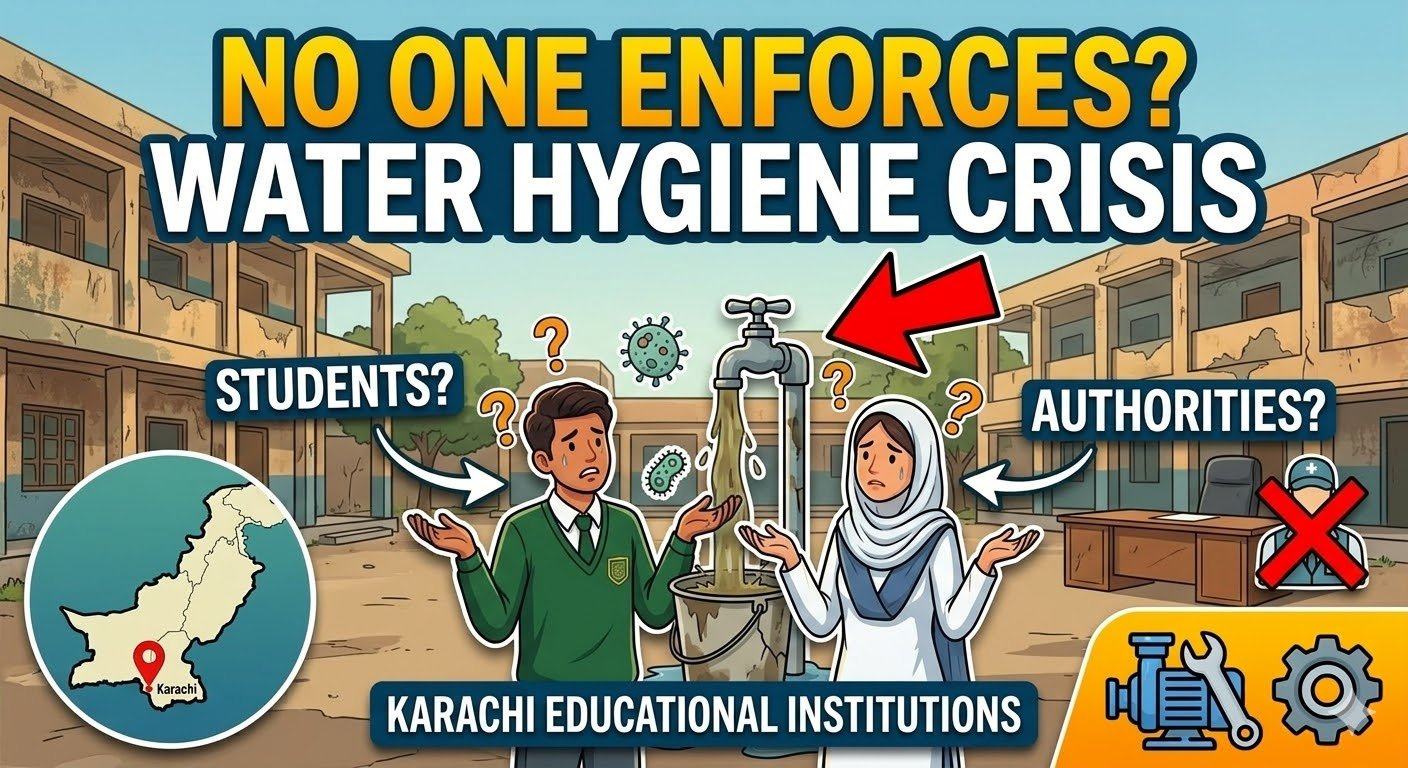
A child spends six or seven hours a day at school and drinks from whatever the school provides. In Karachi that water has almost always been stored in a tank on the premises, sometimes for days. Parents choose schools on fees, results and distance. Very few ask when the water tank was last cleaned, and very few schools could answer.
This article is about school water safety in Karachi: why the issue goes unenforced, what the risks are, what parents can reasonably ask, and what a workable water hygiene routine looks like for a school, college or university.
In brief
- School water in Karachi is stored in tanks on the premises, and no rule we know of sets how often they must be cleaned.
- Hundreds of children share one tank, and it stands unused through weekends and long holidays.
- Coolers chill water. They do not make it safe.
- Parents can ask seven simple questions. Schools should be able to answer them.
- A cleaning before each term gives a natural three-month cycle.
A problem hidden in plain sight
The scale of the wider problem is on record. In January 2026 Sindh’s education minister told the provincial assembly that 14,000 schools in Sindh have no drinking water facility at all. Globally, the WHO and UNICEF’s monitoring programme reports that 77 percent of schools had a basic drinking water service in 2023, leaving 447 million children without one.
Karachi’s private and better-resourced schools mostly do have water. The question there is not whether it exists but what condition it is in. A school with a cooler in every corridor can still be serving water from an underground tank that has not been opened in three years.
Why nobody enforces it
- No specific rule. We are not aware of any regulation in Sindh that sets a cleaning interval for school water tanks or requires schools to publish one.
- Inspections look elsewhere. Registration and inspection of schools tend to concentrate on premises, staffing and curriculum.
- Split responsibility. In rented buildings the school assumes the landlord maintains the tank, and the landlord assumes the school does.
- Out of sight. The principal sees classrooms every day and the tank never.
- Parents do not ask. What is not asked about is not prioritised.
The absence of a rule does not remove the duty. A school has charge of other people’s children, and providing safe drinking water is part of that.
Why schools are more exposed than homes
| Factor | At home | At school |
|---|---|---|
| People using one tank | A family | Hundreds or thousands |
| Who is drinking | All ages | Mostly children, who are most vulnerable to waterborne illness |
| Usage pattern | Steady, every day | Heavy in term; stagnant through weekends and long holidays |
| Treatment at the tap | Often a filter or boiled water | Coolers with filters that may not be serviced |
| Who notices a problem | The family, quickly | Nobody connects scattered absences across classes |
| Building | Purpose-built | Often a converted bungalow with a tank sized for one household |
The holiday problem
Water that sits unused goes stale. Over a two-month summer break a school’s tanks and pipes hold the same water through the hottest weeks of the year. The WHO notes that legionella bacteria live and grow in water systems at 20 to 50°C, with stagnation as a key risk, and Karachi’s tanks are in that range all summer. The first week of term is when that water reaches the children. Heat is covered in more detail in heat and bacteria in water tanks.
The cooler problem
Electric coolers chill water; they do not purify it. Many have a small filter cartridge that is rarely changed, and the reservoir inside the cooler is itself a tank that needs cleaning. A cold drink from a dirty cooler fed by a dirty tank is still dirty water.
The health picture
UNICEF attributes 53,000 deaths of children under five in Pakistan each year to diarrhoea linked to poor water and sanitation. School-age children are sturdier, but stomach infections, typhoid and hepatitis A and E still mean missed lessons and, in a classroom, quick spread from one child to the next. Karachi was the centre of the drug-resistant typhoid outbreak recorded by WHO from 2016. The infections and their routes are explained in waterborne disease in Karachi, and our guide for parents covers what families can do at home.
Ablution areas deserve a mention. Naegleria fowleri infects through water entering the nose, and the Sindh health department’s advice after the deaths of 2025 was to clean tanks before summer and keep water chlorinated.
What parents can ask
These are fair questions for an admissions meeting or a parent-teacher association, and a well-run school will have answers.
- Where does the school’s water come from: the line, tankers or a borehole?
- How many tanks are there, and when was each last cleaned?
- Is there a written report from the cleaning, with photographs?
- How is drinking water treated, and when were the cooler filters last changed?
- Who on the staff is responsible for water?
- What happens to the tanks before school reopens after the summer?
- Has the water ever been laboratory tested?
Ask as a group if you can. One parent’s question is an awkward moment; a PTA’s request becomes an agenda item. Meanwhile, send your child with a filled bottle from home, and keep your own tank in order.
School water safety in Karachi: a plan for administrators
| When | Action |
|---|---|
| Two weeks before each term | Clean and disinfect all tanks; clean cooler reservoirs; replace filter cartridges |
| First day back after any long break | Run every tap and cooler for several minutes before pupils arrive |
| Every month | Check lids, mesh and the area around the underground hatch; look inside each tank with a torch |
| Every three months | Professional cleaning of all tanks |
| After flooding, a sewage leak or a long supply crisis | Immediate cleaning |
| Once a year | Laboratory test of drinking water from an accredited lab |
| Always | One named member of staff holds the water file: reports, invoices, test results, filter change dates |
Three terms and a pre-summer cleaning give a natural quarterly rhythm, which matches the interval we recommend for any premises serving the public. The reasoning is in how often to clean a water tank in Karachi.
Larger campuses
Universities and colleges have more to manage: hostels, cafeterias, laboratories, several buildings with separate tanks, and sometimes their own boreholes. Start with an inventory of every tank, its size, material, location and source, and clean them on a rotating schedule so that no building is ever without water. Hostels and canteens should be treated like residential and food premises respectively; see our guides for apartment buildings and hotels and restaurants.
Rented premises
If the school rents its building, settle in writing who cleans the tanks and who pays. The school should hold the schedule whatever the lease says, because it is the school’s pupils who drink the water.
Nurseries, tuition centres and madrasas
The same reasoning applies to smaller settings, which are often less well equipped than schools. A nursery or day-care centre in a converted house relies on a domestic tank while looking after the age group most at risk. Tuition and coaching centres run in the evenings in rented floors where nobody knows who maintains the tank. Madrasas and hostels combine drinking, cooking, bathing and ablution for residents who live on site.
If you run one of these, the minimum is the same: know where your water comes from, clean the tanks every three months, treat drinking water, and keep the report. If your child attends one, the questions above apply just as well.
Choosing a contractor for a school
- Safety first. Work must be done when children are not on site, and underground tanks entered only with ventilation, a gas check and an attendant. Never allow school staff to go into a tank.
- A disinfectant suitable for drinking water tanks, rinsed out before refilling.
- A dated report with photographs for the school’s records.
- A proper tax invoice for the accounts. See why SRB and FBR registration matters.
- Holiday and weekend working.
A general checklist is in what to ask before hiring a tank cleaning company.
How we work with schools and universities
Educational institutions are surveyed first, free of charge, so that tank count, access and timing are agreed in advance. Cleaning follows our eight-step procedure: drainage, ventilation and gas check, jet washing at 3,000+ PSI, vacuum extraction, disinfection, rinse and inspection, and a dated report with photographs. Both branches work around the clock, including Sundays and public holidays, so the work can be done while the campus is empty.
Institutions on our clients page include IBA and SZABIST. Campuses in the south of the city are served by our DHA and Clifton branch and those in the east and centre by our Gulshan and Jauhar branch. Parents arranging a cleaning at home can get a price online.
Frequently asked questions
How often should a school clean its water tanks?
Every three months, with a cleaning shortly before each term and always before reopening after the summer break.
Is there a law requiring schools in Karachi to clean their tanks?
We are not aware of a rule that sets a specific interval. Schools nonetheless have a duty of care for the children in their charge, and safe drinking water is part of it.
Are water coolers enough?
No. A cooler chills water and may filter it lightly. It does not make contaminated water safe, and its own reservoir and filter need regular attention.
Can tanks be cleaned during term?
Yes, at weekends or overnight. Rooftop tanks take two to four hours and underground RCC tanks four to eight.
What should a school keep on file?
For each tank: the date of every cleaning, the service report and photographs, the invoice, filter change dates and any laboratory results.
Should schools provide filtered water or ask children to bring their own?
Both. A bottle from home covers the child; safe water at school covers the refill and the children who forget. The filter on a school cooler still needs a clean tank behind it.
How can a PTA raise this without causing offence?
Frame it as a request for information: the cleaning dates and the last report. Most administrators respond well to a specific, reasonable question, and the request itself often prompts a cleaning.
Sources
Figures in this article were checked in October 2026 against the following:
- The Express Tribune, January 2026: 14,000 schools without water in Sindh
- WHO/UNICEF Joint Monitoring Programme: WASH in schools, 2024 highlights
- WHO: Legionellosis fact sheet
- UNICEF Pakistan: Water, sanitation and hygiene
- WHO Disease Outbreak News, 27 December 2018: Typhoid fever, Pakistan
- Geo News, 13 September 2025: Naegleria claims another life in Karachi, toll hits five in Sindh
About Khan Tank Cleaning
This guide is published by Khan Tank Cleaning, a Karachi water tank cleaning company founded in 2005 by Mateen Khan. We work from two branches, DHA Phase 2 and Gulshan-e-Iqbal, and you can read more about the company or contact either branch at any hour. Call or WhatsApp 0333 0293174 (DHA) or 0340 2717530 (Gulshan).

Mateen Khan is the Founder & Owner of Khan Tank Cleaning, Karachi’s first dedicated professional water tank cleaning company (est. 2005). With 20+ years of industry experience, he leads an ISO 9001 & ISO 45001 certified team that follows a strict 8-step process using industrial equipment and food-grade disinfectants. Mateen is committed to making clean, safe water accessible to every household and business in Karachi.