Category: Company Credibility

Learn why Khan Tank Cleaning has been Karachi’s most trusted water tank cleaning service since 2005. Explore our 20+ years of experience, ISO 9001 & ISO 45001 certifications, SRB & FBR registration, real customer reviews, and before & after results from across the city. We don’t just clean tanks — we earn your trust.

  • Our Certifications Explained: What ISO 9001 and ISO 45001 Mean for You

    Our Certifications Explained: What ISO 9001 and ISO 45001 Mean for You

    There is no licence for cleaning water tanks in Karachi. Anyone can offer the service. In a trade with no regulator, management system certificates are one of the few outside checks a customer can rely on, provided the certificates are genuine and the customer knows what they do and do not cover.

    Khan Tank Cleaning is certified to ISO 9001 and ISO 45001. This article explains ISO 9001 and ISO 45001 in tank cleaning terms: what each standard asks of a company, how a certificate is earned and kept, what changed with the 2026 revision of ISO 9001, and how to check any certificate you are shown, ours included.

    First, three things people get wrong

    1. ISO does not certify anyone. The International Organization for Standardization writes the standards. It does not issue certificates. Certification is carried out by independent certification bodies.
    2. There is no such thing as plain “ISO certified”. A company is certified to a specific standard, such as ISO 9001. The standard should always be named.
    3. These standards certify a management system, not a service. They show that the company runs its work through a documented, audited system. They are not a product approval and they do not guarantee that every job is perfect.

    ISO 9001 and ISO 45001 at a glance

    ISO 9001ISO 45001
    SubjectQuality managementOccupational health and safety
    Question it answersIs the work done the same, correct way every time?Are the people doing the work protected from harm?
    Current editionISO 9001:2026, published 16 September 2026; certificates to the 2015 edition remain valid during the transitionISO 45001:2018
    Core requirementsDocumented processes, trained staff, records, customer feedback, internal audits, corrective actionHazard identification, risk controls, safe procedures, emergency planning, incident investigation
    In tank cleaningOne procedure, followed on every job, with a report as evidenceConfined-space entry, chemical handling, equipment inspection
    Who benefitsThe customerThe crew, and the customer on whose property they work

    ISO 9001: quality management

    ISO 9001 is the most widely used management standard in the world. ISO’s own description is that it helps organisations of any size consistently provide products and services that meet customer and regulatory requirements. In practice it comes down to a loop: say what you do, do what you say, record it, check it, and fix what went wrong.

    What that means on a tank cleaning job

    • A written procedure. Ours has eight steps, and they are published on our cleaning procedure page. A customer in Clifton and a customer in Gulistan-e-Johar should get the same sequence.
    • Defined inputs. Which disinfectant is used, at what strength, for which kind of contamination. No improvising with whatever is on the van.
    • Records. A dated service report with photographs for each job. Without records there is nothing for an auditor to audit.
    • Training. People are shown the procedure and assessed on it before they work unsupervised.
    • Handling complaints. Customer feedback is recorded and followed up, and repeated problems lead to a change in the procedure.
    • Internal audits and management review. The company checks itself between external audits.

    The 2026 revision

    A new edition, ISO 9001:2026, was published on 16 September 2026. Organisations certified to the 2015 edition have a transition period of about three years to move across. So for the next few years you will see valid certificates quoting either edition. What matters is that the certificate is current and issued by an accredited body.

    ISO 45001: occupational health and safety

    ISO 45001:2018 sets requirements for a management system that prevents work-related injury and ill health. For most service trades that means ladders and electrics. For tank cleaning it means something more serious.

    Confined spaces

    An underground tank is a confined space. Gas can collect in it and oxygen can run low. In June 2025, five men died in a household water tank in Ibrahim Hyderi, three of them trying to rescue the first two. In 2022, four workers died in a factory tank in Landhi in the same way.

    A safety management system exists to make sure that cannot happen through habit or haste. On our jobs it translates into forced ventilation and a gas check before entry, a harness and tripod, an attendant at the hatch, and a rule that the step is never skipped. Sindh law takes the same view for factories: section 48 of the Sindh Factories Act, 2015 bars entry into a confined space where dangerous fumes are likely unless it has been made safe or the person has breathing apparatus and a rope held from outside.

    Chemicals

    Disinfectant concentrates are hazardous before dilution. The standard requires the company to assess that risk, train staff, provide gloves and eye protection, and keep safety data for each product. For the customer, the visible result is that the crew can tell you what they are using. Ours is described in silver hydrogen peroxide for tank disinfection.

    Equipment

    A hose that bursts at 3,000 PSI can injure someone. Pressure washers, vacuums, electrical leads, harnesses and gas detectors all need inspection on a schedule, with records.

    How a company gets certified, and stays certified

    1. Build the system. Procedures, responsibilities, forms and records are written and put into use.
    2. Run it. The system has to operate for some months so there is evidence to examine.
    3. Internal audit and management review.
    4. External audit in two stages by a certification body: first the documents, then the work itself.
    5. Certificate issued, normally valid for three years.
    6. Surveillance audits each year in between.
    7. Recertification at the end of the three years.

    The certification body should itself be accredited by a national accreditation body. In Pakistan that is the Pakistan National Accreditation Council (PNAC). Accreditation bodies around the world recognise one another through the International Accreditation Forum (IAF).

    How to verify a certificate

    Fake and lapsed certificates are common enough that checking is worth five minutes.

    1. Ask for a copy of the certificate itself, not a logo.
    2. Read it. It should show the company’s legal name and address, the standard and edition, the scope of certification, a certificate number, issue and expiry dates, the certification body and an accreditation mark.
    3. Check the scope. It should cover the service you are buying, not something unrelated.
    4. Check the dates. An expired certificate means nothing.
    5. Look it up. The IAF CertSearch database lists certificates issued under accredited certification. ISO explains the process in how to verify an accredited certification.
    6. Contact the certification body named on the certificate if you are still unsure.

    We encourage customers to do this with ours. Ask either branch to show you the current certificates.

    A short glossary

    TermMeaning
    StandardA published document setting out requirements, such as ISO 9001
    Management systemThe policies, procedures and records a company uses to run an aspect of its work
    CertificationWritten assurance from an independent body that the system meets the standard
    Certification bodyThe organisation that audits and issues the certificate
    AccreditationFormal recognition that a certification body is competent, given by a national accreditation body such as PNAC
    ScopeThe activities and locations the certificate covers
    Surveillance auditThe yearly check between full recertifications
    NonconformityA failure to meet a requirement, which must be corrected

    What the certificates do not tell you

    • They do not test your water. No ISO management standard certifies that a tank is free of bacteria.
    • They do not replace the report. The evidence for your job is the dated report and photographs, not the certificate on the wall.
    • They do not cover tax status. That is a separate check, explained in why SRB and FBR registration matters.
    • They do not make a company the cheapest. Running an audited system costs money.

    Why this matters in Karachi

    Three features of the city raise the stakes. The trade is unregulated, so there is no minimum standard. Buildings are dense, so one shared tank serves dozens of families or hundreds of staff. And the supply water is poor, so a badly cleaned tank becomes a health problem quickly. The background is in our guide to KWSB water supply. Factories have legal duties of their own, set out in our industrial water compliance guide. How certification plays out for different kinds of customer, with a cleaning schedule by property type, is covered in why ISO-certified tank cleaning matters.

    Certificates are only one of the things worth checking. A fuller list of questions is in what to ask before hiring a tank cleaning company, and the company’s own background is in our story.

    Booking a certified service

    Our branches cover DHA, Clifton and South Karachi and Gulshan, Jauhar and East Karachi. Standard homes can get a fixed price online; commercial and industrial sites are surveyed free of charge.

    Frequently asked questions

    Is ISO certification required by law for tank cleaning in Pakistan?

    No. It is voluntary. Some corporate and industrial clients require it of their contractors as part of supplier approval.

    What is the difference between ISO 9001 and ISO 45001?

    ISO 9001 is about the quality and consistency of the service. ISO 45001 is about the health and safety of the people doing the work.

    Does ISO 9001:2026 make older certificates invalid?

    No. Certificates to ISO 9001:2015 remain valid during the transition period of about three years from September 2026, as long as they have not expired.

    How can I tell if an ISO certificate is fake?

    Check that it names a real certification body with an accreditation mark, that the scope and dates make sense, and that it can be found through IAF CertSearch or confirmed by the certification body.

    Do ISO 9001 and ISO 45001 in tank cleaning mean my water will be safe?

    They mean the company follows an audited system for doing the work and protecting its workers. The safety of your water also depends on the supply, the condition of your tank and lids, and how you treat drinking water.

    How long does an ISO certificate last?

    Normally three years, with a surveillance audit each year. After three years the company is audited again in full.

    Can a company lose its certificate?

    Yes. A certification body can suspend or withdraw a certificate if serious problems found at audit are not corrected, or if the audits are not kept up.

    Sources

    Figures in this article were checked in October 2026 against the following:

    About Khan Tank Cleaning

    Written by the team at Khan Tank Cleaning, which has worked on Karachi’s water tanks since 2005 under founder Mateen Khan. Some of the organisations we clean for are listed on our clients page. To talk to a branch, use the contact page or call 0333 0293174 (DHA Phase 2) or 0340 2717530 (Gulshan-e-Iqbal).

  • SRB and FBR Registered: Why It Matters When You Choose a Service Company in Karachi

    SRB and FBR Registered: Why It Matters When You Choose a Service Company in Karachi

    Most people choosing a service company in Karachi ask about price and timing. Few ask whether the company is registered for tax. It sounds like a matter for accountants, but it is one of the quickest ways to tell a real business from a phone number, and for companies and institutions it has direct tax consequences.

    This article explains what it means to hire an SRB and FBR registered company in Karachi, how to check registration yourself, and why it matters differently for households and for businesses. It is general information, not tax advice. For your own tax position, ask your accountant.

    Who the SRB and FBR are

    Federal Board of Revenue (FBR)Sindh Revenue Board (SRB)
    LevelFederalProvincial (Sindh)
    Main taxesIncome tax, sales tax on goods, customsSindh sales tax on services
    What registration gives a businessA National Tax Number (NTN) and, if it files returns, a place on the Active Taxpayer ListAn SRB registration number and the obligation to charge and deposit sales tax on its services
    How to verifyActive Taxpayer List, online or by SMS to 9966SRB online taxpayer search

    The SRB was set up under the Sindh Revenue Board Act, 2010 and has collected sales tax on services in the province since 2011. The standard rate rose from 13 to 15 percent on 1 July 2024. A service business operating in Sindh deals with both bodies: the FBR for its income and the SRB for the tax on its invoices.

    How to verify registration in two minutes

    1. Ask for the numbers. A registered company will give you its NTN and its SRB registration number without fuss. They are usually printed on its invoices.
    2. Check the SRB. Enter the name or number in the SRB’s online taxpayer search.
    3. Check the FBR. The Active Taxpayer List can be searched online, or by sending ATL and the number by SMS to 9966. Being on the list means the business is filing returns, not just holding a number.
    4. Match the name. The name on the registers should match the name on the quote, the invoice and the bank account you are asked to pay into.
    5. Look at the invoice. A proper tax invoice is numbered, dated, shows the supplier’s registration numbers and shows the sales tax as a separate line.

    If a provider cannot produce the numbers, or the names do not match, you are dealing with an individual and not a company, whatever the letterhead says.

    What registration tells you, and what it does not

    What it tells you

    • The business exists on paper. It has an identity, an address and a bank account in its own name.
    • It can be traced. If there is a dispute, there is a legal entity on the other side.
    • It can issue a valid invoice, which you may need for your own accounts, a housing society audit or an insurance claim.
    • It has something to lose. A company that files returns year after year is not planning to vanish next month.

    What it does not tell you

    Registration is not a quality mark. A registered company can still do poor work, and tax status says nothing about equipment, safety or the chemicals used. Treat it as a first filter, then ask the practical questions in what to ask before hiring a tank cleaning company.

    Why it matters for households

    • Accountability. If a worker damages the tank, floods the courtyard or leaves the job half done, you have a company to call, not a number that has been switched off.
    • Safety on your property. Underground tanks are dangerous, and people die in them. A registered company with a reputation and certificates to protect has every reason to follow confined-space precautions; a casual labourer usually has neither the equipment nor the training. See tank wallah versus professional cleaning.
    • A record. The invoice and service report together show what was done and when, which is useful when you sell or let the property.
    • No surprises on price. A business that issues written quotes and invoices has little room to change the figure at the door.

    Why it matters more for businesses and institutions

    For a company, school, hospital, hotel, factory or housing society, paying an unregistered service provider is not just untidy. It creates problems in the accounts.

    • Documentation. Expenses need a valid invoice behind them. A handwritten cash receipt from an individual will not satisfy an auditor.
    • Withholding. Organisations designated as withholding agents under the Sindh Sales Tax Special Procedure (Withholding) Rules, 2014 must withhold part of the sales tax when they pay for services. A KPMG summary of the rules notes that one-fifth of the tax is generally withheld from a registered provider, while the whole amount of sales tax applies when the provider is unregistered. In other words, the tax still has to be paid; it simply lands on the customer.
    • Audit trail. If the SRB or FBR examines your records, payments to untraceable individuals raise questions.
    • Compliance files. Food businesses, hospitals and factories are inspected. A tank cleaning record is only credible if it comes from an identifiable contractor with a dated report and invoice.
    • Liability. If an informal worker is injured in your underground tank, there is no employer standing between you and the consequences.

    Which organisations count as withholding agents, and how the rules apply to you, is a question for your tax adviser. The practical point is simple: use a registered contractor and keep the invoice.

    Sector-specific requirements are covered in our guides for factories and warehouses, hotels and restaurants, hospitals and property managers.

    What a proper tax invoice looks like

    If you have never looked closely at one, these are the things to find on a service invoice in Sindh.

    ItemWhy it matters
    Supplier’s name and addressShould match the registers and the bank account
    NTN and SRB registration numberLets you verify the supplier
    Serial number and dateShows the invoice comes from a controlled sequence
    Your name and, for a business, your own NTNTies the expense to you
    Description of the serviceFor example, cleaning and disinfection of one underground and one overhead water tank
    Value excluding tax, rate, tax amount and totalSales tax shown as a separate line

    A slip of paper with a mobile number and a round figure is a receipt at best. It will not support an expense claim or a withholding calculation.

    Karachi’s informal service market

    A large share of household services in Karachi is provided by individuals working for cash: plumbers, electricians, painters and tank cleaners among them. Many are skilled and honest. The difficulty is that the customer has no way to tell in advance, and no recourse afterwards. With most trades the worst outcome is a bad job. With water tanks the worst outcomes are contaminated drinking water and a death in a confined space, as in the Ibrahim Hyderi incident of June 2025, when five men died in a household tank.

    Registration does not remove those risks by itself. It does mean you are dealing with an organisation that can be held to a written scope, a named method and a documented result.

    What this looks like when you book with us

    • Registration: Khan Tank Cleaning is registered with both the SRB and the FBR. Ask either branch for the numbers and check them using the steps above.
    • Invoice: every job ends with a numbered SRB/FBR tax invoice.
    • Report: a dated service report with photographs taken inside the tank and a recommended next-service date.
    • Price: quoted in writing before work begins. The quote is the final price. Standard homes can use the online calculator; larger sites are surveyed free of charge.
    • Method: the same eight-step cleaning procedure on every job.
    • Clients: organisations we work for are named on our clients page.

    Tax registration is one of several things you can verify about us. Our quality and safety certificates are explained in ISO 9001 and ISO 45001: what our certifications mean, and the wider picture is in how we built a trusted tank cleaning service. The company’s background is told in our story since 2005, and customer feedback in where to read our reviews.

    A short checklist before you hire any service company

    1. Ask for the NTN and SRB registration number.
    2. Verify both online.
    3. Check that the business name matches on the quote, invoice and bank account.
    4. Get the price and scope in writing.
    5. Ask what document you will receive at the end.
    6. For tank cleaning, ask how they enter an underground tank and what disinfectant they use.

    Our branches

    We work across the city from two offices: DHA, Clifton and South Karachi and Gulshan, Jauhar and East Karachi.

    Frequently asked questions

    What is the difference between NTN and SRB registration?

    The NTN is issued by the FBR and identifies a taxpayer nationally for income tax. SRB registration is provincial and covers sales tax on services provided in Sindh. A service company in Karachi normally needs both.

    Does a registered company charge more?

    Its invoice includes sales tax, which a cash operator does not charge. For an organisation that is a withholding agent, that tax falls due anyway under the withholding rules, so the saving from using an unregistered provider is often illusory.

    Do I need a tax invoice as a homeowner?

    You are not obliged to keep one, but it is your proof of what was done and by whom. It costs nothing to ask.

    Can I check a company’s registration without asking them?

    Yes. The SRB search works by name, and the FBR’s Active Taxpayer List is public.

    Is an SRB and FBR registered company in Karachi automatically reliable?

    No. Registration shows the business is real and traceable. Reliability still has to be judged from its method, its safety practice, its reports and its reviews.

    What rate of sales tax applies to services in Sindh?

    The standard rate has been 15 percent since 1 July 2024. Some services have different rates or exemptions, so check the current position with the SRB or your tax adviser.

    Does paying by bank transfer matter?

    It gives you a second record of the payment, in the supplier’s registered name. For businesses it is good practice whatever the amount.

    Sources

    External references used in this article, checked in October 2026. This article is general information and not tax advice.

    About Khan Tank Cleaning

    This guide is published by Khan Tank Cleaning, a Karachi water tank cleaning company founded in 2005 by Mateen Khan. We work from two branches, DHA Phase 2 and Gulshan-e-Iqbal, and you can read more about the company or contact either branch at any hour. Call or WhatsApp 0333 0293174 (DHA) or 0340 2717530 (Gulshan).

  • From One Branch to Two: How We Built a Trusted Water Tank Cleaning Service in Karachi

    From One Branch to Two: How We Built a Trusted Water Tank Cleaning Service in Karachi

    Any company can call itself trusted. The word only means something if a customer can check what stands behind it. This article sets out what we think trusted water tank cleaning in Karachi should involve, the seven standards we hold ourselves to, and how you can verify each one for us or for anyone else.

    It also explains how a company that ran from a single office in DHA for twenty years came to open a second branch, and what that changes for customers.

    Why trust is the real product

    A water tank is a closed box. When the crew leaves, you cannot see the back wall, the ceiling or the floor corners, and you cannot see bacteria at all. You are relying on the provider to have done what they said. That is why the tank cleaning trade has so many operators who do a quick rinse and collect the cash: the customer has no easy way to tell.

    The stakes are not small either. Karachi’s supply water regularly fails testing, as described in our guide to KWSB water supply, and the family will drink, cook and bathe from that tank for months. And underground tanks are dangerous to enter. A provider you can trust protects both your water and the people working on your property.

    Trusted water tank cleaning in Karachi: seven standards and how to check each

    StandardWhat we doHow you can check
    One tradeTank cleaning only, since 2005Ask what else the company does; visit the office
    Proper equipment3,000+ PSI jet washing and vacuum extraction on every jobWatch the crew unload
    Safe entryVentilation, gas check, harness, attendant at the hatchWatch before anyone goes down
    Named disinfectantSilver-stabilised hydrogen peroxide; food-grade chlorine for heavy contaminationAsk to see the label
    Written priceQuote before work; the quote is the final priceGet it in writing
    EvidenceDated report with photographs from inside the tankAsk for a sample report before booking
    A legal identitySRB and FBR registration; ISO 9001 and ISO 45001; published client listSearch the public registers; ask to see certificates

    1. One trade

    We have done nothing but clean water tanks since 2005. A specialist owns the equipment, trains the same crews year after year and has seen every kind of tank. A general contractor who also paints and fumigates usually hires day labour for the tank. The company’s background is in our story.

    2. Proper equipment

    Water at 3,000+ PSI strips biofilm off walls, floor and ceiling. A vacuum lifts sludge out of the tank and off the property. Without those two machines the job is a rinse. The full sequence is on our cleaning procedure page.

    3. Safe entry

    Before anyone enters an underground tank, air is blown in and the atmosphere is tested. The person entering wears a harness on a tripod and someone stays at the opening. People die in unventilated tanks in Karachi: five in a single incident in June 2025. A company that skips this step is gambling with lives on your property.

    4. A named disinfectant

    We can tell you what goes into your tank and why. Details are in silver hydrogen peroxide for tank disinfection. We do not use industrial acids, raw household bleach or unlabelled products.

    5. A written price

    The price depends on the property type, where the tank is and its size. Standard homes get it instantly from the online calculator; commercial and industrial sites get a free survey. Nothing is added on the day.

    6. Evidence

    Every job ends with a dated service report, photographs taken inside the tank, a recommended next-service date and a numbered tax invoice. You do not have to take our word for the result.

    7. A legal identity

    We are registered with the Sindh Revenue Board and the Federal Board of Revenue, certified to ISO 9001 and ISO 45001, and we publish the names of organisations we work for on our clients page. Each of those can be checked independently. The how-to is in why SRB and FBR registration matters and why ISO-certified tank cleaning matters.

    From one branch to two

    From 2005 until 2025 the whole of Karachi was served from Office-6, Plot-6-C, DHA Phase 2. It worked, but Karachi is large, and a crew crossing from DHA to North Nazimabad in traffic can lose two hours each way. That cost customers in the east flexibility on timing, which matters when a tank has to be cleaned just before the supply turn.

    In 2025 we opened a second branch at Suite-203, Mumtaz Manzil, Block 16, Gulshan-e-Iqbal, which puts a crew much closer to the east, centre and north of the city.

    DHA Phase 2 branchGulshan-e-Iqbal branch
    Opened20052025
    Phone0333 02931740340 2717530
    Core areasDHA Phases 1 to 8, Clifton, Defence View, Gizri, Seaview, SaddarGulshan-e-Iqbal, Gulistan-e-Johar, Federal B Area, Nazimabad, North Nazimabad
    Also coversKorangi, Malir, LandhiLiaquatabad, North Karachi, New Karachi, SITE, PECHS, Bahria Town
    Typical propertyBungalows with large underground cisterns; commercial premisesApartment blocks with shared tanks; family houses
    Hours24 hours, every day24 hours, every day
    Branch pageDHA and CliftonGulshan and Jauhar

    What stays the same at both branches

    • The same eight-step procedure, in the same order
    • The same equipment and the same disinfectants
    • The same confined-space precautions
    • The same report format and the same invoice
    • The same pricing basis
    • Oversight by the founder, Mateen Khan, who remains involved in quality control across both

    A second location is only worth having if a customer in Gulistan-e-Johar gets exactly what a customer in Phase 6 gets. Standardising the work is what the quality management system is for, as explained in our certifications explained.

    What changed for customers

    • Shorter travel to the east, centre and north of the city, so more same-day slots
    • Easier scheduling around supply days in Gulshan, Johar and the surrounding blocks
    • Local familiarity: a team based in the area, where apartment buildings with shared tanks are the norm. See water tanks in Gulshan and Johar.
    • Two numbers, both answered around the clock

    A customer’s scorecard

    If you want to hold any tank cleaning company to account, ours included, score the visit against these ten points. A good job gets all ten.

    1. The price was given in writing before the crew arrived.
    2. The crew came in the agreed window.
    3. A pressure washer and a vacuum were unloaded and used.
    4. Air was blown into the underground tank before entry.
    5. Someone stayed at the hatch throughout.
    6. You saw sludge leave the tank.
    7. The disinfectant was named when you asked.
    8. The tank was rinsed until the water ran clear.
    9. You received a dated report with photographs.
    10. The invoice matched the quote.

    Trust has to be re-earned on every job

    Twenty years of history does not clean your tank. What matters to you is the visit you book. So judge us the way you would judge anyone: ask the questions in what to ask before hiring a tank cleaning company, watch the safety setup, look at the photographs, and read what other customers have said. This article explains where to find our reviews and how to weigh them.

    And if you are deciding between a professional service and the man with the bucket, the comparison is set out fairly in tank wallah versus professional cleaning.

    A trusted water tank cleaning service in Karachi is also honest about limits

    We cannot make supply water safe to drink. We do not do structural repairs. A tank with a broken lid will not stay clean, however well we clean it. And most houses need the job repeated every four to six months, because the water that fills the tank has not changed. We would rather say that plainly than promise something no tank cleaner can deliver.

    Frequently asked questions

    How do I know a tank cleaning company can be trusted?

    Check what can be checked: tax registration, current certificates, a real office, named clients, a written price, and a report with photographs. Then watch how they enter an underground tank.

    Which branch should I call?

    The nearest one: DHA Phase 2 for the south and the Korangi side, Gulshan-e-Iqbal for the east, centre and north. Either will direct you if you are unsure.

    Are prices different between the two branches?

    No. Pricing is on the same basis at both.

    Do both branches handle commercial and industrial work?

    Yes. Larger sites are surveyed first, free of charge.

    Is a bigger company more trustworthy than a small one?

    Not necessarily. Size matters less than whether the method, the safety practice and the paperwork are in place on your job.

    What is the quickest single check?

    Ask how they enter an underground tank. A company that answers with ventilation, a gas check and an attendant usually has the rest in order as well.

    Sources

    External references used in this article, checked in October 2026:

    Contact Khan Tank Cleaning

    Read more about the company or contact either branch. DHA Phase 2: 0333 0293174. Gulshan-e-Iqbal: 0340 2717530. Both are answered 24 hours a day.

  • Khan Tank Cleaning Reviews: What Karachi Customers Say and How to Check Them

    Khan Tank Cleaning Reviews: What Karachi Customers Say and How to Check Them

    If you are looking for Khan Tank Cleaning reviews in Karachi, the best place to read them is not our own website. It is the public profiles where customers post in their own words and we cannot edit what they say. This page tells you where those are, what people tend to comment on, and how to weigh reviews for us or for any other tank cleaning company.

    Where to read Khan Tank Cleaning reviews in Karachi

    Each branch has its own Google profile, so check the one that will be serving you. We have not copied individual reviews onto this page. Reviews quoted on a company’s own site cannot be verified by the reader, and the counts change every week. Read them at the source, sort by newest, and include the critical ones.

    What customers usually notice

    Read the reviews themselves for the detail. As a guide to what to look for, these are the things a customer usually notices after a first proper cleaning.

    How much came out of the tank

    People who have never had a vacuum extraction are surprised by the volume of sludge. It had been there for years under clear-looking water. What we find in Karachi’s water tanks describes the usual picture.

    Smell and colour

    A musty smell or a faint tint that the household had stopped noticing usually goes within a day or two of refilling.

    Punctuality and tidiness

    Arriving in the agreed window matters in a city where the tank has to be cleaned around the supply turn. So does leaving the courtyard and roof clean.

    The safety setup

    Customers notice the blower, the harness and the person stationed at the hatch, often because they have never seen an underground tank entered that way.

    The report

    Photographs from inside the tank let customers see the result for themselves, and landlords and unions use the report for their records.

    The price matching the quote

    The figure is agreed in writing before work starts and is the final price.

    Common concerns after a cleaning, and what they usually mean

    No service company gets every job right, and you should be wary of one that claims to. These are the concerns that come up most often after a tank cleaning, with any provider.

    ConcernUsual causeWhat to do
    Water is dirty again within daysThe next supply or tanker load arrived dirty; the tank itself is cleanLet the first flow run to waste where you can; call the branch if it does not clear
    The job took longer than expectedMore sludge than the survey suggestedNothing: the written quote is the final price
    A chlorine taste after cleaningChlorine was used because the tank was heavily contaminatedRun the taps; the taste fades within a fill or two
    A crack or bad lid was reported but not fixedCleaning does not include structural repairShow the photographs in the report to a mason or plumber
    The result does not look rightSomething was missedCall the branch the same day, while the tank can still be inspected

    If you are unhappy with a job of ours, call the branch that did it and quote the date on your report, so we can look up what was recorded. You are also free to say so in a public review.

    How to judge reviews for any tank cleaning company

    1. Read the recent ones. A company can change in a year. Sort by newest.
    2. Look for detail. Genuine reviews mention the area, the type of tank, what was found, how long it took. Vague praise in identical words is a warning sign.
    3. Read the worst reviews and, more importantly, the replies. How a company answers a complaint tells you more than its rating.
    4. Check the reviewer. A profile with one review ever written is weaker evidence than a local guide with dozens.
    5. Compare volume with age. Hundreds of reviews for a business that opened last month do not add up.
    6. Check the address. The profile should point to a real office you could visit.
    7. Do not stop at reviews. Stars say nothing about safety practice, disinfectant or registration.

    Red flags in tank cleaning reviews

    • A burst of five-star reviews in a few days, followed by silence.
    • Reviews that never mention a place, a tank or a problem. “Great service, highly recommended” repeated twenty times tells you nothing.
    • The same phrases appearing under different names.
    • No reply from the owner to any complaint, or replies that attack the customer.
    • A profile with no street address, or an address that turns out to be a different business.
    • Photographs that are stock images and never show the inside of a tank.

    The opposite signs are just as telling: reviews spread steadily over years, written in the reviewer’s own words, some of them critical, with replies that deal with the problem.

    Beyond reviews: what you can verify yourself

    Reviews are one signal. These are others, and all of them can be checked without taking anyone’s word.

    What to checkHowMore detail
    Tax registrationSRB online search; FBR Active Taxpayer ListWhy SRB and FBR registration matters
    CertificatesAsk to see the current certificate; check the issuing bodyISO 9001 and ISO 45001 explained
    Named clientsA published client listOur clients
    The methodA written procedure you can hold them toOur cleaning procedure
    Who runs itA named owner with a historyMateen Khan, founder
    Questions to ask on the phoneA short checklistWhat to ask before hiring a tank cleaning company

    Who our customers are

    Most are households: houses with an underground and a rooftop tank, and flats with shared tanks managed by a union. The rest are institutions and businesses, including hotels, universities, banks, food manufacturers and welfare organisations. Over twenty years that adds up to more than 7,000 houses, 1,500 apartments and 650 industrial tanks. How the company got here is told in our story, and the standards we hold ourselves to are set out in how we built a trusted tank cleaning service in Karachi.

    What a first-time customer can expect

    1. A price before anyone arrives, from the online calculator for standard homes or after a free survey for larger sites.
    2. A crew with a pressure washer, a vacuum and safety equipment.
    3. Ventilation and a gas check before anyone enters an underground tank.
    4. Jet washing, sludge extraction, disinfection and a clear-water rinse.
    5. A dated report with photographs, a suggested next date, and a tax invoice.

    A fuller account is in what happens during a professional tank cleaning.

    Leaving a review

    If we have cleaned your tank, an honest review helps other families decide, and helps us see what to fix. The most useful reviews say which area you are in, what kind of tank you have, what was found, and whether the price matched the quote. Mention anything that fell short as well. Review platforms do not allow businesses to offer rewards for reviews, and a review earned that way would be worth nothing to the next reader.

    Booking with either branch

    South of the city: DHA, Clifton and South Karachi, 0333 0293174. East and centre: Gulshan, Jauhar and East Karachi, 0340 2717530. Both answer 24 hours.

    Frequently asked questions

    Where can I read genuine Khan Tank Cleaning reviews?

    On the Google profiles for our DHA Phase 2 and Gulshan-e-Iqbal branches, and on our Facebook page. Links are at the top of this article.

    Why are there no customer quotes on this page?

    Because you could not verify them here. We would rather you read reviews where customers posted them.

    What if I have a complaint after a cleaning?

    Call the branch that did the work and give the date on your service report.

    Do you respond to negative reviews?

    A specific complaint is more useful to us than a general compliment. If something went wrong, the quickest way to have it put right is to call the branch as well as posting.

    Which branch’s reviews should I look at?

    The branch that will do your job: DHA Phase 2 for the south of the city, Gulshan-e-Iqbal for the east, centre and north.

    Can I see a sample service report before booking?

    Yes. Ask either branch. Seeing what you will receive at the end is a better guide than any star rating.

    Sources

    Public profiles referred to in this article:

    Contact Khan Tank Cleaning

    Read more about the company or contact either branch. DHA Phase 2: 0333 0293174. Gulshan-e-Iqbal: 0340 2717530. Both are answered 24 hours a day.

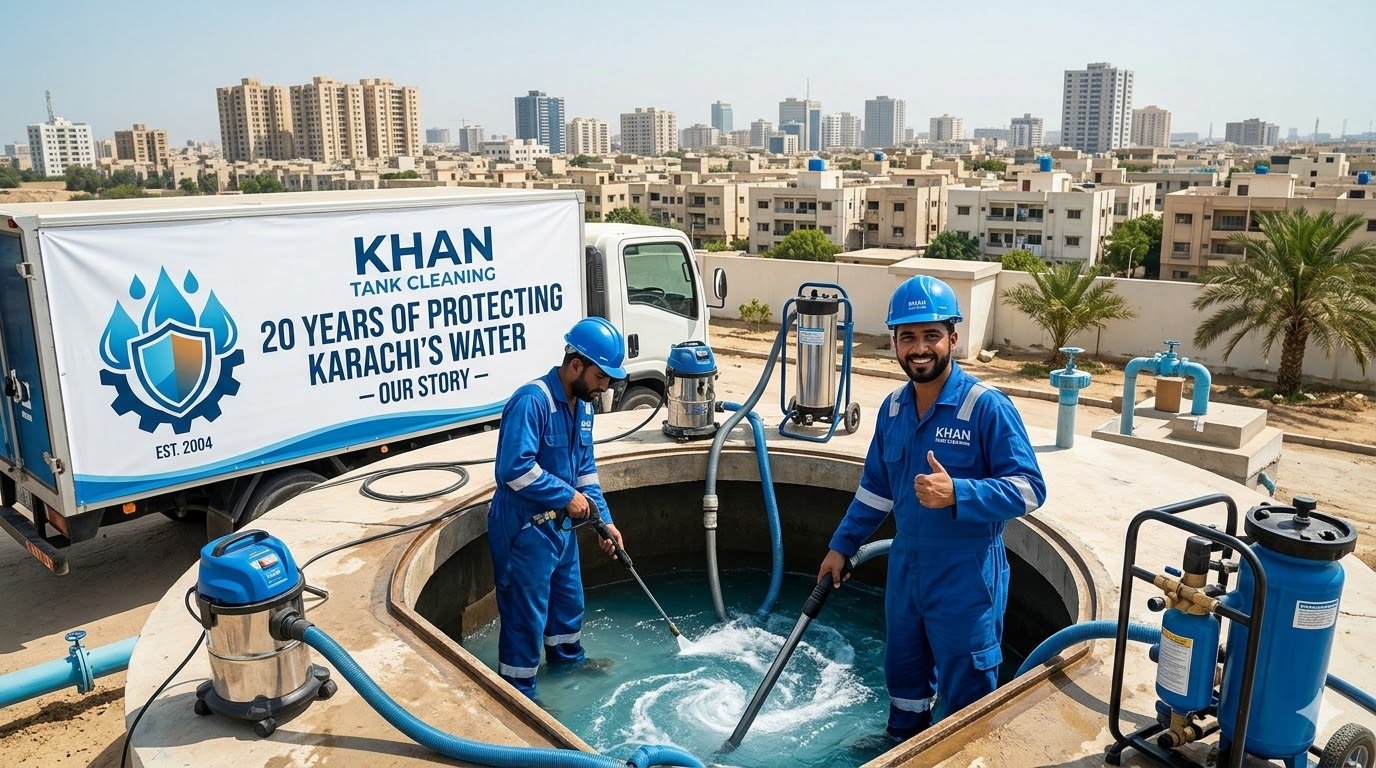
  • Khan Tank Cleaning: 20 Years of Protecting Karachi’s Water. Our Story

    Khan Tank Cleaning: 20 Years of Protecting Karachi’s Water. Our Story

    Khan Tank Cleaning started in 2005 with one office in DHA Phase 2 and one idea: that cleaning water tanks should be a trade in its own right, done with proper equipment by people who do nothing else. Twenty years later we work from two branches and clean tanks for households, apartment buildings, schools, hotels and factories across the city.

    This is the Khan Tank Cleaning history in Karachi, told plainly: where we began, what changed in the city’s water over those years, what we learned from it, and how we work today.

    2005: one office in DHA Phase 2

    The company was founded by Mateen Khan, who still owns it and oversees quality control at both branches. In 2005 a tank in Karachi was cleaned, if at all, by a labourer with a rope and a brush. The job was treated as a chore, not a health measure, and nobody left a record of what had been done.

    The founding idea was to treat it as a specialist service instead. That meant three decisions which still define the company: do only tank cleaning, invest in equipment that removes what a brush cannot, and put the work in writing.

    The city’s water over the same twenty years

    Our own story makes more sense set against what was happening to Karachi’s water. The need for clean storage grew every year, because the supply feeding it kept falling behind.

    YearWhat happened in Karachi’s waterWhy it matters for stored water
    2005Hub and Pipri III treatment plants commissioned, the last major additions to filtration capacity listed by KWSCTreatment capacity has barely grown since, while the population has
    2012First recorded deaths in Karachi from Naegleria fowleri, the amoeba linked to unchlorinated waterPut household tanks and chlorination on the public health agenda
    2016 to 2018Drug-resistant (XDR) typhoid outbreak in Sindh; WHO counts 5,274 XDR cases, 69 percent in KarachiShowed how far sewage contamination had entered drinking water
    2017PCRWR tests for a Supreme Court commission find 107 of 118 Karachi samples unsafeThe first widely reported citywide evidence
    2023KWSB reconstituted as the Karachi Water and Sewerage CorporationSame network, new structure
    202484-inch University Road main bursts; three weeks of disruptionDirty first flow into thousands of tanks
    2025Five Naegleria deaths in Sindh; health department advises annual tank cleaning before summerThe first clear official guidance to households
    2026Repeated Dhabeji failures; K-IV still under constructionSupply remains at about 650 MGD against demand above 1,200

    The sources for these events are listed at the end. The supply system itself is explained in our guide to KWSB water supply.

    The method, and what it replaced

    Each part of the way we work answers a weakness in how tanks were, and often still are, cleaned in Karachi.

    • Jet washing in place of scrubbing. Brushes leave the slippery bacterial film on the walls. Water at 3,000+ PSI removes it, with reduced pressure for fibreglass and plastic.
    • Vacuum extraction in place of bailing. Sludge that is stirred and bailed mostly stays in the tank. A vacuum lifts it out and off the property.
    • A named disinfectant in place of bleach by eye. We use silver-stabilised hydrogen peroxide for routine work and food-grade chlorine for heavily contaminated tanks, and nothing unlabelled. The reasoning is in our article on silver hydrogen peroxide.
    • Confined-space practice in place of “the boy goes down”. Forced ventilation and a gas check before entry, a harness and tripod, and a person at the hatch. Underground tanks kill people in Karachi every year.
    • A report in place of a handshake. Every job ends with a dated report, photographs taken inside the tank and a numbered tax invoice.

    Today those pieces form the eight-step procedure on our website, and this article walks through a visit step by step.

    Putting the business on a formal footing

    Doing the work properly was half of it. The other half was being a company that customers, and especially institutions, could check.

    • Tax registration. We are registered with the Sindh Revenue Board and the Federal Board of Revenue and issue numbered tax invoices. What that means for a customer is covered in why SRB and FBR registration matters.
    • ISO 9001 and ISO 45001. Under Mateen Khan’s leadership the company was certified to the quality management and occupational health and safety standards. Our certifications explained sets out what each one covers and how to verify a certificate.
    • Written prices. The quote is given before work starts and is the final price. Standard homes can get it from the online calculator.

    Who we clean for

    Most of our work is still houses and flats. Over the years we have cleaned more than 7,000 houses, 1,500 apartments and 650 industrial tanks. Alongside households, the organisations on our clients page include Avari Towers, IBA, SZABIST, UBL, Mondelez, Shan Foods, SGS and Edhi Homes.

    Different clients need different things from the same job. A family wants clean water and a tidy courtyard. A factory needs a report its auditor will accept. A hotel needs the work done overnight. We have written separate guides for factories and warehouses, hotels and restaurants and apartment buildings.

    2025: a second branch in Gulshan-e-Iqbal

    For twenty years we covered the whole city from DHA. Karachi is a large city to cross, and a second base in the east shortens the journey to a great many customers. In 2025 we opened at Suite-203, Mumtaz Manzil, Block 16, Gulshan-e-Iqbal.

    BranchAddressPhoneMain areas
    DHA and CliftonOffice-6, Plot-6-C, Phase 2, DHA, Karachi 754000333 0293174DHA Phases 1 to 8, Clifton, Gizri, Seaview, Saddar, Korangi, Malir, Landhi
    Gulshan and JauharSuite-203, Mumtaz Manzil, Block 16, Gulshan-e-Iqbal, Karachi 753000340 2717530Gulshan-e-Iqbal, Gulistan-e-Johar, Nazimabad, North Nazimabad, Federal B Area, North Karachi, SITE, PECHS

    Both branches use the same procedure and both answer 24 hours a day, including Sundays and public holidays. How the two-branch structure serves customers is described in how we built a trusted tank cleaning service.

    What twenty years have taught us

    1. Clear water proves nothing. Sludge sits on the floor and film on the walls while the water above looks fine. What we find inside Karachi’s tanks describes the usual picture.
    2. The underground tank is the one people forget, and the one that collects the most.
    3. A filter is not a substitute for a clean tank. It treats one tap.
    4. The lid matters as much as the cleaning. A tank with a broken cover is dirty again in weeks.
    5. Schedules beat emergencies. Cleaning every four to six months prevents most of the urgent call-outs. See how often to clean a tank in Karachi.
    6. Safety cannot be optional. No job is worth sending someone into an unventilated tank.
    7. Customers should not have to take our word for it. Before and after photographs settle what an explanation cannot.

    What we still cannot do

    It is worth being honest about the limits. We cannot fix the supply. A tank we clean today will be refilled tomorrow with whatever the line or the tanker delivers, which is why we tell every customer to keep boiling or filtering drinking water. We do not carry out structural repairs, though we photograph and report every crack and corroded fitting we find. And we cannot make a tank stay clean without a lid that seals.

    Where we go from here

    Karachi’s water shortage is not about to end. The K-IV project is still under construction, the network still loses more than half of what enters it, and households will be storing water for years to come. Our plan is unexciting: keep the method consistent across both branches, keep the paperwork straight, and keep explaining to customers what we find. This blog is part of that. If you want to know what others say about the work, see our reviews and how to check them.

    You can read more about the company, or contact either branch at any hour.

    Khan Tank Cleaning history in Karachi: quick answers

    When was Khan Tank Cleaning founded?

    In 2005, in DHA Phase 2, Karachi, by Mateen Khan.

    How many branches does Khan Tank Cleaning have?

    Two: the original office in DHA Phase 2 and a second branch in Gulshan-e-Iqbal, opened in 2025.

    Does Khan Tank Cleaning do anything other than tank cleaning?

    No. Cleaning and disinfecting water storage tanks is the whole business.

    Which areas do you cover?

    All of Karachi. The DHA branch handles the south and the Korangi side; the Gulshan branch handles the east, centre and north.

    Who owns Khan Tank Cleaning?

    Mateen Khan, who founded the company in 2005 and remains involved in operations and quality control at both branches.

    Is Khan Tank Cleaning the same as other tank cleaning companies with similar names?

    No. Check the address and phone numbers: Office-6, Plot-6-C, DHA Phase 2 (0333 0293174) and Suite-203, Mumtaz Manzil, Block 16, Gulshan-e-Iqbal (0340 2717530).

    Sources

    Sources for the events in the timeline, checked in October 2026: